Taumoeba and Astrophage's predator-prey relationship is the central biological discovery of the Hail Mary mission: Taumoeba, a microbe from the planet Adrian in the Tau Ceti system, naturally preys on Astrophage, the alien organism that is consuming the Sun's energy and threatening Earth with extinction. This discovery transforms the mission from a desperate search for an unknown solution into a concrete plan to deploy a natural predator against the Astrophage infestation, first on Venus and then on Threeworld, the breeding ground in the 40 Eridani system. The relationship is not merely a biological curiosity but the key to saving two civilizations, and its manipulation through directed evolution—breeding nitrogen-resistant Taumoeba—becomes the core scientific and engineering challenge of the second half of the novel.
The engineered relationship between Taumoeba and the planets Venus and Threeworld is the central scientific solution of Project Hail Mary: a predator microbe, native to the Tau Ceti system, is artificially evolved to tolerate the nitrogen concentrations in the atmospheres of Venus and Threeworld so that it can be deployed to consume the Astrophage that is dimming Earth's sun and threatening Erid's star.
The Eridian day is the fundamental unit of time on the Eridian homeworld, Erid, defined as the period it takes for the planet to complete one full rotation on its axis. It is a critical piece of shared knowledge that Ryland Grace and Rocky establish early in their communication, allowing them to synchronize their activities and build a common scientific vocabulary. The Eridian day is precisely 7,776 Eridian seconds long, a number that is six to the fifth power, reflecting the Eridians' base-six numerical system. This unit is not merely a measure of time but a cultural and scientific bridge between two alien species, enabling them to coordinate their efforts to save their respective worlds.
Miss Strong is a minor but pivotal character in Stephen King's *The Shining*, a French teacher at Stovington Preparatory Academy whose intervention during Jack Torrance's violent assault on student George Hatfield marks the decisive moment that ends Jack's teaching career and sets the Torrance family on the path to the Overlook Hotel.
Danny Torrance's bathroom trance is a pivotal event in which his psychic ability, called the shining, manifests as a terrifying vision of the Overlook Hotel's malevolent power, revealing the word REDRUM and a monstrous figure wielding a roque mallet, and it marks a critical escalation in the hotel's assault on the Torrance family.
The gangland murder at the Overlook Hotel, occurring in June 1966, was a triple shotgun slaying of mob figure Vittorio "The Chopper" Gienelli and his two bodyguards in the Presidential Suite, an event that exposed the hotel's secret history as a Mafia key club and left a permanent stain of violence on the building's psychic fabric.
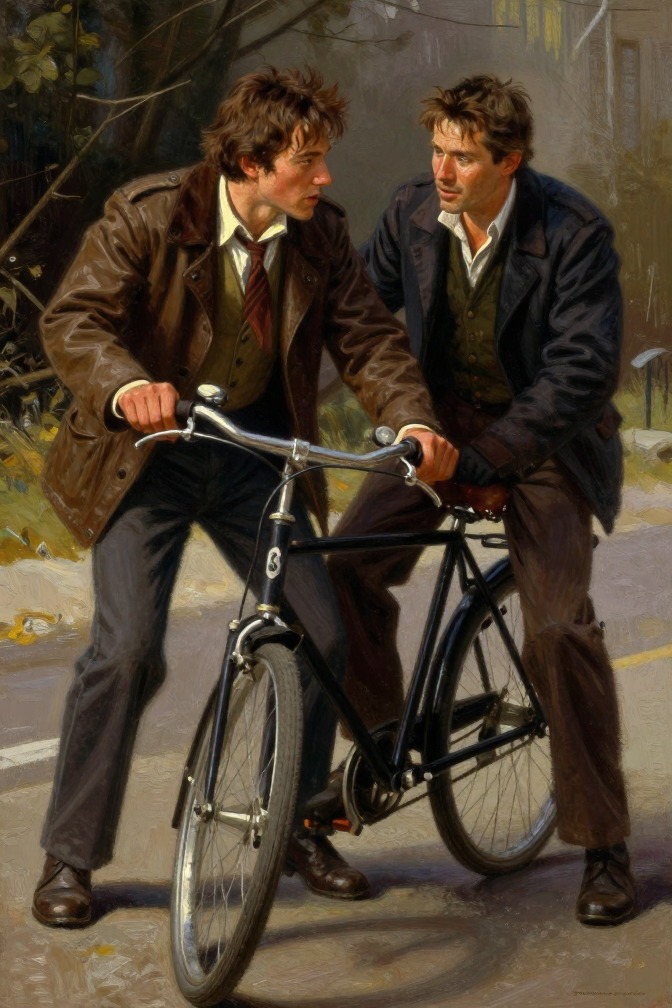
One night in late November, a drunk Jack Torrance and his friend Al Shockley, driving Al's Jaguar on a Vermont road, hit a child's bicycle left in the middle of the highway. They search frantically for a body but find none, and Al arranges for a friend to bring replacement tires to cover up the accident. The incident becomes a turning point: Al Shockley stops drinking that night, and Jack, though he does not yet quit, is haunted by the crash and the image of the bicycle's crushed wheel. The event deepens Jack's self-loathing and his secret conviction that he is a destructive force, and it provides the hidden trauma that, weeks later, helps him find the resolve to stop drinking—though the guilt never leaves him.
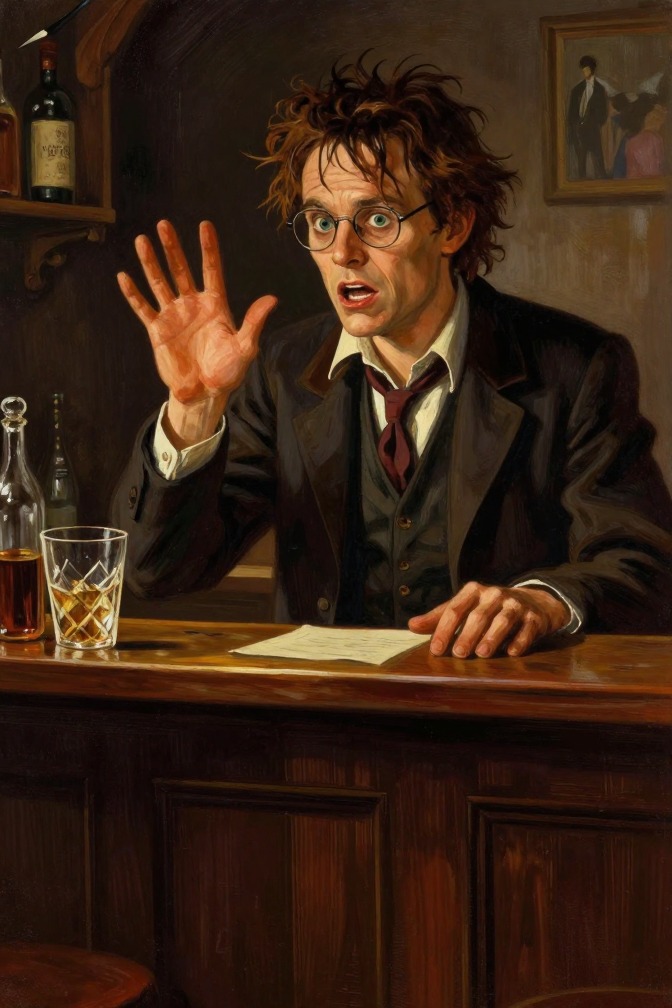
Jack Torrance, isolated in the Overlook Hotel and struggling with his sobriety, hallucinates an elaborate encounter with a bartender named Lloyd in the empty Colorado Lounge, where he drinks imaginary martinis and delivers a bitter monologue about the nature of the 'wagon' of sobriety, marking a decisive psychological break as the hotel's influence begins to fully possess him.
The crystal radio is a small, battery-free device that Danny Torrance uses to listen to music and news, serving as a symbol of his isolation, his connection to the outside world, and his quiet, observant nature during the family's winter at the Overlook Hotel.
The Scrapbook is a white leather-bound volume discovered by Jack Torrance in the Overlook Hotel's basement, containing a curated collection of newspaper clippings, invitations, and handwritten annotations that document the hotel's most scandalous and violent history, from its glamorous opening under Horace Derwent to its use as a Mafia key club and the site of a gangland murder. It functions as the novel's central narrative device for revealing the Overlook's true, malevolent nature, and its discovery marks a turning point in Jack's psychological corruption, feeding his obsession with the hotel and his growing paranoia.
Love Flies Out the Window When Poverty Comes in the Door is a proverb that Yozo reinterprets in a deliberately perverse way during his first morning with Tsuneko, and which later becomes a bitterly ironic refrain that encapsulates his conviction that material lack destroys the capacity for love. The phrase first appears as a piece of calculated clowning meant to mask his terror of intimacy, but it recurs at crucial moments—when he is living as a kept man with Shizuko, when he contemplates marriage to Yoshiko, and when he reflects on the ruin of every relationship—to expose the core of his belief that poverty and love are mutually exclusive, and that he himself is the agent of that destruction.
Ueno is the Tokyo district where Yozo lives in his father's town house after leaving the college dormitory, a setting that marks his first attempt at independent urban life and his growing isolation from both family and society.
The Three Notebooks are the autobiographical manuscripts written by Yozo that form the core of No Longer Human, serving as the primary narrative vehicle through which his life of shame, fear, and self-destruction is recounted. They are delivered to the Madam of the Kyobashi bar after Yozo's disappearance and later passed to the unnamed narrator, who publishes them as the novel's text, making them the structural and thematic heart of the work.
The roadagent with the tattoo is a marauder encountered by the man and the boy in the woods, whose brief, violent confrontation forces the man to kill him at close range to protect his son, marking a decisive moment of moral compromise and traumatic aftermath.
Josef K. is the protagonist of Franz Kafka's The Trial, a bank chief clerk who is arrested one morning for an unspecified crime and spends the remainder of his life navigating an opaque, labyrinthine legal system that ultimately condemns him to execution.
Juliusstrasse is the street in a poor suburb where Josef K. must report for his first cross-examination, and its bleak, crowded tenement buildings house the court's interrogation room and attic offices, embodying the squalid, labyrinthine nature of the judicial system that ensnares him.
The Court badges are small, colored emblems worn on the collars of coats by officials and participants within the Court's proceedings, serving as a visible marker of membership in the organization that prosecutes Josef K. and revealing the hidden unity of the supposedly divided factions in the interrogation room.
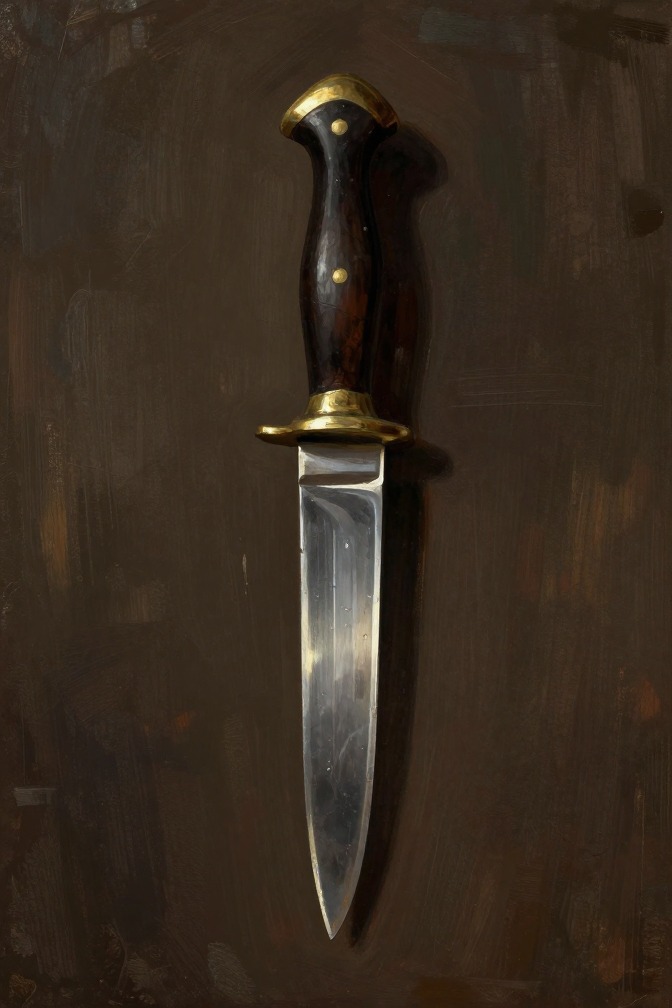
The execution knife is the double-edged butcher's blade used to kill Josef K. in the final chapter, a weapon that embodies the court's impersonal, ritualized violence and the protagonist's ultimate failure to take his fate into his own hands.
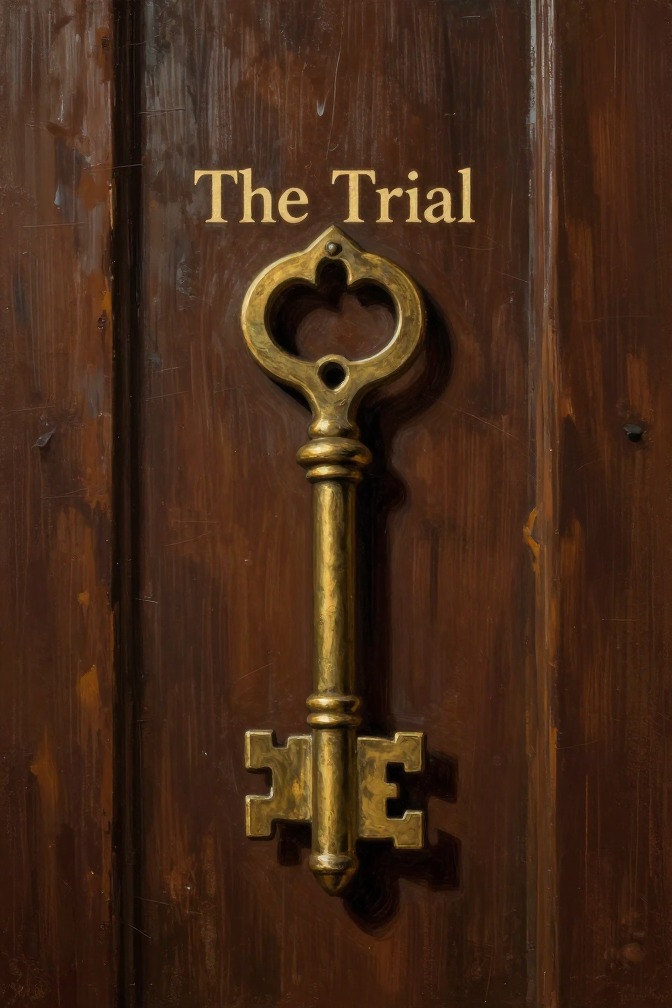
The Key to the lawyer's door is a small but symbolically charged object in Franz Kafka's The Trial, given by Leni to Josef K. as an open invitation to visit Dr. Huld's apartment at any time. It represents the promise of secret access, intimacy, and behind-the-scenes influence within the court's opaque system, yet it ultimately proves to be a token of a compromised and illusory form of help, binding K. more tightly to the very apparatus he seeks to escape.
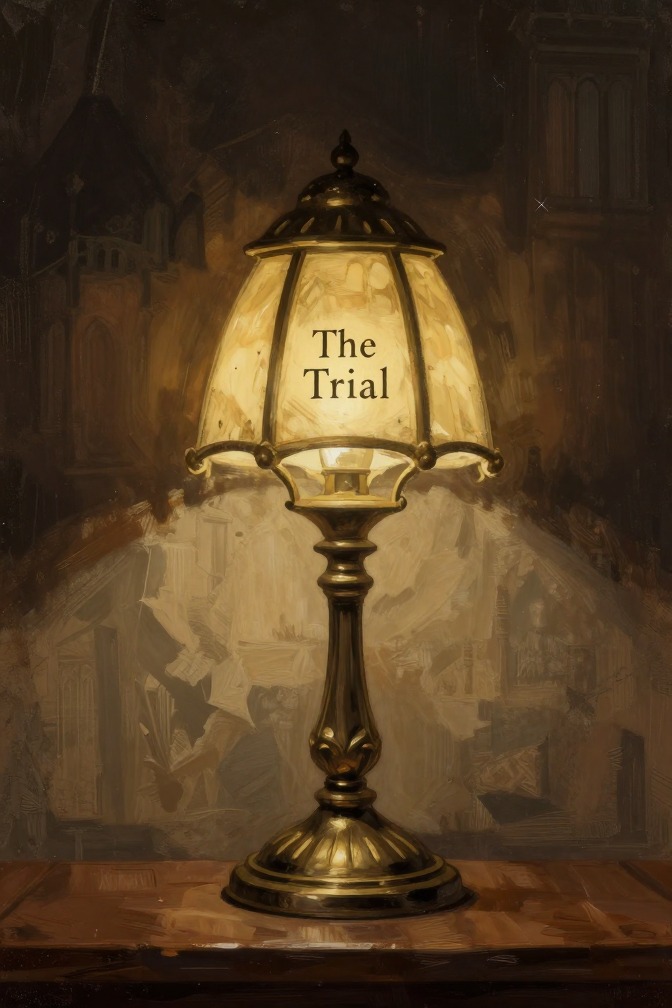
The lamp in the cathedral is a small, portable light source that the prison chaplain uses during his encounter with Josef K., serving as a crucial instrument of illumination, guidance, and symbolic weight in the novel's climactic chapter.
Amber is a minor character in the novel, a wealthy and popular student at Theo's Las Vegas high school who becomes involved in Boris's drug-dealing circle. She is the sister of Jordan, a college student, and part of a group of affluent girls, including KT Bearman, who provide Boris with a lucrative customer base for cocaine. Amber's brief appearance highlights the stark contrast between the privileged, carefree world of Las Vegas's elite youth and Theo's and Boris's precarious, drug-fueled existence.
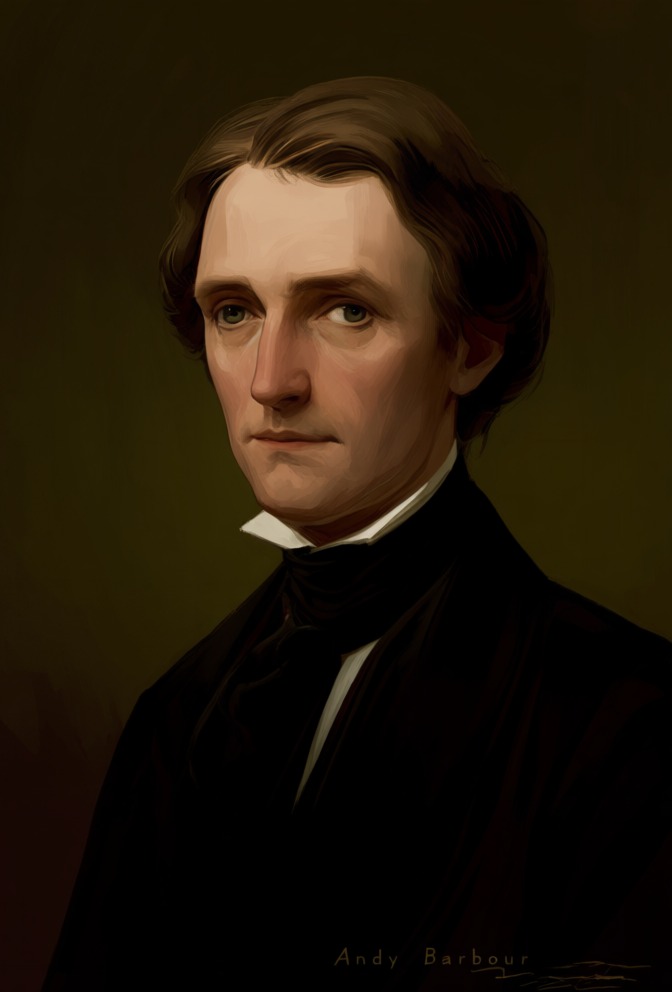
Andy Barbour is Theo Decker's childhood best friend, a brilliant but socially isolated boy from a wealthy Park Avenue family, whose quiet loyalty and tragic death by drowning form a poignant counterpoint to Theo's own life of loss and survival.
Cinzia is the Decker family's housekeeper, a loyal and affectionate presence in Theo's childhood who is let go after Larry Decker abandons the family, but who remains emotionally connected to Theo and his mother long after she stops working for them.
Daisy Horsley, a fashion intern and one of Theo Decker's casual sexual partners during his early twenties in New York, is a minor character who embodies the hollow, drug-fueled relationships that fill Theo's life before his engagement to Kitsey Barbour. She is notable for being a fellow drug user whom Theo meets in a dog park, and for her brief, transactional affair with him that ends when she marries her fiancé and moves to Washington, D.C.
Forrest Longstreet is a minor character from Theo Decker's childhood school, a dull-witted but wealthy student who later reappears in Theo's adult social circle as a friend of the Barbour family, hosting a dinner party that Theo and Kitsey attend during their engagement.
George Bracegirdle is the New York lawyer who administers the educational trust fund Audrey Decker set up for her son Theodore before her death, and who becomes a crucial gatekeeper preventing Theodore's father from accessing the money. He first appears in the novel when he visits the grieving Theo at the Barbour apartment shortly after the museum bombing, and later becomes a key figure in Theo's legal and financial life, helping to secure his guardianship with James Hobart and advising him on his future.
Kenneth is the night doorman at the Barbours' Park Avenue building, a recurring minor character whose presence spans Theo Decker's childhood and adulthood, marking the continuity and decay of the old New York world Theo briefly inhabited.
Martina Lichtblau is a minor character from Theo Decker's childhood at his Upper West Side school, remembered primarily for her brief, unsatisfying affair with him years later, and for being a source of gossip that exposed his drug use to his fiancée Kitsey Barbour.
Mr. Pavlikovsky is Boris's father, a Ukrainian mining engineer and a violent alcoholic whose erratic presence and brutal beatings shape Boris's childhood and his own volatile, survivalist worldview.
Mrs. Spear is the Honors English teacher at Theo Decker's Las Vegas high school, a limp, long-boned woman in earthtone clothing who appears to suffer from major depression. She presides over a contentious classroom where students rail against Thoreau's Walden, and she is the teacher who first introduces Boris Pavlikovsky to Theo as a fellow outsider.