Elizabeth Sinskey is the director of the World Health Organization who, after a confrontation with the geneticist Bertrand Zobrist over his apocalyptic population-control theories, becomes the central figure racing to stop his engineered plague, Inferno. Her personal history of infertility, her fierce determination, and her eventual willingness to listen to Sienna Brooks define her arc from antagonist to collaborator in a crisis that threatens the human species.
Louis Lippo is a minor but revealing character in John Steinbeck's East of Eden, a rancher of Italian descent who serves as a bridge between the established community of the Salinas Valley and the newcomer Adam Trask. His primary function is to introduce Adam to the revered Samuel Hamilton, and through his dialogue and actions, he embodies the valley's pragmatic, cautious, and community-minded ethos, as well as its latent suspicion of wealthy outsiders.
The Gate of the Gods is one of the seven gates of King's Landing, through which Barristan Selmy, disguised as a commoner, re-entered the city after escaping from the Red Keep during the War of the Five Kings.
The Nightingale is the code name adopted by Isabelle Rossignol for her work as a courier and guide on the Nightingale escape route, a network that smuggled downed Allied airmen out of Nazi-occupied France across the Pyrenees into Spain. More than a simple alias, the name becomes a symbol of female resistance, a secret identity that allows a young woman dismissed as reckless to become a legendary figure hunted by the Gestapo, and it ultimately represents the hidden, unsung contributions of women to the war effort.
Ilya is a senior field operative of the Moscow Night Watch, a powerful Light Magician whose calm, analytical demeanor and readiness for extreme violence make him one of Gesar's most trusted agents. He is distinguished by his ability to wield a magic wand charged with devastating energy—most notably a white cobra spell designed specifically to counter the Dark Magician Zabulon—and by his willingness to impersonate his own superior to execute a complex deception. Ilya's role in the story is defined by his quiet competence, his sardonic humor, and his pivotal interventions during the climactic confrontations on the roof and in the hunt for the Maverick.
Gringotts is the wizarding world's premier bank, a vast marble institution run by goblins, where Harry Potter and other witches and wizards store their wealth in underground vaults accessed by high-speed cart rides. It serves as a key location for financial transactions, a symbol of the wizarding economy, and a site where class distinctions between wealthy families like the Malfoys and poorer ones like the Weasleys are starkly revealed.
Peter Cratchit is the eldest son of Bob and Mrs. Cratchit, a young man who, in the course of A Christmas Carol, emerges from the shadow of his father's poverty to become a symbol of the family's resilience and hope for the future. Though he appears in only a few scenes, his actions—from proudly wearing his father's oversized shirt collar to reading the biblical account of Jesus and the children after Tiny Tim's death—mark him as a figure of quiet responsibility and burgeoning maturity within the Cratchit household.
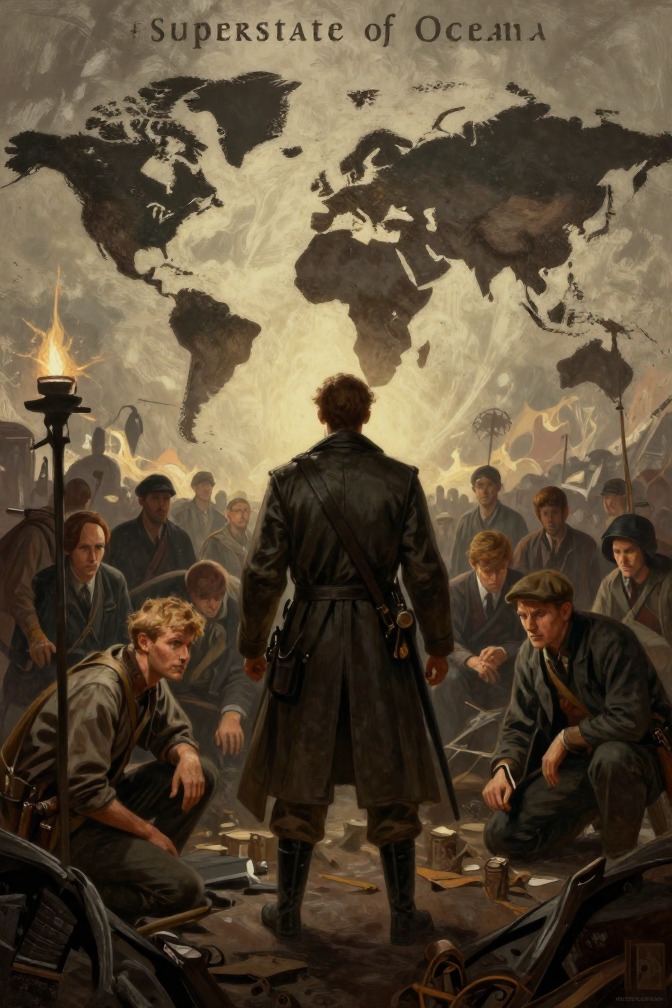
The Superstate of Oceania is the central dystopian polity in George Orwell's Nineteen Eighty-Four, a totalitarian state ruled by the Party through perpetual war, surveillance, and the manipulation of history. It embodies the logical endpoint of twentieth-century political trends, where the pursuit of power for its own sake has been perfected into a system of absolute control over body and mind.
Aeolus, the mortal king of the floating island of Aeolia, is the appointed keeper of the winds whom Odysseus visits after his escape from the Cyclops. He provides Odysseus with a bag containing all the storm winds to ensure a safe voyage home, but the crew's fatal curiosity undoes the gift, and Aeolus, concluding that Odysseus is hated by the gods, refuses all further help.
Aloeus is a minor figure in the Odyssey, mentioned as the husband of Iphimedeia and the father of the giant twins Otus and Ephialtes, whose story of hubris and early death serves as a cautionary tale about the limits of mortal ambition.
Anticlea, daughter of Autolycus and mother of Odysseus, appears in the Odyssey as a ghost in the Underworld, where her encounter with her son reveals the depth of her love and the nature of death in Homeric cosmology.
Antiphates is the king of the Laestrygonians, a race of giant cannibals who destroy all but one of Odysseus's ships and devour his crew in the harbor of Telepylus, representing the most catastrophic single loss of life in Odysseus's wanderings.
Epeus is the craftsman who built the Trojan Horse, the wooden device that enabled the Greek victory at Troy. Though he appears only briefly in the Odyssey, his creation is central to the poem's climactic narrative of the fall of Troy and to Odysseus's identity as the mastermind behind the stratagem.
Eurydice, daughter of Clymenus and wife of King Nestor of Pylos, appears briefly in the Odyssey as the venerable queen who presides over the household during Telemachus's visit, yet her single recorded action—screaming with delight at the sacrifice of a heifer—reveals the poem's subtle investment in female presence within male-dominated ritual.
Eurymachus, son of Polybus, is the second most prominent suitor in Ithaca, a smooth-talking and manipulative leader who orchestrates the plot to ambush Telemachus and later attempts to negotiate for his life when Odysseus reveals himself. His death at Odysseus's hands marks a key turning point in the slaughter of the suitors.
Medon is a herald in the household of Odysseus in Ithaca, who serves the suitors during their occupation of the palace but remains loyal to Penelope and Telemachus. He overhears the suitors' plot to ambush and murder Telemachus on his return from Pylos and reports the conspiracy to Penelope, thereby alerting the queen to the danger. After the slaughter of the suitors, Medon is spared by Odysseus on the intercession of Telemachus, who testifies that the herald was always kind to him as a boy. Medon later appears before the assembly of Ithacans to testify that the killing of the suitors was carried out with divine sanction, helping to avert a civil war. His role thus spans from passive service to active loyalty, from witness to peacemaker.
Melantho is a maidservant in Odysseus's household who, despite having been raised by Penelope, becomes the lover of the suitor Eurymachus and treats the disguised Odysseus with contempt, ultimately earning a place among the twelve disloyal maids executed after the suitors' slaughter.
Orion is a giant huntsman in Greek mythology whom Odysseus sees in the underworld, serving as a figure of eternal prowess and a marker of the poem's meditation on death, fame, and the afterlife.
Orsilochus is a minor but structurally significant character in the Odyssey, appearing only in the false tales Odysseus tells to conceal his identity. He is named as the son of Idomeneus, king of Crete, and his murder at Odysseus's hands—invented on the spot—serves as a key piece of the elaborate cover story Odysseus presents to Athena and later to Eumaeus, demonstrating the hero's quick-witted cunning and his mastery of deceptive narrative.
Piraeus, son of Clytius, is a loyal Ithacan who accompanies Telemachus on his voyage to Pylos and later hosts the seer Theoclymenus, embodying the steadfast friendship and hospitality that contrast with the suitors' corruption.
Theoclymenus is a fugitive seer from Argos who joins Telemachus on his return voyage from Pylos and provides prophetic confirmation of Odysseus's imminent return and the doom of the suitors.
The Turk is a Turkish merchant whose imprisonment and escape set in motion the ruin of the De Lacey family and the eventual arrival of his daughter Safie at their cottage, a story the monster overhears and recounts as part of his own education in human cruelty and injustice.
Caroline Beaufort is the mother of Victor Frankenstein, whose tragic early life and death shape the emotional landscape of the novel. Her story of poverty, rescue, and marriage to Alphonse Frankenstein establishes a pattern of benevolent intervention that Victor later fails to replicate, while her death from scarlet fever, contracted while nursing Elizabeth, becomes the first great loss that sets Victor on his path of obsessive creation.
Uncle Thomas is a minor but pivotal figure in Mary Shelley's Frankenstein, remembered solely through the recollections of Robert Walton. Though he never appears in the narrative, his library of voyage books shapes Walton's childhood dreams and his obsessive ambition to reach the North Pole, making him an unseen catalyst for the novel's framing narrative.
Ernest Frankenstein is the younger brother of Victor Frankenstein, a secondary character whose presence in the novel underscores the domestic happiness that Victor's ambition destroys and who survives the monster's rampage to witness the family's ruin.
Feyd-Rautha Harkonnen is the nephew and heir-designate of Baron Vladimir Harkonnen, a cunning and ambitious young man groomed for power. He is a skilled fighter, as shown in his arena combat, and a schemer who plots against his uncle. His story culminates in a duel with Paul Atreides, where he is killed, marking the end of the Harkonnen line's direct threat.
Leto II is the son of Paul Atreides and Chani, born among the Fremen of Arrakis. He is the firstborn of the Atreides line to be born on Arrakis, and his birth and death are pivotal to the narrative, marking the personal cost of Paul's rise to power and the beginning of the jihad that Paul foresees.
Theo Decker and Boris Pavlikovsky share a profound, transformative friendship that begins in the desolate suburbs of Las Vegas and endures through years of separation, crime, and mutual rescue. Their bond—forged in shared grief, delinquency, and a desperate need for connection—becomes the most vital relationship in Theo's life, ultimately leading to the recovery of the stolen painting and a chance at redemption.
Cocles is the one-eyed cashier of Morrel & Son, whose unwavering devotion to arithmetic and to his employer makes him the last loyal employee standing during the firm's financial collapse.
Mademoiselle Louise d'Armilly is the intimate friend, musical companion, and co-conspirator of Eugenie Danglars, a young woman of modest fortune and considerable vocal talent who serves as Eugenie's singing teacher and confidante, and who ultimately participates in Eugenie's dramatic flight from Paris to escape an unwanted marriage.