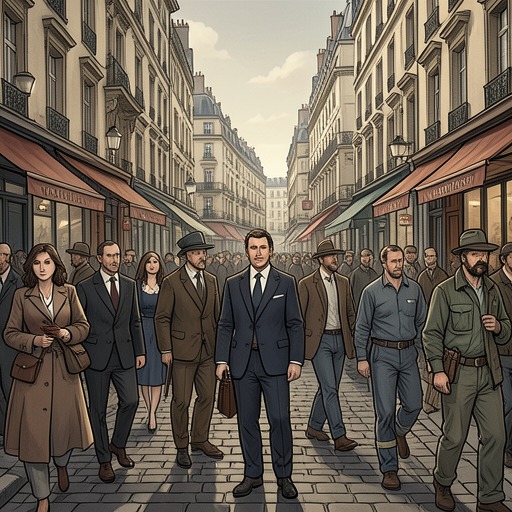
The Paris air raid during Eveline’s arrival
1919The Paris air raid during Eveline’s arrival transforms a disorienting walk through the city into a night of sudden danger and compromised safety. Eveline Hutchins encounters the attack after leaving a claustrophobic restaurant, and the officer who escorts her to shelter proves to be both a protector from the bombs and a source of unwanted pressure.
A lost walk through Paris
After coffee and Cointreau with Adrienne and Miss Felton in a dark, stuffy room, Eveline leaves for her hotel, pleading a headache and sleepiness. Once outside, she realizes that she does not know the way back. Unwilling to return to the restaurant, she hurries along the moonlit side of the street, frightened by the silence, the few shadowy passersby, and the old houses’ dark doorways. At last she reaches a boulevard where people stroll and cars pass, their blue lights moving across the asphalt.
The contrast between Eveline’s alarm and the calm pace of the crowd sharpens as sirens begin sounding in the distance. A faint hum grows louder and fades, while searchlights rake the sky. People identify the planes without stopping their evening stroll. Eveline stands at the curb watching the sky sparkle with shrapnel; its distant beauty briefly recalls fireworks seen across a lake on the Fourth of July, even as the spectacle signals an attack.
The officer’s escort
A French officer nearby explains that the flashes are shrapnel from antiaircraft guns and offers to take Eveline home. His manner is paternal, and he uses gestures to show the danger of falling debris and the need to find cover. When she gives him the name of her hotel, he leads her back through narrow streets, keeping close to the walls. A fragment strikes the pavement opposite them; the officer pulls her into a doorway before it lands.
The pair reach the riverbank, where they walk beneath thick trees toward the hotel. The officer points out the German planes wheeling overhead: for a moment, their wings catch the moonlight and make them look like small silver dragonflies. A bomb’s tearing rush from across the river cuts through the brief, delicate image. The officer takes Eveline into the hotel and down to the cellar.
Shelter and an unwelcome turn
In the cellar, a mixed group in bathrobes and overcoats over nightclothes gathers around a couple of candles. The officer salutes them and tries to order a drink, but the waiter tells him it is forbidden. Eveline sits on a table, excited by the people and the distant bombs; amid the noise and confusion, she scarcely notices at first that the colonel is squeezing her knee more than necessary. His hands then become a problem, changing the meaning of an escort that had begun as practical help.
When the air raid ends, a strange seesawing noise from the street makes Eveline laugh uncontrollably. She tries to say goodnight and go upstairs to sleep, but the colonel insists that he wants to go up too. Her French fails as she tries to explain that she has a friend with her and to get the concierge to understand that the officer is not coming to her room. The immediate danger of the raid has passed, but she is still unable to secure privacy through her own words.
Escape to her room
A young American in civilian clothes intervenes, pretending in broken French to be Eveline’s brother and telling the colonel that she is tired and wants to say goodnight. He links arms with the officer and invites him to his room for a drink. The colonel draws himself up angrily, but Eveline does not wait to see what follows: she runs upstairs, enters her room, and double-locks the door.
The ending makes the episode’s rescue deliberately uneasy. The officer has guided Eveline through streets under bombardment and brought her to shelter, yet his attention in the cellar turns that assistance into pressure. Her escape depends not on the safety of the hotel or the officer’s courtesy, but on an unexpected intervention and the lock she secures behind herself.