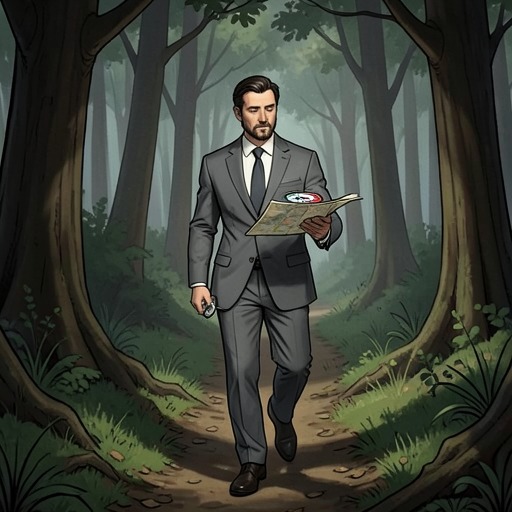
Gilyaks Who Keep Away from Roads
1Q84Gilyaks Who Keep Away from Roads are described as a people who continue to travel through the taiga rather than use roads, even when roads are available. For Tengo and Fukaéri, this detail becomes more than an account of unfamiliar customs: it offers a way to think about what a path demands of those who follow it, and about Fukaéri’s own refusal to accept the life laid out before her.
The Gilyaks and the Road
In the passage Tengo reads, the Gilyaks have no tribunal and no concept of justice. Their difficulty in understanding the world around them is illustrated by their incomplete grasp of the purpose of roads: although roads exist, they continue to travel through the taiga. They are seen moving in single file beside a marsh, with their families and dogs following. The account does not present the road simply as an absent convenience. It is a route whose meaning has not become part of their understanding of time, space, and possibility.
Tengo imagines the group as poorly dressed and taciturn, making its way through the taiga near a road without turning onto it. The contrast between the built route and the difficult forest path gives the image its force. A road is practical, but practicality does not by itself make it an inhabitable way of life. From the Gilyaks’ perspective as Tengo imagines it, the road does not exist as a meaningful possibility; their continued journey through the forest may let them apprehend their own existence more clearly.
Tengo’s Reading and Fukaéri’s Response
The image comes to Tengo through his reading, and enters his thoughts with unusual persistence. While trying to avoid an early climax during sex with his older girlfriend, he concentrates on the Gilyaks; the imagined procession through the taiga displaces his immediate surroundings. The detail is both intellectual and intimate: an account of a people walking beside roads becomes a mental route away from the present moment.
Fukaéri responds to the Gilyaks with pity, calling them poor. Later, after Tengo has read to her, she thanks him and says that the Gilyaks touch her heart. Her questions about why they do not walk on broad roads lead into her own account of their forest paths: roads are useful, she says, but the Gilyaks find the muddy paths through the woods easier. Learning to use roads would mean having to learn how to walk again, and to learn other things—to change. In this formulation, the road is not merely a more efficient route; it stands for a demand to acquire a different way of living.
Fukaéri’s Self-Identification
Fukaéri draws the comparison directly to herself. She does not want to live like the Gilyaks, but she also does not much like walking on broad roads. The distinction matters: her identification is not a claim that their hardships are desirable. She rejects the life of being beaten repeatedly by men and describes it as filthy, full of worms. Yet the alternative of conforming to the broad road is not comfortable either. Her words place her between an intolerable life already experienced and a prescribed route that would require her to change herself.
Her refusal extends to authorship. She does not want to become a novelist or to write something else afterward. She asked Azami to research the Gilyaks; Azami went to the library and found that they live on Sakhalin and, like the Ainu and American Indians, have no written signs and make no documents. Fukaéri connects this absence of writing to her own story: once it is written down, it is no longer hers. She acknowledges that Tengo changed the written work exceptionally well, and tells him it is not his fault that it is no longer her story. Her image of walking far from broad roads thus joins cultural difference, literary ownership, and personal resistance without making them identical.
The Image’s Narrative Significance
The motif changes as it passes between readers and speakers. In the account Tengo reads, the Gilyaks’ way of life is described from the outside, through the observer’s difficulty in understanding a people who do not use the routes he considers intelligible. Tengo then turns that description into an imagined scene; Fukaéri takes it up as a language for her own position. The shift does not erase the distance between her circumstances and theirs. Instead, the shared figure of the road makes that distance legible: what appears practical from outside can carry the pressure of learning, conformity, and a changed identity.
Walking away from broad roads also becomes a compact expression of Fukaéri’s relation to the rewritten story. She can recognize the skill of Tengo’s work while insisting that the result has crossed out of her ownership. The Gilyaks’ unwritten lives, as she understands them, offer a parallel for a story whose passage into written form alters who it belongs to. At the end of her explanation, Tengo imagines Fukaéri walking alone and silently away from the broad roads. The image remains unresolved: it can register her self-protection and refusal, but the text does not turn it into a simple promise of freedom or an account of where she will go.