Réalité altérée
1Q84Réalité altérée is the destabilization of Aomamé’s familiar world, where the dates and public facts she remembers no longer align with what other people report as settled history. Its force lies in the conflict between intimate memory and apparently corroborated evidence: the calendar becomes difficult to hold in sequence, the police equipment she sees seems to belong to another present, and a television bulletin supplies news she has never heard. The changes leave her questioning not only the world but the reliability of her own recollection.
Time and Memory
Aomamé tries to locate her memories against the present, which she understands to be April 1984, and recalls that she was born in 1954. Yet those dates quickly lose their solidity. In the image that gives the disorientation its shape, years are printed on white cards and blown away by a violent wind; she runs after them, but too many scatter beyond reach. Alongside 1954 and 1984, she sees 1645, 1881, 2006, 771, and 2041. The sequence that should organize knowledge breaks apart, and even the mental staircase beneath her thought seems at risk of collapsing.
This disorder is not simply a failure to remember one detail. Aomamé feels that the drawers of memory have been switched, so that she cannot retrieve things she believes she ought to know. The contrast between her firm initial dates and their rapid loss of reality makes time itself feel unstable: the problem is not merely that events are missing, but that their place in an ordered past can no longer be guaranteed.
A Discrepancy in the Present
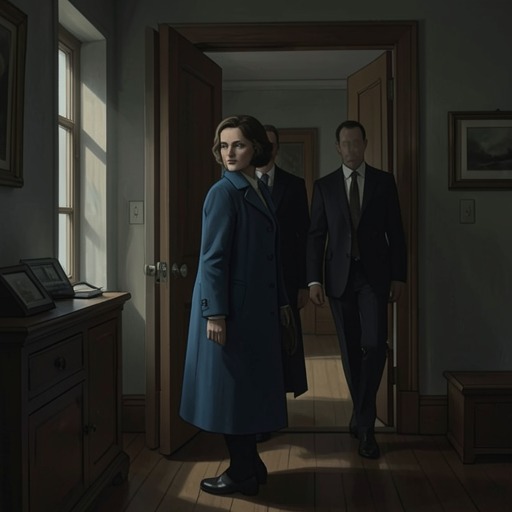
The same uncertainty appears in the ordinary public world. At Sangenjaya station, Aomamé passes a young police officer and notices that his uniform differs from the one she knows. Its navy jacket has a looser, more comfortable cut, softer fabric, a shorter collar, and a slightly lighter color. More strikingly, the officer carries a large semi-automatic pistol rather than the old-style revolver she expects Japanese police to carry. She remembers that only a few hours earlier officers were still wearing the familiar stiff uniform and carrying their familiar revolvers.
The discrepancy is specific enough to unsettle her, but she cannot stop to investigate: she has work to do. Later, she questions a bartender and an older man about when the police equipment changed. They tell her that the uniform and weapons had changed years earlier. According to the bartender, the police had received more comfortable jackets and automatic pistols; his brother, a police officer, had complained about the new uniform and the weight of his Beretta. He explains that the new weapon could be switched to semi-automatic fire and that the old revolvers had all been collected for destruction. Aomamé presses the point, asking whether Japanese police had stopped using their old revolvers two years earlier. The bartender confirms that, as far as he knows, they had.
Their accounts make the contradiction harder to dismiss as a lone mistake. Aomamé remembers seeing an officer in the old uniform with an old revolver that very morning, while the men describe a replacement and disposal process completed years before. She considers whether both men could be mistaken or lying, then rejects that possibility and concludes that she must be the one in error. Her grimace registers not a resolution but the unnerving cost of accepting their shared account over her own recent observation.
News and Public Reality
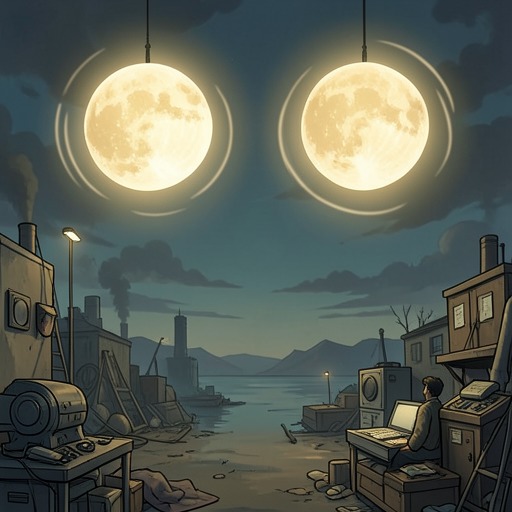
Television adds another layer to the mismatch. After watching the eleven o’clock news, Aomamé hears reports of the continuing Iran–Iraq war, young draft resisters hanged in Iraq, and Iranian accusations that Saddam Hussein’s government had used nerve gas and biological weapons. The program also covers Walter Mondale and Gary Hart competing for the Democratic presidential nomination. These items establish the bulletin’s ordinary register of international and domestic news; within it, a report about a permanent lunar observation base stands out because Aomamé has never heard of it.
The broadcast treats the American and Soviet collaboration on the lunar base as an existing development, comparing it to cooperation over the Antarctic station. Aomamé is perplexed, but turns her attention back to more immediate concerns. The same bulletin reports a deadly coal-mine fire in Kyushu, American pressure for Japan to open its financial markets, and a cat in Shimane that has learned to open and then close a window. The juxtaposition places the unfamiliar moon base among routine reports and a small human-interest item: it is not introduced as a vision or a rumor, but as news she appears to have missed.
The bulletin ends without reporting the discovery of a corpse in a Shibuya hotel. That absence does not settle the larger question of what has changed, but it shows Aomamé checking the public record for information connected to her immediate circumstances. News can provide facts, yet the very news program that offers a familiar structure of events also contains a major development she cannot remember. Public information therefore sharpens rather than repairs the gap between her remembered world and the one she inhabits.
Competing Accounts of Change
Aomamé’s attempt to test her impressions gives the altered reality a concrete, procedural form. She does not encounter only an impossible landscape; she notices practical details, questions people who might know, and compares their answers with what she remembers. The bartender’s account includes a personal source—his younger brother is a police officer—and specific details about the Beretta and the destruction of the old weapons. That specificity makes it difficult for Aomamé to preserve her original certainty, even though her memory of the morning remains clear to her.
The tension is between different kinds of evidence rather than a simple opposition between fact and fantasy. Her own recent observation is immediate and vivid; the men’s explanations are consistent with each other and with an established change in police policy. The novel leaves that contradiction active in these episodes. Aomamé adapts to the information she receives, but doing so requires her to treat an experience she remembers as certain as though it were mistaken.
Narrative Significance
Réalité altérée turns habits of orientation into sources of doubt. Dates normally make memory sequential; uniforms and weapons make public authority recognizable; the news gives distant events a shared, reportable chronology. Here, each familiar system falters. Years scatter out of order, police equipment seems to have changed without Aomamé’s knowledge, and a lunar base appears in the news as established fact despite her failure to remember its announcement.
The details do not all carry the same weight: an altered jacket can be explained as a policy change, while the lunar base is a more startling omission from the world she recalls. Their accumulation nevertheless produces a common effect. Aomamé can no longer assume that a confident memory, a public account, or a routine daily report will independently confirm the same reality. The concept names this widening estrangement between lived experience and the apparently settled world around her, without resolving it into a single explanation in these scenes.