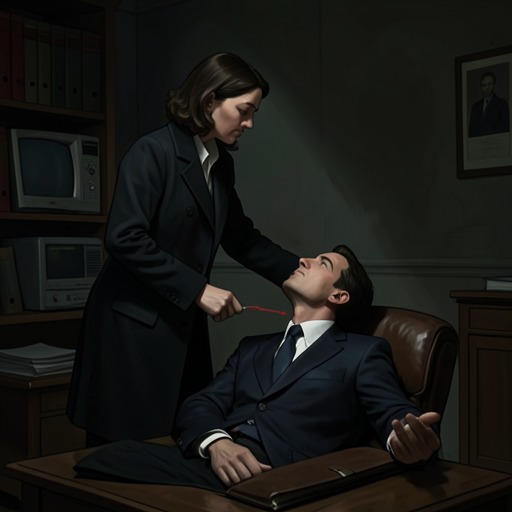
Event 1
Aomamé Leaves the Metropolitan Expressway via the Emergency Stairway
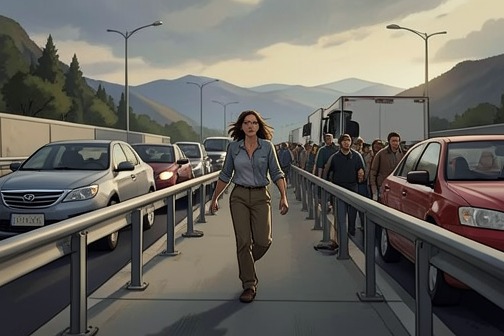
[Aomamé Leaves the Metropolitan Expressway via the Emergency Stairway](entity:event-recall-event-708a77b6eacb) is the moment [Aomamé](entity:character-recall-character-aomam-6f0ef39c7aa1) converts a concealed possibility into action: unable to risk being late, she leaves a traffic-bound taxi, crosses a barrier on foot, and begins descending from the Metropolitan Expressway. The scene makes movement itself the decisive choice. Around her, cars and passengers remain trapped; she alone accepts the awkward, conspicuous route toward whatever awaits below.
## The decision to leave the taxi
The driver has already suggested that, if circumstances force an emergency measure, Aomamé could continue by train to [Shibuya](entity:location-recall-location-630a8203ac51). He presents it obliquely as something people do not announce publicly, leaving the method unexplained at first. Aomamé asks what he means, but the exchange establishes that an alternative to remaining in the jam exists—and that it is unusual enough to be treated discreetly.
The immediate pressure is plain. In front of the taxi, a red Suzuki Alto with Nerima plates has barely moved for ten minutes. A young mother grips the steering wheel while her restless daughter stands on the seat, and the mother scolds her. The small, repetitive scene gives physical form to the traffic’s paralysis: during those ten minutes, the car has probably advanced less than ten meters.
Aomamé sorts through her priorities and reaches a decision. As the Sinfonietta seems to enter its final phase, she takes out her small Ray-Ban sunglasses, puts them on, and hands the driver three 1,000-yen bills. She tells him she is getting out and cannot be late. The driver accepts the money and begins to ask whether she wants a receipt. Her payment closes the taxi journey without further negotiation; the next movement will be on her own.
## Crossing the barrier
At the emergency parking area, Aomamé stops and looks around for the stairway. She finds it immediately, protected by a metal gate reaching somewhat above waist height, its door locked. The obstacle makes clear that this is not an ordinary pedestrian exit. The driver’s discreetly described option requires her to cross a boundary and use an access point not open for casual passage.
Her clothing complicates the practical act without changing her resolve. Wearing a tight miniskirt, she judges that climbing over the gate will be embarrassing, but not especially difficult if she ignores other people’s looks. She removes her high heels and pushes them into her bag, accepting that walking in tights may ruin them because another pair can be bought elsewhere. The choice is concrete and economical: she gives up comfort and appearance rather than abandon the route.
The motorists watch in silence as she takes off her shoes and coat. From a black Toyota Celica stopped nearby, Michael Jackson’s high-pitched voice sings “Billie Jean.” Aomamé privately likens the exposure to going onstage for a striptease, but refuses to let the audience dictate her actions. She will remove no more than her heels and coat. The people watching are stuck in the jam; she is the one who can leave it.
## The descent and its significance
Aomamé slings her bag diagonally over one shoulder so it will not fall, turns her back on the silent onlookers, and starts carefully down the stairs. The metal feels cold beneath her bare feet, and the chilly wind of early April lifts her hair, at times exposing her deformed left ear. These details keep the descent bodily and precarious: she has left the enclosed comfort of the car, but has not yet arrived at the train or at her destination.
The scene’s decisive contrast is between collective immobility and individual purpose. Aomamé imagines the motorists as prisoners of the place, unable to move forward or even back, while she has work to finish and a mission to carry out. She considers making one last grimace at them, then refrains because there is no time for an unnecessary gesture. Her departure therefore marks more than a change of transport: urgency overrides embarrassment, and purposeful movement separates her from the stalled world she leaves behind. The episode ends with her descending, not with the journey completed; its outcome beyond the stairway remains outside this scene.
Event 2
Aomamé Discovers a Time Discrepancy in Reality
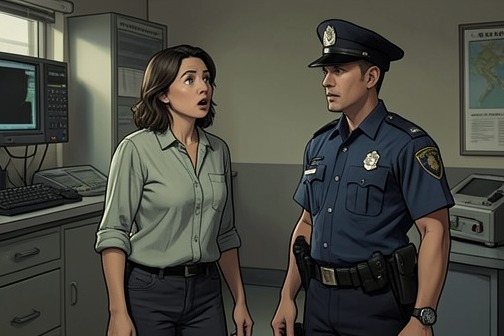
[Aomamé](entity:character-recall-character-aomam-6f0ef39c7aa1)’s discovery that the police uniform and weapons around her no longer match her recent memories gives the changed reality a concrete, public form. The discrepancy is not initially announced as a supernatural revelation: it begins with a passing officer, becomes a question put to people who should know, and ends without an explanation. The ordinary details are the disturbance. A jacket, a service weapon, and a date recalled with confidence make the world itself seem to have revised its past.
## The officer at the station
At Sangenjaya Station, Aomamé crosses paths with a tall, young police officer walking quickly. She feels nervous for a moment, but he appears preoccupied and does not look at her. What catches her attention is his uniform. The jacket remains navy blue, yet its cut is looser and more comfortable than the stiff, closely fitted uniform she remembers; its material seems softer, its collar shorter, and its color slightly lighter.
His weapon is the sharper anomaly. Japanese police officers, as Aomamé knows them, ordinarily carry old six-shot revolvers: inexpensive, mechanically simple weapons suited to a country where armed crime and police gunfights are rare. This officer instead wears a modern large-caliber semiautomatic, capable of holding as many as sixteen nine-millimeter rounds. She considers a Glock or Beretta as possibilities. The contrast is not merely between two pieces of equipment. It is between the familiar police force she remembers from only hours earlier and the one now passing in front of her.
Aomamé cannot readily explain the change as a recent national decision that she has missed. She reads the newspapers regularly and pays close attention to police appearance. If uniforms and weapons had been replaced, she reasons, the change would have been widely reported. She remembers officers in their customary stiff uniforms and carrying their customary revolvers that very morning. The observation unsettles her, but she has work to do and cannot stop to investigate it at the station.
## Testing memory against other accounts
The discrepancy returns when Aomamé asks an older man whether police uniforms and weapons have changed recently, specifying a period of about a week. He understands that there has been a change, but places it years in the past: fitted jackets gave way to more comfortable blousons, and revolvers were replaced by small automatic pistols. He knows of no important change since then. His account does not fit Aomamé’s memory of the police she saw only days, even hours, before.
She presses for a date. The older man asks the senior barman, who answers immediately that the change happened in the spring two years earlier. The exchange has a light social surface—the man laughs about how much hotel barmen know, and the barman laughs with him—but the certainty of the answer makes the discrepancy harder for Aomamé to dismiss. She asks the barman directly whether Japanese police have stopped using their old revolvers, and he confirms that, to his knowledge, they have.
Aomamé’s own recollection remains precise: that very morning, she saw an officer in the old uniform carrying the old revolver. Yet neither the older man nor the barman seems mistaken, and she cannot imagine them sharing a lie. She therefore turns the doubt on herself, wondering whether she has gone mad and concluding, for the moment, that she must be the one in error. The scene offers no authority that can reconcile the two accounts; it leaves her caught between a vivid personal memory and a calm, mutually corroborating version of public history.
## A broadcast from a changed world
Later, naked in bed beside an older man who falls asleep, Aomamé watches the eleven o’clock news to its end. Its reports place recognizable international and domestic events alongside another jarring sign of alteration. The Iran–Iraq conflict continues without a visible prospect of resolution; the news reports young Iraqi draft resisters hanged from telephone poles and Iran’s accusations that Saddam Hussein is using nerve gas and biological weapons. In the United States, Walter Mondale and Gary Hart are competing for the Democratic presidential nomination. A coal-mine fire in Kyushu has caused many deaths, and the government is investigating its cause.
The most startling item for Aomamé is that a permanent observation base is being established on the Moon through unusual cooperation between the United States and the Soviet Union. She has never heard of it. The report is presented among other news, not as an explanation of her experience, and the familiar act of watching television supplies no answer. She is perplexed, but does not pursue the lunar base for long: more immediate problems demand her attention.
Other details make the bulletin feel at once recognizable and estranged. The countries, politicians, war, and economic pressures are reported in the matter-of-fact register of a routine newscast, while the lunar project is treated as an accomplished development of which Aomamé has somehow remained unaware. The final item is smaller and more intimate: a thin black cat in Shimane has learned to open a window, go outside, and close it behind itself. Aomamé watches the animal extend a paw and slide the window shut with admiration. The sequence ends without resolving the larger discrepancy; she switches off the television, and the room falls quiet except for the sleeping man’s light breathing.
## Significance of the discrepancy
The event makes Aomamé’s uncertainty testable. Her unease is attached to public institutions and material particulars, not merely to a vague sense that the atmosphere has changed: the officer’s jacket, the model of his weapon, the remembered timing of a national replacement, and the lunar news report all place the difference in observable facts. Yet observation does not settle the matter. The man and the barman agree with each other, while Aomamé’s own memory remains vivid, leaving her without a dependable external check.
The movement between street, conversation, and television widens the disturbance without turning it into a single revelation. At the station, the change is visible; in the later conversation, it is given a history that contradicts Aomamé’s; on the broadcast, an unfamiliar technological development appears within an otherwise ordinary news routine. Her immediate work and more urgent personal concerns keep her moving, so the contradiction is registered before it can be solved. The episode’s force lies in that unresolved interval: the world speaks confidently about its own past, while Aomamé remembers another version of it.
Event 3
Aomamé Assassinates Miyama
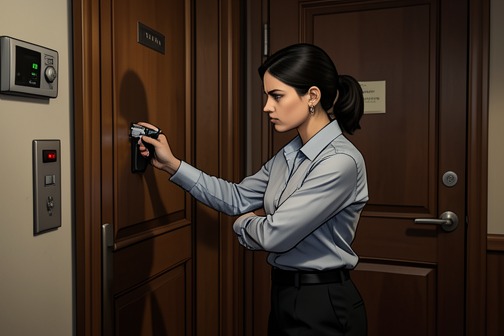
[Aomamé Assassinates Miyama](entity:event-recall-event-da69095e58e0) is a carefully prepared killing carried out in a hotel room, where [Aomamé](entity:character-recall-character-aomam-6f0ef39c7aa1) uses a concealed, purpose-built instrument and then manages the scene so that the death is likely to be mistaken for a natural one. The episode turns on the contrast between the ordinary appearance of a hotel call and the precision of Aomamé’s actions: she enters unnoticed, approaches Miyama under a plausible pretext, and leaves without drawing attention.
## Entry and Target
Aomamé rides the elevator to the third floor and goes directly to room 326. She takes from her bag a prepared shirt, holds it against her chest, and knocks softly. When there is no immediate response, she knocks again, harder. Miyama opens the door, looking irritated and tired. Aomamé’s professional appearance seems to fit the possibility that he has been expecting hotel staff to replenish the refrigerator, giving her a plausible reason to be at his door.
Aomamé knows that Miyama works in the oil industry, specializing in investments in Middle Eastern countries. She understands him as professionally successful and socially confident: he has an expensive new Jaguar, an education that included study abroad, and fluency in English and French. The outward polish is set against his treatment of others. He does not tolerate demands or criticism, especially from women, yet is comfortable making demands himself. He has seriously abused his wife, an act that does not trouble him. This background establishes the target of Aomamé’s intervention and the disparity between Miyama’s cultivated public standing and his private conduct.
## Method and Execution
Before acting, Aomamé takes a deep breath, holds it, and identifies a precise point on Miyama’s neck. She first presses the spot lightly with her fingertip, checking its location by touch. The careful pause conveys the technical nature of the act: she wants to be certain of the placement, though the circumstances do not allow her more time.
Aomamé then takes a small, rigid plastic case from her bag. Inside is an instrument wrapped in thin cloth. It resembles a miniature ice pick, about ten centimeters long, with a solid wooden handle, but it was made by Aomamé for this purpose. Its fine point is protected by a specially treated piece of cork, which she removes and puts in her pocket before using the instrument. The concealed tool is thus both ordinary-looking and highly specialized; its construction makes the apparent simplicity of the act depend on exact preparation.
With the point positioned, Aomamé raises her right hand and brings it down onto the wooden handle, applying controlled force at the chosen angle. She avoids striking too hard, since the fine point could break, and instead lets the movement fall directly and lightly. The scene stresses restraint and accuracy rather than force: the success of the method depends on how carefully she directs the motion.
## Death and Intended Appearance
The effect is gradual: Miyama’s body stiffens, and his energy ebbs. Aomamé keeps a finger on the selected point and shifts him forward onto the table, where his documents serve as a pillow. His open eyes register astonishment, but the narration describes no fear or pain. He seems to have encountered something inexplicable without being able to identify what happened. This quiet, puzzling end contrasts with the deliberateness of Aomamé’s preparation and leaves Miyama unaware of the cause of his death.
The method is designed to resemble a natural fatal illness. The account explains that a very fine puncture at a precise point below the brain would be read by a doctor as a heart attack; Miyama’s apparent collapse at his work could be attributed to stress and overwork. Nothing in the immediate circumstances would necessarily suggest an unnatural cause, and an autopsy would not be essential. Concealment is therefore built into the method itself: the killing is intended to pass as an ordinary death rather than provoke an investigation.
## Concealment and Exit
After the killing, Aomamé replaces the cork tip on the instrument, wraps it in cloth, returns it to its case, and puts the case at the bottom of her bag. She then retrieves a towel from the bathroom and carefully wipes the prints she left in the room, noting that she had touched nothing else apart from the air-conditioning panel and the door handle. These practical steps extend the preparation beyond the act itself: the room is arranged to offer little immediate reason to suspect an intruder.
Aomamé leaves the coffee pot and cup on the tray in the corridor, so the staff member collecting them will not need to knock and delay discovery. She expects that, ideally, the room attendant will find Miyama the following day, after checkout time. The delayed discovery and the intended medical explanation work together: both are part of her effort to make the death appear unremarkable.
She checks the corridor before slipping out, takes the stairs instead of the elevator, and crosses the hotel reception without attracting notice. Her back is straight, her gaze fixed ahead, and her pace quick but measured. The scene closes on her assessment of herself as a professional close to perfection, followed by a wry acknowledgment that she must make do with what she has. That turn from meticulous composure to private self-deprecation gives the exit a controlled, character-specific ending without undoing the gravity of the killing.
## Concealment and Exit
After the killing, Aomamé replaces the cork tip on the instrument, wraps it in cloth, returns it to its case, and puts the case at the bottom of her bag. She retrieves a towel from the bathroom and carefully wipes the prints she left in the room, having touched nothing else apart from the air-conditioning panel and the door handle. These practical steps extend the preparation beyond the act itself: she leaves as little evidence of an intruder as she can.
She places the coffee pot and cup on the tray in the corridor so that the staff member collecting them will not have to knock and delay discovery. Ideally, she expects the room attendant to find Miyama the following day, after checkout time. Delayed discovery and the intended medical explanation reinforce one another: both are part of her effort to make the death appear unremarkable.
After checking that the corridor is empty, Aomamé leaves the room, takes the stairs rather than the elevator, and crosses reception without drawing notice. Her back is straight, her gaze fixed ahead, and her pace quick but measured. The episode ends with her private assessment that she is a professional close to perfection, followed by a wry acknowledgment that she must make do with what she has. That shift from meticulous composure to self-deprecation gives the escape a character-specific close without diminishing the gravity of the event.
Event 4
Tengo Agrees to Rewrite La Chrysalide de l’air

[Tengo](entity:character-recall-character-tengo-207999a29189)’s agreement to rewrite [Fukaéri](entity:character-recall-character-fuka-ri-84c2a2dd75a0)’s [La Chrysalide de l’air](entity:object-recall-object-la-chrysalide-de-l-air-ce88320b77fd) turns a private editorial scheme into a shared, carefully concealed undertaking. [Komatsu](entity:character-recall-character-komatsu-04b9166b2f49) sees the novel’s imaginative force and Tengo’s command of style as complementary: Fukaéri will supply the story, Tengo will reshape its language, and the published work will bear only her name. The decision rests on Fukaéri’s consent, but it also binds Tengo to a demanding deadline and a secret that the collaborators agree to keep from the public.
## Komatsu’s proposal and Tengo’s role
Komatsu does not present the plan as a routine revision or merely a bid for the newcomer’s prize. He tells Tengo that he has a much larger objective in mind, then makes clear that Tengo, rather than an unnamed substitute, will rewrite the novel. The manuscript’s central story and atmosphere are to remain, but its style must be changed profoundly; Komatsu describes the task as a genuine adaptation, not a correction of a few passages.
Komatsu frames the collaboration as the creation of a new writer out of two people’s distinct abilities. Fukaéri has brought an unfinished story with unusual imaginative power, he argues, while Tengo can give it an elaborate style. He praises Tengo’s artistic sense and considers him the only person suited to the work, while also urging him to discover the story’s emotional center in himself. Komatsu’s confidence is both personal and practical: he says he has supported Tengo and asks him to trust that he can manage the production. The literary competition is the immediate route to recognition, but Komatsu also mentions the possibility of the Akutagawa Prize.
## Tengo seeks Fukaéri’s consent
Before committing himself, Tengo explains the plan to Fukaéri and asks what she thinks of his rewriting her novel. He has already read the work and found it compelling; Komatsu, too, has responded to it. Their concern is that the strength of its story is not matched by its style, which may make it difficult to select for the competition. Tengo makes his decision conditional on Fukaéri’s agreement and collaboration rather than treating her manuscript as material he can simply take over.
Fukaéri’s reply is brief: she tells him to do it and to write as he wishes. Tengo briefly asks whether she should take more time to consider the important decision, but she shakes her head. Her spare assent contrasts with the elaborate terms Tengo sets out, and gives the collaboration its decisive authorization without resolving every uncertainty surrounding it.
## Authorship, secrecy, and the division of work
Tengo promises to strengthen the style while taking care not to change the story. He allows that substantial alterations may be necessary, but draws a firm distinction between revising the form and claiming the imaginative source: La Chrysalide de l’air will remain Fukaéri’s story, one she brought forth herself. He says that she alone will be named as the author and, if the work wins the newcomer’s prize, as its laureate. If it appears as a book, it will likewise carry only her name.
The arrangement assigns Komatsu and Tengo important but hidden roles. Komatsu will act as editor and oversee the production; Tengo will provide technical and stylistic assistance. They will work as a team of three, yet, in Tengo’s image, he and Komatsu will remain in the shadows like stagehands. He tells Fukaéri that she must not disclose his help and that they will have to lie to everyone about their collaboration. The secrecy is not incidental to the agreement: it is part of the authorship plan and a continuing obligation the three accept.
## From agreement to a deadline
After the meal, Tengo and Fukaéri part, and he calls Komatsu from a pink telephone at the restaurant, feeding coins into it while waiting for the editor to answer at his office. Komatsu’s first question is whether the meeting went well. Tengo reports that Fukaéri has accepted the principle of his rewriting the novel, as Komatsu evidently anticipated.
Komatsu immediately turns consent into a work schedule. The rewritten manuscript must join the other competition submissions as soon as possible, replacing the original, and he asks whether Tengo can finish in ten days. Tengo recognizes the workload and says the deadline will be tight, though he believes he can manage it. The change is concrete: what had been a proposal requiring Fukaéri’s permission becomes an active assignment with a short delivery window and a specific plan to substitute the new version for the submitted text.
## Mediation between two worlds
Komatsu describes Tengo as a mediator between the real world and Fukaéri’s world. The phrasing captures the collaboration’s central tension: Tengo is expected to make her story legible and formally effective without making it his own. His task is therefore more than polishing prose. He must preserve the imaginative source while translating it into a style and shape suited to the literary competition, all while concealing the process that produced it.
The agreement establishes a carefully divided authorship: Fukaéri retains the story and public credit, Tengo supplies the rewrite, and Komatsu manages the production. Its promise of recognition is inseparable from its deception, since the public is to see a single author where the work has been made by a concealed partnership. Tengo’s acceptance begins that arrangement, and his call to Komatsu closes the scene not with a completed manuscript but with the pressure of the work already underway.
Event 5
Aomamé kills the abusive oil executive

[Aomamé kills the abusive oil executive](entity:event-recall-event-aomam-kills-the-abusive-4cda08ab4479) in a [Shibuya](entity:location-recall-location-630a8203ac51) hotel, presenting his death as a heart attack. The killing ends his ability to harm his wife and bypasses the legal and financial burdens of divorce; its aftermath, however, remains deliberately quiet, as news reports omit the death and [Tamaru](entity:character-recall-character-tamaru-a5e5b3f73b3f) describes it as an apparently ordinary medical event.
## Background and Circumstances
The event is framed by the limited options available to a woman seeking divorce on grounds of domestic violence. Tamaru explains that proving abuse takes time and money, and that a capable lawyer for the husband can make the process especially difficult. Family courts are overburdened and short of judges; even when a wife wins damages and maintenance, former husbands often use evasions to avoid paying. In Tamaru’s account, imprisonment for nonpayment is rare, and the courts show leniency when a man demonstrates some willingness to pay. [Aomamé](entity:character-recall-character-aomam-6f0ef39c7aa1)’s action takes place against this institutional imbalance, though the evidence does not detail the killing itself.
The victim is identified in their later conversation as a violent husband, and Tamaru says he was just over forty. Aomamé connects the death to the steps taken against him, while Tamaru objects to calling those steps concrete measures. Their exchange makes the central reversal plain: a man whose wife would otherwise face a protracted and uncertain legal route has died, and the immediate danger he posed is over.
## The Death and Its Concealment
After the killing, Aomamé watches a television bulletin for news of a body found in a Shibuya hotel. No such report appears. She switches off the television, leaving only the quiet presence of the elderly man sleeping beside her. The contrast between the possible public discovery of the death and the silence of the broadcast keeps the act from becoming a public incident in that moment.
Aomamé’s recollection of the dead man’s stillness is brief and controlled. She thinks of him as no longer able to wake or rise, then gets out of bed and gathers the clothes she had left on the floor. The restrained narration registers the finality of the killing without depicting its physical details. His death is later reported in conversation as an apparent heart attack, and Tamaru notes that newspapers have not covered it.
## Tamaru’s Account of the Consequences
When Aomamé meets Tamaru, he mentions that a man has died in a Shibuya hotel and says the reported cause is a heart attack. Aomamé replies that she had not heard. Tamaru describes the deceased as a little over forty and remarks that the newspapers have omitted the story. The exchange confirms how the death is understood outside Aomamé’s immediate experience: as an unremarkable medical event, not as a killing.
Tamaru also sets out the practical consequence for the wife. Because the stated cause of death is not suspicious and no unusually large life-insurance policy is involved to draw attention, he expects the insurer not to raise questions. He says the wife should receive a reasonable sum with which to begin a new life. The death has also spared her the cost and time of divorce proceedings, their complicated formalities, and the psychological suffering those proceedings can entail. The evidence presents this as Tamaru’s assessment, not as a separately confirmed account of the wife’s later circumstances.
## Moral Framing and Narrative Significance
Aomamé and Tamaru frame the outcome differently from the legal order that failed to offer a swift remedy. Aomamé points to the concrete steps that brought the violent husband down; Tamaru recasts the result as providence. He calls the apparent heart attack a resolution and says that the matter has ended well. Aomamé’s answer—that an ending may exist somewhere—holds open a doubt his neat conclusion cannot settle.
Tamaru extends that doubt through an image of a ladder: no final rung announces itself as the last one, and no sign warns against stepping beyond it. His reflection makes the event’s apparent closure unstable. The husband can no longer harm another victim, and his wife may be able to start again, but the conversation does not establish that the broader conditions Tamaru has described have changed. The killing therefore resolves an immediate danger while leaving the question of where an ending truly lies unanswered.
Event 6
Tengo begins rewriting Air Chrysalis

[Tengo](entity:character-recall-character-tengo-207999a29189) begins rewriting [Fukaéri](entity:character-recall-character-fuka-ri-84c2a2dd75a0)’s [La Chrysalide de l’air](entity:object-recall-object-la-chrysalide-de-l-air-ce88320b77fd) as a practical assignment that quickly becomes an absorbing act of interpretation. Asked by [Komatsu](entity:character-recall-character-komatsu-04b9166b2f49) to obtain a word processor and begin immediately, he works through the manuscript by expanding and cutting in turn. The revised story becomes clearer and more fluent, but the process exposes a persistent tension: making Fukaéri’s fiction legible risks weakening the very strangeness that gives it force.
## Commission and Preparation
Komatsu tells Tengo to buy a word processor that day, choose the make and model himself, and start rewriting La Chrysalide de l’air as soon as possible. The price does not deter him: when Tengo points out that even the least expensive machines cost 250,000 yen, Komatsu replies that it makes no difference and promises to reimburse him. The request turns a proposed literary collaboration into an immediate undertaking, with Tengo responsible for both acquiring the equipment and doing the work.
At ten o’clock, Tengo goes to [Shinjuku](entity:location-recall-location-3dcaa645c9c5) and buys the latest Fujitsu word processor, paying by card. He also buys spare ink ribbons and paper, brings the machine home, sets it on his desk, and plugs it in. Although lighter than the larger Fujitsu he uses at school, it has essentially the same functions. Once he has checked that he can operate it, he begins the rewrite. The new machine is therefore not simply a convenience: it marks the point at which the arrangement becomes sustained work at his own desk.
## Establishing a Method
Tengo starts without a clear plan or settled principles. He is unsure whether a delicate, fantastical novel can be rewritten logically, and worries that radically changing its style might damage the original’s qualities and atmosphere. The problem is not merely how to correct awkward sentences, but how to give shape to a story without reducing what makes it distinctive. He nevertheless begins with a manageable unit: he types the opening pages, stopping at a natural break, and decides to revise that portion until satisfied.
His first approach is to preserve the content while reorganizing syntax and transforming the style. He likens the work to renovating an apartment: retain the sound structure and the fixed arrangements, but replace what can be changed—floors, ceilings, walls, and partitions. Without a blueprint, he relies on his experience and intuition. In practice, he clarifies difficult passages, smooths sentence flow, removes unnecessary material and repetitions, fills gaps, and occasionally changes the order of sentences or paragraphs. He generally respects the original’s scarcity of adjectives and adverbs, adding a qualifying word only when it seems necessary.
The qualities he has to handle are divided against themselves. Fukaéri’s style is broadly childlike, which makes some passages hard to understand, yet that same quality gives other passages a freshness that would be lost if they were simply corrected into conventional prose. Tengo removes obscurity where it obstructs reading while trying to retain the vividness that emerges from the original’s unusual expression. He understands the manuscript as a work of singular contradictions: it has original beauty and substantial flaws, while also containing a particular design. The rewrite thus requires discrimination, not uniform polishing.
## Expansion and Reduction
The first major revision enlarges the text to two and a half times the length of the original manuscript. Tengo sees that the underdeveloped passages are more numerous than the superfluous ones; restoring coherence therefore makes the whole longer. The added material makes the sentences logical and sensible, clarifies the point of view, and eases the reading. Yet the gains carry a cost: the new opening feels heavy, and its increased logic has weakened the sharpness and edge of Fukaéri’s original.
Tengo answers that imbalance by cutting. He removes what he judges nonessential, stripping away excess until the revised text has been reduced by nearly seventy percent. Expansion and reduction become opposing but complementary stages of one method: he first develops the material as much as possible, then pares it back as far as he can. Repeatedly working between those extremes, he aims for a stable balance at which nothing more needs to be added or removed. The point is not maximal explanation or maximal brevity, but a version in which the ego’s indulgences and needless qualifiers have been cut away and the logic no longer dominates the surface.
This cycle suits Tengo’s strengths. He is described as a natural technician, able to follow the rules of the exercise patiently and persistently. Revision gives him a concrete way forward when his initial uncertainty might otherwise leave him stalled: he can test a passage, assess its effect, and adjust it again. The process is demanding—he works almost to the point of dizziness—but it also gives the task a rhythm and a standard of completion.
## The First Day and Its Result
Tengo begins the actual rewriting at half past twelve. By nearly three in the afternoon he has worked intensely enough to realize he has not yet eaten; he pauses for coffee, biscuits with cheese, and an apple, then returns to the work. By close to five, as it grows dark, he has reached the limit of his concentration. The opening alone has taken almost a full day, longer than he expected. He knows it will need further adjustments after he has left it for a few days, but decides that the beginning is sufficient for now and plans to tackle another part the next day. He expects the work to move faster once he has laid the tracks and found a cruising rhythm.
The day’s effort leaves him with more than a mechanically improved text. Tengo feels that, through a kind of reaction within himself, he has grasped the essence of the world Fukaéri sought to describe—or record. Her scenes, initially drawn with a limited and unusual vocabulary, seem more vivid and clear in his careful rewrite; he believes a harmonious flow has emerged, and that the story now stands out more sharply. Though his changes have been technical, the result feels natural enough to him that it seems as if he could have written it in the first place.
That sense of closeness is paired with uncertainty about Fukaéri herself. Tengo imagines her reading the altered manuscript but cannot predict her response. He knows a few facts about her—she is seventeen, in her third year of high school, uninterested in university entrance examinations, speaks in a distinctive way, likes white wine, and is strikingly beautiful—but recognizes that he knows little about her as a person. He cannot even picture her smiling with pleasure or darkening with disappointment. His satisfaction lies instead in the work and in the possibility that he may not disappoint her, even as he doubts whether he can imagine what disappointment or approval would look like for her.
## Significance of the Rewrite
The rewrite begins as Komatsu’s urgent commission, but its central difficulty is artistic rather than procedural: clarity can improve the story and at the same time blunt its force. Tengo’s renovation metaphor expresses his attempt to distinguish what can be altered from what must remain, while the repeated movement between expansion and drastic cutting gives that attempt a practical form. The manuscript’s growth to two and a half times its original length and subsequent reduction by nearly seventy percent make visible how far the work swings before it approaches balance.
For Tengo, the undertaking also becomes a source of intense concentration and happiness. Once away from the word processor, he wants to return to it; the technical labor has drawn him into the imaginative world behind Fukaéri’s words. Yet the result does not resolve the distance between the collaborators. He can make her recorded scenes clearer and more vivid, and can feel that he has caught their underlying world, while remaining unable to read the expressionless young woman whose story he is reshaping. The first day therefore establishes both the power and the limit of the collaboration: Tengo can transform the manuscript with conviction, but cannot yet know how its author will receive the transformation.
Event 7
Fukaeri reveals who wrote Air Chrysalis
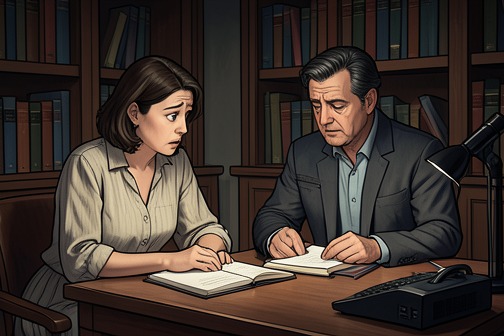
[Fukaeri](entity:character-recall-character-02de2a3e1012) reveals that she did not write [Air Chrysalis](entity:concept-recall-concept-04ca3e0fd671) herself: she told the story, and another young woman, [Azami](entity:character-recall-character-azami-48fd74301ddc), transcribed it. The disclosure changes the stakes of [Tengo](entity:character-recall-character-tengo-207999a29189)’s rewriting project. It eases some of his guilt about altering the work, but makes the scheme of presenting Fukaeri as a novelist more fragile, while deepening Tengo’s conviction that the manuscript must be rewritten.
## The questioning and the disclosure
The revelation emerges from Tengo’s attempt to understand why Fukaeri struggles with reading and writing. He asks whether she has dyslexia, explaining that it is a reading disorder. When he cautiously observes that, even if she cannot read, she can still write, Fukaeri shakes her head and indicates that writing also takes time. Her brief answers leave Tengo to piece together what her difficulties mean for the book.
He then asks whether she may have been unable to write Air Chrysalis herself. Fukaeri answers plainly that she did not write it. After a pause, Tengo asks who did; she names Azami. The exchange identifies a distinction between the story’s origin and the physical production of its text: Fukaeri supplied the narrative, while Azami put it into written form.
Tengo checks his reconstruction aloud. Fukaeri had told her story, he understands, and Azami had typed and printed it. He reasons that Azami submitted the printed text to a literary magazine for the Newcomer’s Prize and probably chose the title, Air Chrysalis, without telling Fukaeri. Fukaeri’s nod does not establish an unambiguous yes, but it does not refute his account; the narration presents his reconstruction as broadly accurate, while preserving a small measure of uncertainty about the particulars.
## An oral work and its written author
The [Sunday](entity:time-recall-time-95868a7bbce2) conversation in mid-April establishes that Fukaeri was not the person who wrote the text submitted under her name. As Tengo understands it, she narrated the story and Azami transcribed it. The narrator compares this mode of creation to oral literary works such as the Kojiki and The Tale of the Heike: the written work has a source in spoken storytelling, but its passage into print involves another person’s labor.
That distinction complicates authorship without erasing Fukaeri’s role. She is the source of the story, while Azami is the person who rendered it in writing and, in Tengo’s reconstruction, prepared the submission and selected its title. The revelation therefore makes the history of Air Chrysalis more complex than a simple account of a young writer composing a manuscript. It also gives Tengo a reason to feel somewhat less guilty about revising the work: the text has already passed from oral telling through another person’s written mediation. But that relief is limited. The work’s layered origin does not make the plan to recast it straightforward; it makes the circumstances harder to manage and, as the narration puts it, nearly irredeemable.
## Dyslexia and the problem of sustaining a public fiction
After the conversation, Tengo recalls what he learned about dyslexia in a teacher-training lecture at university. In his understanding, dyslexia is not a measure of intelligence and does not make reading or writing categorically impossible. Rather, reading takes longer, and the difficulty can intensify as a text grows: written signs and their meanings do not connect readily enough for the reader to process extended passages. Tengo also considers that Fukaeri appears to have a related difficulty with writing.
He connects that condition to what he has observed of her speech. At seventeen, Fukaeri seems almost unable to read a book or write long sentences, and in conversation she rarely says more than one sentence at a time unless she intends to. The issue is not merely whether she can produce a single text with help. If the project succeeds and Air Chrysalis wins the Newcomer’s Prize, the public image of Fukaeri as a novelist could require her to sustain a role that her reading and writing difficulties make implausible. Tengo imagines that people would soon sense that something was unusual, and that discovery would discredit everyone connected with the enterprise. He sees his own future as especially exposed: his career as a novelist might be broken before it had properly begun.
## The danger does not release Tengo
Tengo’s first practical response is to imagine withdrawing. The project now seems impossible to bring safely to completion; what had already felt like walking on a thin sheet of ice appears to him to be cracking before anyone has even stepped onto it. He resolves, in thought, to call [Komatsu](entity:character-recall-character-komatsu-04b9166b2f49) when he gets home and say that the plan is too dangerous and that he is leaving it. It is the decision he associates with any sensible person.
Yet his attachment to the manuscript defeats that calculation. Thinking about Air Chrysalis leaves him violently divided: the risks are real, but he cannot make himself abandon the work. He believes that he might have withdrawn before beginning; now he is immersed too deeply. The story’s world has become something he breathes and has taken into himself, and he feels the narrative pressing for revision by his hand. His fear of exposure remains, but it no longer determines his choice. The revelation makes the scheme more precarious even as it sharpens his sense that he must continue.
## Narrative significance
The scene discloses not only who wrote down Air Chrysalis, but how unstable the boundary is between telling, writing, authorship, and public credit. Fukaeri’s spoken story, Azami’s transcription, the likely submission and title, and Tengo’s contemplated rewrite form successive stages in the work’s production. No single stage explains the whole book’s origin, and the revelation makes the proposed attribution to Fukaeri both more understandable and more dangerous.
The narration also keeps the discovery close to Tengo’s limited understanding. He asks questions, tests a reconstruction, and then measures its consequences against what he knows of dyslexia and literary publication. Fukaeri’s sparse replies disclose the essential fact, but they do not settle every detail about Azami’s choices; Tengo’s reading of her nod is explicitly cautious. That combination of a decisive answer and residual uncertainty gives the episode its force: the account of the manuscript becomes clearer, while the larger undertaking becomes harder to control. Tengo recognizes the danger and imagines retreat, only to find that his investment in the story has already become stronger than his instinct for self-protection.
Event 8
Tengo meets the Master
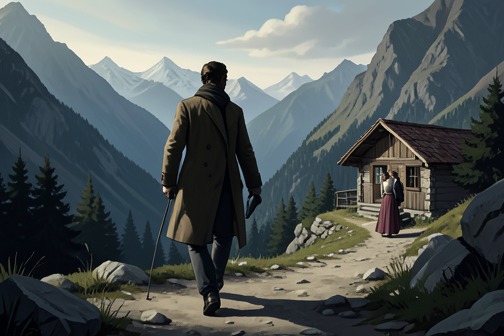
[Tengo meets the Master](entity:event-recall-event-tengo-meets-the-master-16291806df92) at his secluded mountain residence after traveling with [Fukaéri](entity:character-recall-character-fuka-ri-84c2a2dd75a0) to [Futamatao](entity:location-recall-location-futamatao-ffd2dfcb5a9d), a station he does not recognize. Their meeting turns the proposed revision of Éri’s [La Chrysalide de l’air](entity:object-recall-object-la-chrysalide-de-l-air-ce88320b77fd) from an editorial scheme into a question of trust and responsibility: the Master asks whether [Tengo](entity:character-recall-character-tengo-207999a29189) will help present Éri as the author, hears why Tengo has agreed despite his reservations, and identifies facts about Éri’s reading disability and childhood that Tengo needs to know.
## Journey to the Mountain Residence
The visit begins at Futamatao, a small, old wooden station where only five other passengers get off the train. They are the sort of travelers who have come to climb mountain paths and breathe the clean air, not to visit urban entertainment or restaurants. Outside, there is no substantial shop and almost nothing moving: one taxi waits, apparently for the arriving train. Fukaéri taps on its window, gets in, and briefly tells the driver where to go; Tengo follows her lead.
The taxi ride is short but difficult. It climbs steep hills and descends sharply over narrow roads more like farm tracks than regular streets, with tight bends and little room for passing. The driver does not slow much at the curves, leaving Tengo anxious and holding the door handle. After an especially steep ascent, the taxi stops at the top of a small mountain. The remote approach, with its contrast between the quiet station and the arduous climb, marks the meeting as a departure from Tengo’s familiar world.
## The Master’s Arrival
After Fukaéri and Tengo reach the residence, they wait in silence. Fukaéri remains absorbed in her private world, while Tengo tries to stay calm by breathing steadily. A distant bird occasionally breaks the quiet. Tengo looks at his watch and out at the landscape, but feels that time is barely moving; the stillness becomes an experience in its own right before anyone explains why they have come.
About ten minutes later, a slender man of roughly sixty-five enters quickly. He is short, but his upright, energetic posture resists any impression of frailty. Thick eyebrows and large black-framed glasses give his face a severe cast; his precise movements seem economical, as if every part of a compact mechanism works without excess. When Tengo starts to rise, the man gestures for him to sit, then takes the chair opposite and studies him in silence. His eyes seem sharply perceptive without being inquisitorial. The old, well-worn clothes and the sparse, exact manner of his movements present a figure whose attention is directed less toward appearances than toward the matter before him.
## The Rewrite and Tengo’s Reasons
The Master frames the proposal plainly: Tengo and [Komatsu](entity:character-recall-character-komatsu-04b9166b2f49) intend to revise the novel Éri wrote, make it more finished, and submit it for a new-writers’ prize, presenting the girl as its author. Tengo accepts that this is the substance of the plan, but distinguishes his part from Komatsu’s responsibility for the scheme. He describes himself as a technician whose task is to retouch the style of La Chrysalide de l’air, and admits that he does not know whether the plan will happen or whether it is morally right.
Asked why he has entered a risky undertaking, Tengo says that reason, common sense, and instinct all told him to withdraw. He considers himself cautious rather than adventurous, and says that with any other manuscript he would have refused Komatsu immediately. What changed his answer was the text itself: La Chrysalide de l’air captivated him. His explanation puts the work’s literary force beside the ethical uncertainty of presenting a rewritten novel under Éri’s name. The Master listens, then checks whether Tengo is approaching the project chiefly through the deep interest of revising the text rather than through its potentially fraudulent aspect.
## Éri’s Choice and the Conditions of Trust
The Master turns to Fukaéri and asks what she thinks of the proposal. After fixing her gaze on a point in the air, she answers only that it is all right. Tengo notices her small fists clenched; her brief assent is not expanded into an argument, but the Master treats it as a decision with weight. He says that Éri appears to trust Tengo, though he does not claim to know her reasons, and makes his own position explicit: he trusts Éri and will accept her choice to entrust the work to Tengo.
That trust does not make the project simple. The Master tells Tengo that Éri is dyslexic, a condition he believes is probably congenital. Because of it, her school long regarded her as developmentally delayed, although, in his account, she is in fact highly intelligent and full of ideas. He cautions that the disability remains real even if others minimize it, and asks whether it could have adverse consequences for the plan. The conversation thus separates Éri’s ability and authorship from the difficulty she has with reading, while making clear that a public literary undertaking cannot responsibly ignore that difficulty.
## The Unfinished History
The Master’s consent is conditional in an important sense: before Tengo can carry the project through, he must learn more than the facts of Éri’s dyslexia. The Master says he will explain what kind of childhood she had, where and under what circumstances he took charge of her upbringing. He acknowledges that this may be a long story. Tengo says he is listening, and Fukaéri adjusts her position beside him, keeping her hands joined behind her neck and gripping the collar of her cardigan.
The meeting ends at the threshold of that account rather than with the history itself. Its sequence moves from an obscure mountain journey, through the Master’s scrutiny and Tengo’s defense of his motives, to the disclosure of a condition that changes the practical meaning of the rewrite. The Master’s trust in Éri’s decision authorizes the collaboration, while his promise to disclose her past establishes that the literary work is inseparable from the circumstances of the person whose name it will bear.
Event 9
Aomamé identifies the 1Q84 world
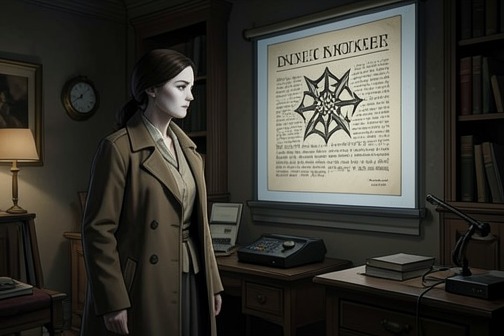
[Aomamé identifies the 1Q84 world](entity:event-recall-event-aomam-identifies-the-1q-d31b47ca2b90) when gaps in her memory lead her to a more disturbing explanation: not that her own judgment has become unreliable, but that the reality she remembers has been replaced by a subtly altered one. The name she gives this world turns private unease into a working account of her situation, while leaving its causes and rules unresolved.
## The evidence of missing news
[Aomamé](entity:character-recall-character-aomam-6f0ef39c7aa1) begins from a discrepancy she cannot reconcile with her ordinary habits. The affair she is investigating took place on October 19, while the fatal Yubari mine disaster still occupied public attention. Yet she has no memory of the Yamanashi police killings that [Tamaru](entity:character-recall-character-tamaru-a5e5b3f73b3f) had mentioned only hours earlier. The morning newspaper had carried the story in a large front-page headline, accompanied by photographs of the three dead officers and an aerial view of the fighting near Lake Motosu. It was not an obscure report that could plausibly have escaped notice.
The scale and coverage of the incident sharpen the problem. Police and the Self-Defense Forces pursued the surviving extremists through the mountains; three were killed, two badly wounded, four arrested, and one remained unaccounted for. The affair filled the newspapers for days. That coverage also pushed the separate story of an [NHK](entity:organization-recall-organization-nhk-a202b57000ac) collector stabbing a student out of view. Aomamé realizes that she has missed both events, even though she remembers other news from the period precisely and reads the newspaper with meticulous attention. Her memory, on which she depends in her work, seems intact everywhere else.
## From personal failure to altered reality
Aomamé first considers whether some function in her brain has concealed the two stories from her, as though information had been hidden under a black cloth. But that explanation does not satisfy her: she cannot understand how she could have skipped only those reports, or why these particular events vanished while the rest of her recollections remained available. She closes her eyes, presses her fingertips to her temples, and tests the possibility that the fault lies outside herself.
The decisive turn comes when she reverses the premise. Perhaps her consciousness and judgment have not malfunctioned; perhaps an inconceivable force has changed the world around her. As she develops the hypothesis, the missing news becomes evidence of a world that has been switched onto another track. The greater part of this new world, she reasons, remains almost indistinguishable from the one she knew, so daily life has not yet been seriously disrupted. But the differences may multiply. If they begin to undermine the logic of her actions, a mistake could become fatal.
This is not a confirmed explanation supplied from outside Aomamé’s perspective. It is a theory she adopts because it accounts for her experience better than the idea that she has suddenly lost her powers of observation. She knows she needs to investigate the change without help and asks herself where and when the switch could have occurred. The passage’s suspense rests on the distance between a familiar setting and an increasingly consequential discrepancy: the world still looks usable, but its reliability can no longer be assumed.
## Locating the point of divergence
Searching her recent memories, Aomamé places the earliest alterations a few days earlier, on the day she killed the oil specialist in a [Shibuya](entity:location-recall-location-630a8203ac51) hotel room. She recalls leaving the taxi on Metropolitan Expressway Route 3, descending by the emergency stairway, reaching National Route 246, changing her stockings, and heading toward Sangenjaya station to take the Tokyu line. There she saw a young policeman whose uniform differed from the one she expected. The contrast with the officers near her home that morning, still wearing their familiar uniforms and carrying the older-model revolver, makes the changed police equipment her first concrete marker of a shifted reality.
The remembered sequence does not prove that her killing caused the change. Instead, Aomamé identifies that day as the likely threshold: the point just before the world’s track may have changed. Her effort to anchor a vast hypothesis in a particular route, a change of clothes, and an unfamiliar uniform shows how she proceeds—by treating small discrepancies as clues and reconstructing their order. The question of when the divergence occurred remains open, but the incident on the way from Shibuya gives the uncertainty a provisional location in her own chronology.
## Naming the new year
Aomamé decides that the altered conditions need a name, both to distinguish them from the world she remembers and to give herself a way to think within them. She calls the new world [1Q84](entity:expression-recall-expression-1q84-fff528afb30b). The Q, she notes, begins the word “Question” and signals that this is a reality burdened with unanswered questions. Naming does not explain the transformation; it makes the transformation legible enough for her to confront.
She consequently understands herself as living in the year 1Q84, not in the [1984](entity:time-recall-time-1984-74446ae4d2ef) she knew. The air and landscape, she believes, have changed, and she must acclimatize like an animal released into an unfamiliar forest. Survival will depend on learning the new world’s rules and adapting to them. Her conclusion is at once a recognition and a practical decision: rather than dismissing the discrepancies as a defect in her own mind, she will use her hypothesis as a guide until a more convincing one appears.
## Narrative significance
The episode changes Aomamé’s uncertainty from a private memory puzzle into an account of an altered world. Its clues are mundane and public—the missing newspaper stories, police uniforms, and a weapon—yet their accumulation threatens the assumption that the present is simply the past continuing unchanged. The gap between what Aomamé remembers and what the world appears to contain makes ordinary news and familiar streets evidence requiring interpretation.
Her label 1Q84 gives that interpretation a durable form without closing the mystery. The name preserves the recognizable outline of 1984 while marking a difference that cannot yet be measured in full. Aomamé’s method is correspondingly provisional: she identifies a likely point of divergence, anticipates that small changes may grow dangerous, and commits herself to learning the rules. The episode’s decisive movement is therefore not from ignorance to complete knowledge, but from self-doubt to alertness toward a world whose apparent familiarity may conceal consequential changes.
Event 10
The 1981 Lake Motosu clashes
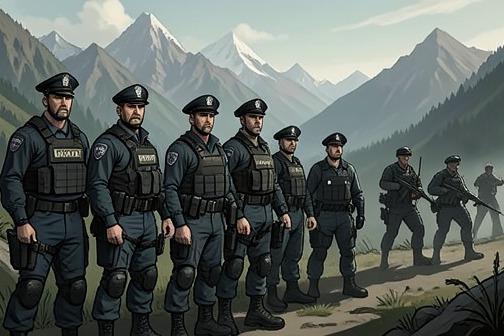
[The 1981 Lake Motosu clashes](entity:event-recall-event-the-1981-lake-motosu-cl-e4ac510a0321) were an armed confrontation between local police and members of the Dawn in the mountains near Lake Motosu. The battle left three police officers dead, drew in [Japan](entity:location-recall-location-820f849a273a)’s Self-Defense Forces, and was followed by a large-scale pursuit of the fleeing group. It also prompted changes to police organization and equipment; in the novel, the event returns not as a complete, stable memory, but as a public catastrophe whose details [Tengo](entity:character-recall-character-tengo-207999a29189) struggles to recover.
## Background and confrontation
The battle took place in mid-[October 1981](entity:time-recall-time-1981-10-ace43281640c) in Yamanashi Prefecture, near Lake Motosu. A later account describes a stark imbalance in weapons: the armed group had five AK-47s, while police carried older six-shot revolvers. The confrontation was consequently remembered as a disastrous defeat for the police, with three officers killed.
The scale of the crisis brought a special battalion of the [Japan Self-Defense Forces](entity:organization-recall-organization-f0d5089f54de) to the area by helicopter. The response made the clash more than a local police operation: it became a public test of the state’s ability to confront an armed group and regain control of the mountain terrain.
## Manhunt and immediate aftermath
The fighting was followed by a prolonged search involving the Self-Defense Forces and prefectural police. They pursued about ten extremists who had escaped into the mountains. Three were killed, two were seriously wounded, and four people, including a woman, were arrested. One member of the group remained unaccounted for.
The scale of the operation was visible in press coverage. A newspaper account included an aerial photograph of the site near Lake Motosu, a rough map, photographs of the three dead officers, and images of the helicopter-deployed special troops in camouflage carrying rifles with scopes and compact automatic weapons. The reporting continued for days, making the clash a sustained national news story rather than a brief report of violence in a remote area.
## Political and institutional consequences
The police’s loss of face after the deaths prompted a political response. Prime Minister Nakasone sought to strengthen police powers, and the organization underwent substantial changes, including the creation of special armed units. Ordinary officers also received more capable semi-automatic weapons, including Beretta Model 92 pistols. The episode thus links a particular mountain battle to a broader shift in policing and state preparedness.
Its prominence also shaped what the public heard about other events. In the aftermath, coverage of the clashes crowded out reporting about a university student injured by an [NHK](entity:organization-recall-organization-nhk-a202b57000ac) fee collector. The contrast shows how a spectacular armed confrontation can redirect attention, allowing a separate story to recede from view even as the news cycle continues.
## Memory and narrative role
When the Dawn is mentioned later, Tengo recognizes that it was involved in a serious armed clash but cannot summon the details. His effort to remember is interrupted by a crisis: he feels his body twisting, experiences pain in his head, and senses the surrounding air and sounds changing. The scene does not supply a fuller account of the battle; instead, it makes the limits of Tengo’s recollection part of the event’s significance.
The clash therefore has two related forms in the narrative. It is a documented public episode, with dates, casualties, weapons, photographs, and institutional consequences; it is also a fragment of personal memory that Tengo cannot readily assemble. That tension between abundant public records and failing private recall gives the event a wider role in a novel concerned with unstable memory and the difficulty of making a coherent account of reality.
Event 11
The NHK collector’s stabbing of a student
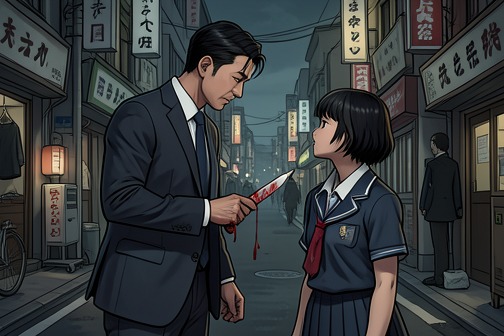
[The NHK collector’s stabbing of a student](entity:event-recall-event-the-nhk-collector-s-sta-246809ba7a11) is a [1981](entity:time-recall-time-1981-16063b32b4e5) knife attack in [Tokyo](entity:location-recall-location-tokyo-0b4edfa3fe2f)’s Itabashi district, but its decisive significance lies in [Aomamé](entity:character-recall-character-aomam-6f0ef39c7aa1)’s failure to remember it. When she discovers the report, she cannot tell whether she had overlooked it in the newspaper or whether the event has disappeared from her memory. The ordinary-seeming crime thus becomes evidence that the reality she inhabits may be changing in ways her careful habits cannot explain.
## The Incident in Itabashi
On October 12, an [NHK](entity:organization-recall-organization-nhk-a202b57000ac) fee collector, aged fifty-six, argued with a student who refused to pay the reception fee. The collector carried a knife in his bag and used it to inflict a serious abdominal wound. Police arrived and arrested him at the scene; he still held the bloodied knife, stood almost prostrate, and offered no resistance. A colleague described him as having worked as a collector for six years, with impeccable conduct and excellent results at work. The discrepancy between that reassuring professional account and the sudden violence is part of the incident’s starkness.
The collector was named Shinnosuke Akutagawa. Aomamé notes the name’s resemblance to that of the famous writer, but there is no photograph of the assailant in the report. Instead, the newspaper shows the injured student, Akira Tagawa, a twenty-one-year-old third-year law student at Nihon University and a second-dan in kendō. Aomamé reflects that he might have been harder to wound if he had been holding a bamboo sword, while also recognizing the absurdity of expecting an ordinary student to carry one during an argument with a fee collector. The contrast sharpens the strangeness of the encounter: neither man fits the ordinary expectation suggested by his role.
## A Gap in Aomamé’s Record
The newspaper account unsettles Aomamé because the attack is not an obscure item buried in a few lines. It occupies nearly half a page of crime reporting, and she reads the Yomiuri every day, closely enough to study criminal cases in particular. She cannot rule out the possibility that she skipped the article, but considers that explanation highly improbable. The uncertainty matters: she has no evidence that the incident itself is impossible, only the unnerving fact that she remembers no report of it.
She writes a summary of the case and records its date, turning the news into something she can check against her own memory. She then follows coverage of the injured student for several days and finds no report that he died. That absence leaves open the possibility that he survived; the newspaper trail provides no definitive resolution. Even as Aomamé tries to establish what happened after the stabbing, the case has already become a test of whether her recollection can be trusted.
## The Attack amid a Changing News Record
Aomamé’s uncertainty about the report becomes more consequential when she sets it beside the other news she remembers from the same period. The stabbing was not the only event missing from her recollection: she also finds that she had no memory of the Lake Motosu confrontation, although that pursuit had filled newspapers for days. She recalls that the police and Self-Defense Forces hunted the fleeing extremists through the mountains, killing three, seriously wounding two, arresting four, and losing track of one. The scale and duration of the coverage make the gap difficult to explain as ordinary forgetfulness.
The two stories also occupied sharply different positions in the news. The Lake Motosu operation, involving police officers killed and a major manhunt, crowded out coverage of the student injured by the NHK collector. Aomamé considers that the attention given to the confrontation may have helped bury scrutiny of the fee-collection system and NHK itself. Public doubts about the broadcaster’s political independence had already been intensified by controversy over a program on the Lockheed corruption scandal: NHK had shown the proposed content to politicians from the governing [Liberal Democratic Party](entity:organization-recall-organization-4ff98b478697) before broadcast, and the program was altered after political objections. Because NHK’s financing depended on Diet approval, its senior staff feared retaliation from the government or ruling party; some members of that party, in turn, regarded the broadcaster as being under their control. The stabbing therefore belongs not only to a private crisis of memory but also to a public setting in which a major story could eclipse questions about institutional power.
## What the Missing Report Reveals
The contrast between Aomamé’s usual precision and these two omissions turns a newspaper check into a test of reality. She considers herself conscientious and meticulous, confident in a memory that has helped her carry out killings without error; she reads the paper daily and believes that no significant item escapes her attention. Yet she remembers the period’s other stories clearly, while the NHK stabbing and the Lake Motosu confrontation alone are absent. Her difficulty is not simply that one violent incident went unnoticed: the selectiveness of the gap resists an ordinary explanation.
Aomamé presses her fingertips against her temples and entertains the possibility that a function in her brain has concealed information from her, as though a black cloth had been laid over certain facts so her eyes could not see them and her memory could retain nothing of them. Alongside the stabbing and the firefight, the concealed items include changes to police weapons and uniforms and a proposed American-Soviet lunar base. The news report thus acquires a significance far beyond its immediate crime: it becomes one concrete trace in Aomamé’s growing suspicion that the world itself has changed, and that some of the evidence has been hidden from her.
Event 12
The founding of the Pioneers community
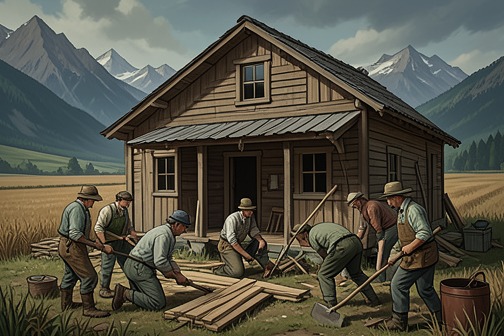
[The founding of the Pioneers community](entity:event-recall-event-the-founding-of-the-pio-7b24265071c1) was a 1974 attempt by [Fukada](entity:character-recall-character-d944f2bce67d) and his followers to build an enduring communal life through agriculture in the mountains of Yamanashi Prefecture. Cheaply acquired land, local subsidies, and a substantial source of money Fukada never explained enabled the settlement to take shape; its practical achievements and public reputation would later stand in sharp contrast to the abuse committed under the authority of its founder.
## Origins and Establishment
Fukada’s group sought a village that had been largely depopulated, where farms lacked successors and the remaining elderly residents could no longer cultivate the fields. The situation gave the newcomers an opportunity to acquire land and houses for very little. They also obtained plastic greenhouses, municipal subsidies on the condition that they continue farming existing cultivated land, and favorable tax treatment during the community’s first years.
The public support did not account for all the resources behind the project. Fukada had a private source of financing, but even Professor Ebisuno, his close friend, did not know where the money came from or what its nature was. Fukada never disclosed the secret to anyone. The capital was nevertheless substantial and indispensable: it paid for agricultural equipment and building materials and allowed the group to maintain reserves as it repaired existing houses and constructed facilities for its approximately thirty members. In 1974, they named the new community the Pioneers.
The settlement’s founding also brought a close friendship into a shared historical account. Ebisuno remembered Fukada as physically and temperamentally unlike himself: Fukada was tall, imposing, political, and naturally a leader, while Ebisuno described himself as small, solitary, and apolitical. Despite these contrasts, the two men had been close, respected, and trusted one another. Ebisuno’s account of the community thus comes from a witness who admired Fukada personally, even as he acknowledged that the community’s founding finances remained unexplained.
## Building a Working Community
The Pioneers needed several years to adjust to their new region. Fukada insisted on rigorous management, but daily life went better than he had expected. Favorable weather helped, and some neighbors offered practical assistance. Local residents appreciated Fukada’s honesty and admired the young members’ willingness to work hard; repeated contact allowed the newcomers to learn farming methods and the habits of communal life from people who knew the land.
The group retained practices learned at Takashima while developing its own agricultural methods. It abandoned chemical insecticides and cultivated vegetables using organic fertilizer alone, anticipating what would later be called ecological agriculture. Its members’ urban backgrounds gave them an understanding of city consumers’ preferences: affluent customers would pay more for attractive, fresh, unpolluted produce. That knowledge turned cultivation into a viable business rather than simply an ideal of self-sufficiency.
To reach those customers, the Pioneers contracted with a delivery company, simplified distribution, and arranged rapid delivery into the city. They also became early sellers of irregularly shaped vegetables still covered in soil, making a selling point of produce that conventional expectations might have rejected. The combination of organic cultivation, direct delivery, and attention to urban demand increased their profit margins. It made the community’s agricultural project both a social experiment and a commercially effective enterprise.
## Growth and Public Reputation
Ebisuno visited Fukada’s farms and found him apparently happy in an environment that allowed him to test bold possibilities. He thought this may have been the calmest period of Fukada’s life, when his hopes seemed to be coming true; Fukada’s family also appeared to adapt well to the new communal life. The early years were therefore remembered not only as a period of labor and adjustment, but as a time when the founding vision seemed to be working.
As the Pioneers’ produce circulated, the community’s name became more widely known. The media presented it as an example of a successful community, and its reputation attracted people seeking physical work in nature away from an information-saturated, money-centered society. Applicants were interviewed and admitted only if they could contribute. The group did not accept everyone: it sought candidates whose health, agricultural abilities, and capacity for hard physical work suited communal farming, while also welcoming women as part of its effort to achieve a balanced membership.
The public picture of the Pioneers emphasized practical competence and a persuasive account of communal life. When journalists later visited, they could move freely through the grounds, talk to residents, and report as they chose, although the association asked the media to use only approved photographs or footage to protect members’ privacy. Leaders answered questions about the association’s organization, religious principles, and management in a large meeting room. Their courteous, polished explanations made them seem less like the officers of a sect than highly skilled publicists.
## Founding Ideals and Later Contradictions
In its public explanation of its religion, the association claimed not to have a fixed doctrine or codified manual. It described its approach as studying early Buddhist principles and practicing different forms of exercise in pursuit of enlightenment, understood as fluid and free rather than obedience to literal dogma. Individual awakenings, it said, came first; rules and doctrine were supposed to emerge afterward, spontaneously from those experiences. The statement offered an ideal of a community whose principles grew from its members instead of being imposed in advance.
The association also presented agriculture and simplicity as alternatives to dependence on donations and the materialism of the market economy. It acknowledged voluntary contributions but said its aim was an austere, largely self-sufficient life based chiefly on farming. Its representatives appealed especially to educated people and specialists with high social standing, describing the community not as an institution that relieved people of responsibility but as a place for people who wished to save themselves. The language of individual awakening and self-direction gave the Pioneers a distinctive public identity, though it could not establish how power was exercised in private.
That contradiction becomes unavoidable in the account of [Tsubasa](entity:character-recall-character-tsubasa-7d098a0debb5). The Dowager later states that Fukada, the Pioneers’ founder, sexually abused her, presenting the assault to her parents as a spiritual-stimulation rite that had to occur before the girl’s first menstruation. Her parents believed his claim that the suffering was necessary for spiritual advancement. The Dowager says other girls suffered the same fate and characterizes the religious doctrine as a convenient cover for Fukada’s sexual appetites. The community’s history therefore cannot be reduced either to the successful agricultural venture its members and the media displayed or to its founder’s abusive conduct: the record holds both its real organizational achievements and the violence hidden beneath its spiritual authority.
Event 13
The split of the Pioneers and the formation of the Dawn
[The split of the Pioneers and the formation of the Dawn](entity:event-recall-event-the-split-of-the-pionee-d488370efe6b) transformed an initially flexible farming community into two increasingly estranged projects: one oriented toward communal life in nature, the other toward revolution and clandestine military preparation. The division was not simply a dispute over agricultural management. It exposed the distance between [Fukada](entity:character-recall-character-d944f2bce67d)’s increasingly metaphorical conception of revolution and the literal, violent future his former students expected him to help bring about.
## Causes and Competing Visions
Under Fukada’s leadership, the Pioneers’ farms were organized around a system of separate units, allowing a degree of communal life without abolishing personal property. The structure had been designed to remain flexible, but it also made it possible for sharply different political commitments to develop within the same community. Ordinary farm work could continue, yet disagreement over the movement’s larger direction repeatedly overwhelmed attempts at compromise.
The militant faction, centered on former “Red Guards” trained by Fukada, saw farming as a preparatory stage. Its members concealed their revolutionary purpose behind agricultural work and intended to take up arms when the time came. The moderate faction also opposed capitalism, but kept its distance from politics and sought instead to live communally and self-sufficiently amid nature. It had more adherents among the farming community. The two positions could coexist in routine labor but were, in the account, as incompatible as oil and water whenever the community had to choose a general course.
The conflict sharpened because Fukada’s idea of revolution had changed. He had come to doubt that an actual revolution could take place in [1970s](entity:time-recall-time-20-70-867b55708f13) [Japan](entity:location-recall-location-820f849a273a), and thought of revolutionary thinking chiefly as a possibility or metaphor: a healthy society, in his view, needed a destructive, anti-system current as a kind of corrective. The students he had once led wanted a real revolution, with real bloodshed. Fukada bore responsibility for that expectation: under pressure, he had told them stirring stories about revolution without making clear that he meant the term conceptually rather than literally. He was intelligent and capable, but prone to being carried away by his own eloquence and lacking deeper self-scrutiny. His later uncertainty therefore did not undo the militant movement he had helped inspire.
## The 1976 Separation
The Pioneers divided in 1976. The moderate faction remained in the original village, while the militant faction relocated about five kilometers away and established a base for its revolutionary movement. Fukada’s family and the other families stayed with the Pioneers. At first, the separation was made on roughly friendly terms: Fukada apparently helped the departing group secure funds, and the two agricultural settlements continued to exchange essential provisions and route their produce through shared channels for economic reasons. Their continued dealings reflected practical interdependence, not agreement about what the communities were for.
That limited cooperation soon faded. The factions’ aims had grown too far apart, and movement between the original Pioneers and the dissidents effectively stopped. Exchanges continued chiefly between Fukada and the former extremist students he had organized. He felt responsible for them because he had led them into the Yamanashi mountains, and because his secret source of funding remained indispensable to their community. The material connection endured even as their political relationship became more strained.
## Fukada Between the Communities
Fukada occupied an increasingly divided position after the schism. He remained the Pioneers’ leader while also advising the militant settlement, traveling between the two. Inwardly, he no longer believed in the possibility or romance of revolution as he once had, yet he could not wholly reject it. To do so would have meant repudiating the group’s past and admitting his own errors; pride made that reckoning difficult, and he may also have feared confusing the original Pioneers, over whom he still held some influence.
The militants’ course moved further from his own. Alongside their farm work, they underwent rigorous ideological education and trained in the use of weapons. Their political position became increasingly radical in comparison with Fukada’s. They organized in complete secrecy, admitted no outsiders, and remained under distant police surveillance; despite their declarations in favor of armed revolution, the police regarded them as relatively low-risk. The combination of routine agricultural life, ideological discipline, weapons training, and strict isolation shows how the break produced a community operating on two levels: visible farm work and a concealed revolutionary structure.
## From the Dissidents to the Dawn
In 1977, the dissident faction took the new name Dawn. The renaming followed the 1976 division and marked the group’s separate identity, but it did not resolve the tensions inherited from the Pioneers or Fukada’s ambivalent role between them. Its members continued to live and work as a clandestine revolutionary community while Fukada maintained ties through counsel and funding, despite no longer sharing their certainty about the revolution they pursued.
The history reaches the reader through the Master’s account to [Tengo](entity:character-recall-character-tengo-207999a29189), who recognizes the name Dawn but finds that his recollections of it are confused and fragmentary. That delayed recognition gives the schism significance beyond the internal history of a farming settlement: the movement’s name resurfaces in a later, uncertain present, while the account of its origins reveals how a flexible communal experiment became the ground for a concealed armed project. The split thus joins an ideological failure of communication to a lasting political consequence: Fukada’s revolutionary rhetoric outlived his belief in it, embodied by students who took literally what he had treated as metaphor.
Event 14
Fukaeri’s escape from the Pioneers
[Fukaeri’s escape from the Pioneers](entity:event-recall-event-fukaeri-s-escape-from-t-bd96c8398e85) in 1977 was a decisive break from the mountain community where she had grown up, and the beginning of her refuge in the Master’s household. Recalled years later, the departure is framed not as a simple rescue or a fully explained flight, but as a passage from one guarded environment into another life whose first defining feature was her silence.
## Background and Departure
The Master tells [Tengo](entity:character-recall-character-tengo-207999a29189) that the Pioneers divided in 1976, and that Eri escaped from the group and came to take refuge with him the following year. At roughly ten years old, she left the community in the mountains where she had been assigned to care for an elderly blind goat, a task treated as important to the group. The sequence places her escape against a rupture already underway: the faction that broke away from the Pioneers adopted the name the Dawn around the time she fled.
[Fukaeri](entity:character-recall-character-02de2a3e1012)’s account of the community gives the departure a disturbing background. When she neglected her assigned watch, the blind goat died; she was then locked with its corpse in an old earthen storehouse for ten days, isolated and forbidden to leave or speak with anyone. The goat was said to mediate passage between this world and the [Little People](entity:character-recall-character-little-people-85335adb85e4), who entered through its body at night and departed at dawn. The girl could speak with them, and they taught her how to make an [Air Chrysalis](entity:concept-recall-concept-04ca3e0fd671). The account describes both her unusual access to the community’s sacred world and the severity of its discipline, without establishing every detail as independently verified fact.
## Refuge in the Master’s Household
The Master recalls that Fukaeri did not seem frightened, shocked, or anxious about separation from her parents when she arrived. Instead, she appeared entirely unresponsive, though she adapted to life in the household more easily than he had expected. He chose not to press her to open up or question her about what had happened, reasoning that she needed time; he treated her silence as something he could live alongside rather than force her to overcome.
Fukaeri spent much of her time with [Azami](entity:character-recall-character-azami-48fd74301ddc). After school, the two girls would finish their meal, shut themselves in their room, and remain together privately. The Master did not know what they did there and did not intrude, allowing them to act as they pleased. They became inseparable. Because Fukaeri did not speak, she could not attend school, but the Master describes her as intelligent and attentive to what he told her. Her silence was therefore both a practical barrier to ordinary schooling and a condition the household accommodated without demanding an explanation.
## The Community and the Story of Escape
The Pioneers publicly described their religious orientation in terms of spontaneous, individual awakening rather than a fixed doctrine or codified manual. Their representatives said that personal awakenings came first and that doctrine and rules emerged afterward; they presented practical exercises, spiritual development, and a simple, largely self-sufficient agricultural life as alternatives to materialism. This public account contrasts sharply with Fukaeri’s remembered punishment and with the community’s claim that the blind goat served as a passage between worlds. The contrast does not itself settle what happened, but it places her childhood narrative beside the group’s polished account of its beliefs and methods.
The Master’s chronology also links Fukaeri’s escape to the Pioneers’ political fracture. After the 1976 division, the breakaway faction took the name the Dawn, while Fukaeri sought shelter with him in 1977. Tengo recognizes the name but finds his recollections confused and fragmentary, so the escape also becomes a point where personal history intersects with a larger conflict whose implications he does not yet fully grasp.
## Significance
The escape changes Fukaeri’s circumstances without immediately making her past legible. She is no longer living in the community that assigned her the blind goat and punished her after its death, yet she arrives at the Master’s home unable or unwilling to speak about her experience. His restraint, and her closeness with Azami, make refuge possible without turning it into a forced confession.
The event also establishes a tension between institutional explanations and private experience. The Pioneers’ public language of free, spontaneous awakening sits beside a child’s confinement and the mysterious account of the Little People. Fukaeri’s escape leaves those accounts unresolved: it marks a clear physical departure, but the silence surrounding her arrival preserves the uncertainty of what she endured and what, if anything, she carried out of the community.
Event 15
The blind goat’s death and Fukaeri’s punishment
[The blind goat’s death and Fukaeri’s punishment](entity:event-recall-event-the-blind-goat-s-death-3229d6ca73c0) form a defining episode in the account of her childhood later encountered by [Tengo](entity:character-recall-character-tengo-207999a29189) in *The [Air Chrysalis](entity:concept-recall-concept-04ca3e0fd671)*. A ten-year-old charged with watching an aged blind animal, [Fukaeri](entity:character-recall-character-02de2a3e1012) fails in that assigned duty; after the goat dies, the community confines her with its corpse for ten days. The episode links a child’s punishment to the community’s belief that the goat mediated between worlds, and to Fukaeri’s encounters with the [Little People](entity:character-recall-character-little-people-85335adb85e4).
## The child and the community
At ten, Fukaeri lived in a peculiar mountain “commune,” or something like one, where each child had a specific task. Hers was to watch an elderly blind goat. The community regarded the animal as having a special purpose and repeatedly warned her not to take her eyes off it. Her responsibility was therefore both practical and charged with significance: she was assigned to protect an animal that the group treated as more than livestock.
The account specifies that Fukaeri forgot her duty through negligence. The goat died, and she was punished: she was shut inside an old earthen storehouse with the animal’s corpse for ten days. Isolated from everyone, she was forbidden to leave, and nobody was allowed to speak to her. The confinement turns the failure of a child’s assigned watch into a severe communal sentence, imposed through enforced solitude and proximity to death.
## The goat as passage between worlds
The goat’s special function, as the story explains it, was to secure passage between this world and the world of the Little People. At nightfall, the Little People entered this world through the goat’s corpse; at dawn, they departed through it to return to the other side. Its death thus concerns more than the loss of an animal: the corpse is described as the route through which beings cross between realms.
Fukaeri could speak with the Little People, although she did not know whether they were good or evil. Tengo, encountering the account, cannot know either. The story attributes another teaching to them: they showed Fukaeri how to make an Air Chrysalis. The goat’s death and the child’s punishment therefore sit beside a claim of contact and instruction, without resolving what the Little People are or whether their influence should be understood as benevolent.
## The episode in Tengo’s reading
Tengo is struck by how precisely the account describes the blind goat’s habits and behavior, down to small details. For him, those passages give life to the whole text. He wonders whether Fukaeri truly cared for such a goat and lived in a mountain community of the kind she describes. He allows that she may have done so; if not, he thinks, the narrator would need exceptional talent to create the account.
The episode leaves an unresolved question about the relationship between Fukaeri’s life and the story’s material. Tengo plans to ask her about the community and the goat when he next sees her, on [Sunday](entity:time-recall-time-95868a7bbce2), but doubts she will answer. From their earlier conversation, he has learned that she seems to choose which questions to respond to and simply ignores the rest. The confinement is thus presented both as a grave childhood experience within the tale and as part of the mystery surrounding how its details came to be told.
Event 16
The 1945 Soviet invasion of Manchuria
[The 1945 Soviet invasion of Manchuria](entity:event-recall-event-the-1945-soviet-invasio-ecfcc658e168) is the turning point that ends [Tengo](entity:character-recall-character-tengo-207999a29189)’s father’s precarious life as a settler and forces his return to [Japan](entity:location-recall-location-820f849a273a). The account makes that escape the product of both a warning and a narrow chance: told that the Japanese army could not resist, he abandons his possessions, reaches the railway on horseback, and boards the penultimate train for Dairen. Of his companions, he alone returns safely that year.
## Background: poverty and settlement
Tengo’s father had been the third son of a farming family in Tohoku. Poverty and hunger, rather than belief in the government’s promise that [Manchuria](entity:location-recall-location-98a78fbe7fe5) was a prosperous “paradise governed by virtue,” drove him and other men from the same region to join the Manchurian and Mongolian settlement program. They received basic instruction in using firearms if necessary, learned rudimentary facts about farming there, and departed after ceremonial farewells.
At the edge of Manchuria and Mongolia, the settlers were given land, farm tools, and a rifle. Their reality was harsher than the official promise: the soil was poor and stony, winter froze the ground, and food was so scarce that they sometimes ate stray dogs. Government assistance helped them survive the first years, but their prospects remained fragile.
## Invasion and escape
In August 1945, just as the settlers were beginning to glimpse an easier life, Soviet forces renounced the neutrality pact and invaded Manchuria. The Soviet military had transferred much of its strength to the Far East after the war in Europe ended and had prepared to cross the border. A Japanese official secretly warned Tengo’s father that the weakened Kwantung Army would not be able to resist and that he should flee, leaving everything behind.
Once he learned the Soviet army had crossed the border, Tengo’s father acted on the warning. He rode a horse to the station and boarded the penultimate train bound for Dairen. The detail of that nearly-last departure gives the escape its narrow margin: among his fellow settlers, he was the only man to reach Japan safely that year.
## Aftermath and significance
The invasion ended the father’s attempt to make a living in Manchuria and left him repatriated to Japan without money. His later hardship in [Tokyo](entity:location-recall-location-tokyo-0b4edfa3fe2f) belongs to the aftermath rather than the battle itself: he tried black-market work and an apprenticeship in carpentry without success, and struggled to feed himself. In autumn 1947, while making a delivery for a sake merchant in [Asakusa](entity:location-recall-location-fdf1b203eb92), he encountered the same official who had warned him before the invasion. That reunion eventually led to a suggestion that he become an [NHK](entity:organization-recall-organization-nhk-a202b57000ac) fee collector, linking the wartime escape to the work that would shape Tengo’s childhood.
The episode situates the father’s later life within a history of poverty, state-sponsored settlement, and sudden military collapse. His survival is not presented as triumph over the invasion so much as a costly flight made possible by advance warning and a final train; the only immediate certainty is that he returned alive while his companions did not make it back with him that year.
Event 17
La dissolution de L’Aube
La dissolution of L’Aube was the aftermath of an armed confrontation in the mountains in [1981](entity:time-recall-time-1981-16063b32b4e5), which brought the dissident community to an end and reshaped the public position of the Predecessors. The group’s collapse followed a dispute over land and access to water, but its consequences extended beyond the fighting: the Predecessors publicly disavowed the armed faction, obtained religious-association status, and went on to grow. In the Master’s account, the divergence between L’Aube’s defeat and the Predecessors’ success is central to understanding what the crisis changed—and what it failed to explain.
## Causes and Background
L’Aube had emerged from the same broad community as the Predecessors, but the groups had separated over their principles and direction. The Predecessors’ later public account described the split as an outcome of disagreements about management: after debate, the two communities had agreed to pursue different paths. By contrast, L’Aube pursued a radical revolutionary ideal, while the Predecessors presented themselves as a peaceful agricultural community seeking a spiritual life within the law.
The immediate dispute concerned a small river that ran through L’Aube’s land. The neighboring farmers had long used it as a shared irrigation source, but L’Aube refused them access. The disagreement continued for years. When local residents came to complain at the community’s barbed-wire boundary, members of L’Aube assaulted them. The [Yamanashi Prefectural Police](entity:organization-recall-organization-df3b74ac4b44) issued arrest warrants on assault charges and sent officers to the site; instead of a routine response, the arrival of police was met by gunfire.
## The Armed Confrontation and Dissolution
The exchange of fire in the mountains was severe, and the account identifies it as the event that led to L’Aube’s dissolution in 1981. The Master later placed the fighting three years before his conversation with [Tengo](entity:character-recall-character-tengo-207999a29189), and four years after Éri had come to live with him. The confrontation thus belonged to the recent history of the communities, but not to the circumstances that had brought Éri to his home.
The crisis also drew official suspicion toward the Predecessors. Although the two groups had formally split, exchanges between them had continued, prompting investigators to ask whether the Predecessors had secretly commissioned L’Aube’s action. The authorities inspected the Predecessors’ extensive grounds for a full day, searching buildings and records and questioning several leaders. They found no evidence to support the theory. The inspection instead encountered orderly farms and maintained equipment, living quarters, a modest but well-equipped medical facility, and a library devoted to Buddhist texts and scholarship. Nothing found during the search indicated weapons or violence.
## The Predecessors’ Public Response
Soon after the shooting, the Predecessors issued a public statement through a young, polished spokesperson addressing journalists. The statement insisted that the communities no longer had an organizational connection, that their members had largely ceased visiting one another except for professional reasons, and that the Predecessors had not participated in the incident. It expressed regret for the deaths of police officers and said the association would receive judicial investigators if necessary.
The Predecessors followed the statement with a carefully open presentation of their community. Journalists were invited to visit, move around the grounds, and speak with members; the association asked only that images be limited to those it authorized in order to protect members’ privacy. Its representatives described a religious life based on practical exercises and study rather than a fixed, codified doctrine. They said individual awakenings came first and that shared principles arose afterward, rather than being imposed in advance as dogma. They also described a communal ideal of simple living supported primarily by agriculture, with voluntary contributions playing a part in funding.
Their explanation of the split made the contrast with L’Aube explicit. The Predecessors portrayed the armed faction as having become too dogmatic and cut off from actual society, while presenting themselves as committed to self-criticism, peaceful practice, and greater openness to the outside world. The association denied seeking converts or trying to impose its beliefs. The press largely left with a favorable impression: its members appeared courteous, its meals were modest and made from produce grown on the grounds, and the inspected settlement seemed more like a small university campus than a violent organization.
## Aftermath and Unresolved Change
The official break did not end suspicion. Authorities remained uncertain whether the Predecessors had been involved behind the scenes, but their search uncovered no proof. The group’s public account nevertheless helped establish a sharp distinction between its lawful, peaceful identity and L’Aube’s armed radicalism. The account also records a concrete institutional consequence: the Predecessors obtained approval in [1979](entity:time-recall-time-1979-e4dd6858fb61) to organize as a religious association. In the Master’s later summary, they survived L’Aube’s elimination, prospered, and developed as a religious group; the crisis brought them publicity rather than damage.
That public success did not resolve the Master’s concern about the Predecessors’ transformation. Before Éri’s departure, the community had seemed friendly to the outside world, and local residents had taken to it. Over time it became increasingly isolated: [Fukada](entity:character-recall-character-d944f2bce67d)’s long letters stopped, telephone conversations became difficult, and the Master was eventually refused entry when he tried to speak with him about Éri. A high fence enclosed the grounds, and outsiders were barred. The Master could not determine what had happened within the community or whether Fukada and his wife were still alive. He regarded the armed crisis and L’Aube’s dissolution as occurring after Éri had left, not as the direct cause of her arrival at his door. The divergence matters: the Predecessors publicly presented the dissolution as proof of their separation from violence, even as their growing secrecy remained unexplained to the people closest to their earlier history.
Event 18
Les Précurseurs deviennent une association religieuse
The Pioneers’ registration as a religious corporation gave a secluded agricultural community a new institutional identity and practical protection. The change, approved by the Yamanashi prefecture in [1979](entity:time-recall-time-1979-e4dd6858fb61), sharply limited the police’s ability to investigate the group’s private grounds and helped establish a religious organization whose public claims of openness and individual awakening coexist with secrecy, strict discipline, and concentrated authority.
## From Agricultural Community to Religious Corporation
The Master explains that from 1979 it had become effectively impossible to investigate inside the Pioneers’ grounds. The land was private, and police could not enter without evidence that a crime had occurred there. He had approached the local police without disclosing Eri’s situation, saying only that friends might be held against their will and that his attempts to negotiate had failed. The police, he says, had no means to intervene.
The community’s official recognition changed the force of that limitation. The Pioneers received approval to constitute themselves as a religious corporation, and the prefecture’s decision made police entry increasingly vulnerable to being characterized as an infringement of constitutional religious freedom. The Master’s account stresses that the organization had capable lawyers and a strong defense, while the local police were not in a position to challenge them.
## Legal Recognition and Its Consequences
The novel presents religious registration not merely as a change of name but as a shift in the organization’s relation to public authority. The Master describes the distinction between a genuine religion and a sect as difficult to define conclusively. Because the boundary depends on interpretation, he suggests, political influence or preferential treatment can help an organization clear administrative obstacles. Once recognized, a religious corporation receives favorable tax treatment and substantial legal protection.
Those protections have a direct consequence for people seeking information or intervention. The Pioneers’ status makes the privacy of their grounds harder for the police to penetrate, even when concerns have been raised about people inside. The official recognition therefore supplies a legal shield around a community whose internal life remains difficult for outsiders to examine.
## Public Doctrine and Hidden Authority
The Pioneers publicly describe themselves as lacking a fixed, codified doctrine. Their account emphasizes the study of early Buddhism, practical exercises, and individual awakenings that arise spontaneously before rules or doctrine take shape. This self-description presents the group as distinct from established religions and places lived spiritual practice above formal dogma.
Other descriptions in the novel complicate that account. The community is associated with demanding work and training, secret practices, and strong solidarity directed toward the outside world. Its founder, known as the [Leader](entity:character-recall-character-62ca9783ca18), is said to possess extraordinary abilities, although the claims are treated as appearances rather than established fact. He remains unseen publicly and unidentified by name or age; a nominal president represents the organization at official events, while the Leader appears to be its real center of authority. The group thus combines collective administration in form with an obscure, charismatic figure at its core.
## Hierarchy Behind the Claim of Spontaneity
The Pioneers’ professed rejection of worldly values also sits uneasily beside an internal hierarchy. [Ayumi](entity:character-recall-character-ayumi-f92e71bf4813) reports that members who leave are generally low-ranking, while the organization separates leaders and subordinates more sharply than ordinary society. Education or specialist status helps determine who can rise into the leadership, approach the center, meet the Leader, and receive his instructions. Most members remain distant from that center, contributing money, training, and labor on the farms.
The contrast matters to the significance of the registration. Legal recognition gives an organization founded on spiritual practice the standing and protections of a religious corporation, but it does not make its internal arrangements transparent. The Pioneers’ official identity can shield its private domain even as the evidence describes unequal access, controlled information, and authority organized around a leader whom outsiders cannot identify. Registration secures public legitimacy; the novel’s accounts reveal how little that legitimacy, by itself, says about life inside the community.
Event 19
La fuite d’Éri de la communauté des Précurseurs
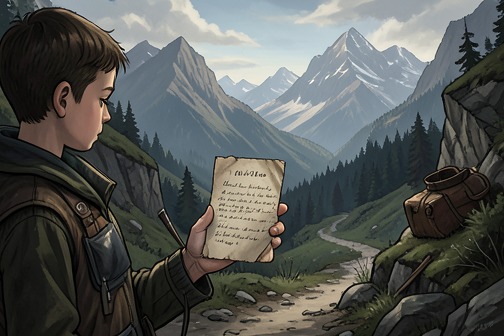
Éri’s flight from the Pioneers at the age of ten brought a silent, isolated child to the Master’s door and began seven years in which she had no contact with her parents. Recalled by the Master to [Tengo](entity:character-recall-character-tengo-207999a29189), the episode joins a practical act of escape to the community’s deepening secrecy, while the story Éri later told of a blind goat and the [Little People](entity:character-recall-character-little-people-85335adb85e4) gives her departure a darker, uncanny background.
## Departure and arrival
Éri appeared unexpectedly at the Master’s home when she was ten. Once taciturn and distant with strangers, she had previously spoken freely with the Master, whom she had known since early childhood. On arrival, however, she could no longer speak: when addressed, she could only nod yes or no. Her changed manner made plain that something grave had happened, though the Master did not claim to know precisely what.
Her journey to the house was difficult. She had a little money and a piece of paper bearing the address, and had been raised in an unusually secluded environment; despite being unable to explain herself, she managed to make the necessary connections between different forms of transport and reach the mountain. The small scrap of paper was both her practical guide and the only evidence of a destination she could pursue without words.
A woman who helped in the household and the Master’s daughter, [Azami](entity:character-recall-character-azami-48fd74301ddc), cared for her. When Éri had become calmer after a few days, the Master called the Pioneers and asked to speak with [Fukada](entity:character-recall-character-d944f2bce67d). He was told that Fukada could not speak at that time. The same answer followed when he asked to speak with Fukada’s wife; no explanation was offered for either parent’s unavailability. The Master chose not to disclose that Éri was with him until he could speak directly with Fukada, and later attempts to make contact through other means also failed.
## Silence, shelter, and separation
The Master did not press Éri to explain what had happened or force her to open up. He judged that she needed time, and acted as though her silence did not alarm him. Though she seemed neither frightened nor visibly distressed, she adapted to the household more easily than he had expected. She was intelligent and listened attentively to what he told her; apart from her inability to speak, their life together brought no obvious difficulty.
Azami became Éri’s constant companion. After returning from school and finishing their meal, the two girls would shut themselves in their room together. The Master did not know what they did or whether they conversed, and deliberately did not intrude. Éri did not attend school: as long as she could not utter a word, sending her there seemed impossible. The household therefore gave her a place to live without demanding an account of her past, while her closest connection there formed in private, through her inseparability from Azami.
Her parents did not contact her during the seven years she lived with the Master. Nor did they ask him what had become of her, although, as he emphasized to Tengo, the Fukadas had loved Éri deeply and regarded her as their most precious possession. They had broken with their own families, and Éri had grown up without knowing her grandparents; in the Master’s understanding, his home was the only place where she could have been helped. Her parents had even told her that she could go there if necessary. Their complete silence after her arrival is therefore not a simple absence of a known refuge: it is a striking contradiction between the refuge they had designated and their failure to seek news once she reached it.
## The community behind the flight
The Master’s account places Éri’s departure amid a broader withdrawal by the Pioneers from the outside world. Before her flight, Fukada’s long letters to the Master—once full of community events and personal feeling—began arriving late and then stopped. The Master’s own letters went unanswered, telephone calls became difficult to complete, and when Fukada did speak, the brevity and abruptness of his replies suggested that someone might be listening. When the Master later tried to reach both parents after Éri’s arrival, neither could be reached or allowed to speak.
The timing does not, in the Master’s view, establish that Éri fled because of the armed conflict involving the dissident L’Aube, which had led to that community’s dissolution in [1981](entity:time-recall-time-1981-16063b32b4e5). He says that her coming to his home was, at least for the moment, unrelated to those troubles. The distinction matters: the flight is set against the wider history of conflict and increasing enclosure, but its immediate cause remains undisclosed. The narrative preserves the gap between what can be established—the child’s arrival, her silence, and her parents’ inaccessibility—and what the adults cannot explain.
## The blind goat and [Air Chrysalis](entity:concept-recall-concept-04ca3e0fd671)
Tengo encounters another account of Éri’s childhood in Air Chrysalis, whose central girl is evidently modeled on Éri herself. At ten, the girl lives in a strange mountain commune and is assigned to watch an old, blind goat, an animal treated as important to the community. She is repeatedly told not to take her eyes off it. When the goat dies after she neglects her duty, the community punishes her by locking her for ten days in an old earthen storehouse with its corpse, cut off from everyone and forbidden to leave or speak with anyone.
In the story, the goat serves as a passage between this world and the world of the Little People. They enter through its corpse after nightfall and depart again at dawn. The girl can speak with them, and they teach her how to make an Air Chrysalis. Tengo is struck by the precision with which the goat’s habits and behavior are described. He cannot tell whether Éri truly lived in a mountain community or actually tended such an animal, but he considers it possible; if the experience was invented, he thinks, the narrator must possess extraordinary talent.
The book’s account of her flight and the tale in Air Chrysalis remain related but not interchangeable. The Master recounts the real-world circumstances of a child arriving at his house, while Tengo reads a fictional narrative whose details may draw on Éri’s life. Together, they place separation and silence beside an image of punishment and passage: in the story, the child is confined with the dead goat, yet that same animal opens a route between worlds. The novel does not resolve the mysteries surrounding Éri’s departure, but it shows how a hidden childhood can surface indirectly, transformed into a story whose vividness exceeds what its reader can verify.
Event 20
Le récit de La Chrysalide de l’air par Éri
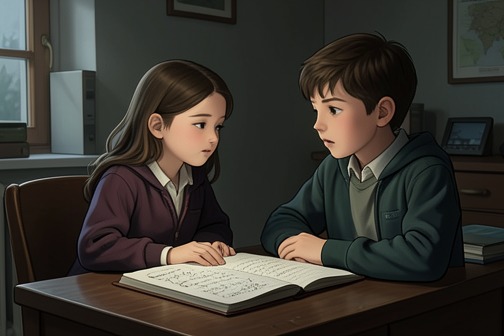
Eri’s account of [Air Chrysalis](entity:concept-recall-concept-04ca3e0fd671) is the story Eri tells [Azami](entity:character-recall-character-azami-48fd74301ddc) after coming to live with her and the Master. As Azami records and transcribes it, the tale of a blind goat, a child’s confinement, and the [Little People](entity:character-recall-character-little-people-85335adb85e4) becomes more than a mysterious narrative: its telling coincides with Eri’s partial recovery from emotional withdrawal, though neither the Master nor [Tengo](entity:character-recall-character-tengo-207999a29189) can establish whether its events are literal memories.
## The account takes shape
After Eri arrived at the Master’s home, she spoke little and did not attend school. The Master did not press her to explain what had happened to her, and allowed her to spend long stretches alone with Azami, who had become her closest companion. Their private conversations remained their own; he suspected that, at some point, they began to center on the story Eri later called Air Chrysalis.
Azami wrote down or recorded Eri’s telling, then transcribed it on the word processor in the Master’s study. The account therefore passed from Eri’s speech through Azami’s recording and into a written text. The Master did not know exactly what the girls did in their room, and the narrative preserves that boundary: the story’s emergence is reconstructed from what he observed and inferred, not from direct access to their conversations.
## A child, a goat, and a passage between worlds
In the story, Eri is ten and lives in a mountain commune where every child has an assigned task. Her responsibility is to watch over an aged, blind goat that matters greatly to the community. She has repeatedly been told not to take her eyes off it. One day, through carelessness, she fails in that duty, and the goat dies.
The community punishes the child by shutting her in an old earthen storehouse with the goat’s corpse for ten days. She is isolated from everyone and forbidden to leave; no one is allowed to speak to her. The punishment turns her assigned act of care into a period of enforced confinement, placing the child alone with the dead animal on which the community’s beliefs depend.
The goat, Eri says, serves as a passage between this world and the world of the Little People. At night they travel through its corpse to enter this world, and at dawn they return to the other side. Eri can speak with them, though neither she nor Tengo can tell whether they are good or evil. They teach her how to make an Air Chrysalis, binding the child’s experience of isolation to an encounter that exceeds ordinary explanation.
## Telling and partial recovery
The Master recalls that Eri had seemed emotionally indifferent when she first came to his home, though she adapted readily. He gave her time rather than demanding disclosure; she remained close to Azami, and, apart from her silence, their life together presented no particular difficulty. Eri’s account thus takes shape within a household that makes room for silence without knowing what lies behind it.
The Master observes a change as Eri begins telling the story. The emotional indifference that had seemed to surround her like a membrane recedes, expressions return to her face, and she becomes more like the Eri he had known before. When Tengo asks whether this marks the beginning of her recovery, the Master agrees, but qualifies the answer: she recovers only in part, and the connection between telling the story and that improvement remains his considered belief, not a complete explanation.
## Text, experience, and uncertainty
Tengo, while rewriting the account, is struck by the precision with which it describes the blind goat’s habits and behavior. Those details give the whole text a vividness that makes him wonder whether Eri really cared for such a goat and lived in a mountain community like the one she describes. He allows that she may have done so; if not, the narrator would need exceptional talent to make the experience feel so exact.
That uncertainty is central to the account’s force. The Master can describe how the story was recorded and what changed in Eri, but cannot report what she and Azami said in private or verify the world the story depicts. The account reaches the reader through several distinct layers—Eri’s speech, Azami’s transcription, and Tengo’s scrutiny of the manuscript—while its possible basis in lived experience remains unresolved. Its imaginative world is also structured by passage and enclosure: the goat’s corpse connects two worlds, while the storehouse seals a child away from her community. The story’s telling opens a channel back toward feeling, without making the experience that produced it fully knowable.
Event 21
La réécriture de La Chrysalide de l’air par Tengo
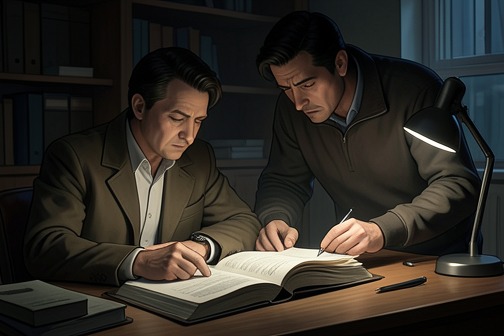
[Tengo](entity:character-recall-character-tengo-207999a29189)’s rewrite of [Air Chrysalis](entity:concept-recall-concept-04ca3e0fd671) is the point at which an attempt to reshape [Fukaeri](entity:character-recall-character-02de2a3e1012)’s story becomes an irreversible literary undertaking. The Master authorizes the work because Fukaeri trusts Tengo, and [Komatsu](entity:character-recall-character-komatsu-04b9166b2f49) later confirms that the revised manuscript has already gone to the printers and entered preparations for the Newcomer’s Prize. Their collaboration gives the story a public future, while its impossible image of two moons remains a precise, still-unfinished challenge for Tengo as a writer.
## Authorization and Trust
Tengo seeks a clear answer from the Master: permission to rewrite Air Chrysalis. The question is not merely whether the manuscript can be improved. The Master has spent seven years trying to learn what happened to Fukaeri among the Pioneers and what became of the Fukadas, and he hopes the story may contain a key to those unresolved questions. He cannot promise that Tengo has the necessary ability, but recognizes that Tengo has valued the story and immersed himself in it. That attention, rather than credentials, supports his request.
The Master says yes and gives Tengo freedom over the work, while asking to read the revised version. His authorization rests in part on Fukaeri’s confidence: she trusts Tengo, the Master says, and trusts no one else apart from [Azami](entity:character-recall-character-azami-48fd74301ddc) and himself. The permission therefore carries a double weight. Tengo receives room to alter the story, but that freedom is entrusted to him by people for whom the manuscript is connected to a concealed past, not simply a literary exercise.
The decision is marked by a heavy silence. Fukaeri brings tea just as the conversation ends, as though she had waited for the men to finish. The scene gives the authorization a quiet finality: once the Master has agreed, Tengo returns alone, while Fukaeri is out walking the dog. The practical journey back toward [Futamatao](entity:location-recall-location-futamatao-ffd2dfcb5a9d) and the Chuo Line follows a decision that will soon prove difficult to reverse.
## From Private Revision to Submission
When Tengo later meets Komatsu, the editor recognizes both the strain and the result. Tengo says that the ten days spent on the work left him unsure whether he was alive or dead; Komatsu replies that he has secured Fukaeri’s guardian’s consent and rewritten the novel successfully. He praises the achievement, admitting that he had underestimated Tengo, who had managed the task despite living apart from the literary world.
Komatsu’s praise is not the same as a declaration that the manuscript is finished in every respect. He calls the rewrite close to perfect and says it is already good enough for the Newcomer’s Prize. If it wins, Tengo can make further revisions before publication in the magazine. The distinction matters: the work has passed into the machinery of publication, yet a final opportunity to refine it remains.
That opportunity is narrow because the manuscript is already at the printers. Komatsu explains that proofs are being prepared and will then go to the editor-in-chief, the director of publications, and the four members of the jury. He rejects the idea of simply restoring the original manuscript: the text has already entered a process involving readers and decision-makers beyond the two collaborators. When Tengo sighs, Komatsu frames the situation as one in which time cannot be turned back. He takes responsibility for what follows and proposes keeping Fukaeri’s public appearances to a minimum if the novel wins, presenting her as an enigmatic young author who refuses to appear in public. His confidence in managing publicity contrasts with the more exposed position of the manuscript itself.
## The Two Moons and the Craft of Description
Komatsu’s sole requested revision concerns the scene in which the [Little People](entity:character-recall-character-little-people-85335adb85e4) make an Air Chrysalis. In Tengo’s version, the little girl looks up and sees two moons. Komatsu does not object to the event; he objects to the amount of description it receives. Readers are accustomed to seeing one moon, he argues, and have never seen two. A familiar object can be left largely undescribed, but an image without a counterpart in the reader’s experience requires precise, detailed presentation.
Tengo accepts the reasoning and agrees to develop the passage. The exchange turns the doubled moon into more than an arresting detail in the plot: it becomes a formal problem the rewrite must solve. The image is strange enough to unsettle ordinary perception, but the prose cannot rely on strangeness alone. To make the scene legible, Tengo must give readers enough concrete description to imagine what the girl sees. The editor’s demand links the novel’s extraordinary occurrence to the ordinary discipline of writing.
Komatsu says that after this change the manuscript will be perfect and raises no other objection. His confidence makes the requested passage appear small in relation to the rewrite as a whole, but its significance is concentrated: a single unfamiliar sight tests whether the revised story can carry its readers beyond what they already know without leaving them unable to picture it.
## Consequences and Significance
The rewrite brings together literary judgment, trust, and the practical consequences of publication. The Master’s permission enables Tengo to alter a story associated with Fukaeri’s past; the revised manuscript then moves beyond private hands, toward printers, prize jurors, and possible magazine publication. Komatsu can limit Fukaeri’s exposure and handle the public presentation, but he cannot retrieve the manuscript from the process already underway. The moment of consent has become a commitment with consequences neither editor nor writer can simply undo.
The episode also distinguishes two kinds of uncertainty. The Master hopes the story may illuminate the unresolved history of Fukaeri and the Fukadas, but the evidence here does not establish that the rewrite answers those questions. At the level of craft, however, Komatsu gives Tengo a definite problem and Tengo accepts it: the two moons need fuller description. The manuscript thus remains open to revision even as its route toward publication becomes fixed. Its central tension lies in that combination: the story may hold a key to a hidden past, while its most visibly impossible image must be made exact enough for readers to see.
Event 22
La vengeance d’Aomamé contre l’agresseur de Tamaki
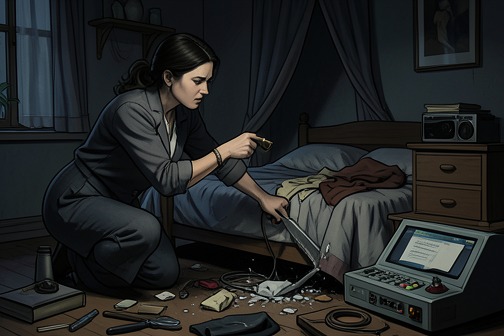
[Aomamé](entity:character-recall-character-aomam-6f0ef39c7aa1)’s revenge against [Tamaki Ootsuka](entity:character-recall-character-tamaki-ootsuka-4701f12fc877)’s assailant is a calculated act of destruction undertaken after Tamaki refuses to report her sexual assault. Rather than seek punishment through official channels, Aomamé breaks into the young man’s room and methodically ruins nearly everything in it, making the space a material answer to the humiliation and powerlessness inflicted on her friend.
## Background and Stakes
Aomamé understands the assault as more than Tamaki’s loss of virginity: it has violated her dignity and left her with a lasting sense of powerlessness. She urges Tamaki to report the man so that he might face some form of punishment, but Tamaki declines. She blames herself for having gone alone to his room and thinks a complaint would now be pointless; perhaps, she says, she will eventually forget what happened.
Tamaki’s refusal does not persuade Aomamé that the harm can simply be left behind. She knows how deeply the assault has wounded her friend, and regards the enduring powerlessness it caused as something that can eat away at a person. Her decision to punish the man herself grows from this conviction: Tamaki may not seek redress, but Aomamé will not treat the injury as inconsequential.
## Planning and Entry
Aomamé gets the assailant’s address from Tamaki and goes to his room carrying a softball bat concealed in a large plastic tube used for industrial drawings. She chooses a day when Tamaki is away in Kanazawa for a relative’s memorial, so that her friend will have an alibi. Aomamé also makes sure beforehand that the young man will be absent.
She forces the door lock with a hammer and screwdriver, then wraps the bat in several towels to keep the noise down. The preparations make the episode less a sudden outburst than a controlled operation: she selects the time, accounts for Tamaki’s exposure to suspicion, checks that the target is away, and takes care to limit the sound of the attack.
## The Destruction
Inside, Aomamé systematically smashes whatever she can. The television, floor lamp, alarm clock, records, toaster, and vases are among the objects she breaks; she also cuts the telephone wires with scissors. She opens and tears books and scatters their pages, empties toothpaste and shaving-cream tubes onto the carpet, and pours sauce over the bed.
The damage extends beyond conspicuous breakage. Aomamé tears notebooks from drawers, snaps pens and pencils, breaks light bulbs, slashes curtains and cushions with a knife, and cuts every shirt in the wardrobe to pieces. She smears ketchup on underwear and shoes, removes the refrigerator fuses and throws them out the window, breaks the toilet’s flush stopper, and crushes the showerhead. The accumulation is exhaustive: the room is not merely damaged but rendered unusable in detail.
## Consequence and Significance
The room’s final appearance is compared to a Beirut street after a bombardment, as seen in newspaper photographs Aomamé had encountered some time earlier. That comparison gives the private wrecking a stark, warlike scale, while the painstaking inventory of domestic objects keeps the violence concrete. Everyday things that ordinarily support a private life become the targets and evidence of its deliberate disruption.
The episode offers no indication that Aomamé reports the assault or secures a formal consequence for the man. Its immediate consequence is instead the destruction she carries out in his absence, with Tamaki protected from being present and provided with an alibi. In the contrast between Tamaki’s self-blame and Aomamé’s uncompromising intervention, the act registers both the limits of the remedy Tamaki is willing to pursue and Aomamé’s refusal to accept the assault as something her friend should simply forget.
Event 23
Le suicide de Tamaki Ootsuka
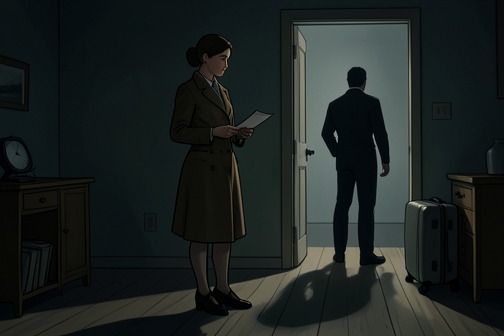
[Tamaki Ootsuka](entity:character-recall-character-tamaki-ootsuka-4701f12fc877)’s suicide, after prolonged abuse by her husband, is both a death concealed by a public account of domestic normality and the rupture that redirects [Aomamé](entity:character-recall-character-aomam-6f0ef39c7aa1)’s life. The final letter Tamaki sends her friend exposes the isolation behind the marriage and Aomamé’s inability to reach her in time; grief gives way to a decision to punish the man she believes may harm someone else.
## Background and concealed abuse
The violence began early in Tamaki’s marriage and worsened over time. Her husband was violent and sadistic, and his behavior approached paranoia. Tamaki found herself unable to leave, as though trapped in a nightmare, and did not tell Aomamé what was happening. She expected that Aomamé, who had warned her against the marriage, would urge her to leave immediately. That advice, however, could not make escape feel possible to Tamaki.
The abuse was not wholly unknown to those around her. Tamaki’s parents were more or less aware of her situation, and the police inferred something from the state of her body. Yet the circumstances never became public. Her husband was away on a business trip in Hokkaido when she died; since her death was treated as a suicide and he was not present at the time, he faced no criminal charge. Tamaki’s younger brother later disclosed this account to Aomamé in confidence, supplying the truth that the public explanation had suppressed.
## Death and the false account
Tamaki died at home in late autumn, three days after her twenty-sixth birthday. The wind was strong that day. She hanged herself and was discovered the following evening, when her husband returned from his business trip. He told the police that there was no problem in their household, that he had never heard her complain, and that he could not understand why she had taken her life. Her parents gave the same account. Their statements concealed the sustained abuse behind the appearance of a marriage without warning signs.
In the final days before her death, Tamaki wrote Aomamé a long letter. She began and ended by admitting that she had been wrong from the beginning and that Aomamé had been right. She described daily life as unbearable and herself as unable to escape, even unsure where she could go if escape were possible. She understood her entrapment as something she had entered and locked herself into; she also believed that the deeper problem lay within her, not only in her husband or marriage. This self-blame coexisted with her plain recognition that marrying him had been a mistake.
The letter also made clear how singular Aomamé’s place in Tamaki’s life had been: she named her as her only friend and the one person in whom she had been able to trust. She asked Aomamé to remember her and imagined that they might have played softball together forever. That wish looks back to their shared friendship and to an ordinary future that the letter can no longer make possible.
## Aomamé’s missed arrival and response
After reading the letter, Aomamé trembled and repeatedly tried to call Tamaki’s home, but each attempt reached a recorded message. She took the train to Tamaki’s house in Okusawa, in Setagaya Ward. The large residence stood behind a high fence. Aomamé rang the gate intercom and received no answer; only a dog barked. She left without knowing that Tamaki was dying inside at that very moment. The phone and entrance chime rang unanswered in the silent house, making Aomamé’s attempted contact a final, unwittingly futile approach.
When Aomamé later learned that Tamaki had died, she was hardly surprised; somewhere in her mind, she had expected it. She did not experience immediate sadness. Instead, she cut off the telephone and sat down, then remained there as time passed and she felt emptied of her bodily fluids. She did not get up for a long while. She told her workplace that she was unwell and would take several days off, shut herself in, and barely ate or slept, drinking only a little water. She did not attend the funeral.
## Consequences and significance
Aomamé understood the death as an inward rupture: something in her had broken and been replaced, and she had crossed a boundary after which she would not be the same. The contrast between her apparent efficiency—turning off the phone, sitting down, arranging leave—and the prolonged withdrawal that followed gives the aftermath its shape. Her response does not undo the missed visit or restore the friendship; it marks how decisively the loss has altered her.
Aomamé’s next thought turns grief toward action. She decides to punish Tamaki’s husband, reasoning that unless he is made to face an ending, he will repeat his behavior against someone else. The resolution makes Tamaki’s concealed suffering consequential beyond the household: what was publicly left without a criminal charge becomes, for Aomamé, the cause of a private pursuit of retribution. The episode also joins friendship to belated knowledge: Tamaki’s final testimony reaches the person she trusted, but only when she can no longer be helped.
Event 24
La rupture de Tengo avec son père
[Tengo](entity:character-recall-character-tengo-207999a29189)’s rupture with his father begins with a child’s carefully considered refusal: he will no longer spend every [Sunday](entity:time-recall-time-95868a7bbce2) accompanying his father on [NHK](entity:organization-recall-organization-nhk-a202b57000ac) fee collections. The confrontation brings anger, a brief departure from home, and the intervention of a teacher; its lasting result is not a complete break but Tengo’s first practical claim to independence. The episode establishes the cost of opposing his father and the importance of turning that opposition into an enforceable right.
## Background and decision
By the time Tengo was in the fifth year of primary school, he had thought for a long time about the Sunday routine. He told his father that he wanted to use the time to study, read, go out, and have fun. His request was modest in form but fundamental in meaning: he wanted a normal life, with personal time of his own, rather than a childhood organized around his father’s work.
Tengo kept the declaration short and explicit. He did not argue at length or try to persuade his father through a prolonged exchange. The decision had already taken shape within him; speaking it aloud made the conflict unavoidable, but did not create his resolve.
## Confrontation and departure
His father reacted with anger and rejected the idea that other families’ arrangements had anything to do with their household. He challenged Tengo’s understanding of a normal life and insisted on the family’s own rules. Tengo remained silent, convinced that further explanation would not make his father understand. His father then threatened to stop feeding him and ordered him out.
Tengo packed his belongings and left the house. The departure was not a sudden surrender to his father’s anger: he had decided in advance to make his refusal, and the order to leave felt like permission to escape a cage. Although his father might have become violent, he did not do so. Still, a ten-year-old could not live alone, and Tengo had no place to sleep that night. The episode therefore tests his resolve against the immediate vulnerability of his age and circumstances.
## The teacher’s intervention
After school, Tengo explained his situation to his classroom teacher, including both his lack of anywhere to sleep and the burden of accompanying his father on Sundays. She listened, understood how he felt, and offered him a place for the night. He slept on her living-room sofa under blankets; the next morning, she made him breakfast. That evening she took him back to his father’s home and spoke with him directly.
Tengo did not hear their conversation and never learned what passed between them. Its outcome, however, was clear: his father had to yield. The fact that a ten-year-old could not simply be left on the street, together with the parents’ legal duty to support their children, constrained the father’s attempt to make obedience the only option. The teacher’s intervention turned Tengo’s private protest into a negotiation with practical consequences.
## Outcome and significance
The settlement gave Tengo Sunday mornings for helping at home and left him free to do as he wished for the rest of the day. His father was irritated and did not speak to him for a time, but Tengo regarded that silence as a minor retaliation beside what he had gained. He had secured a specific right, not merely expressed a wish: this was the first victory he won over his father and his first step toward freedom and independence.
The event is a rupture in the father’s control, but not a total separation. Tengo’s immediate demand concerns the Sunday collections, and the negotiated result preserves a household obligation in the morning while opening the afternoon to his own choices. Its significance lies in that concrete change. The scene also sets the father’s insistence on a distinct family rule against the teacher’s willingness to listen and the legal duty that ultimately limits his authority. For Tengo, independence begins neither with a grand escape nor with reconciliation, but with a bounded right he has made possible by refusing silence.
Event 25
Aomamé发现天空中出现两个月亮
[Aomamé](entity:character-recall-character-aomam-6f0ef39c7aa1) discovers two moons in the night sky while staying with [Ayumi](entity:character-recall-character-ayumi-f92e71bf4813), and the sight becomes the clearest evidence yet that the reality she knows has shifted. The revelation begins as a small discrepancy, not a dramatic rupture: beside the familiar yellow moon hangs a second, smaller one, green and irregular. When the pair remains in the sky the next night, Aomamé can no longer dismiss the anomaly as a momentary visual mistake; she must reckon with the possibility that either the world or she herself has changed.
## The First Sighting
After Ayumi has fallen completely asleep, Aomamé leaves the bed and settles on the small balcony. She drinks mineral water, sits in an aluminum chair, and looks out over the city on a peaceful spring night. The traffic murmurs in the distance like an artificial sea, while the neon lights have thinned after midnight. Against this quiet, ordinary scene, she senses that something in the night sky is different.
Her attention wanders through memories of Tamaki: the time they spent together, their exchanges, and their caresses. Then the difference in the sky registers. It is subtle but unmistakable, although she needs time both to identify it and to accept what she is seeing. Her consciousness can take in the changed view before it can make sense of it.
There are two moons: the large, nearly full yellow moon she has always known, and a smaller moon with an unusual, slightly distorted outline, colored a tender moss green. The new object does not replace the familiar moon; it hangs beside it. The pairing makes the change legible through contrast: the old celestial landmark remains recognizable, while its green companion makes the sky irreducibly unfamiliar.
## Testing What She Sees
Aomamé narrows her eyes and studies the moons, then closes them, waits, breathes deeply, and looks again. She hopes the second moon will disappear and the sky will return to normal. It does not. The two lights remain side by side, one yellow and one green. She rules out a diffraction of light and a change in her eyesight, but the checks cannot explain the sight itself.
She considers waking Ayumi to ask whether she sees the same thing. Either answer seems to leave the central problem unresolved: if Ayumi sees two moons, Aomamé would still have to make sense of their presence; if Ayumi sees only one, she would have to question her own vision. Rather than transfer the uncertainty to her sleeping companion, Aomamé keeps watching alone.
With her chin in her hands, she concludes that something is happening. Her heart beats faster as the question opens in two directions: perhaps something has happened to the world, or perhaps it has happened to her. The sight changes the terms of her uncertainty. It is no longer simply an obscure unease about whether reality is different; it is a persistent fact before her eyes that demands an explanation.
## The Second Night
The following evening, the two moons are still there. The large moon has an unusual whiteness, as though it has passed through a mountain of ash, yet otherwise remains the familiar moon. Aomamé’s thought reaches back to the summer of 1969, when Neil Armstrong took his first step on it. Beside that old point of reference, the little green moon appears deformed and almost sheepish, like a guilty child beside its larger companion.
The recurrence matters: the sight has survived the passage of a day and cannot be contained as a transient impression from one sleepless night. Aomamé reasons that if the moon had suddenly split in two, the tides and other aspects of life on Earth would have changed, and everyone would be talking about it. The absence of such public recognition does not settle the question. Instead, she considers a more disquieting alternative: perhaps information has somehow escaped her awareness.
## Reality or Perception
Aomamé asks herself whether she is mad and whether she can be completely certain that she is not. Her doubt is not resolved by simply trusting her eyes: the sight persists, but its persistence does not explain why nobody else appears to have noticed a second moon. Nor can she easily assume that the whole world has changed when ordinary life gives no corresponding confirmation.
She has already noticed curious events and changes occurring without her knowledge. In that context, she imagines the world playing a game of “1, 2, 3, sun,” changing while her consciousness is asleep. The green moon may have appeared from somewhere in the universe and settled into Earth’s gravitational field during just such an interval. This is speculation, not an established account of the moon’s origin, but it gives form to her fear that the world can alter without warning and without her participation.
## Significance
The discovery turns a visual anomaly into a crisis of orientation. The familiar moon anchors Aomamé’s memories and assumptions; the smaller green one sits beside it as an unmistakable breach in that familiar order. Her repeated tests establish that she is not casually mistaking a flash of light for a second body, while her reasoning about the tides and public attention shows why the evidence remains disturbing rather than reassuring.
The event’s force lies in its unresolved alternative: reality may have changed, or Aomamé’s relation to it may have changed. The next-night recurrence intensifies rather than answers the question. Two moons therefore become the concrete sign of a world whose alterations may precede awareness, and of a witness who cannot yet tell whether the rupture belongs to the sky or to herself.
Event 26
Aomamé Joins the Dowager’s Secret Operation
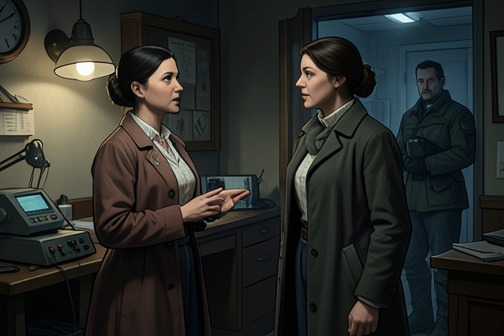
[Aomamé Joins the Dowager’s Secret Operation](entity:event-recall-event-834d4b65807e) marks the change from private confidence to shared, clandestine action. After [Aomamé](entity:character-recall-character-aomam-6f0ef39c7aa1) discloses the secret she has long kept to herself, the Dowager reveals that she, too, has arranged for a man to disappear. She then asks Aomamé to become a trusted collaborator in a mission intended to answer harm that ordinary institutions may not be able to address. Aomamé agrees, though the account leaves open whether the mission is justice, something close to madness, or both.
## From Confession to Proposal
The turning point begins in the room where Aomamé has previously spoken with the Dowager. Recalling that conversation, Aomamé recognizes how difficult it had become to live alone with the burden she carried. When the Dowager encouraged her to speak, she opened a secret she had kept closed for a long time. The disclosure matters not merely as new information between them: it creates the conditions for the Dowager to answer in kind.
The Dowager says that, by an unusual coincidence, she has also made a man disappear for similar reasons. She clarifies that she did not carry this out personally. Instead, she used means available to her and says that no concrete evidence remains. Even a confession, she believes, would not be provable. Her account establishes a parallel with Aomamé’s experience while distinguishing their methods: both have acted outside ordinary justice, but the Dowager’s role has been indirect.
## A Case for Acting Outside the Law
The Dowager frames her proposal around loss and the lasting psychological wounds left by absurd or unjust circumstances. Such wounds, she says, may never fully heal, but people cannot remain forever fixed on them; they must get up and take the next action. She distinguishes this purpose from individual revenge, presenting the work instead as an attempt to practice real justice.
That distinction does not remove the legal or moral risk. The Dowager imagines being judged by the gods after death, but says she is unafraid because she considers her reasons defensible and is prepared to state them openly. Her confidence contrasts with the covert nature of the operation: she claims moral accountability while relying on actions that leave no concrete proof. The story does not resolve that tension for the reader.
## Aomamé’s Decision
The Dowager asks for competent people she can trust: collaborators able to share secrets and accompany her in the mission. Aomamé does not accept immediately. She needs time to put the Dowager’s story in order and absorb both its difficult confession and the proposal that follows. The Dowager waits silently and watches her, appearing in no hurry to force a decision.
Aomamé finally agrees to help as best she can. The Dowager reaches out and clasps her hand. That gesture formalizes a new arrangement: Aomamé will share the Dowager’s secrets and mission, which the narration describes as approaching madness—perhaps being actual madness. Aomamé cannot identify where that boundary lies. Nevertheless, she judges that the people the two women have sent into a distant world did not deserve to be spared. Her acceptance is therefore neither uncomplicated faith in the Dowager nor a claim that their actions are lawful; it is a decision made with the stakes and ambiguity still present.
## The Operation’s Moral Context
Aomamé’s account of an abusive husband helps explain the social conditions against which the Dowager’s project takes shape. He appears amiable to neighbors, while his violence at home is concealed; Aomamé observes that a wife who complains may not be believed, and that the husband knows how to avoid leaving visible signs. The contrast is between a respectable public image and harm hidden in private, where social recognition and protection can fail.
The same problem of failed protection appears in the Dowager’s concerns about children within the Pioneers. She says a doctor considered reporting a particularly grave case to the police, but she persuaded him not to do so. In her view, a child who speaks very little may not be able to explain what happened, and any account might be difficult to verify. A police intervention could send the child back to the parents, who retain parental authority despite what they allowed; the harm might then recur. The Dowager presents this as a reason formal intervention may expose a vulnerable person to further danger, not as proof that every alternative she chooses is justified.
Information from teachers extends the concern beyond one child. Some children in the group stop attending the local primary school, despite compulsory education; the group says that it educates them itself. Teachers report that many children initially seem cheerful and ordinary, then grow quieter and increasingly withdrawn as they get older, until they stop going to school. The Pioneers refuse outsiders access to their grounds, leaving teachers unable to see what happens to children who become enclosed within the community. These reports give the Dowager’s concern a broader institutional context: both private households and a closed religious community can make abuse difficult to observe, substantiate, or prevent.
## Significance and Limits
The joining of Aomamé and the Dowager turns shared knowledge into shared responsibility. The Dowager offers a framework of justice shaped by the failure of ordinary safeguards; Aomamé brings her own experience and agrees to take part, without pretending that the moral boundary is clear. Their clasped hands conclude the decision, but not the ethical dispute. The event establishes the operation as a response to hidden harm and failed protection while preserving the disturbing uncertainty of whether its methods can be reconciled with its stated purpose.
Event 27
The Dowager’s Daughter Dies by Suicide
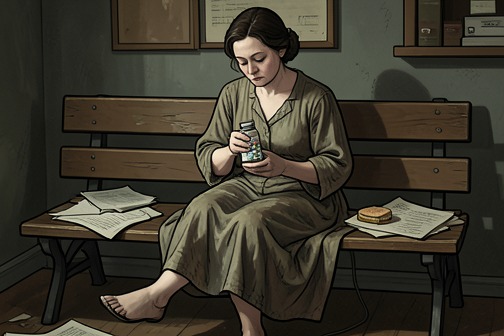
[The Dowager’s Daughter Dies by Suicide](entity:event-recall-event-df64a50146b5) is the private family tragedy that shapes the Dowager’s response to abused women and girls. Her daughter died after enduring severe domestic abuse, and the Dowager later confides to [Aomamé](entity:character-recall-character-aomam-6f0ef39c7aa1) that she had been six months pregnant. The disclosure links the daughter’s death to the present danger surrounding [Tsubasa](entity:character-recall-character-tsubasa-7d098a0debb5), while revealing the personal grief behind the Dowager’s determination to protect her.
## Marriage and Abuse
The Dowager explains that her daughter married a man she recognized as a harmful partner, but no one was able to prevent the marriage. The husband’s conduct became seriously abusive. Over time, the daughter lost her self-respect and confidence, fell into depression, and could not regain her independence or escape the situation. Her death followed this prolonged erosion of agency: she took a large quantity of sleeping pills with whisky.
The aftermath did not bring public accountability. An autopsy documented evidence of repeated abuse, but the husband told police that the violence had been consensual and part of a sexual game. The police assigned him no criminal responsibility. He had social standing and a capable lawyer, the daughter had never filed a complaint, and her death was classified as suicide. The contrast between what the Dowager knew of the marriage and what the authorities could or would establish leaves the abuse effectively unanswered by the law.
## A Second Life Lost
When the Dowager finally tells Aomamé what she had kept to herself, she reveals that her daughter was six months pregnant when she died. She believes the daughter may not have wanted to give birth to the husband’s child. The suicide therefore ended not only her daughter’s life but also the life of the fetus. The Dowager says that she lost two precious lives at once; the child, had it been born, would have been the same age as Tsubasa.
This concealed fact gives the death a particular weight in the present. The Dowager’s account of Tsubasa’s abuse includes the doctor’s assessment that the girl’s reproductive capacity had been irreparably harmed. The Dowager insists that no one’s worth is defined solely by pregnancy or childbirth, but that violently taking away a woman’s ability to choose whether to have a child is intolerable. Her daughter’s pregnancy and death make that judgment personal without making it, she tells Aomamé, a reason to expose her to unnecessary danger.
## Disclosure and Protection
The story of the daughter’s death emerges in a conversation about the risks of reporting Tsubasa’s abuse. The Dowager explains that the child can barely speak and might not be able to describe what happened; even if she gave information, it could be difficult to verify. The authorities might return her to her parents, who retain parental authority despite what they had allowed to happen, putting her at risk of further harm. The Dowager therefore regards protecting Tsubasa from that outcome as essential.
Against this account, the Dowager’s confession is an act of trust. She tells Aomamé that she has never shared the fact of the pregnancy because speaking about it was too painful, then reassures her that her personal history will not distort her judgment or lead her to endanger Aomamé. She calls Aomamé a precious daughter and says they have already become a family. The disclosure turns private bereavement into the basis of an intimate bond, while explaining why the Dowager’s protection of Tsubasa is resolute rather than abstract.
## Significance
The daughter’s suicide is narrated retrospectively, through the Dowager’s account, and its circumstances echo the fate of [Tamaki Ootsuka](entity:character-recall-character-tamaki-ootsuka-4701f12fc877): both women endured abusive marriages, and in both cases the husband escaped criminal responsibility. That parallel makes the daughter’s story part of a pattern of violence that private knowledge can expose even when formal procedures do not secure justice.
The episode also distinguishes bodily autonomy from any claim that motherhood is a woman’s sole purpose. The Dowager explicitly affirms each woman’s freedom to choose while condemning the violent removal of that choice. Her daughter’s death, disclosed only after years of silence, thus informs both the ethical language of the conversation and the practical choice to shelter Tsubasa rather than risk returning her to an unsafe home.
Event 28
Tsubasa Escapes the Pioneers and Finds Shelter
[Tsubasa](entity:character-recall-character-tsubasa-7d098a0debb5)’s escape from the Pioneers brings a ten-year-old survivor of sexual abuse to the Dowager’s safe house, where she is given protection after fleeing not only the community but also parents who enabled what was done to her. Her rescue reveals how the Pioneers’ language of spiritual advancement conceals sexual violence, and makes the safe house a refuge beyond the reach of the family and religious authority that failed her.
## Escape and Arrival at the Safe House
Tsubasa reaches the safe house after a journey through homelessness and silence. Six weeks before [Aomamé](entity:character-recall-character-aomam-6f0ef39c7aa1) learns her story, a women’s consultation office had referred her to the Dowager. She had been sleeping in a railway station; after being sent from place to place, she arrived in a wretched condition and unable to speak. At first she seemed absent, as if she had lost the use of speech altogether. The Dowager spent time reassuring her that the house was safe and that she did not need to be afraid. Only gradually did Tsubasa begin to say a few words, confused and disconnected ones from which the Dowager pieced together what had happened.
The refuge is a small, old, one-storey wooden building on the neighboring grounds, reached through a locked garden gate. Once used to house servants, it now provides temporary shelter for women with nowhere else to go. It has ten rooms; although five or six women usually live there, at some times every room is occupied. Its function is practical, but its atmosphere underscores how little ordinary domestic life has survived for its residents: in the evening, light shows in only some of the windows, children’s voices are occasional, and a strange quiet seems to hold the house in suspension.
## The Abuse and Its Religious Cover
The Dowager tells Aomamé that Tsubasa is ten years old and that her injuries were not inflicted by a husband. The girl’s parents are known to the refuge, but they had not merely accepted the abuse: they encouraged it. Tsubasa therefore fled her parents as well as the place where the violence occurred. The disclosure turns her escape into a break with the whole structure that should have protected her, not simply an attempt to get away from one abuser.
The Dowager identifies the perpetrator as the founder of the Pioneers. He presented the assault as a means of supplying him with “spiritual stimulants,” and told Tsubasa’s parents that the rite had to take place before the girl’s first menstruation, while she was supposedly still untainted. He described the suffering as unavoidable and necessary for reaching a higher spiritual stage. The parents believed him. The Dowager also says that other girls had suffered the same abuse within the group. In her account, the religious doctrine and organization serve as convenient clothing for the founder’s sexual appetite: the language of spiritual practice does not sanctify the violence but helps disguise and enable it.
## Protection and the Dowager’s Decision
The safe house is part of a wider, privately funded response to domestic and sexual violence. The Dowager established it the year after her daughter’s suicide, adapting an otherwise vacant building to shelter women who needed immediate safety. Lawyers in [Tokyo](entity:location-recall-location-tokyo-0b4edfa3fe2f) had organized a consultation service for women facing abuse; volunteers took turns answering calls, and the office referred women in urgent danger to the house. Some arrived with young children, including girls around ten who had been sexually abused by their fathers. Residents received food and spare clothes, helped one another, and lived in a small community while waiting for a more permanent place to go. The Dowager personally paid the costs.
Lawyers and counselors visited periodically to discuss future options with residents. The Dowager also listened to women individually, offered advice, and helped them seek employment and permanent housing. When a husband found out where his wife had taken refuge and tried to force her home, [Tamaru](entity:character-recall-character-tamaru-a5e5b3f73b3f) handled the physical intervention. That network matters to Tsubasa’s rescue: shelter is not only a locked door, but a combination of listening, material support, planning, and protection from those who may try to reclaim a survivor.
Faced with Tsubasa’s case, the Dowager declares that she will take personal responsibility for the child. Whatever her parents or anyone else may do, she will not send Tsubasa home; she will hide her if necessary. Aomamé silently agrees. The Dowager’s voice trembles as she insists that the child has nowhere safer to go, and her resolve marks a clear contrast with the parents who facilitated the abuse. For Tsubasa, escape becomes more than physical flight: it opens the possibility of being believed and protected by adults outside the community that exploited her.
## The Dowager’s Justice and the Limits of Protection
The refuge’s work grows from the Dowager’s conviction that some violence cannot be left to private endurance. Years earlier, when a husband inflicted grave injuries on a victim—including three fractures and damage that might leave her deaf in one ear—the Dowager insisted that the people responsible had to be dealt with. Her response to Tsubasa belongs to the same ethic: protection requires acting, not merely recognizing suffering. The safe house offers immediate security and practical help, but the Dowager also acknowledges that she and Tamaru cannot resolve every case, and that the law sometimes offers no useful remedy.
That gap between formal justice and necessary intervention shapes the decision to protect Tsubasa. The Dowager says the founder of the Pioneers must be removed before he can injure anyone else, but cautions against haste: the response must be patient and extremely careful. Her words express a protective purpose while also revealing the severity of the measures she is prepared to contemplate. The girl’s safety is urgent, yet the Dowager’s plan is deliberately deferred until an opportunity can be taken without acting recklessly.
## Trauma, Shelter, and the Limits of Rescue
Tsubasa’s arrival does not mean that the violence has already become a story she can tell. During her first month at the safe house, she says nothing; even afterward, her words come only in confused fragments. Aomamé perceives that whatever Tsubasa understands of the conversation around her, her living emotions seem to be elsewhere, as though her heart were locked away in a distant, dark storeroom. The image echoes the literal refuge’s task: to provide a place where the child can remain safe even when she cannot yet explain what safety must repair.
The Dowager rejects the idea that Tsubasa’s parents’ knowledge makes them a source of protection. They knew what was happening and encouraged it; the girl’s escape was therefore also a flight from her family. The Dowager promises that neither her parents nor anyone else will be allowed to take her back, and says she will conceal Tsubasa if necessary. Aomamé agrees silently. The refuge’s commitment is not conditional on the child making a fluent account or on the adults who failed her consenting to her removal.
The Dowager names a further aim: the Pioneers’ founder must be stopped before he can harm other girls. She insists that action is necessary, but also that it must be undertaken patiently and with extreme caution. Tsubasa’s rescue thus remains both a concrete act of care and the beginning of an unresolved response to the institution that enabled the abuse. The safe house can keep the child beyond her parents’ reach; it cannot, by shelter alone, undo what happened or guarantee that the founder will never injure another person.
## Trauma, Shelter, and the Limits of Rescue
Tsubasa’s arrival does not mean that the violence has already become a story she can tell. During her first month at the safe house, she says nothing; even afterward, her words come only in confused fragments. Aomamé perceives that whatever Tsubasa understands of the conversation around her, her living emotions seem to be elsewhere, as though her heart were locked away in a distant, dark storeroom. The image echoes the refuge’s work: it provides a place where the child can remain safe even when she cannot yet explain what safety must repair.
The Dowager rejects the idea that Tsubasa’s parents’ knowledge makes them a source of protection. They knew what was happening and encouraged it; the girl’s escape was therefore also a flight from her family. The Dowager promises that neither her parents nor anyone else will be allowed to take her back, and says she will conceal Tsubasa if necessary. Aomamé agrees silently. The refuge’s commitment does not depend on the child giving a fluent account or on the adults who failed her consenting to her removal.
The Dowager names a further aim: the Pioneers’ founder must be stopped before he can harm other girls. She insists that action is necessary, but also that it must be undertaken patiently and with extreme caution. Tsubasa’s rescue is both a concrete act of care and the beginning of an unresolved response to the institution that enabled the abuse. The safe house can keep the child beyond her parents’ reach; shelter alone cannot undo what happened or guarantee that the founder will never injure another person.
Event 29
Fukaeri Wins the Newcomer’s Prize
[Fukaeri](entity:character-recall-character-02de2a3e1012)’s *[Air Chrysalis](entity:concept-recall-concept-04ca3e0fd671)* wins the Newcomer’s Prize by unanimous decision, carrying a story born through concealed collaboration into the public literary world. The award confirms the manuscript’s exceptional reception, but its announcement also creates a practical risk: Fukaeri must appear as its author before the press, even as [Tengo](entity:character-recall-character-tengo-207999a29189) and [Komatsu](entity:character-recall-character-komatsu-04b9166b2f49) manage the gap between the public account and the work’s hidden making.
## The Award and Its Announcement
The news arrives in May, when Komatsu calls Tengo shortly before nine in the evening. His unusually excited announcement initially leaves Tengo unsure what he means. The prize has gone to *Air Chrysalis*, and all four jury members supported it unanimously, with almost no discussion. Komatsu describes it as the only powerful text in contention and says the success means that everyone involved is now embarked on the same course and must hold together.
Tengo checks the wall calendar and realizes that the prize was being decided that day. Absorbed in writing his own novel, he had lost track of the schedule. The small gesture registers the distance between his solitary work and the public machinery now gathering around *Air Chrysalis*: the decision has already been made while he was elsewhere, writing.
## Publicity and the Laureate’s Appearance
Komatsu lays out what follows. The result will appear in newspapers the next day, with coverage across the country and perhaps photographs. He expects the laureate’s age—seventeen—to become a central point of media interest, contrasting that prospect with the very different attention a thirty-year-old preparatory-school teacher might attract. Tengo calls the difference night and day.
The award ceremony is scheduled for May 16 at a hotel in Shimbashi, followed by a press conference. Fukaeri is expected to attend: Komatsu considers it implausible for the winner to miss the ceremony. Afterward, if no serious mistake is made, the team will insist on respect for her privacy, explaining that the author dislikes public appearances. The arrangement is a balancing act: Fukaeri must be visible enough to make the award credible, then recede from view without disrupting the public story of authorship.
## Press Reception and the Press Conference
The next day’s evening papers report on the press conference. On his way home from school, Tengo buys four newspapers at the station kiosk and compares their coverage. The articles are short, but unusually substantial for reporting on the Newcomer’s Prize, which typically receives fewer than five lines. As Komatsu predicted, the newspapers focus on the winner’s youth. They also emphasize that all four jurors chose *Air Chrysalis* unanimously, in about fifteen minutes and virtually without debate—an exceptional agreement among four well-known writers with strong egos. The novel has already acquired a reputation in literary circles.
The press conference takes place in the hotel lounge where the award ceremony was held. Reports say that Fukaeri answers journalists clearly and with a smile. Asked whether she intends to keep writing novels, she is reported to have described the novel as one possible form for her thought, while leaving open what form her next work might take. Tengo doubts that she said such a long, orderly sentence: perhaps the journalist combined fragments, filled gaps, and reconstructed them. Yet he cannot rule out that she spoke that way; with Fukaeri, even the improbable remains possible.
Asked about her favorite works, Fukaeri names *The Tale of the Heike*. When a journalist asks which passage she prefers, she recites it aloud for five minutes. The room is impressed, and the performance ends in a long silence. The reported interview thus gives the public an image of a young literary prodigy, while Tengo’s uncertainty about how her answers were shaped keeps that image at a slight distance from the person he knows.
## Significance and Immediate Consequences
For Tengo, the award is a first hurdle cleared, not a resolution. He feels some relief after Komatsu’s call, but cannot tell how many obstacles remain. The prize validates the force of *Air Chrysalis* in the eyes of the jury and makes its success visible to readers; at the same time, newspaper attention, the ceremony, and the press conference intensify the need to control what can be said about its author and origins.
The episode turns literary recognition into a public performance. Unanimity and rapid judgment make the work’s reception seem decisive, while the press’s focus on Fukaeri’s age, appearance, and unusual manner supplies a ready-made story around the book. The prize therefore advances the collaboration’s immediate fortunes but binds its participants more closely to the public account they have arranged: Fukaeri must appear as the author, and the people behind that appearance must hold together as Komatsu urges.
Event 30
Affrontement armé de Yamanashi (1981)
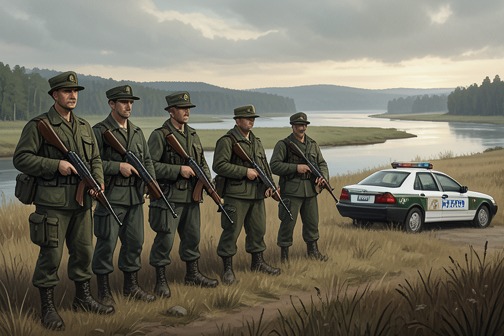
The [1981](entity:time-recall-time-1981-16063b32b4e5) Yamanashi armed clash was the violent culmination of a years-long dispute over a shared irrigation stream, and it ended with the dissolution of L’Aube. Its aftermath reshaped public understanding of the Pioneers: the community presented itself as a lawful, spiritual alternative to its former radical faction, while police investigators remained suspicious of the separation and found no evidence to substantiate their doubts.
## Causes and Background
After relocating to its new territory, L’Aube combined agricultural work with weapons training. Tensions grew with neighboring farmers, particularly over a small river that had long served as a common source of irrigation. L’Aube denied local residents access to the water, and the dispute persisted for several years. The conflict therefore began not with the police action itself but with a sustained contest over access to a resource the neighbors had previously shared.
## The Clash
The immediate escalation came when residents went to complain at L’Aube’s barbed-wire boundary and were assaulted by members of the faction. The [Yamanashi Prefectural Police](entity:organization-recall-organization-df3b74ac4b44) issued arrest warrants on assault charges and sent officers to L’Aube. A gunfight broke out when they arrived, turning an attempt to enforce the law into a deadly armed confrontation in the mountains. The source account identifies the exchange of fire as violent and reports that police officers were killed, but gives no further tactical detail.
## The Pioneers’ Response
After L’Aube was dissolved, the Pioneers issued a public statement through a young spokesperson in a business suit, who read a prepared communiqué to journalists. The group said that, despite their shared past, the two communities had separated by mutual agreement: the Pioneers sought a peaceful spiritual life within the law, whereas L’Aube had pursued radical revolutionary thought. The statement asserted that their contacts had largely ceased except for professional reasons and denied that the Pioneers had participated in the clash. It also expressed condolences to the families of the slain officers and offered to cooperate with judicial investigators.
A few days later, the Yamanashi Prefectural Police searched the Pioneers’ extensive grounds for a full day, inspecting buildings and documents and questioning several senior members. Investigators suspected that the Pioneers might have secretly commissioned L’Aube’s action, since exchanges between the groups had continued after their official split. The search yielded no evidence to support that theory; the suspicion remained unproven rather than confirmed.
## Aftermath and Public Meaning
Most media accounts cast L’Aube as a sinister offshoot that the spiritually oriented Pioneers had been compelled to eliminate. The surrounding commentary placed the clash against a changed political climate: by the [1980s](entity:time-recall-time-20-80-3a3c79b97539), the revolutionary Marxist politics associated with the previous decade seemed out of date, with former radicals absorbed into market competition or seeking individual self-realization away from public struggle. In that framing, the bloody confrontation appeared as the last act of a vanished political era, while the Pioneers were presented as an alternative with a future.
The contrast between the Pioneers’ polished public account and the unresolved suspicions about their relationship with L’Aube gives the event a double significance. The armed clash ended the faction’s existence, but its aftermath also exposed how quickly a shared history could be divided into separate public identities: one lawful and spiritual, the other revolutionary and violent. The narrative presents the police’s failure to find proof alongside the media’s confident distinction, leaving the question of the Pioneers’ private responsibility unanswered.