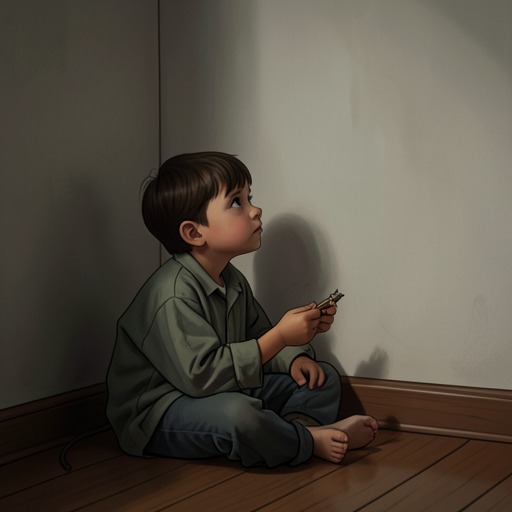
Powerlessness
1Q84Powerlessness is not simply an inability to act in 1Q84: it is a condition that violence can impose, that shame can deepen, and that a person may eventually mistake for a deserved fate. Aomamé recognizes its lasting damage in Tamaki, whose assault and abusive marriage turn helplessness into a prison; the Dowager, in turn, warns Aomamé that even resistance undertaken from pure motives needs limits.
Meaning and Recognition
Aomamé gives the condition its sharpest early formulation during an exchange with the Dowager, whom she had met through a self-defense class at the sports club where she worked. When the older woman suggests that at her age she may no longer need to protect herself from an attacker, Aomamé rejects age as the issue. What matters, she says, is how one lives: a person must remain able to protect herself, because resignation to being assaulted leads nowhere. Chronic powerlessness, she insists, eventually destroys a human being.
The Dowager does not answer immediately. She watches Aomamé in silence, then affirms that the younger woman’s judgment is right. The exchange establishes a shared understanding between them before either has explained the private burdens behind it. A few days later the Dowager sends Aomamé her name and telephone number, inviting her to get in touch when she can. When they speak again, she says that she sensed a heavy burden in Aomamé from their first meeting and recognizes something similar in herself. She offers patience, secrecy, and the possibility of help. For Aomamé, confiding in her later opens another door in her life: protection begins not only with physical readiness but with the possibility of telling another person what one carries.
Tamaki’s Assault and Its Aftermath
The novel gives the idea of powerlessness a concrete origin in Tamaki’s experience at university. Aomamé continues playing softball and wins recognition as a player of national caliber, while Tamaki enters a leading private law university and hopes to become a lawyer. Though their lives take different paths, they meet weekly for lunch and conversation. Their friendship persists across those differences, making Aomamé the person Tamaki can turn to when her sense of safety and dignity is violated.
In the autumn of her first university year, Tamaki goes to the room of an older student from her tennis club after he invites her there. She feels some sympathy for him, which is why she accepts the invitation, but he forces sex on her with a brutality and disregard that shock her. She leaves the club, becomes depressed, loses her appetite, and loses six kilograms in a month. The injury is not presented as a simple consequence of losing her virginity. Tamaki had wanted affection, understanding, and consideration; the forced encounter leaves her unable to comprehend why he used violence when there was no need to do so.
Aomamé urges Tamaki to report him and have him punished. Tamaki refuses, blaming herself for going alone to his room and hoping she may eventually forget what happened. Aomamé sees the self-blame as part of the injury: what has been trampled is Tamaki’s dignity, and the helplessness left by the assault can continue to gnaw at a person. Her response is to punish the man herself. With Tamaki’s information, she goes to his room while he is away, carrying a softball bat concealed in a long plastic tube for industrial drawings. She chooses a day when Tamaki is in Kanazawa for a family memorial, giving her friend an alibi, and first makes sure the man will not be there.
Aomamé breaks the lock with a hammer and screwdriver and systematically wrecks the room, muffling the bat with towels to keep the noise down. She destroys appliances and furnishings, cuts the telephone wires, tears books and notebooks, empties toothpaste and shaving cream onto the carpet, pours sauce on the bed, and damages clothes, shoes, plumbing fixtures, and other possessions. The meticulous destruction is a direct answer to an assault whose victim has been left to bear the consequences alone. It does not undo the violence or persuade Tamaki to report it; it reveals Aomamé’s conviction that helplessness must be resisted, even when her friend cannot accept the form that resistance takes.
The Prison of the Marriage
Tamaki’s later life makes the damage more difficult to reverse. The abuse in her marriage begins early and worsens over time, but she cannot bring herself to leave. She does not tell Aomamé, knowing that her friend would urge her to get out immediately. The silence separates the two women at precisely the point when Aomamé’s directness might have challenged Tamaki’s growing isolation.
In the last days before her suicide, Tamaki writes Aomamé a long letter. She says she was wrong from the beginning and that Aomamé was right, and she describes her life as a daily hell from which she believes she cannot escape. Even escape seems to offer no destination. She calls herself confined in the mad prison of her own powerlessness, insisting that she walked into it, locked the door, and threw the key far away. The metaphor makes her self-condemnation as central as her husband’s abuse: she acknowledges the marriage was a mistake, yet locates the deeper problem within herself and believes she deserves all the pain she feels. She names Aomamé as her one trusted friend and recalls how good it would have been if they could have played softball together forever.
Aomamé tries repeatedly to telephone Tamaki, receives only a recorded message, and takes a train to her friend’s home in Okusawa, in Setagaya. The house is large and enclosed by a high fence. She rings the intercom without receiving an answer; only a dog barks. Unbeknownst to her, Tamaki is dying inside, having hanged herself from a stair rail. The telephone and doorbell sound without response in the silent house, turning Aomamé’s attempted visit into an encounter with the limits of what a friend can know or reach in time.
When Aomamé learns of the death, she is hardly surprised, as if some part of her had expected it. She feels no grief at first. Instead, she switches off the telephone and sits for a long time; later she feels as if all the fluids have left her body. She takes leave from work, shuts herself inside, barely eats or sleeps, drinks little water, and does not attend the funeral. She senses that something inside her has broken and been replaced, and that she has crossed a boundary. Tamaki’s death thus does not end the story of helplessness with a release: it leaves Aomamé altered by the knowledge that recognition and intervention do not always arrive in time.
Resistance and Its Limits
The Dowager’s later counsel complicates the absolute force of Aomamé’s belief that helplessness must be opposed. She explains that Aomamé’s actions against men who abused their wives have spared those women painful divorce proceedings and custody disputes, and ended their fear that their husbands might return and beat them. The women have received life-insurance payments and survivor’s pensions. The Dowager frames the money given to Aomamé as their acknowledgment, while also insisting that her actions are not costless.
Aomamé admits that she does not fully understand. The Dowager answers that Aomamé is neither an angel nor a god. She recognizes the purity of Aomamé’s motives, but warns that a completely unmixed, pure feeling can itself be dangerous and difficult for an ordinary person to live with. Aomamé must restrain that feeling, the Dowager says, like a balloon firmly anchored to the ground. Even when an action is just and its motive pure, that alone does not mean Aomamé may act. The image does not reject resistance; it gives resistance a counterweight, a limit that protects the person acting as well as those she means to help. Aomamé nods after considering this, though she acknowledges that she does not fully understand and agrees, for the moment, to follow the advice.
Narrative Significance
Across these episodes, powerlessness changes from a principle Aomamé articulates into a condition she confronts in the life and death of her closest friend. Tamaki’s assault produces shame and withdrawal; her refusal to report it gives way to self-blame, and that inward logic reappears in the letter that describes her marriage as a prison she built herself. The progression shows how violence can persist not only through the aggressor’s actions but through a victim’s conviction that the resulting suffering is deserved.
Aomamé’s contrasting response is active and exacting. She names resignation as destructive, then takes revenge on the man who assaulted Tamaki, but her action cannot restore Tamaki’s sense of safety or prevent the later marriage. The Dowager’s counsel adds a further distinction: refusing helplessness does not make every intervention harmless or automatically permissible. The recurring image of the anchored balloon holds these tensions together. The novel presents resistance as necessary to human dignity, yet insists that purity of intention cannot by itself settle what a person should do.