The 1Q84 World
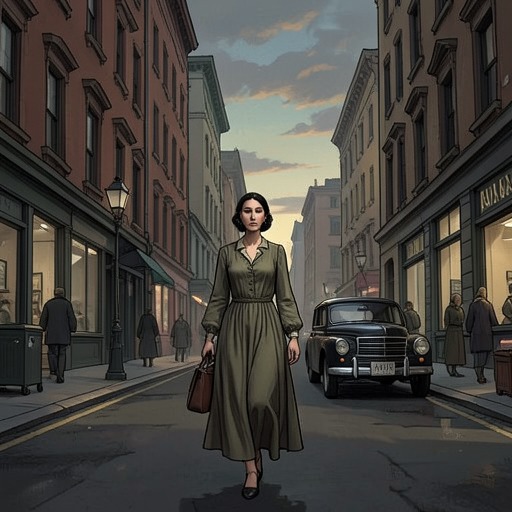
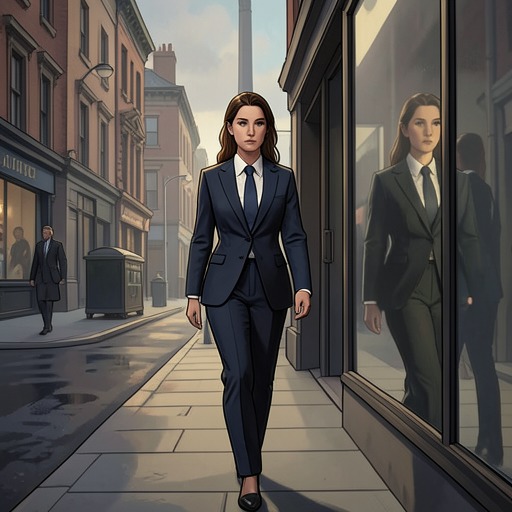
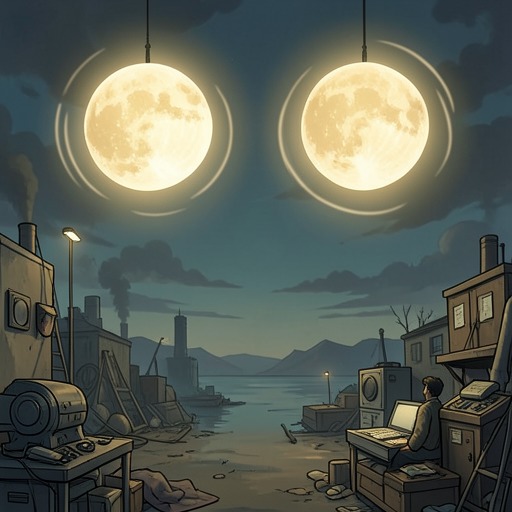
1Q84The 1Q84 World is the changed reality Aomamé begins to inhabit when she sees two moons in the night sky. Its decisive sign is at once unmistakable and difficult to verify: an ordinary yellow moon accompanied by a smaller, misshapen green one. The new moon makes visible a broader uncertainty about time, memory, and the world’s history, while the same image links Aomamé’s experience to the world Tengo is writing about.
The Double Moon
The difference first enters Aomamé’s awareness as a subtle discordance in a familiar sky. Looking upward, she gradually understands what is wrong: beside the large, almost full yellow moon hangs a smaller body with an irregular outline and a tender green color. She narrows her eyes and studies both. Then she closes them, waits, takes a deep breath, and looks again, hoping the scene will have returned to normal. It has not. The two moons remain plainly visible, and she concludes that neither a trick of light nor a defect in her eyesight accounts for them.
Aomamé considers waking Ayumi to ask whether she sees the same thing, but imagines that either answer would leave her isolated. If Ayumi also sees two moons, the fact that Aomamé had not known of such a change becomes another problem; if she sees only one, Aomamé may be taken for someone whose eyes or judgment have failed. Rather than turn the sight into a test she cannot interpret, Aomamé watches in silence, her heart beating faster. She cannot decide whether something has happened to the world or to herself. The image of the bottle and its stopper gives form to the dilemma: is the fault in the container, or in the part through which it is observed?
A Reality That Will Not Stay Put
The next evening, the second moon is still there. The large one looks unusually pale, as though it had crossed a mountain of ash, yet remains recognizable as the old familiar moon. The smaller green one appears awkwardly beside it, like a guilty child. Its recurrence turns a shocking sight into a persistent condition. Aomamé reasons that if the moon had physically split, tides and other features of life on Earth would have changed, and everyone would have noticed. If the change had happened without her registering it, however, then her own memory—not only the sky—would be in question.
The uncertainty is not limited to the moons. Aomamé recalls that police uniforms and weapons have been renewed, that a violent clash between police and a radical group took place in the mountains of Yamanashi, and that the news has announced American and Soviet cooperation on a lunar base. These developments seem to belong to a history she does not remember. In the library, she searches newspaper microfilm for the account of the armed fighting, dated October 19, 1981—three years before the year she understands as 1Q84. The date and the reports give her a way to inspect the discrepancy, but not to settle whether her memory has failed or history itself has changed.
When Aomamé hears the name of the Pioneers, she realizes she does not remember encountering it, although she is told it once appeared in newspapers every day. She begins to suspect that she is no longer in the original 1984 but in a slightly altered world she calls 1Q84. The label does not resolve the uncertainty; it gives it a shape. As she learns more about the world around her, she expects there may be many things she has never known and decides she must be exceptionally attentive.
A World Without a Reliable Witness
Aomamé has no trustworthy person to whom she can easily put the question of the moons. Asked casually, whether another person confirms or denies what she sees, the answer risks deepening the puzzle rather than clarifying it. She tries out possible ways of asking, but each sounds absurd because the situation itself has made an ordinary, logical question impossible. The world’s change is therefore also a change in the conditions of knowledge: familiar confirmation by another observer cannot be assumed.
The mismatch becomes personal when Aomamé is asked what she is doing and answers that she does not know which world she lives in or even which year it is. Her companion confidently identifies the place as Tokyo, Japan, and the year as 1984; Aomamé cannot speak with the same certainty. The contrast sets practical certainty against lived uncertainty. A location and a calendar year can be named, but naming them does not prove that the present is the one Aomamé remembers.
The World in Tengo’s Story
The distinction between worlds also appears in Tengo’s conversation about the book he is writing. He describes a world that is not the one here, and says that people from this world do not appear in the other. When his companion asks how someone who wandered into it would recognize the difference, Tengo points to its two moons. Looking up at night and seeing them would let a person know that this was not the familiar world. In his account, the moons serve as a sign, not simply as an unusual feature of the sky.
Tengo has drawn on the two-moon world of Air Chrysalis but intends to make his new story longer and more complex, and to make it his own story. The overlap between the existing fiction and the story he plans to write may become a problem later; for the present, he wants to write about a world with two moons and postpones deciding what comes afterward. His companion asks whether the moons might overlap. Tengo says their distance remains constant, though he does not know why. The image thus has a rule within his imagined world, even as its cause remains unexplained.
Recognition Without Resolution
For Aomamé, the second moon is not an invitation to treat the change as a harmless wonder. Its persistence undermines her trust in sight, memory, and the shared account of events. She can observe the moons repeatedly, remember the history that seems to contradict them, and gather newspaper evidence about events she had not known; she still cannot establish whether reality has changed around her or something has changed in her. Her growing name for the world marks a provisional recognition, not an answer.
For Tengo, by contrast, the moons provide a legible boundary between worlds: a person who sees two can recognize that they are not in the world they know. The image connects his creative project with Aomamé’s disorientation without making their experiences identical or explaining how they might relate. Its force lies in that unresolved double function: it is both a concrete alteration in the sky and a device for recognizing that the apparently familiar world may no longer be the same one.