Lola’s homelessness
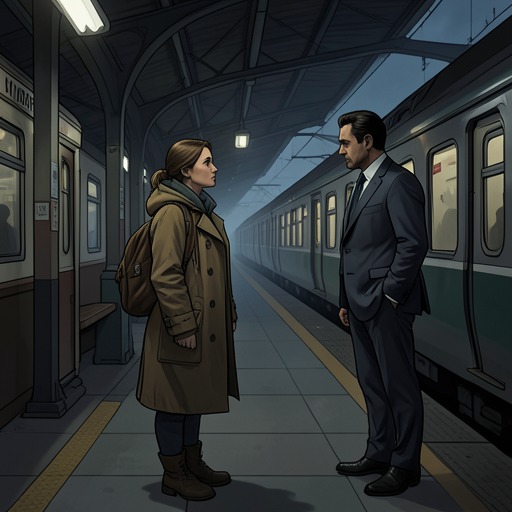
2666Lola’s homelessness is a prolonged state of precarious shelter and self-directed wandering that begins after she leaves Oscar Amalfitano’s household to seek the poet in the Mondragón asylum. With Imma gone and the poet inaccessible, Lola moves through a succession of marginal spaces: a boardinghouse, a railway station, an abandoned warehouse, open country and an empty cemetery niche. Even when Larrazabal offers her a home, she continues to roam and eventually makes her way to France. The pattern is not simply the absence of a house; it is a life organized around thresholds, temporary refuge and an attachment that never becomes a settled destination.
Departure and the loss of shelter
After a week without Imma, Lola imagines her companion travelling alone through a landscape of roads and crossroads, but the practical consequences of the separation soon become immediate. On the ninth day, the boardinghouse owner expels Lola. She sleeps at the station, in an abandoned warehouse where other transients keep apart, or out in the country near the boundary between the asylum and the outside world. The sequence offers no secure place to remain: each shelter is provisional, and the asylum’s nearby presence does not grant Lola entry to the life she is trying to reach.
One night she hitchhikes to a cemetery and sleeps in an empty niche. The following morning, she feels fortunate rather than defeated: she can find water, wash, and wait near the asylum. The niche provides a brief, practical refuge, and Lola decides to stay there until Imma returns. While drying a washed shirt on a slab by the cemetery wall, she hears voices in a family mausoleum and encounters Larrazabal. Their meeting begins inside another improvised shelter, but it does not end her homelessness. He lends her ten thousand pesetas and promises to return; she spends the night in the niche and sets out the next morning for Mondragón.
Near the asylum, outside its gates
Lola’s days are shaped by proximity to the poet without access to him. After breakfast in town, she accepts a ride from a woman whose father is a patient at the asylum. The woman asks whether Lola is visiting someone or is herself an inmate; Lola says she is visiting. Once there, she walks along the grounds and watches from the section of fence with the clearest view. She sees the poet among other patients, signals to him, and witnesses a brief altercation on a bench. The episode leaves her on the visitor’s side of the institution: she can watch, wave and attempt to reach him, but the fence remains between them.
This boundary gives her homelessness a particular shape. The asylum is close enough to orient her movements, yet it does not become a home or a route to reunion. Lola repeatedly returns to its edge, while the poet’s response remains uncertain and beyond her control. Her account itself preserves that uncertainty: she cannot tell whether the laugh she thinks she hears belongs to the poet or to her own madness. The narrated encounter therefore offers no reliable sign that her attention has reached him, only the continuation of her vigil outside.
Larrazabal’s temporary refuge
In a later letter, Lola describes Larrazabal as a good person who invites her to stay in his apartment, offers to drive her to the asylum each morning and gives her money without asking for anything in return. He takes her to the movies, checks whether there is news of Imma at the boardinghouse, and buys her clothes. After they have been together, he proposes marriage; Lola reminds him that she is already married, and he accepts the answer without taking offense. His generosity creates a temporary domestic shelter, but it does not resolve the forces that keep her moving.
Lola’s visits to the asylum become less frequent: she goes every three days rather than daily, looking through the fence without hope of seeing the poet and seeking a sign she expects not to understand. She sometimes fails to return to Larrazabal’s apartment, and he searches for her at the cemetery, the asylum, the boardinghouse, the places where transients gather, the train station and a bench at La Concha. At home, he makes breakfast and dinner; during the day, Lola drinks water and carries only a small piece of bread or a roll. The difference between having a place to stay and feeling at home is made concrete in this routine: Larrazabal can provide meals and a bed, but he cannot stop her from disappearing into the city’s other spaces.
Departure and life on the road
Lola eventually tells Larrazabal that she plans to leave and asks for train money. He says he will give her what he has, but not money to go away forever. She nevertheless scrapes together enough for a ticket and takes the train to France. Her route passes through Bayonne, Landes, back to Bayonne, then Pau and Lourdes. This departure is another change of location rather than a transition into stable housing; the account follows her onward movement rather than showing her establish a home.
In Lourdes, Lola begins helping sick and disabled travellers arriving by train. She moves through the station’s different spaces, including rooms used as first-aid posts and resuscitation posts, and an improvised morgue. At night she sleeps in the trash compartments of a large steel-and-glass building, entering through a small door; at other times she stays in the station or its bar, where older men buy her coffee and talk with her. Her homelessness places her among people passing through systems of transport and care, but the help she gives them does not secure a place for herself.
Once, Lola thinks she sees Imma step down from a train from Madrid, accompanied by a group of disabled travellers. She does not call out. After Imma passes, Lola leaves the station and Lourdes, walks to the highway and tries to hitch a ride. The moment repeats the pattern of her earlier life: a possible encounter appears, but does not become a reunion or a reason to stay.
Narrative significance
Lola’s homelessness is conveyed through a changing map of thresholds rather than through a single episode of deprivation. The cemetery niche, asylum fence, boardinghouse, apartment, train station and highway each offer a different degree of shelter or access, yet none becomes a lasting home. Her movements link private loss to public spaces where people wait, travel, seek care or are excluded. The account also resists a simple arc of rescue: Larrazabal’s kindness eases some material hardship, but Lola leaves, and the narrative gives no settled resolution to her wandering.
That unsettled form matters to the larger story. Lola’s letters reach Oscar Amalfitano, but they report a life that remains mobile and difficult to hold in a single place. After five years without news, he sees Imma in a park; the encounter does not establish that Lola has returned or that her own homelessness has ended. Her condition therefore persists in the narrative as a history of departures and temporary shelters whose final destination remains unknown.