Allyson's Emergency Brain Surgery
AccidentAllyson's Emergency Brain Surgery marks the first urgent attempt to save Allyson Clarke after the Golden Gate Bridge collision. The operation places Page Clarke between an immediate decision and an unknowable future: without surgery, the doctors warn, Allyson may die within hours, while even survival could mean profound and lasting impairment.
Background and Emergency Decision
Before Page learns the full extent of Allyson's injuries, she is trying to understand who was driving the car. She knows that the driver has died and initially assumes it was Trygve Thorensen; instead, she is told that the driver was seventeen-year-old Phillip Chapman. At this stage, the collision's responsibility is unsettled, and the urgent question is not blame but whether Allyson can be saved.
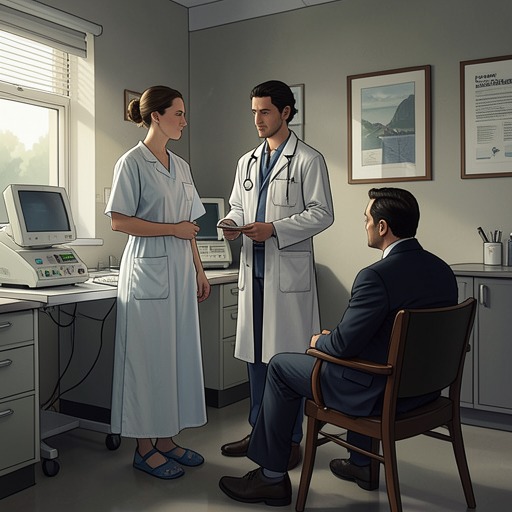
The surgeons explain that the impact has caused two distinct head injuries. The first is the forceful movement of Allyson's brain within her skull, which may have stretched nerve fibers and damaged blood vessels. The second is a skull fracture with an open wound. The medical team says that the latter injury may look especially alarming, yet the damage from the impact itself is their greater concern. Blood loss and reduced oxygen add further uncertainty: the extent of possible brain damage cannot yet be determined.
The operation is intended to relieve pressure by raising the depressed bone, treat the wound, and repair damage around Allyson's eye sockets. The blow could affect her vision. The doctors also warn Page that swelling, blood clots, or bruising may emerge later; wearing a seat belt helped Allyson avoid additional injuries, but cannot remove the danger posed by the injuries already sustained.
The prognosis is stark. The surgeons say Allyson may remain in a coma, suffer extensive brain damage, lose motor and reasoning abilities, or die. Page asks whether her daughter could ever be well again, but receives no assurance. When the chief surgeon says that Allyson may not live another two hours without an operation, the possibility of seeking another opinion gives way to the need to act immediately.
Trygve is beside Page as she hears the explanation and holds her hand, but he clarifies that he is only a friend, not Allyson's father. The consent decision therefore falls to Page. She cannot reach Brad Clarke, Allyson's father, and the surgeons stress that waiting for him is not an option. After hesitating, Page signs the forms; the operation is expected to begin in about half an hour.
Immediate Outcome
Allyson survives the operation, but survival is only the first threshold. The initial report is cautiously encouraging: she has made it through surgery, yet the doctors warn that the next forty-eight hours—and possibly several days beyond them—will be decisive. Her injuries remain severe, her recovery cannot be predicted, and she is still far from out of danger. The operation changes the immediate prospect from likely death without intervention to a period of vigilant waiting, not to a promise of recovery.
Brad Clarke reaches the hospital at six o’clock, an hour after speaking with Page Clarke from Cleveland and just after she learns that Allyson has survived. His rapid arrival surprises Page. He questions the surgeons and hospital staff, but they do not let him see Allyson; she is to remain in the recovery room until morning. The family’s first relief is therefore bounded by distance and delay: they know she is alive, but cannot yet be with her.
The uncertainty continues through the later course of Allyson’s treatment. After another operation, the surgeons report that she has survived and that her vital signs are good, while emphasizing that she remains in a coma and that lasting effects cannot yet be assessed. That later crisis underscores the limits of the first operation’s success: it buys time and makes further treatment possible, but does not settle whether Allyson will regain consciousness or how much function she will recover.
Uncertainty Beyond the Operating Room
The surgery could address Allyson’s immediate injuries, but it could not settle who had caused the collision. The highway patrol said the wreck’s force made it nearly impossible to establish which car had crossed the line. Phillip Chapman’s blood contained alcohol, but not enough for him to be considered drunk; Laura Hutchinson had appeared sober, and police had not tested her. Even so, a newspaper account emphasized Hutchinson’s grief and standing as a mother while indirectly casting suspicion on the young driver. Trygve objected that the reporting and the Senator’s aides’ account shaped an impression of Phillip’s guilt without resolving the evidence. Page, caught between the search for someone to blame and the fact that blame could not change Allyson’s condition, could not reach a firm conclusion either.
That uncertainty returned when news broke of a later head-on collision in La Jolla: Hutchinson had been arrested for driving under the influence, and the crash had killed a family. The report also connected her to the earlier Golden Gate Bridge collision, in which Phillip had died and Allyson and Chloe had been badly injured. Page understood the new report as vindicating Phillip, and Trygve’s earlier suspicion seemed newly weighty; still, the first crash had never been conclusively assigned fault. For Allyson, meanwhile, survival did not mean an immediate return to her former abilities. When she eventually opened her eyes, she could follow simple requests but would not speak; Dr. Hammerman told Page that she had probably lost much of her language and large motor skills, with the extent of her brain damage still unknown. Her possible recovery would have to be measured in what she could relearn, not in the first operation’s survival alone.
A Provisional Turning Point
The operation’s significance lies in the change of scale it imposes on the crisis: before it, the question is whether Allyson can survive the next hours; afterward, survival opens onto days of monitoring and weeks before her condition can be reassessed. Each milestone offers only limited knowledge, not a final answer. The surgery is therefore a turning point in the immediate emergency, but not a resolution: medical intervention makes continued waiting possible, while the extent of Allyson’s recovery remains beyond anyone’s certainty.