Page Clarke and Trygve Thorensen
AccidentPage Clarke and Trygve Thorensen begin as familiar faces in one another’s lives, connected through their daughters’ close friendship and years of school events, sports, and occasional picnics. The crash involving Allyson Clarke and Chloe Thorensen transforms that easy acquaintance into a partnership under pressure: at the hospital, the two parents share the immediate terror of not knowing whether their children will survive, and Trygve becomes the companion Page relies on while Allyson undergoes emergency treatment. Their bond develops through presence rather than declaration, strengthened by shared uncertainty, mutual care, and the refusal to leave one another alone with the crisis.
From Familiarity to Crisis
Before the collision, Page and Trygve had known each other for eight years but had never been close friends. Their families’ connection was chiefly social: their daughters were inseparable companions, and their parents encountered one another at school functions, sports events, and picnics after the Clarkes moved to Marin County. That background gives their later intimacy a specific shape. They are not strangers brought together by the hospital, but neither is their closeness an established habit; the emergency makes an existing, ordinary connection newly essential.
At first, the hospital’s confusion deepens Page’s shock. She is told that the driver has died and momentarily believes Trygve is dead. Then she sees him emerge from a treatment room, alive and visibly shaken. He takes her hand, cries, and apologizes, blaming himself for failing to notice Chloe’s plans. He recalls seeing her leave in a black leather skirt and black stockings, and says that he had been occupied with Bjorn Thorensen and accepted her explanation that she was going out with Page. His regret is not a claim that he knows precisely what happened on the road; it is a parent’s painful conviction that he should have intervened before the outing.
Page is horrified by his self-accusation, especially as both of them are confronting the possibility that their daughters may be gravely harmed. When she asks who was driving, Trygve can offer only the name Phillip Chapman and his age, seventeen; Chloe is in no condition to answer questions. In these first exchanges, neither can make sense of the event. Their conversation moves between blame, unanswered questions, and the urgent fact that both girls need medical care.
A Companion Through the Hospital Hours
Trygve recognizes the danger of trying to imagine every possible future at once. He tells Page that he has caught himself wondering whether Chloe will walk, dance, or run again, and even planning where a wheelchair ramp might go. His counsel is to stop projecting beyond what they know and take events minute by minute. Page understands because her own thoughts swing between preparing for Allyson’s death and refusing to believe it could happen. They do not offer each other certainty; they help one another endure its absence.
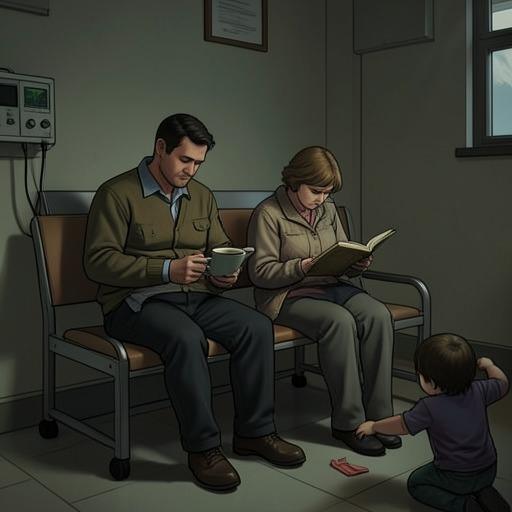
When the neurosurgeons are ready to explain Allyson’s condition, Trygve asks whether Page wants him to accompany her. She accepts, frightened both by the doctors’ account and by the prospect of seeing her daughter. He responds without hesitation as they hurry down the hall. The narrative describes them as looking like brother and sister, both blond and Scandinavian-looking, and presents Trygve as gentle and easy to be with. Page has never felt as comfortable with anyone, and the two have become, in the crisis, partners in disaster. The image marks the speed of the change: an eight-year acquaintance has become the person she can bring with her into the most frightening room in the hospital.
Their care for each other is also practical. At four in the morning, after Page has signed papers and the neurosurgeon has said the operation may take twelve to fourteen hours, Trygve insists that she at least go for water and have a change of scene. He suggests that she might go home to rest, but understands when she refuses to leave. He, too, does not want to leave Chloe. Their family responsibilities differ: Trygve has an older son at home to care for Bjorn, while Page is worried about Andy Clarke, who may be panicked without his mother and sister. Page eventually agrees to go with Trygve to the cafeteria, where they sip coffee while both girls are in surgery. The small break does not relieve the danger; it gives them a way to remain alongside each other through the long wait.
Mutual Regard and the Search for Responsibility
The emergency also reveals what each sees in the other. Trygve is struck by Page’s ability to absorb the blow of the crash while continuing to think about her husband, her son, and the Chapman family as well as Allyson. He regards her as remarkable, not because she is untouched by fear, but because she remains attentive to other people while enduring it. Page, in turn, recognizes the care Trygve has given Bjorn, whose capabilities and needs he describes with affection and realism. Their exchange about Bjorn makes visible a shared concern with supporting children as they are, rather than abandoning them because life does not match an ideal of normality.
Their developing trust does not make them agree on every question. In the first aftermath, Trygve is angry at Phillip, Chloe for lying to him, and the other driver if she was responsible. Yet he also knows that the evidence cannot establish who crossed the line: the collision was so forceful that the positions of the cars do not settle what happened, and Phillip’s blood test shows alcohol but not enough to classify him as drunk. The other driver appeared sober, and the available information leaves the cause uncertain. Page asks about the driver partly because she has mistaken Trygve for the person killed; the answer makes clear how little either parent can yet know.
Later, when a newspaper account seems to cast Phillip as responsible while presenting Laura Hutchinson favorably, Trygve questions the framing. He explains to Page that a report can imply more than it establishes and can be shaped around a preconceived version of events. He has spoken with the highway patrol, whose evidence remains inconclusive, and with Jamie Applegate, who says Phillip was attentive and had consumed only half a glass of wine followed by coffee. Trygve does not claim that this proves Laura was at fault. He insists instead that either driver could have caused the collision, and that Phillip’s youth may make him an easier person to blame despite the uncertainty. Page is troubled by the same problem: assigning fault cannot bring Allyson out of intensive care, repair Chloe’s legs, or restore Phillip to his family, though it could matter in future lawsuits.
A Bond Sustained by Uncertainty
The relationship is tested by the recurring pressure to find someone to blame. Trygve admits that he initially wanted to blame Phillip and Jamie, and was angry that Chloe had deceived him. His view shifts as he speaks with Jamie and hears that the boy was attentive; he comes to doubt that the young driver was responsible, without pretending to know the answer. Page listens to this uncertainty rather than demanding a verdict that the evidence cannot supply. Their companionship rests not on a shared conclusion but on the ability to consider changing evidence together while their daughters remain in danger.
When a later television report reveals that Laura Hutchinson has been arrested after an intoxicated-driving collision in La Jolla, Page realizes that Trygve’s earlier suspicion may have been right. She breaks down, and Chloe cries as well. Trygve turns off the television and sits with them. The report does not undo the earlier crash or settle every detail of it, but it retrospectively exposes how premature the favorable portrayal of Laura had been and vindicates Trygve’s refusal to treat the first public account as the whole truth. In this final moment of the relationship’s documented arc, he again responds less with argument than with presence. The friendship that began in the shared routines of school and family life has become a form of mutual shelter: not an escape from grief or uncertainty, but a way of facing both together.