Burial truce
AeneidThe Burial truce is the rule by which active hostilities are suspended to recover and bury the dead. Its immediate force is practical—the fallen must be drawn from the battlefield and funeral pyres prepared—but its deeper importance is ethical and political: death ends the enmity that made killing possible, while burial restores the dead to communal order. In the poem, the rule provides a formal interval in which the Latins and Trojans acknowledge obligations that war itself cannot erase.
Grounds and Moral Basis
The truce is requested by suppliants sent from Laurentum, who approach with olive branches rather than weapons. Their appeal is framed as a plea for clemency and as a claim grounded in custom: the defeated dead, having fallen in fair battle, are entitled to the common rites of burial. The petitioners insist that no one should deny those rites to conquered enemies. Their argument does not depend on military advantage or affection for the slain. It rests on the proposition that death has altered the moral status of the conflict: once the bodies are lifeless, the cause of hatred has ended, and war against them would be meaningless.
The request also invokes the political relationship between the opposing sides. The suppliants remind the victorious hero that their king had once been regarded as his host and that the dead belong to a community whose ruler is making a ruler’s request. The appeal therefore joins three forms of obligation: ritual duty toward the dead, restraint toward defeated enemies, and respect between political households. Burial is not treated as a private favor but as a public right that a legitimate leader must recognize.
Granting the Suspension
The hero grants the petition because it is too just to deny. His decision places clemency within the conduct of victory: military success does not authorize the victor to suspend every human or ritual obligation. The truce thus marks a boundary between combat and the treatment of those who can no longer fight. It also reveals that authority is measured not only by the ability to defeat an enemy, but by the capacity to restrain force once its purpose has been achieved.
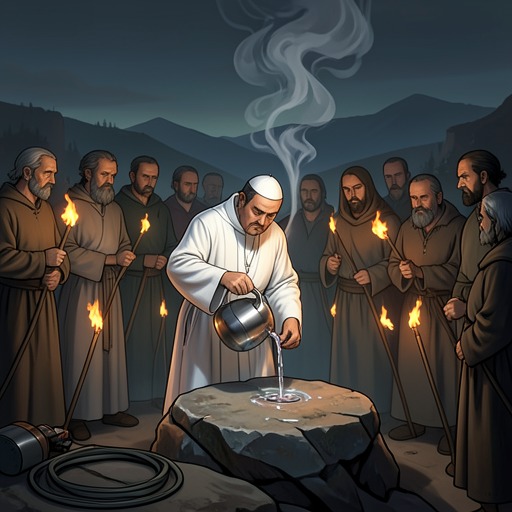
The arrangement becomes a twelve-day truce. During this fixed period, Latins and Trojans are no longer enemies in the active sense. They enter the woods together to cut timber for funeral pyres, and the sound of axes through the groves replaces the immediate noise of battle. The image is significant because the two communities cooperate in the material labor of mourning: the forest supplies the fuel, the bodies demand attention, and the former combatants share the work required to convert battlefield remains into funerary rites.
Political Negotiation and Collective Consequences
The truce emerges through persuasion as well as compassion. Drances speaks in support of the request, and his words persuade the assembled leaders to empower the agreement. The decision is therefore collective rather than merely personal. A ruler grants the immediate petition, but the wider Latin political body accepts the suspension, making the practice a recognized agreement between communities rather than an isolated act of mercy.
The twelve-day term creates a controlled interval inside a larger war. It does not abolish the conflict or resolve every political grievance; it suspends violence long enough for the dead to be handled properly. In that interval, the Latins and Trojans are described as no longer foes, a temporary transformation that exposes the artificiality of their separation. They remain opposing peoples in the war’s larger structure, yet their shared funeral labor demonstrates that ritual obligations can briefly create a common human status above military allegiance.
Relation to the Wider War
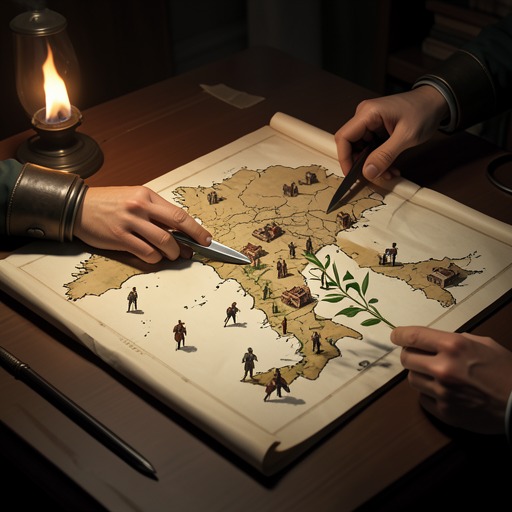
The Burial truce belongs to a conflict shaped by embassies, alliances, battlefield reversals, and attempts to regulate violence. Messages are sent to seek aid, armies gather, and champions move between camps, but the funeral suspension introduces a different kind of political language. The olive branch, the appeal for clemency, and the appeal to customary rites all oppose the logic of unlimited retaliation. Even amid the war between the Latins and Trojans, the dead remain capable of imposing duties on the living.
The rule also contrasts with moments when violence threatens to exceed all limits. Elsewhere, a combatant stretches out an arm in a sign of peace and calls for the fighting to stop, while at the end of the conflict the Trojan hero hesitates before striking a defeated opponent. These related gestures show that restraint is repeatedly presented as a contested but intelligible possibility. The Burial truce gives that possibility its clearest institutional form: instead of relying on a single warrior’s impulse, it is negotiated, authorized, timed, and carried out through communal action.
Significance
The truce makes burial a condition of civilized victory. It recognizes that the dead are not disposable remnants of military action but members of communities whose bodies require rites, recovery, and remembrance. By allowing enemies to gather timber together and forget the war for a defined period, the poem presents mourning as a temporary peace-making practice: it does not erase violence, but it prevents violence from possessing the entire moral world.
Its force lies in the balance it establishes. The truce is limited to twelve days, so it does not promise permanent reconciliation; nevertheless, within those days, the customary rights of the dead overrule the momentum of battle. The agreement therefore reveals a law of war that is also a law of humanity: hostilities may divide the living, but death demands recognition, and the proper burial of an enemy can become the first visible act by which political order begins to recover from war.