Latium at war
AeneidLatium at war is the central state of crisis in the poem’s latter half: a conflict in which the arrival of the Trojans in Italy becomes a struggle over marriage, sovereignty, land, and the future political order. What begins as local hostility expands into a general war, yet the poem repeatedly interrupts collective violence with embassies, vows, truces, and appeals to justice. The war therefore tests not only military courage but also whether political communities can recognize limits on violence and submit their claims to a larger design of fate.
Causes and Expansion
The conflict is framed as the culmination of a long historical movement. The poem announces its subject as the arrival of the Trojan fleet in Ausonia, the love and rivalry that followed, and the war that began and was ultimately concluded by the “godlike man.” Its causes are thus both immediate and inherited: the Trojans seek a future in Italy, while local powers resist the rearrangement of Latium that their settlement entails. The dispute is not presented as a private quarrel alone, because the projected consequences reach far beyond the first generation.
Divine hostility turns tension into organized bloodshed. Juno declares that the work is complete once blood has been drawn and war begun, treating discord as an accomplished political fact rather than an accidental outbreak. She then forces open the Gates of War, making the conflict public, formal, and difficult to reverse. The image gives the war an institutional and almost ritual character: once the barriers are broken, violence spreads through the community and becomes a condition shared by armies, rulers, and civilians.
The Latins and their allies respond by gathering strength and seeking external assistance. Their forces forage through the country, while Venulus is sent to Diomede to ask for aid in defending Ausonia and to explain the danger facing the commonwealth. Diplomacy therefore accompanies mobilization from the beginning. The war is fought through armies in the field, but also through appeals to former heroes, calculations of alliance, and attempts to define which side represents the legitimate defense of Italy.
Campaigns and Military Conduct
The war repeatedly changes scale. It includes broad movements of troops and the devastation of the countryside, but its decisive moments are often concentrated in particular encounters. After leaving Evander, Aeneas travels through the night to the Tyrrhenian camp and Tarchon’s tent, seeking the support needed to sustain the Trojan cause. His movement links personal obligation with coalition warfare: the alliance with Evander is not ornamental, but becomes part of the military structure confronting Turnus and the Rutulians.
The conflict also exposes the instability of command. Turnus is cast from the camp in shame, after which mortal war continues on both sides. Later, when Turnus sees the Latins leaving the field, their armies broken and their courage subdued, he himself becomes the object of public blame. The reversal is political as well as military. A leader who had embodied resistance now stands under the pressure of a defeated community, and the war begins to demand a single answer for the failures of the whole side.
Even at the height of combat, the poem preserves a distinction between legitimate battle and uncontrolled slaughter. Aeneas stretches out his arm as a sign of peace and calls aloud for the Rutulians to hold and the Latin troops to retire. The gesture briefly places restraint before victory. It shows that the war is not governed solely by the impulse to kill: combat can be interrupted by an acknowledged authority, and the opposing armies remain capable of recognizing a command that protects them from needless continuation.
Truce, Law, and the Possibility of Peace
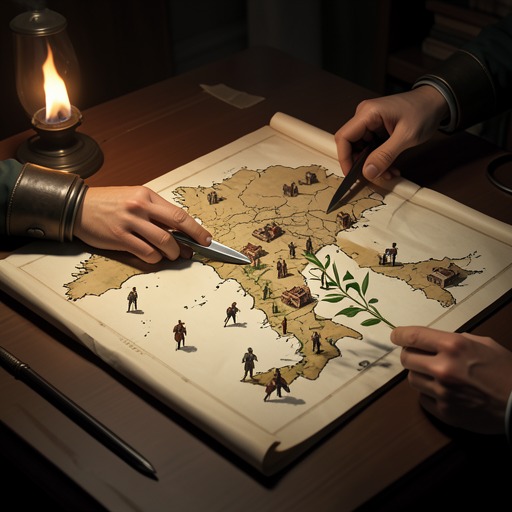
The clearest interruption comes when suppliants from Laurentum approach with olive branches. They ask for a truce and appeal to Aeneas’s clemency, making the defeated party’s need visible through the formal language of supplication. Their request is granted because it is just, not merely because it is strategically convenient. Aeneas addresses the Latian princes as men whose state has been drawn into severe fate by causeless quarrels, presenting the war as a collective disaster rather than an honorable end in itself.
The truce creates a temporary legal and moral order within the larger conflict. Its purpose is not to erase hostility but to suspend it so that the dead and the living can be treated according to recognized obligations. Later, peace is publicly tied with solemn vows and sworn on both sides, with all dues performed that holy rites require. The ceremony makes agreement visible before the community and places political settlement under religious sanction. Peace is therefore more than a pause in fighting: it is an enacted contract whose validity depends upon mutual oath, public acknowledgment, and ritual completion.
The movement toward peace is also directed from above. Aeneas sends to the Latin king to cease the rage of arms and ratify the peace, while the coming morning is associated with a formal meeting from the mountain’s height. The language of ratification shows that the war can end only when violence is translated into a recognized settlement. Its conclusion requires not simply that one army prevail, but that the surviving political order accept the terms by which that victory becomes lawful.
Renewed Combat and Final Narrowing
The peace does not immediately hold. The poem’s larger pattern is one of interruption and recurrence: armies assemble, violence is suspended, vows are made, and combat returns. This instability reveals how difficult it is to transform a battlefield victory into a durable political agreement. The personal passions attached to marriage and honor continue to press against the formal mechanisms of truce and treaty.
By the final phase, both hosts unite their broken troops and form equal ranks before mixing in mortal fight. The image of damaged forces recombining emphasizes the cost of the prolonged struggle: neither side appears untouched, and the war has consumed the distinction between an initial expedition and a national emergency. Yet the equal ranks also prepare the narrative for a final reduction of the collective conflict to a contest between champions.
Turnus eventually challenges Aeneas to single combat. Articles are agreed upon, but the Rutulians break the arrangement and wound Aeneas. Venus then restores him miraculously, after which Aeneas forces Turnus into the duel that will determine the war. The structure converts a conflict involving peoples and alliances into a concentrated judgment between two leaders, while the broken articles preserve the war’s central problem: peace is repeatedly promised, but factional violence keeps violating the terms meant to contain it.
Outcome and Political Meaning
The war ends only when Aeneas stands over a yielded Turnus. At the decisive instant, Aeneas hesitates, repressing his hand as he considers whether to strike. The moment gathers the entire political and ethical history of the conflict into a single act of judgment. Victory is already within reach, but the conqueror must decide what kind of victory this will be and whether the defeated enemy can be separated from the injuries and obligations that brought the war to its final point.
Latium at war thus functions as both a story of conquest and a test of political order. The projected future includes the spread of the descendants of the Trojan line and the imperial conquests of Rome; the conflict is consequently placed within a destiny that reaches beyond its immediate deaths. Yet the poem does not make that future effortless. It shows the violence, appeals, broken agreements, external alliances, and ritual negotiations through which a new community comes into being. War establishes the conditions of the future, but the repeated demand for mercy, truce, oath, burial, and ratification insists that lasting rule must be distinguished from mere force.