Trojan exile
AeneidTrojan exile is the defining condition of the surviving Trojans after the destruction of Troy: a people expelled from their homeland who must carry their family, sacred powers, and memory through foreign lands toward an uncertain future. It is not merely a journey away from ruins. Exile becomes the form through which a broken community preserves continuity, obeys divine direction, and transforms catastrophe into the possibility of a new home.
Origin in the Fall of Troy
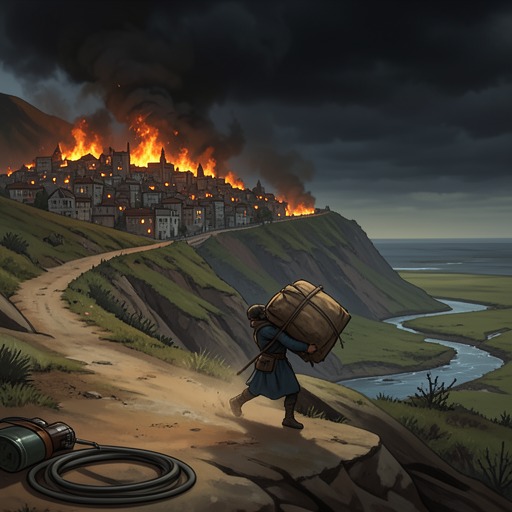
The condition begins when Heaven has overturned the Trojan state and the throne of Priam. Troy has become the prey of the Greeks, and the towers of Ilium lie in ashes. The Trojans’ departure is therefore not voluntary migration but the consequence of conquest, political collapse, and the destruction of the city that had organized their identity. Their homeland survives only as a devastated landscape and a remembered name.
Celestial omens warn the survivors to retreat and seek a happier settlement in foreign lands. Exile thus has two simultaneous causes: the immediate violence of Troy’s ruin and a larger providential command that gives flight a direction. The Trojans are driven out by disaster, yet they are also summoned onward by signs from Heaven. This tension between dispossession and destiny governs their movement from the beginning.
The Community in Motion
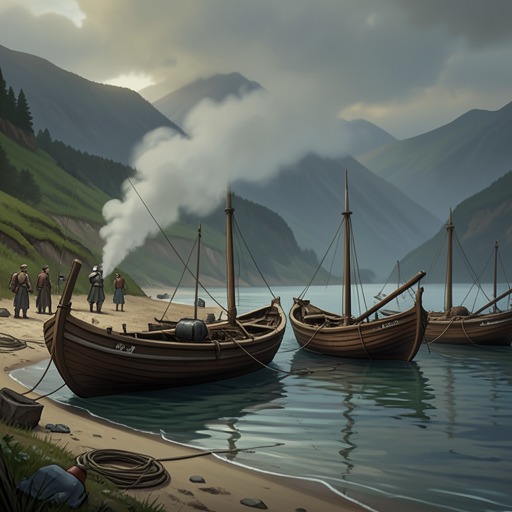
The departure near Antandros and at the foot of Mount Ida gathers the remnants of the Trojan world into a travelling community. When Anchises calls everyone to the sea, the crew obeys both their father and the Fates. Authority in exile is consequently shared between human kinship and divine necessity: Anchises provides the immediate command, while fate supplies the larger meaning of departure.
Aeneas presents the departure through the emotional cost of leaving. He sighs and weeps as he abandons his native shore and the empty fields where Ilium once stood. The image of the abandoned fields is crucial: exile is not escape from a living city but movement through the negative space left by annihilation. The survivors do not simply lose houses or territory; they lose the material world that made return imaginable.
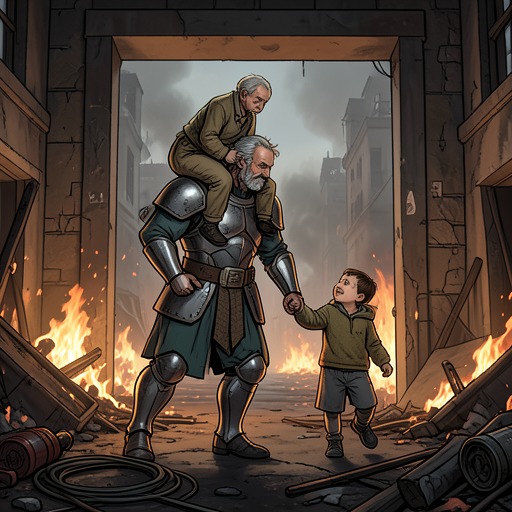
Yet the community does not leave everything behind. Aeneas travels with his father Anchises, his son Ascanius, and the household gods, described as both the lesser and greater divine powers of the Trojan people. The convoy therefore carries three generations and the sacred objects of domestic and civic continuity together. Family and religion become portable forms of homeland. What cannot be preserved in walls is preserved in bodies, ritual obligations, memory, and the gods carried across the sea.
Exile as Repeated Separation
The exilic condition is marked by further farewells even after the first escape. In a later recollection, Aeneas takes a final leave with tears, addressing a happy pair whose fortune is already made while contrasting their secure condition with his own different state. The scene shows that exile is not only the initial break with Troy; it is a continuing experience of separation from people whose lives have reached stability. Aeneas remains defined by movement, while others possess the settled future that exile denies him.
The Trojan condition also includes the violent deaths encountered along the road. Pyrrhus drags the trembling Priam through blood and sacred mire after murdering his son, an image that concentrates the fall of the royal household into one bodily humiliation. In the wider history of exile, such scenes are not remote background. They are the wounds from which the survivors depart and the memories they must carry into every proposed settlement.
The same pattern recurs when the displaced community discovers Misenus extended dead upon the shore. Even before entering the Underworld, the exiles find that their voyage repeatedly turns into an encounter with death. Later, the Arcadians bear the breathless body of Pallas back from the unhappy field on a shield, while Aeneas sees the dead Lausus and grieves at the sight. These battlefield bodies show exile continuing within the new lands: the refugees may travel beyond Troy, but war keeps reproducing the losses that first made them refugees.
From Displacement Toward a Future Home
The narrative of Trojan exile is therefore episodic and cumulative. Each shore offers neither immediate restoration nor uncomplicated refuge; instead, the survivors move through omens, departures, deaths, and mistaken or incomplete settlements. The journey’s direction depends on discovering and correctly interpreting divine guidance, while its emotional force comes from the contrast between the promised future and the irrecoverable past.
Aeneas’s exile joins personal duty to collective survival. His attachment to Anchises, Ascanius, and the household gods makes departure an act of preservation rather than simple flight. The exiles’ goal is not to recreate Troy exactly where it stood, since Troy has been irretrievably destroyed, but to carry its familial and sacred order into another land. Their future settlement can therefore be understood as a transformation of homeland: the old city is lost, yet its lineage and religious identity are made capable of continuing elsewhere.
Narrative and Thematic Significance
Trojan exile supplies the epic with its central movement from ruin toward foundation. It places Aeneas in a threshold condition, neither belonging to the destroyed past nor yet possessing the promised future. Every act of travel contains both mourning and obedience: the Trojans grieve for the fields of Ilium, but the same grief is made part of a larger passage ordained by Heaven and the Fates.
The condition also makes the body a vessel of historical memory. Priam is dragged through the blood and mire of his murdered son; Misenus lies dead on a foreign shore; Pallas is carried on a shield; Lausus’s death becomes an image that enters Aeneas’s grief; and Turnus’s final death is later linked to the memory of Pallas through the belt taken from the fallen youth. Across these scenes, the displaced community’s history is written on bodies that are carried, mourned, or violently displayed. Exile is thus both geographical and corporeal: a people survives by bearing its dead as well as its gods.
The enduring significance of Trojan exile lies in this fusion of loss and continuity. The fall of Troy removes the Trojans from history as a settled nation, but exile prevents that destruction from becoming absolute. Through Anchises’s command, Aeneas’s tears, Ascanius’s presence, and the household gods’ passage across the sea, the ruined city becomes a travelling inheritance. The future homeland is not a denial of catastrophe; it is the form that catastrophe takes when a community succeeds in carrying its identity beyond the place where it began.