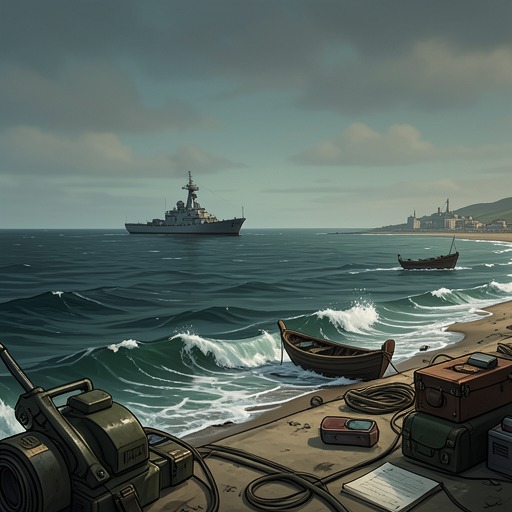
“A Russian lake”
Afterburn“A Russian lake” is more than a nickname for the Black Sea: it compresses a history of presumed Russian command into a phrase that American sailors repeat just as that command is being challenged. The expression’s blunt certainty becomes ironic as a U.S. carrier battle group prepares to enter waters where no such force has sailed before, and as the surrounding crisis makes the sea less a possession than a possible war zone.
Historical Weight of the Phrase
The phrase draws force from a remembered imbalance of power. The Black Sea had once been described as a Russian lake, and the narrative emphasizes how rarely foreign fleets of consequence had appeared there: not even the Nazis had stationed a fleet of any importance in its waters. To find a comparable challenge to that dominance, it looks back roughly a century and a half, to the British, French, and Turkish siege of Sevastopol. In this framing, “lake” does not mean a small or peaceful body of water. It suggests a bounded domain whose access and military balance have long seemed to belong to Russia.
That history makes the prospect of an American carrier group sailing into the Black Sea a break with precedent. The group’s arrival is presented as unprecedented, not as routine passage through an open international waterway. The old phrase therefore measures the scale of the change: a sea remembered as a Russian preserve is about to host a force that has never entered it before.
A Phrase Circulating Aboard Ship
As the carrier group approaches, “A Russian lake” has been circulating through wardrooms and squadron ready rooms alongside other nicknames, including “Lakeski Russki” and “Red Sea North.” The phrase belongs to shipboard talk rather than to a formal declaration of sovereignty. That setting matters: sailors handle the immense political and military stakes through compressed labels, testing the language of ownership in the spaces where crews prepare for operations.
Tombstone reminds himself that Romanians still call the Black Sea the “Friendly Sea,” as the ancient Greeks did. The contrast makes the competing names do more than decorate the scene. “Friendly Sea” preserves an older, gentler description; “A Russian lake” asserts strategic possession; “Red Sea North” and “Lakeski Russki” turn that assertion into informal gallows humor. None can make the water ahead benign. The gray waters are explicitly expected to be anything but friendly to the American battle group.
The phrase’s recurrence also gives it a double edge. It carries the authority of historical memory, but aboard an American force entering the sea it is repeated from the position of outsiders preparing to contest that inherited balance. The label can sound like an admission of Russian strength, a sardonic shorthand for the mission’s danger, or both at once. Its circulation does not settle who controls the Black Sea; it shows how power is being imagined and talked about before the carrier group arrives.
The Sea as a Contested Political Space
The later political debate complicates any picture of the region as a stable Russian domain. The United Nations hopes that a strong military presence can help defuse other problems in the area, while Turkey has repeatedly threatened to invade former Soviet Armenia. The Black Sea’s geography thus sits within a wider set of unresolved tensions: military presence is proposed as a means of preventing conflict, but the possibility of intervention also marks how close the region is to further escalation.
That contradiction becomes explicit when a senior official argues that the situation supports intervention to maintain peace and Admiral Scott challenges the premise: the whole area, he says, is tearing itself apart. The reply points out that Ukraine has not attacked yet and begins to argue for taking control, though the passage does not complete the proposal. The exchange makes “peace” a disputed political word rather than a condition everyone agrees already exists. Against that debate, “A Russian lake” sounds less like a settled fact than a claim made in a region where control, intervention, and the risk of war remain unsettled.
From Nickname to Warning
The danger grows concrete as the situation becomes more explosive day by day. If the northern half of the Black Sea, from Odessa to Gagra, becomes a war zone, movement by the UN-U.S. force could become difficult or perhaps impossible. The scale of that threatened closure gives the earlier shipboard phrase a practical consequence: a sea called a lake is not simply a metaphor for dominance, but a potential trap for the force entering it.
Later, a Russian statement calls attacks accidents caused by the well-known “fog of water,” while also insisting that foreign powers must not hinder the government’s purpose. In another exchange, Admiral Scott refuses to give in to Dmitriev’s demands, calling them extortion; the response turns to the fleet’s onboard stores, which can sustain it for many months. These episodes do not repeat “A Russian lake” verbatim, but they continue to stage the same struggle over who may act in these waters and on whose terms. The expression’s lasting significance lies in that tension: its familiar, almost casual wording carries an assumption of command, while the narrative repeatedly shows that command being challenged amid military danger, political dispute, and the prospect of isolation.