30 October, 1047 hours (Zulu +3)
The Fleet’s Decline
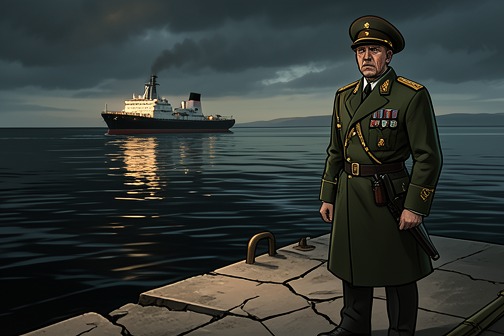
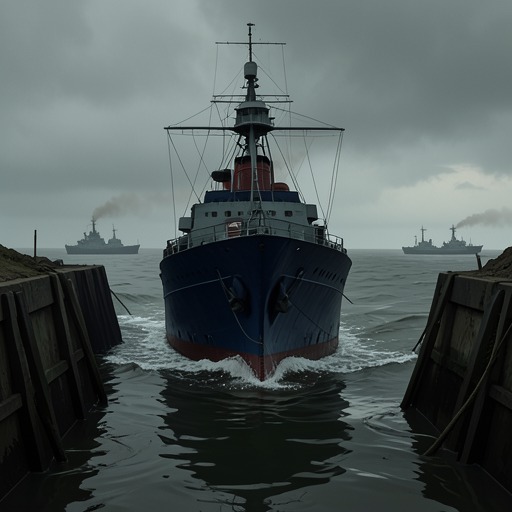
At [Sevastopol](entity:location-recall-location-1ff0e8513108), [Nikolai Sergeivich Dmitriev](entity:character-recall-character-nikolai-sergeivich-a74268581847) learns that an American carrier battle group is entering the [Black Sea](entity:location-recall-location-black-sea-180ad0f90007). Once treated as a Russian lake, these waters now expose how far the country and its navy have fallen: defections, mutinies, and neglect have left the [Russian Black Sea Fleet](entity:organization-recall-organization-775b6565b279) a shadow of its former strength.
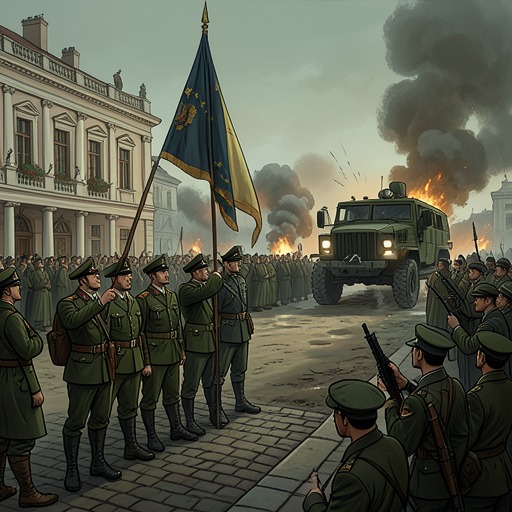
[Dmitriev](entity:character-recall-character-dmitriev-5949dbab485e) recalls the failed campaigns in [Norway](entity:location-recall-location-7fceb8f3598f) and the [Kola Peninsula](entity:location-recall-location-65d9188631cc), and the civil war between the [Reds](entity:organization-recall-organization-bca606c485dd) and [Blues](entity:organization-recall-organization-1e68b5946caf). He sees [Ukraine](entity:location-recall-location-579435a0d9f6), not the Americans, as the more immediate danger to [Crimea](entity:location-recall-location-14f700c5d2bf) and the fleet. Still, the American arrival is a final humiliation—and a sign that the old order is gone.
30 October, 1520 hours (Zulu +3)
The Carrier Enters the Straits
Aboard the Thomas Jefferson, Captain [Matthew Magruder](entity:character-recall-character-matthew-magruder-d0333efcc210) watches as the carrier moves through the [Bosporus Strait](entity:location-recall-location-4556bd2001f7), escorted by a Turkish frigate. The narrow passage leaves the ship unusually exposed: Turkish transit rules have grounded its aircraft, while most of the battle group has already entered the [Black Sea](entity:location-recall-location-black-sea-180ad0f90007).
Matthew Magruder and Captain [Jeremy Brandt](entity:character-recall-character-jeremy-brandt-015db4e53803) joke about the danger, but their unease is real. They have no clear picture of whether the Russians will tolerate the American presence, and the mission’s peacekeeping purpose seems uncertain even to the officers carrying it out.
30 October, shortly after the Bosporus transit
The Warning at the Helm
As the carrier clears the strait, its Turkish pilot warns [Matthew Magruder](entity:character-recall-character-matthew-magruder-d0333efcc210) and Captain [Jeremy Brandt](entity:character-recall-character-jeremy-brandt-015db4e53803) that the ship is an obvious, tempting target. The warning is indirect, but it sharpens their sense that the [Black Sea](entity:location-recall-location-black-sea-180ad0f90007) may be more dangerous than the planners in Washington have admitted.
The Turkish government has permitted passage while refusing American air basing, balancing its strained ties with the United States against its own regional concerns. The carrier is now beyond the narrow channel, but its limited room to maneuver and dependence on supply routes through [Turkey](entity:location-recall-location-c27b19c1bfda) remain serious vulnerabilities.
30 October, 1615 hours (Zulu +3)
A Frustrated Combat Ace
[Tricia Conway](entity:character-recall-character-tricia-conway-98a5a91ef6b4) struggles with the weak, lukewarm water in the carrier’s shower. The everyday irritation exposes the compromises women aboard the Thomas Jefferson still endure: separate facilities have improved matters, but privacy, harassment, and unequal treatment remain part of shipboard life.
She takes pride in her record as a combat aviator and in having proved herself during the Kola campaign. The Navy’s expanding opportunities have given her a career she loves, even as the ship’s routines remind her that acceptance is incomplete and often hard-won.
30 October, 1635 hours (Zulu +3)
A Submarine in the Wake
Sonarman [Brian Davies](entity:character-recall-character-brian-davies-8d73c678a94c) aboard the [USS Orlando](entity:object-recall-object-uss-orlando-4eb3834873b1) tracks a Russian Victor III submarine following the American group. Captain [Peter Lang](entity:character-recall-character-peter-lang-b2eb826883c2) orders his crew to remain in the target’s baffles, where the Russian boat’s own noise makes it harder to detect the American submarine.
The contact’s course will bring it toward the carrier. Lang knows the rules forbid firing on Russian units unless they fire first, but he also knows that a torpedo attack could leave no time to respond. The encounter turns an uneasy shadowing mission into a potentially lethal test of judgment.
30 October, 1710 hours (Zulu +3)
The Carrier Takes Station
Once outside Turkish territorial waters, the Thomas Jefferson launches its Combat Air Patrol and an [E-2C Hawkeye](entity:object-recall-object-e-2c-hawkeye-974e2d5f2d46). [Matthew Magruder](entity:character-recall-character-matthew-magruder-d0333efcc210) feels less exposed with the carrier’s airborne surveillance restored, though the confined sea still compresses the battle group’s defenses and leaves little room for mistakes.
The carrier must balance its [Georgia](entity:location-recall-location-b6801ed1f683) mission against the danger of provoking [Russia](entity:location-recall-location-e36341713c23) or [Ukraine](entity:location-recall-location-579435a0d9f6). Aircraft are sent to watch the sea and coastline, while the fleet’s commanders continue to operate under an uncertain truce and restrictive orders.
30 October, evening
The Georgia Mission
In the carrier’s air-traffic control center, [Matthew Magruder](entity:character-recall-character-matthew-magruder-d0333efcc210) reviews the deployment supporting the [United Nations](entity:organization-recall-organization-united-nations-ab3732a83729) effort in [Georgia](entity:location-recall-location-b6801ed1f683). [Marine Expeditionary Unit 25](entity:organization-recall-organization-marine-expeditio-4fb847dc7a3f) is offshore near [Poti](entity:location-recall-location-dce9a4f98cc1), ready to secure a port for relief supplies, while the carrier’s aircraft are meant to enforce a no-fly zone.
The mission has grown out of a complicated political bargain: [Turkey](entity:location-recall-location-c27b19c1bfda) has rejected American bases and overflights, and Washington has agreed to support a United Nations operation without a clear end state. The resulting assignment puts American forces between rival Russian factions, local militias, and competing regional ambitions.
30 October, 1735 hours (Zulu +3)
The Sonar Concert
The American battle group decides to make its presence unmistakable to the trailing submarine. Helicopters lower active sonar into the water, sending repeated pings through the Russian boat and warning its crew that it has been detected.
[Matthew Magruder](entity:character-recall-character-matthew-magruder-d0333efcc210) understands the maneuver as a coercive signal rather than an attack: the Americans want the submarine to leave their immediate vicinity. But with a Russian boat close to the carrier and the rules of engagement unclear in practice, even a warning can become the beginning of a fatal miscalculation.
30 October, 1757 hours (Zulu +3)
Vyatkin’s Decoy
Aboard the [Kislovodsk](entity:object-recall-object-kislovodsk-cb8efdd9b1e1), Captain First Rank [Aleksei Aleksandrovich Vyatkin](entity:character-recall-character-aleksei-aleksandrov-a80f64c4366c) refuses to retreat under the American sonar barrage. He orders his crew to prepare Kukla, a decoy torpedo designed to imitate the submarine’s sound as the real boat changes course.
Vyatkin hopes the deception will confuse the Americans long enough for his aging submarine to escape. The plan relies on the Americans interpreting the launch as a decoy rather than a weapon—an assumption that leaves no room for error.
30 October, 1758 hours (Zulu +3)
Orlando Fires
When sonar reports that the [Kislovodsk](entity:object-recall-object-kislovodsk-cb8efdd9b1e1) has opened its outer torpedo doors, [Peter Lang](entity:character-recall-character-peter-lang-b2eb826883c2) decides that waiting could cost the carrier hundreds of lives. He orders the [USS Orlando](entity:object-recall-object-uss-orlando-4eb3834873b1) to fire two wire-guided torpedoes at the Russian submarine.
The decision is made amid active sonar noise and incomplete information. Lang believes the enemy may be preparing to fire at the Thomas Jefferson, but the American crew cannot immediately distinguish a real attack from Vyatkin’s decoy. The torpedoes are already on their way before that uncertainty can be resolved.
30 October, 1758–1804 hours (Zulu +3)
The Kislovodsk Breaks Apart
The American torpedoes cripple the [Kislovodsk](entity:object-recall-object-kislovodsk-cb8efdd9b1e1), flooding its aft compartments and destroying its propeller and steering. Vyatkin orders an emergency surface and tries to keep the boat afloat, but the damaged submarine tears apart near its reactor compartment.
Many crew members escape into the sea, and the Americans quickly begin rescue operations. The attack was triggered by a mistaken interpretation of the decoy, but the rescue effort complicates the moral and political aftermath: the American fleet has destroyed a Russian submarine and is now saving its survivors.
30 October, 2245 hours (Zulu +3)
Dmitriev Hears the Report
General [Sergei Andreevich Boychenko](entity:character-recall-character-sergei-andreevich-b-7fd4c7562d2b) tells [Nikolai Sergeivich Dmitriev](entity:character-recall-character-nikolai-sergeivich-a74268581847) that the Americans have reported the [Kislovodsk](entity:object-recall-object-kislovodsk-cb8efdd9b1e1) sunk by accident. Sixty-eight survivors have been rescued, and the injured are receiving treatment aboard the carrier.
Rather than immediately report the incident to [Novgorod](entity:location-recall-location-419d4802fb43), Boychenko asks [Dmitriev](entity:character-recall-character-dmitriev-5949dbab485e) where he stands in the Russian civil war. He says [Crimea](entity:location-recall-location-14f700c5d2bf) is doomed if left to face [Ukraine](entity:location-recall-location-579435a0d9f6) alone and reveals his plan to surrender the [Crimean Military District](entity:organization-recall-organization-crimean-military-a400977ed24a) to the [United Nations](entity:organization-recall-organization-united-nations-ab3732a83729). Dmitriev is stunned by the proposal.
31 October, morning
A New Pilot’s First Mistake
During a patrol over [Georgia](entity:location-recall-location-b6801ed1f683), [Tom Mason](entity:character-recall-character-tom-mason-c9a187dcfeb0) and [Kathleen Garrity](entity:character-recall-character-kathleen-garrity-a5e78e29210a) are directed toward an unidentified aircraft following a [United Nations](entity:organization-recall-organization-united-nations-ab3732a83729) helicopter. A ground radar paints their Tomcat, and Tom Mason catches only a brief rear view of what he believes is a hostile Hind gunship.
The aircraft is actually a United States Army Black Hawk escorting [UN](entity:organization-recall-organization-e95d8c5557b2) Flight 27. The confusion is made worse by missing identification codes and poor coordination between services. Mason reports a hostile target, and [Matthew Magruder](entity:character-recall-character-matthew-magruder-d0333efcc210)’s experienced squadron commander, [Edward Everett Wayne](entity:character-recall-character-edward-everett-wayn-eebfe5e380e1), must decide whether to trust the report.
31 October, 0930 hours (Zulu +4)
The Black Hawk Goes Down
[Edward Everett Wayne](entity:character-recall-character-edward-everett-wayn-eebfe5e380e1) fires an AIM-9 at the supposed Hind. The missile strikes the rotor of the [UH-60 Black Hawk helicopter of UN Flight 27](entity:object-recall-object-un-flight-27-uh-60-bla-b266d967f036) rather than its engine, forcing [Marty Cole](entity:character-recall-character-marty-cole-1e82bd6f83ec) to fight the damaged aircraft down into a rough valley landing.
Cole and his crew escape before the helicopter catches fire, but the incident leaves the Navy confronting a friendly-fire disaster. [Tom Mason](entity:character-recall-character-tom-mason-c9a187dcfeb0) is shaken by the realization that he identified an American aircraft as an enemy, while Wayne struggles with the responsibility of having authorized the shot.
31 October, late morning
The Debriefing
[Matthew Magruder](entity:character-recall-character-matthew-magruder-d0333efcc210) questions the four aviators involved in the mistaken shootdown. The inquiry reveals that the Black Hawk’s external weapons mounts resembled a Hind’s pylons, but also that [Tom Mason](entity:character-recall-character-tom-mason-c9a187dcfeb0) saw what he expected to see and that [Kathleen Garrity](entity:character-recall-character-kathleen-garrity-a5e78e29210a) never got a visual confirmation.
Matthew Magruder declines immediate disciplinary action but removes Tom Mason from no-fly-zone patrols for several days. He insists that the incident be documented fully, knowing that the missing identification data and interservice failures matter as much as individual judgment. The mistake has become a public and operational liability.
31 October, around noon
The Women’s Place in the Wing
[Edward Everett Wayne](entity:character-recall-character-edward-everett-wayn-eebfe5e380e1) and [Tricia Conway](entity:character-recall-character-tricia-conway-98a5a91ef6b4) discuss the resentment within the squadron over Conway’s appointment as executive officer under [Directive 626](entity:rule-recall-rule-directive-626-11a40d92217d). Conway has authority on paper, but several men believe seniority and experience were bypassed, and others are uncomfortable bringing personal problems to a woman superior.
Wayne recognizes that the tensions are not easily dismissed as simple prejudice: the women have earned respect in combat, yet the policy has also created anger about preferential treatment. The exchange shows how institutional reforms and real operational trust remain entangled aboard the carrier.
31 October, 1342 hours (Zulu +4)
Tomboy Returns to the Carrier
[Joyce Flynn](entity:character-recall-character-joyce-flynn-041ace0c900d) arrives aboard the Thomas Jefferson after recovering from a broken leg sustained during the Kola campaign. Her return lifts the spirits of her old squadron, but it also reminds [Willis E. Grant](entity:character-recall-character-willis-e-grant-967986cf8093) of the brutal cost of women’s service in combat.
Grant hears that [Chris Hanson](entity:character-recall-character-chris-hanson-05f4ad71d6ea), captured and sexually assaulted during the Kola operation, has returned to flying and is seeking a combat assignment. Her determination challenges the Navy’s instinct to protect her by keeping her away from danger, while the memories of [Steve Strickland](entity:character-recall-character-steve-strickland-a42e4a79f9fb)’s death show how rescue and loyalty can become fatal choices.
31 October, afternoon
A Command Under Strain
[Matthew Magruder](entity:character-recall-character-matthew-magruder-d0333efcc210) and [Willis E. Grant](entity:character-recall-character-willis-e-grant-967986cf8093) discuss the strain of running the air wing from staff positions instead of the cockpit. They also worry that the short deployment, stretched supplies, and political decisions are putting the carrier group under pressure before its mission has even stabilized.
Magruder’s thoughts turn to [Pamela Drake](entity:character-recall-character-pamela-drake-7a5a10737f29) and to [Joyce Flynn](entity:character-recall-character-joyce-flynn-041ace0c900d), whose shared combat experience has created a deep bond. The personal questions are not separate from the operation: long deployments shape marriages, loyalties, and the ambitions of officers whose careers keep pulling them away from home.
2 November, 1047 hours (Zulu -5)
The White House Debate
At the White House, [Robert Heideman](entity:character-recall-character-robert-heideman-798bcda046bb) and [Samantha Reed](entity:character-recall-character-samantha-reed-dde4170d9b2c) argue that the [United Nations](entity:organization-recall-organization-united-nations-ab3732a83729) should take operational command of the American forces involved in the proposed Crimean transfer. They see the arrangement as a way to strengthen international peacekeeping and simplify coordination after the submarine and helicopter incidents.
[Brandon Scott](entity:character-recall-character-brandon-scott-b850693a4d34) and [Admiral Thomas Magruder](entity:character-recall-character-admiral-thomas-magr-c971bbc0717b) warn that placing American forces under foreign command risks American lives and national sovereignty. [Herb Waring](entity:character-recall-character-herb-waring-27dcc69bda41) ultimately favors exploring the proposal, treating the crisis as an opportunity to give the United Nations real military authority. The debate sets the political terms for the next phase of the story.
3 November, morning
Operation John Paul Jones
[Rear Admiral Douglas E. Tarrant](entity:character-recall-character-rear-admiral-dougla-a3bbd778a9d3) briefs the officers of the battle group on Washington’s decision to accept Boychenko’s request. The carrier group and its attached forces are to support a [United Nations](entity:organization-recall-organization-united-nations-ab3732a83729) takeover of [Crimea](entity:location-recall-location-14f700c5d2bf), while the Marines are recalled from [Georgia](entity:location-recall-location-b6801ed1f683) and held as a mobile reserve.
Tarrant tells his officers that the United Nations envoy will direct the operation. The room erupts in protest, but Tarrant insists that the force will obey the President’s decision and treat United Nations personnel with respect. The mission is named [Operation John Paul Jones](entity:event-recall-event-operation-john-paul-jon-480afed5065a), invoking a naval officer who once served a foreign sovereign.
3 November, after the briefing
The Press Assignment
Commander Daniel Sykes asks [Matthew Magruder](entity:character-recall-character-matthew-magruder-d0333efcc210) to accompany the admiral’s staff ashore as a liaison with the press. He reveals that [Pamela Drake](entity:character-recall-character-pamela-drake-7a5a10737f29) is coming to [Crimea](entity:location-recall-location-14f700c5d2bf) to cover the operation, and the assignment gives Magruder a personal reason to accept.
The request is unusual because an admiral could simply order a captain to go. Tarrant instead frames it as a volunteer role, hoping Magruder’s connection to a prominent journalist will help the Navy handle the attention surrounding the recent incidents and the coming transfer.
4 November, morning
Dmitriev’s Counterplan
[Nikolai Sergeivich Dmitriev](entity:character-recall-character-nikolai-sergeivich-a74268581847) prepares a fleet operation intended to preserve Russian control and prevent the Crimean forces from simply being absorbed into the [United Nations](entity:organization-recall-organization-united-nations-ab3732a83729). His aide, Anton Kulagin, warns that the plan could provoke the Americans, Ukrainians, and Turkish forces all at once.
[Dmitriev](entity:character-recall-character-dmitriev-5949dbab485e) argues that the American president is politically weak and unlikely to risk war. He believes the United States will ultimately accept a fait accompli. His determination to hold the fleet and [Crimea](entity:location-recall-location-14f700c5d2bf) together sets him on a collision course with Boychenko’s effort to surrender the district.
4 November, 1332 hours (Zulu +3)
The Yalta Landing
[Matthew Magruder](entity:character-recall-character-matthew-magruder-d0333efcc210) arrives in [Yalta](entity:location-recall-location-a964e45cef34) with a small American party aboard a [CH-53 Sea Stallion](entity:object-recall-object-ch-53-sea-stallion-d30efb1a27d1). The party includes naval staff, Marines, translators, and [Joyce Flynn](entity:character-recall-character-joyce-flynn-041ace0c900d), while Russian officers and the [United Nations](entity:organization-recall-organization-united-nations-ab3732a83729) envoy’s aide, Jorge Luis Vargas y Vargas, meet them at the airport.
Vargas insists that the Americans wear United Nations insignia and berets, treating protocol as a condition of their presence. Magruder is surprised by the brusque reception and by how quickly a military mission has become a diplomatic performance, with foreign journalists already gathering in the city.
4 November, afternoon
A City in Decline
At the [Yalta Hotel](entity:location-recall-location-f2d29990fc32), [Matthew Magruder](entity:character-recall-character-matthew-magruder-d0333efcc210) sees a city that retains its warm seaside beauty but bears the visible marks of [Russia](entity:location-recall-location-e36341713c23)’s collapse. Tourism has dried up, public spaces are shabby, and poverty and black-market activity have become difficult to ignore.
An attempted solicitation in the hotel stairwell brings the economic devastation into intimate focus. Magruder declines to engage, recognizing that the surrounding group may be looking for an easy target. The encounter leaves him with a sharper sense of what political collapse means for ordinary people.
4 November, afternoon
The Reunion with Pamela
[Matthew Magruder](entity:character-recall-character-matthew-magruder-d0333efcc210) finds [Pamela Drake](entity:character-recall-character-pamela-drake-7a5a10737f29) interviewing [Joyce Flynn](entity:character-recall-character-joyce-flynn-041ace0c900d) in the hotel lobby. Their reunion is cool rather than joyful: [Pamela](entity:character-recall-character-pamela-05f0d95797ac) is surprised that he has come ashore, while Magruder had imagined the meeting as a chance to repair their relationship.
After Pamela leaves for a meeting, Flynn offers to show Magruder the town. Their walk brings back memories of their earlier travels and their shared experience in the [Kola Peninsula](entity:location-recall-location-65d9188631cc). Magruder senses the emotional intimacy between them, even as his engagement to Pamela remains unresolved.
4 November, evening
The Breakup Dinner
During dinner at the [Swallow’s Nest](entity:location-recall-location-2fef432956ab), [Pamela Drake](entity:character-recall-character-pamela-drake-7a5a10737f29) tells [Matthew Magruder](entity:character-recall-character-matthew-magruder-d0333efcc210) that she cannot continue their relationship. She loves him, but she cannot live with the long absences and uncertainty of a Navy life, and she will not give up her own career to become a service wife.
Magruder argues that [Pamela](entity:character-recall-character-pamela-05f0d95797ac) expects him to sacrifice the career that defines him while asking nothing similar of herself. The exchange ends without a reconciliation. They part with affection still present, but with the relationship’s future closed off.
4 November, late evening
The Stairwell Mugging
After the painful dinner, [Matthew Magruder](entity:character-recall-character-matthew-magruder-d0333efcc210) takes the hotel stairs rather than ride an elevator. A teenage mugger blocks his way with a knife and demands money.
Magruder disarms and knocks the boy unconscious, then breaks the knife against the wall. The brief violence is a stark counterpoint to his failed attempt to save his relationship: he can act decisively against an immediate threat, but the personal losses he faces cannot be solved by force.
5 November, 0940 hours (Zulu +3)
The Transfer Ceremony
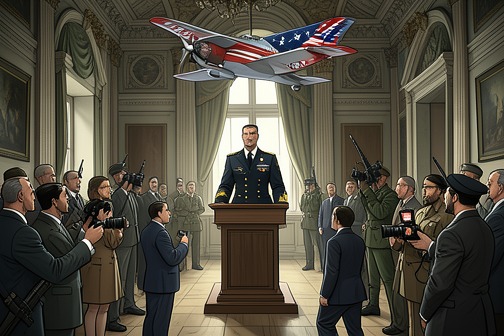
At [Livadia Palace](entity:location-recall-location-646dcd2f93d0), [Sergei Andreevich Boychenko](entity:character-recall-character-sergei-andreevich-b-7fd4c7562d2b) prepares to transfer the [Crimean Military District](entity:organization-recall-organization-crimean-military-a400977ed24a) to the [United Nations](entity:organization-recall-organization-united-nations-ab3732a83729). The ceremony is framed as a negotiated assumption of responsibility rather than a surrender, with promises that Russian troops will be repatriated.
[Matthew Magruder](entity:character-recall-character-matthew-magruder-d0333efcc210) sits among the officials and journalists, including [Pamela Drake](entity:character-recall-character-pamela-drake-7a5a10737f29), while American aircraft patrol overhead. He doubts that speeches can secure lasting peace, especially with [Ukraine](entity:location-recall-location-579435a0d9f6) watching and the armed forces in [Crimea](entity:location-recall-location-14f700c5d2bf) divided over Boychenko’s decision.
5 November, during the ceremony
The Assassins Attack
Three attackers break from the crowd at [Livadia Palace](entity:location-recall-location-646dcd2f93d0) and open fire on the stage. [Matthew Magruder](entity:character-recall-character-matthew-magruder-d0333efcc210) tackles Boychenko behind the podium, shielding him as bullets strike the officials and the platform.
The assault leaves Captain Greg Whitehead and Special Envoy Sandoval dead, with [Rear Admiral Douglas E. Tarrant](entity:character-recall-character-rear-admiral-dougla-a3bbd778a9d3) and others wounded. Magruder attacks one gunman when the man’s weapon fails, helping stop the immediate threat. The attempted killing shatters the planned handover and turns the ceremony into a hostage-like crisis.
5 November, shortly after the attack
The Tatar Explanation
[Matthew Magruder](entity:character-recall-character-matthew-magruder-d0333efcc210) helps treat [Abdulhalik](entity:character-recall-character-abdulhalik-0034b0f6fce8), who has been wounded while defending the stage. Abdulhalik suspects Crimean Tatar nationalists carried out the attack, hoping to advance their claim to a homeland in [Crimea](entity:location-recall-location-14f700c5d2bf).
Magruder doubts that the explanation makes sense: killing Boychenko would likely invite retaliation without bringing the Tatars closer to independence. He begins to suspect that the assassination may be part of a larger political operation, though the evidence is not yet clear.
5 November, around 1006 hours (Zulu +3)
The Bridge Is Destroyed
Russian aircraft launch missiles at the [Bosporus Bridge](entity:location-recall-location-d747a7f8472d), smashing its supports and dropping much of the span into the shipping channel. Vehicles and pedestrians are hurled into the water, and debris blocks the route between the [Black Sea](entity:location-recall-location-black-sea-180ad0f90007) and the [Sea of Marmara](entity:location-recall-location-60c175445123).
The attack cuts the carrier group’s most important exit and threatens its supply line. The destruction is not merely a blow to Turkish infrastructure: it traps the American ships in a confined sea where aviation fuel and maneuvering room are finite.
5 November, shortly after the bridge attack
The Tanker Burns
The [Falcon Patriot tanker](entity:object-recall-object-falcon-patriot-41e88fe12e82) is struck while passing through the straits. Missiles rupture its fuel cargo and ignite a spreading fire; the captain steers toward shallow water in an effort to keep the burning ship from sinking in the channel.
The tanker’s loss deprives the Thomas Jefferson battle group of millions of gallons of aviation and diesel fuel. With the bridge wreckage blocking passage, the fleet’s ability to fly and maneuver has become a countdown, and the possibility of a deliberate attempt to immobilize it becomes difficult to ignore.
5 November, shortly before the attacks are confirmed
Coyote’s Intercept Decision
Aboard the Thomas Jefferson, [Willis E. Grant](entity:character-recall-character-willis-e-grant-967986cf8093) must redirect the available Combat Air Patrol after radar detects a heavily jammed group of aircraft approaching the straits. He sends [Tom Mason](entity:character-recall-character-tom-mason-c9a187dcfeb0)’s flight to investigate and moves other fighters to cover the carrier and the [Yalta](entity:location-recall-location-a964e45cef34) party.
Grant’s choice is made with little certainty and with the ceremony still underway. When reports arrive that the bridge has been destroyed and the tanker is burning, he recognizes that the unknown aircraft were part of a coordinated attack. [Matthew Magruder](entity:character-recall-character-matthew-magruder-d0333efcc210) is still ashore, and Grant must manage the crisis as acting air-wing commander.
5 November, 1009–1010 hours (Zulu +3)
The First Air Battle
[Tom Mason](entity:character-recall-character-tom-mason-c9a187dcfeb0) and his wingman close on the unidentified aircraft, only to be caught in a much larger engagement. Russian fighters emerge through electronic jamming, launch missiles, and force the American Tomcats to defend themselves while trying to identify the attackers.
Tom Mason recognizes a MiG-29 among the hostile aircraft, but neither he nor his wingman can determine whether the attackers are Russian or Ukrainian. The encounter ends the fiction that the operation can remain a quiet peacekeeping mission: American and Russian aircraft are now exchanging fire over the [Black Sea](entity:location-recall-location-black-sea-180ad0f90007).
5 November, late morning
The Carrier Group Is Trapped
The bridge attack, tanker loss, and fighting in the air leave the Thomas Jefferson and its escorts trapped in the [Black Sea](entity:location-recall-location-black-sea-180ad0f90007) with dwindling fuel. Washington has not given clear orders, and the fleet’s commanders must consider the possibility that the shore party cannot be recovered soon.
A Russian broadcast from [Dmitriev](entity:character-recall-character-dmitriev-5949dbab485e) declares Boychenko a traitor and claims that the American group has been neutralized. Dmitriev presents the attacks as accidents while offering to cooperate against [Ukraine](entity:location-recall-location-579435a0d9f6), an attempt to reshape the crisis as an invitation rather than an act of coercion.
6 November, 0847 hours (Zulu -5)
Washington Delays Rescue
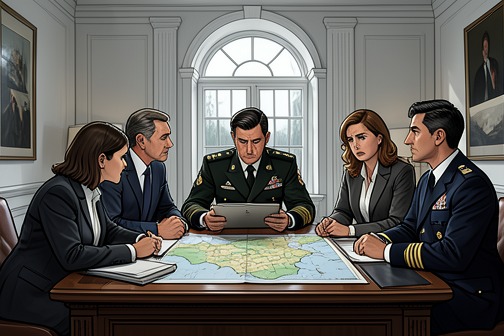
At the White House, [Dmitriev](entity:character-recall-character-dmitriev-5949dbab485e)’s proposal divides the advisers again. [Samantha Reed](entity:character-recall-character-samantha-reed-dde4170d9b2c) and [Herb Waring](entity:character-recall-character-herb-waring-27dcc69bda41) consider whether cooperation with [Russia](entity:location-recall-location-e36341713c23) might secure the carrier group and prevent a wider war; [Brandon Scott](entity:character-recall-character-brandon-scott-b850693a4d34) rejects any deal that rewards attacks on American forces.
[Admiral Thomas Magruder](entity:character-recall-character-admiral-thomas-magr-c971bbc0717b) explains how quickly the fleet’s fuel reserves could run out and argues for clearing the straits by force. The political leadership hesitates, preferring negotiations with Russia and [Turkey](entity:location-recall-location-c27b19c1bfda) to immediate action. The delay leaves the people ashore and the trapped ships dependent on decisions made far away.
6 November, morning and afternoon
The Shore Party Is Stranded
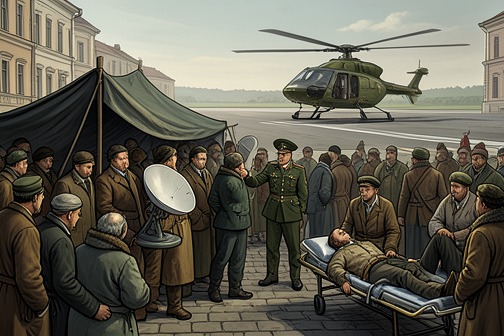
Fighting between forces loyal to [Boychenko and Dmitriev](entity:relation-recall-relation-boychenko-dmitriev-747e65eeb7e9)’s naval units traps more than a hundred [United Nations](entity:organization-recall-organization-united-nations-ab3732a83729) personnel, Americans, and journalists in [Yalta](entity:location-recall-location-a964e45cef34). Flights are canceled, helicopters are grounded, and the wounded—including Tarrant—need better medical care than the city can provide.
[Matthew Magruder](entity:character-recall-character-matthew-magruder-d0333efcc210) uses the [American Cable News](entity:organization-recall-organization-american-cable-n-fae59436f0b0) satellite equipment to establish a communications link to the fleet. He learns that [Jeremy Brandt](entity:character-recall-character-jeremy-brandt-015db4e53803) has taken command of the battle group and that [Willis E. Grant](entity:character-recall-character-willis-e-grant-967986cf8093) is now its air-wing commander. The group must plan for extraction while assuming that Washington may not act quickly enough.
6 November, afternoon
Operation Ranger Takes Shape
[Jeremy Brandt](entity:character-recall-character-jeremy-brandt-015db4e53803) gathers the battle group and Marine commanders to plan their options. The group cannot simply withdraw, since the straits are blocked and the force remains under attack; its first priority is to recover the shore party and the wounded.
[Willis E. Grant](entity:character-recall-character-willis-e-grant-967986cf8093) describes the air threat and the fuel crisis, while the staff considers how to create a safe corridor for helicopters. The operation is named [Operation Ranger](entity:event-recall-event-operation-ranger-d0b5ef2b12a2). Even the commanders’ jokes about digging a canal cannot conceal how little freedom of action remains.
7 November, 0145 hours (Zulu +3)
Dmitriev’s Attack Plan
[Nikolai Sergeivich Dmitriev](entity:character-recall-character-nikolai-sergeivich-a74268581847) learns that Boychenko and many of his followers have escaped [Yalta](entity:location-recall-location-a964e45cef34) and are moving east toward [Kerch](entity:location-recall-location-d572923c0fae). He realizes the American battle group is also heading for the strait, likely to help Boychenko’s troops cross into [Russia](entity:location-recall-location-e36341713c23).
[Dmitriev](entity:character-recall-character-dmitriev-5949dbab485e) orders a fleet sortie to intercept the Americans near the [Taman Peninsula](entity:location-recall-location-e9bc54a222c1). He believes their aircraft have nearly exhausted their fuel and that the carrier can be forced into surrender. His plan turns the rescue movement into a race toward a potential decisive battle.
6 November, late evening
The Night Evacuation
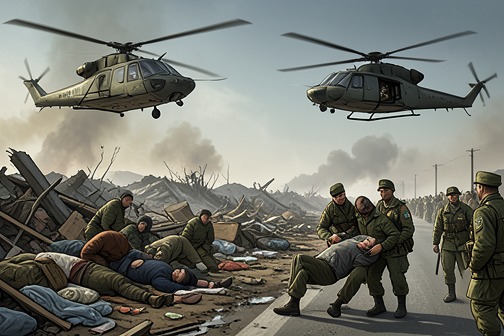
Under fighter cover and after a major air strike suppresses Russian positions near [Yalta](entity:location-recall-location-a964e45cef34), Marine helicopters land to evacuate the wounded and many of the civilians and [United Nations](entity:organization-recall-organization-united-nations-ab3732a83729) personnel. [Rear Admiral Douglas E. Tarrant](entity:character-recall-character-rear-admiral-dougla-a3bbd778a9d3) is carried out unconscious, while [Matthew Magruder](entity:character-recall-character-matthew-magruder-d0333efcc210) remains behind to oversee the operation with Boychenko.
[Joyce Flynn](entity:character-recall-character-joyce-flynn-041ace0c900d) is ordered back to the carrier to fly, despite her anger at being sent away from the ground operation. [Pamela Drake](entity:character-recall-character-pamela-drake-7a5a10737f29) chooses to stay, insisting that her work as a reporter is independent of the military chain of command. The evacuation is only partial: Boychenko’s soldiers must still escape overland toward [Kerch](entity:location-recall-location-d572923c0fae).
6 November, after the helicopter evacuation
Boychenko’s Convoy Moves East
Boychenko gathers loyal soldiers, vehicles, and a small contingent of American personnel for the long drive from [Yalta](entity:location-recall-location-a964e45cef34) toward [Kerch](entity:location-recall-location-d572923c0fae). Their route follows the Crimean coast and then turns across the peninsula toward the [Kerch Strait](entity:location-recall-location-e4ee365b0323).
The convoy is exposed to pursuit and air attack, and the journey depends on the Americans maintaining enough air cover to keep [Dmitriev](entity:character-recall-character-dmitriev-5949dbab485e)’s forces at a distance. Boychenko’s men have been promised a route home, but they do not know that their commander intends to seek asylum rather than remain with them.
7 November, before sunrise
The Carrier Launches for Kerch
The Thomas Jefferson moves northeast toward the [Kerch](entity:location-recall-location-d572923c0fae) area while aircraft launch into the darkening-to-dawn sky. [Joyce Flynn](entity:character-recall-character-joyce-flynn-041ace0c900d), now back in an F-14 with Bruce Kosinski, prepares to enter the crowded airspace over [Crimea](entity:location-recall-location-14f700c5d2bf).
Flynn’s resentment at being ordered away from the shore party gives way to focus once she is back in the cockpit. She recognizes that this is where she can contribute most: the rescue and landing depend on air superiority, and the carrier group cannot act without it.
7 November, 0744 hours (Zulu +3)
The Arsincevo Target
Near [Arsincevo](entity:location-recall-location-a94cbdc2a0fe), [Matthew Magruder](entity:character-recall-character-matthew-magruder-d0333efcc210) surveys the refinery, naval port, airfield, and fuel storage facilities. Boychenko has revealed that some tanks hold aviation fuel compatible with the carrier’s JP-5, making the complex a possible answer to the fleet’s desperate shortage.
Securing the facility could restore the carrier group’s ability to operate, but it would require a landing in range of Russian troops and a ground battle between rival Russian forces. Magruder realizes that the success of the entire rescue operation may depend on taking this vulnerable fuel source.
7 November, 0745 hours (Zulu +3)
The Russian Column Advances
Colonel [Yuri Nikolaivich Yevtushenko](entity:character-recall-character-yuri-nikolaivich-ye-195ec254c1d9) leads Russian naval infantry from the [Kerch naval base](entity:location-recall-location-4c1ef7065c81) toward the [Arsincevo](entity:location-recall-location-a94cbdc2a0fe) area. His men are confident, and he believes Boychenko’s forces are traitors abandoning [Crimea](entity:location-recall-location-14f700c5d2bf) to [Ukraine](entity:location-recall-location-579435a0d9f6).
The column includes tanks and armored carriers, and Yevtushenko expects to stop the convoy before it reaches the strait. He has heard that American forces may be involved, but considers the naval infantry more than capable of dealing with them.
7 November, from 0750 hours (Zulu +3)
The Landing at Arsincevo
Marine forces come ashore at [Arsincevo](entity:location-recall-location-a94cbdc2a0fe) in amphibious vehicles and hovercraft, while helicopters and aircraft strike Russian communications, defenses, and airfields. The landing is designed to seize the refinery and confuse the defenders rather than destroy every Russian position.
The speed and combined force of the operation let the Marines secure the beach and much of the complex before organized resistance can form. The landing gives the Americans a foothold near the fuel supply, but it also brings them into direct conflict with Russian naval infantry advancing from [Kerch](entity:location-recall-location-d572923c0fae).
7 November, 0835 hours (Zulu +3)
Friendly Fire on the Ridge
American aircraft mistake part of Boychenko’s convoy for hostile forces and bomb vehicles near the ridge. [Matthew Magruder](entity:character-recall-character-matthew-magruder-d0333efcc210) and [Pamela Drake](entity:character-recall-character-pamela-drake-7a5a10737f29) take cover as explosions tear through the area; the ACN van is destroyed, but the people nearby survive.
The attack shakes Boychenko’s troops and forces Magruder to explain that the Americans are struggling to distinguish friendly Russian forces amid a crowded battle. Their lack of visible identification panels has turned a preventable coordination problem into another friendly-fire incident.
7 November, shortly after 0835 hours (Zulu +3)
The Ridge Is Cut Off
Boychenko’s column reaches a ridge near the [Arsincevo complex](entity:location-recall-location-7d2158d21eee) and finds Russian naval infantry blocking the route to the beach. The defenders have armored vehicles and favorable ground, while Boychenko’s Spetsnaz are supposed to be a blocking force, not a formation ready for a prolonged battle.
Magruder warns that helicopters cannot land under fire and that the Americans cannot extract anyone until the ground threat is reduced. The shore party, the convoy, and the Marines are now tied to the outcome of the fight on the ridge.
7 November, from 0840 hours (Zulu +3)
The Air Battle over Kerch
Russian aircraft converge on the Marine landing and the American ships, attacking from the north and west. Tomcats and Hornets meet the incoming formations, and the sky fills with missile trails as the fight develops into a sprawling air battle.
The American fighters have the advantage of long-range weapons, but the number of attackers and the tight operating area make every gap dangerous. The battle protects the landing force and the ships, yet it also burns through aircraft fuel at the moment the fleet can least afford to waste it.
7 November, 0905 hours (Zulu +3)
The Carrier Takes on Fuel
The Thomas Jefferson ties up at an offshore fueling dock near the [Arsincevo complex](entity:location-recall-location-7d2158d21eee). With aircraft operations suspended and its close-in weapons systems placed on standby to reduce the risk of igniting fuel vapors, the carrier begins pumping aviation gasoline aboard.
The ship is exceptionally vulnerable during the transfer, relying on its fighters for protection. The fuel operation is the strategic purpose of the landing: if it succeeds, the carrier group can continue to operate rather than become an immobile target trapped in the [Black Sea](entity:location-recall-location-black-sea-180ad0f90007).
7 November, 0904–0906 hours (Zulu +3)
Ivanov Breaks Through
[MiG-27](entity:object-recall-object-mig-27-ce097f7654fa) pilot [Yevgenni Sergeivich Ivanov](entity:character-recall-character-yevgenni-sergeivich-5b58ffd3f230) evades [Tom Mason](entity:character-recall-character-tom-mason-c9a187dcfeb0)’s heat-seeking missile, then slips low over the refinery and toward the ships. His objective is the fueling carrier, whose defensive systems are constrained while fuel is being transferred.
Tom Mason and [Kathleen Garrity](entity:character-recall-character-kathleen-garrity-a5e78e29210a) detect that the aircraft is locking onto the Thomas Jefferson. [Joyce Flynn](entity:character-recall-character-joyce-flynn-041ace0c900d) is nearby but has little ammunition left. The attack becomes a race between Ivanov’s ship-killer missiles and the American fighters’ ability to stop them before they reach the carrier.
7 November, 0907 hours (Zulu +3)
Phoenix Against the Kerry
Ivanov fires two AS-7 Kerry anti-ship missiles at the Thomas Jefferson. [Tom Mason](entity:character-recall-character-tom-mason-c9a187dcfeb0) abandons his chance to shoot down the attacking MiG and directs [Kathleen Garrity](entity:character-recall-character-kathleen-garrity-a5e78e29210a) to target the missiles instead.
The Phoenix interceptors destroy the threat just before one missile can strike the carrier’s flight deck. The close call prevents a catastrophic explosion among aircraft and fuel vapors, and demonstrates that the battle group’s remaining fighters can still protect the ship despite the mounting strain.
7 November, 0908–0909 hours (Zulu +3)
Flynn’s Duel with Ivanov
[Joyce Flynn](entity:character-recall-character-joyce-flynn-041ace0c900d) pursues Ivanov after he evades her Sidewinder. The two pilots meet in a close, twisting aerial contest, each trying to predict the other’s next move as their aircraft climb and roll around one another.
At near-stalling speed, Flynn lets her F-14 slip sideways long enough to bring the [MiG-27](entity:object-recall-object-mig-27-ce097f7654fa) across her gunsight. She fires the cannon into Ivanov’s wing, destroying his aircraft. In the instant before the kill, Ivanov sees the name Joyce Flynn on the Tomcat and realizes that the pilot he has been fighting is a woman.
7 November, around 0912 hours (Zulu +3)
Flynn’s Ground Attack
After using her last missiles, [Joyce Flynn](entity:character-recall-character-joyce-flynn-041ace0c900d) responds to [Matthew Magruder](entity:character-recall-character-matthew-magruder-d0333efcc210)’s request for help on the ridge. She dives low over the Russian tanks blocking the route and strafes them with the F-14’s cannon.
Her attack damages several tanks and helps break the immediate pressure on Boychenko’s position. The fighter was built for air combat, but Flynn turns it into an improvised ground-support aircraft because the people on the ridge have run out of better options.
7 November, shortly after 0912 hours (Zulu +3)
Flynn Is Hit
A Russian antiaircraft vehicle opens fire as [Joyce Flynn](entity:character-recall-character-joyce-flynn-041ace0c900d) makes another pass over the ridge. Her F-14 is hit, and smoke streams from the aircraft as she heads toward the sea with an engine fire.
Flynn tells [Matthew Magruder](entity:character-recall-character-matthew-magruder-d0333efcc210) that she cannot return safely to the carrier while it is still taking on fuel. She and Bruce Kosinski plan to eject over the water, leaving Magruder on the ground with the convoy and the battle still unresolved.
7 November, shortly after 0910 hours (Zulu +3)
The American Shore Party Holds
[Matthew Magruder](entity:character-recall-character-matthew-magruder-d0333efcc210) and the American personnel remain on the ridge as Boychenko’s Spetsnaz hold off repeated assaults by naval infantry. Magruder has taken a dead Russian’s rifle but has no desire to join the battle; he orders the Americans to avoid fighting unless they have no alternative.
He and [Pamela Drake](entity:character-recall-character-pamela-drake-7a5a10737f29) sit amid the mud and casualties, and Magruder admits that he still loves her. Her silence makes clear that the relationship has ended. Meanwhile, [Doc Ellsworth](entity:character-recall-character-doc-ellsworth-0674f6c1fe42) establishes a connection to the aircraft tactical channel, giving Magruder a way to communicate with the fighters overhead.
7 November, 0912–0913 hours (Zulu +3)
The Ridge Attack Is Broken
Guided by [Matthew Magruder](entity:character-recall-character-matthew-magruder-d0333efcc210)’s report, [Joyce Flynn](entity:character-recall-character-joyce-flynn-041ace0c900d) makes strafing passes against the tanks advancing up the ridge. Her attacks break the formation and give Boychenko’s forces a chance to hold their ground.
Flynn’s aircraft is hit during the action, but her intervention helps prevent the naval infantry from overrunning the position. [Pamela Drake](entity:character-recall-character-pamela-drake-7a5a10737f29) recognizes how naturally Magruder and Flynn understand one another’s world, and gently suggests that Flynn may be better suited to him than she is.
7 November, after the fighting begins
The White Palace Party Reaches the Carrier
Marine helicopters recover the wounded and the remaining civilians from the [Yalta](entity:location-recall-location-a964e45cef34) area, carrying [Rear Admiral Douglas E. Tarrant](entity:character-recall-character-rear-admiral-dougla-a3bbd778a9d3) and others toward the amphibious ships. The extraction works because the American air cover has cleared a temporary route through the contested airspace.
[Joyce Flynn](entity:character-recall-character-joyce-flynn-041ace0c900d) and Bruce Kosinski eject over the sea after their damaged aircraft cannot safely reach the carrier. The rescue operation removes many of the most vulnerable people, but [Matthew Magruder](entity:character-recall-character-matthew-magruder-d0333efcc210) and Boychenko’s troops remain committed to the ground movement toward [Kerch](entity:location-recall-location-d572923c0fae).
7 November, after the Kerch battle
The Carrier Group Refuels
The American forces secure the fuel facilities near [Kerch](entity:location-recall-location-d572923c0fae) and transfer aviation gasoline to the Thomas Jefferson. The carrier’s renewed supply lets it resume flight operations and makes a prolonged attempt to trap it far less likely to succeed.
The landing and fuel seizure turn the balance of the crisis. The American group can now protect the evacuation and confront the Russian fleet, rather than having to choose between defending itself and conserving the last of its fuel.
7 November, after the Battle of Kerch
The Pobedonosnyy Rodina Is Lost
As the American battle group moves out from [Kerch](entity:location-recall-location-d572923c0fae), the [USS Orlando](entity:object-recall-object-uss-orlando-4eb3834873b1) detects the approaching [Pobedonosnyy Rodina](entity:object-recall-object-pobedonosnyy-rodina-ea5c577bb72a). The submarine launches Tomahawk missiles from beyond the Russian carrier’s immediate reach.
The Russian flagship is destroyed before it can engage the Americans, and its escorts turn back. The loss ends [Dmitriev](entity:character-recall-character-dmitriev-5949dbab485e)’s hope of using the carrier to force a decisive result and marks the destruction of the last major symbol of Russian naval power in the [Black Sea](entity:location-recall-location-black-sea-180ad0f90007).
7 November, after the carrier is destroyed
Dmitriev Seeks Asylum
[Nikolai Sergeivich Dmitriev](entity:character-recall-character-nikolai-sergeivich-a74268581847) is pulled from the sea by the Americans and asks for asylum aboard the Thomas Jefferson. His confrontation with the carrier has ended in defeat, and his own fleet’s flagship is gone.
[Dmitriev](entity:character-recall-character-dmitriev-5949dbab485e) is reunited, in a sense, with an American force he once worked beside. His change of allegiance reflects the collapse of the Russian chain of command and leaves open the question of what he and Boychenko will make of their shared predicament.
15 November, 0945 hours
The Battle Group Leaves the Black Sea
After engineers and Seabees clear the Bosporus channel, the Thomas Jefferson begins its return passage through the [Bosporus Strait](entity:location-recall-location-4556bd2001f7). [Matthew Magruder](entity:character-recall-character-matthew-magruder-d0333efcc210) is back on the bridge, and Captain [Jeremy Brandt](entity:character-recall-character-jeremy-brandt-015db4e53803) is beside him as the carrier leaves the confined waters behind.
The operation has restored the carrier’s fuel, evacuated the shore party, and defeated the immediate Russian attack, but [Crimea](entity:location-recall-location-14f700c5d2bf) remains contested and Ukrainian forces are moving onto the peninsula. The [United Nations](entity:organization-recall-organization-united-nations-ab3732a83729)’ claim to protect the region has not prevented the next struggle from beginning.
15 November, during the return passage
A Different Sense of Home
[Matthew Magruder](entity:character-recall-character-matthew-magruder-d0333efcc210) watches the carrier’s crew conduct a foreign-object-damage walk-down across the flight deck. The ritual reminds him how a tiny loose object can imperil an aircraft—and how a carrier group, for all its power, can alter events only through the work of thousands of people.
Magruder no longer doubts that he belongs in the Navy. The ties he shares with the people who serve and fly beside him outweigh the uncertainty that had made civilian life seem attractive. Though the ship is still far from home port, he understands that he is already home.