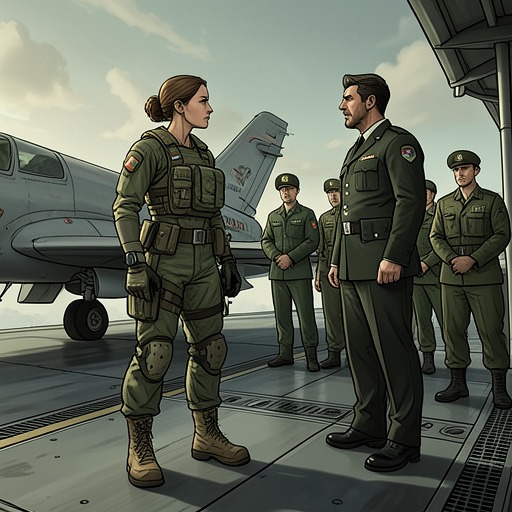
Kola Intervention
AfterburnThe Kola Intervention was the United States’ military entry into the far north during the revived Union’s collapse, when American forces seized key facilities on the Kola Peninsula amid the civil war between Leonov’s Blues and Krasilnikov’s Reds. Presented as a response to a nuclear threat, it was also an intervention on Russian soil with a charged historical precedent; its memory shadows later American movement into the Black Sea.
Background and stated rationale
As the revived Union began to disintegrate, Leonov’s Popular Democratic Front, the Blues, was locked in an all-out civil war with Marshal Krasilnikov’s hard-line Reds. American forces intervened in the far north, taking control of key military facilities on the Kola Peninsula. The stated justification was that Krasilnikov planned to use submarine-launched nuclear weapons to blackmail Leonov into submission. The account also places the intervention in the context of longstanding American anti-Communist sentiment and Western hopes for the success of Leonov and his anti-Communists. The nuclear rationale and the political alignment are both part of the intervention’s meaning: the operation was framed as preventing nuclear coercion while materially affecting the struggle between the Russian factions.
Historical precedent and Russian memory
The intervention was described as only the second time in that century that Western troops had set foot on Russian soil. The first was in 1919, when Western troops joined a small international force during the upheaval surrounding the Revolution. Few outside Russia still remembered that earlier episode, but the narrative stresses that Russians had long memories. The comparison makes the Kola operation more than a remote military action: it places American troops in a recurring history of foreign intervention that remained vivid in Russian political memory even when it had faded elsewhere.
Echoes in the Black Sea crisis
That memory returns when the Jefferson leads a battle group through the Dardanelles and into the Black Sea. The carrier’s passage recalls the Kola Intervention and is perceived as a fresh insult to Russia, prompting the thought that striking back would be satisfying. The passage thus connects an earlier American intervention in the north to a later naval deployment in the south: the military circumstances differ, but the remembered precedent shapes how the new presence is understood.
Legacy in American policy
The intervention also forms part of the background to continuing debate over American forces operating under United Nations command. During the later crisis, the Jefferson was sent toward the waters off the Georgian port of Poti to add its air wing to the United Nations’ pressure, while the question of placing American forces under United Nations commanders remained contested. The National Command Authority had, in the meantime, specified that American forces were not to enter the fighting between the Reds and Blues. These later policies are not presented as direct consequences of the Kola operation; rather, they show the fraught setting in which American intervention recurs, balancing international commitments and domestic limits against the risk of becoming involved in Russia’s internal conflict.