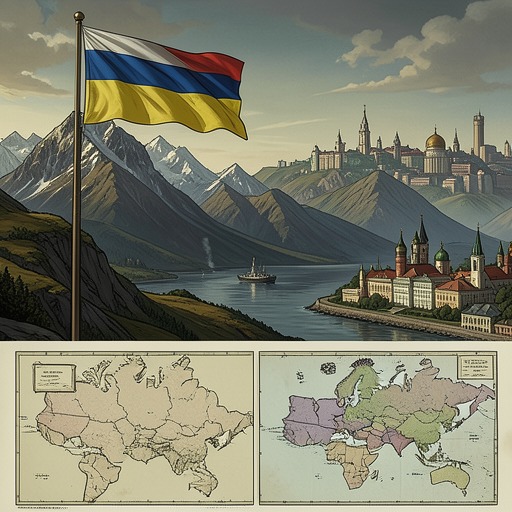
Transfer of Crimea to Ukraine in the 1950s
AfterburnThe Transfer of Crimea to Ukraine in the 1950s is recalled as a political gesture whose meaning changes with the fortunes of the state that made it: what once seemed inconsequential within the Soviet system becomes, in Russia’s later crisis, a source of vulnerability and renewed contest over Crimea.
The transfer and its original meaning
In the 1950s, Nikita Khrushchev formally returned Crimea to Ukraine, presenting the act as one of international goodwill and fellowship. The book emphasizes the gap between that public meaning and its contemporary practical effect: within Soviet politics, the transfer was treated as a largely symbolic gesture, even a public-relations maneuver, because the peninsula remained inside the same state.
A gesture made consequential
That internal political setting does not last. The retrospective account places the transfer against a later Russia unable to defend itself across numerous crumbling fronts. In that weakened position, the earlier goodwill becomes a major problem: it gives Ukraine an opening to settle old scores and to gain at Russia’s expense. Dmitriev’s wry judgment is that Ukraine needs no encouragement; he expects its attention to turn southward. The transfer’s significance therefore lies not only in the territory’s formal assignment, but in how a decision once considered politically harmless can become consequential when the surrounding state order changes.
The Black Sea’s material constraints
The book’s later naval episodes do not present the 1950s transfer as the direct cause of a carrier’s supply crisis. They do, however, make the strategic setting around Crimea tangible. A modern carrier such as the Jefferson requires replenishment of expendables every two to three weeks. Although nuclear-powered, it still depends on fuel for its aircraft, and its available supplies can last no more than ten days—less during heavy flight operations, a major alpha strike, or a prolonged battle. Its regular resupply depends on UNREP tankers.
The danger of losing access is made explicit when the closing of the Bosporus Strait would leave the Jefferson and its escorts with only two to four days of leeway under sustained operations. After that, the ships would be trapped in the Black Sea and unable to continue effectively. A later estimate describes the scale of one attempted solution: nearly three million gallons, or about nine thousand tons, of aviation gasoline had to be pumped aboard, with flight-deck operations suspended during the transfer. These logistical details belong to the book’s later crisis, not to the 1950s act itself; alongside the political recollection, they show how territorial questions in the Black Sea unfold within a region where access and supply routes can determine what military power can actually sustain.