Dissolution of the Soviet Union
AfterburnThe Dissolution of the Soviet Union is not depicted as a clean transfer of power but as a collapse that failed to end the conflicts it had set loose. Economic decline and failed political settlements give way to a revived but unstable Union, civil war, and renewed competition over Ukraine and Crimea; in the Black Sea, that political fracture is felt not only in territorial claims but in the practical vulnerability of military forces.
Collapse and attempted revival
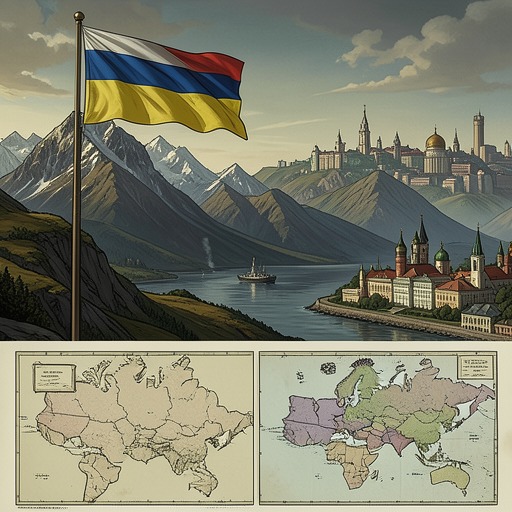
The account traces the old Soviet Union’s collapse to a chain of political and economic failures. After Gorbachev withdrew from Europe, he lost control of the reforms intended to limit the damage from a failing economy. Yeltsin did little better: Soviet Republics were allowed to go their own way, compromises with the West were described as fatal, and the economy continued its descent.
Hard-liners, old Communists, and right-wing Nationalists then united around a project of restoring order and ousted Yeltsin. They installed a figurehead ruler resembling Gorbachev at the head of a revived Soviet Union. But this compromise regime also failed to stabilize the country. The attempt to restore the Union thus produced no durable settlement: the political structure was renewed in name while the underlying crisis remained.
Civil war and renewed fragmentation
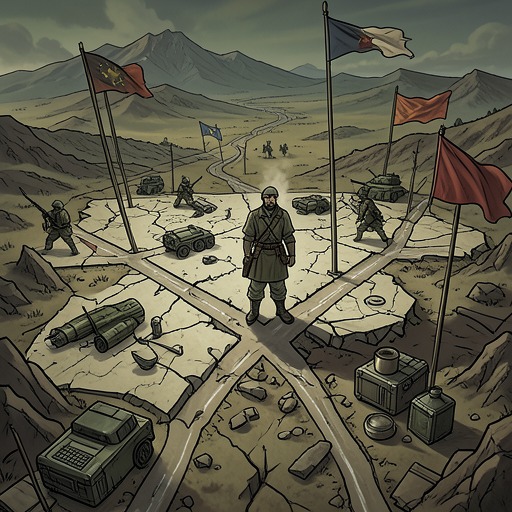
As the revived Union began to disintegrate, Leonov’s Popular Democratic Front, known as the Blues, was locked in an all-out civil war with Marshal Krasilnikov’s hard-line Reds. The conflict makes the dissolution more than a change in government: competing claims to order and authority become armed struggle, while the state’s capacity to hold together its territory weakens further.
The United States intervened in the far north, seizing key military facilities on the Kola Peninsula as the crisis deepened. The Americans claimed Krasilnikov was planning to use something, but the account in the available passage does not specify what. The seizure nevertheless shows how the internal breakdown had become entangled with foreign military action.
Ukraine and the Crimea dispute
The dissolution also sharpens the unresolved place of Ukraine within and beyond the former Union. Ukraine had never been wholly comfortable as one of its largest and most productive republics; the narrative stresses that ethnic Ukrainians were not Russians, whatever outsiders might assume. During the Russian Civil War, Ukrainians used the turmoil to strengthen their position, especially in Crimea.
The peninsula was generally considered part of Ukraine, while the Russian Federation bordered it to the east. The broader crisis leaves that geography politically contested: the old dispute between Ukraine and Russia over ownership of Crimea and the Black Sea Fleet remains, and with Russia occupied by civil war, Ukraine appears poised to settle the question. The passage establishes the heightened stakes and the opportunity created by Russian weakness, but does not establish a final resolution.
The Black Sea crisis in practice
The later Black Sea crisis gives these political disputes a concrete logistical dimension. A modern carrier such as the Jefferson needs replenishment of expendable supplies every two to three weeks. Although nuclear-powered and not dependent on fuel for its own propulsion, its aircraft consume fuel rapidly: the available reserve would last no more than ten days, and less under a heavy flight schedule or an extended running battle. With flight operations continuing around the clock, that margin could shrink to two to four days.
Once those supplies ran out, the Jefferson and its escorts would be trapped in the Black Sea by the closure of the Bosporus Strait and reduced to what the narrative calls large, expensive, useless toys. When Samantha Reed asks whether the force can be reached and resupplied, Magruder distributes estimates to the officials at the table. A later refueling effort involves pumping nearly three million gallons, about nine thousand tons, of aviation gasoline aboard after the fuel is judged suitable for the carrier. These details do not resolve the political origins of the crisis; they show how the region’s contested control and blocked routes turn political fracture into an immediate limit on military endurance.