Joseph II’s Ban on Ballet in Opera
AmadeusJoseph II’s Ban on Ballet in Opera is a court edict whose meaning becomes the center of a struggle over artistic form and institutional authority. In the dispute over the dance in Act III of Wolfgang Amadeus Mozart’s The Marriage of Figaro, the prohibition is invoked to cut music that Mozart regards as essential to the action; the resulting silence makes the cost of that decision visible. The episode ends not with the rule’s disappearance but with Joseph II directing that the music be restored, distinguishing an imposed interpretation from the Emperor’s own judgment.
Court Policy and the Ban
The prohibition belongs to a court culture in which rulers and officials shape what may be commissioned and performed. Earlier, Johann von Strack conveys Joseph II’s wish to commission a comic opera in German as part of an effort to establish a national opera featuring works in German. Count Orsini-Rosemberg, the director of the opera, objects to abandoning Italian, while Gottfried van Swieten questions the purpose of comic music. That exchange establishes a wider institutional argument about operatic language and genre. The later dispute over dance is a separate test of court control: it concerns what may remain inside a particular work once its score is under review.
The ban is presented as Joseph II’s rule against ballet in his operas. When Count Orsini-Rosemberg examines Mozart’s score, he points specifically to the dance in Act III and treats it as prohibited ballet. The distinction at issue is not whether the scene contains dancing, but whether a dance that belongs to the story should be treated as the kind of ballet the edict excludes. The rule’s practical force therefore depends on interpretation as well as on its authority: the director claims the right to apply it, while Mozart disputes how broadly it should reach.
The Score as a Site of Conflict
Antonio Salieri turns the prohibition into a tactical opportunity. After asking Count Orsini-Rosemberg whether the third act contains a ballet, he reminds him that the Emperor has forbidden ballet in opera. The director understands the implication. This exchange frames the ensuing intervention as more than an abstract disagreement about definitions: a specific rule is brought to bear on Mozart’s score through the people empowered to inspect and alter it.
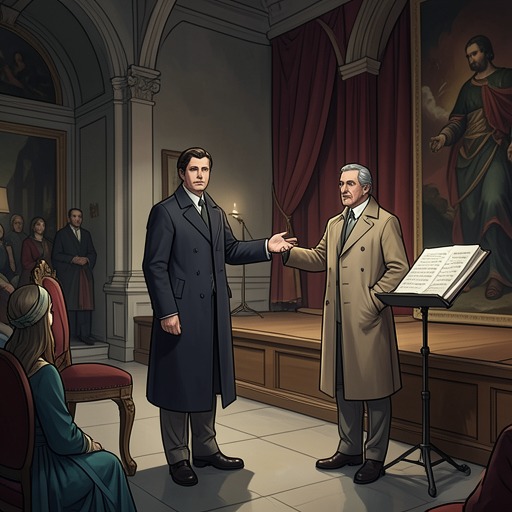
Count Orsini-Rosemberg asks Mozart to bring him the score and has it placed in his hand. He then identifies the third-act passage as a violation. Mozart answers that it is not a ballet but a dance at Figaro’s wedding. He argues that Joseph II’s law was intended to prevent the insertion of pointless ballets of the kind associated with French opera, not to remove dancing that forms part of the story. In Mozart’s account, the wedding dance is dramatically necessary; in the director’s account, the Emperor’s edict leaves no room for Mozart to interpret its limits.
The disagreement becomes a physical alteration of the work. Count Orsini-Rosemberg tears the offending pages out of the score and tells Mozart to obey imperial orders. Antonio Salieri and Johann von Strack watch from the darkness. Mozart protests that removing the passage will leave a large void at the story’s climax, then recognizes Salieri’s hand in the maneuver. The scene makes the ban tangible: its enforcement is not merely a notice or a stated policy, but pages removed from a composer’s work, with an immediate structural consequence for the drama.
The Silent Dance and Imperial Judgment
The consequences become apparent when the opera reaches the point where the dance should begin. The orchestra stops at the censored passage, while the dancers perform without music. Joseph II arrives at precisely this point and watches the silent pantomime, visibly perplexed. He asks whether the scene is modern; Mozart says it is not, then explains that the director removed a dance that was meant to occur there. The interruption supplies a practical demonstration of Mozart’s argument: the cut does not simply eliminate an optional divertissement but leaves the wedding scene conspicuously incomplete.
Count Orsini-Rosemberg defends his decision by invoking the Emperor’s own rule against ballet in opera. Mozart again distinguishes this dance, which belongs to a wedding banquet in the story, from an inserted ballet. Joseph II initially observes that the scene looks strange as presented and says that he cannot say he likes it. His response registers the consequence of enforcement without immediately settling the dispute over the edict’s scope.
Johann von Strack then warns that restoring the passage could establish a precedent, leading to hours of dancing in opera. Joseph II rejects that concern as an insurmountable obstacle: he believes the court can prevent such a consequence while still allowing Mozart’s music. He orders the music put back and insists on hearing Mozart’s music complete. Count Orsini-Rosemberg complies, and Mozart celebrates the reversal by throwing himself at Joseph II’s feet and kissing his hand, repeating the excessive gesture of gratitude associated with their earlier meeting.
Meaning and Limits
The episode shows that the ban is neither a neutral technical instruction nor an automatically self-applying constraint. Its force passes through court officials who can use it to cut a score, but its application remains answerable to the ruler who issued it. Count Orsini-Rosemberg treats the prohibition as covering the wedding dance; Mozart argues for a narrower reading based on dramatic function; Joseph II ultimately sides with restoring the passage after seeing the effect of its removal.
That resolution does not repeal the ban or establish that every dance in an opera is permissible. Joseph II’s decision is specific to Mozart’s music and to the distinction between an inserted ballet and a dance required by the action. The warning about a precedent makes clear that the question of limits remains alive even after the order to restore the score. In dramatic terms, the rule first appears to silence the work at its climax, then becomes the occasion for the Emperor to judge the difference between formal compliance and theatrical sense. Its significance lies in that collision: a court edict can regulate artistic form, but its meaning is contested through the very performance it seeks to control.