La música como voz de Dios
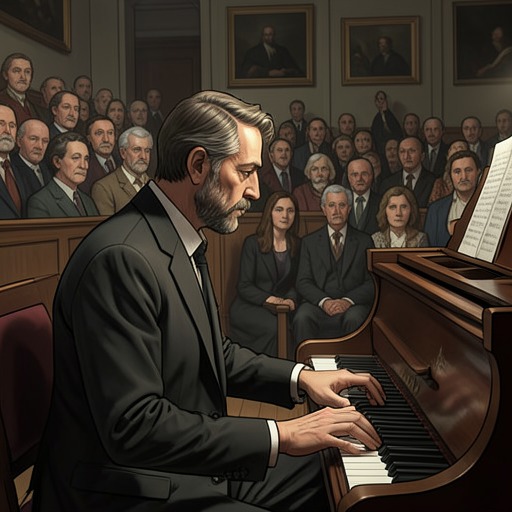
AmadeusLa música como voz de Dios names the belief that organizes Salieri’s ambition and then overturns it: music is not merely an art through which he hopes to become famous, but the means by which he expects to serve God and the medium through which he hears God’s presence. Its decisive contradiction is that Salieri’s disciplined devotion does not make him the voice of the divine. Instead, he hears that voice in the work of Wolfgang Amadeus Mozart, whose manners and conduct he finds unworthy of the privilege. The concept therefore links artistic perception to faith, merit, and an increasingly bitter struggle over who has been chosen to speak for God.
A Devotional Ideal and a Bargain
Salieri’s understanding of music begins in childhood. He distinguishes it from other arts because, in his view, a musical note is right or wrong in a way that time cannot alter. Music’s authority seems absolute: it is, to him, God’s art. As a boy of ten, perfect sequences of notes could make him dizzy; by twelve, he was quietly composing arias and antiphons addressed to the Lord. He wanted to join the Italian composers who had praised God through music, making artistic ambition inseparable from religious service.
At sixteen, Salieri turns this ideal into an explicit bargain. He kneels before a painted image of an austere, deal-making God and asks to become a famous composer. In return, he promises to live virtuously, remain chaste, improve the lot of his fellow human beings, and honor God with music throughout his life. The image matters: Salieri imagines divine favor as an exchange with clear terms, and he reads the subsequent arrival of a family friend who takes him to Vienna and pays for his musical education as evidence that the bargain has been accepted. The protection he later receives from the Emperor of Austria appears to confirm that interpretation.
This early confidence makes music more than a profession or a route to public renown. Salieri understands his craft as a continuing act of praise and his personal discipline as the moral condition of that service. He wants fame, but fame is supposed to certify a larger purpose: a life made useful to others and dedicated to a divine source. The faith built on this exchange will be tested not by a failure to work, but by the possibility that work and virtue do not determine who receives artistic power.
Hearing Mozart as a Divine Voice
The test begins when Salieri hears Mozart’s serenade from beyond a closed door. At first he is too horrified to attend closely. Then the music’s Adagio in A-flat becomes unmistakable: a low pulse from bassoons and clarinets, followed by a single high oboe note that hangs in the air before a clarinet softens it into a phrase. Salieri describes the sound as producing an unfamiliar pain, at once unsatisfied and wholly fulfilling. He leaves the room, runs down the stairs, and reaches the cold night air, asking God what this sound demands and whether it is the music God loves.
The scene turns listening into revelation. Salieri concludes that he has heard God’s voice, but that it comes through a young man whose voice he also knows and whose vulgarity he cannot reconcile with sacred purpose. The conflict is not simply between two composers. Salieri’s religious framework makes Mozart’s music evidence about God: if the music is divine, then Mozart’s apparent lack of virtue and decorum cannot disqualify him from being its vehicle. The very sound that confirms Salieri’s belief in music as God’s art begins to destroy his belief that divine favor follows the moral terms he has fulfilled.
The revelation returns when Salieri opens the folder of Mozart’s original scores. He expects to see the labor and correction through which a composition takes shape, but the pages appear clean, without revisions. They seem to record music already complete in Mozart’s mind. As Salieri reads, different works sound onstage: the opening of a symphony, a violin-and-viola concertante passage, music for flute and harp, and then the Kyrie from the Mass in C Minor. The staging makes the score’s apparent completeness audible and visible. Salieri sees a structure so exact that moving a note would weaken it and shifting a phrase would bring the whole design down.
This second encounter changes recognition into judgment. The serenade, Salieri realizes, was no accident: the scores reveal the same concentrated harmonies and painful delights in abundance. The music grows into a force that overwhelms him; he drops the folder and collapses. When he rises, he interprets the experience as knowledge of his fate. He believes that God has given him the desire and perception necessary to recognize incomparable art, only to make that recognition expose his own mediocrity.
Music as a Dramatic and Social Art
The play also gives the idea a public, theatrical dimension. When Joseph II commissions a comic opera in German, Johann von Strack explains that the Emperor wants to establish a national opera and hear works in German. Count Orsini-Rosemberg objects to German as the language of opera, while Gottfried van Swieten questions why music should serve comedy at all. Their disagreement shows that music’s meaning is contested through institutions as well as private belief: language, genre, and the authority to decide what belongs onstage all shape what an audience is permitted to hear.
Mozart argues for a different kind of musical truth when defending a comic opera based on ordinary people and a recognizable place. He wants the stage to attend to the intimate, bodily details of everyday life rather than limiting opera to gods and heroes. He also explains music’s capacity to represent several people’s thoughts at once. A dramatic writer would have to present those thoughts successively; a vocal ensemble can make them sound simultaneously, while allowing the audience to distinguish them. Mozart imagines an expanding ensemble in which multiple voices combine into a new sound, comparing that totality to how God might hear the world.
In this account, music’s relation to God is not only a matter of inspiration descending upon a solitary composer. It is also a formal power to gather many separate lives and inner voices into a shared, comprehensible whole. Mozart calls this the composers’ task: combining the thoughts of different people and transforming the audience into something like God. Salieri watches, fascinated. The explanation gives dramatic form to the revelation he has experienced in sound: what he understands as divine music is also a way of hearing human multiplicity without reducing it to a single voice.
Performance, Recognition, and Rejection
The difference between Salieri’s professional craft and Mozart’s apparently effortless invention becomes visible when Mozart is given Salieri’s welcome march. Mozart sets the manuscript where he cannot see it, recalls the march from memory, and then starts altering it. Dissatisfied with an interval, he tries another; from that adjustment he develops the tune into an exuberant, increasingly elaborate march. Salieri maintains a composed smile, but the performance exposes the distance between musical competence and spontaneous invention. Mozart does not appear conscious of the insult his transformation causes.
The same tension governs the court performance of Mozart’s opera. The ballet music has been removed, so the dancers perform in silence when the orchestra stops at the cut. Joseph II asks whether the passage is modern; Mozart answers that it is not. The Emperor orders the music restored, despite Count Orsini-Rosemberg’s protest. Salieri then listens to the restored acts and is moved by the final scene, in which a wife, disguised in her maid’s clothes, hears her husband speak tenderly to her because he mistakes her for someone else. He recognizes the reality of the human problem and the artifice through which opera makes it legible. Yet his tears give way to the sight of Joseph II yawning and to the Emperor’s instruction that Mozart should remove repetitions because the scenes are too long. Artistic recognition and institutional approval remain distinct.
For Salieri, that distinction sharpens into an accusation against God. He insists that he has worked hard, cultivated the talent he was given, and tried to help others, yet the divine voice he longs to hear speaks, in his interpretation, through Mozart. Mozart’s childish laughter, crude speech, and apparent indifference to serving other people deepen Salieri’s sense of injustice rather than weakening his recognition of the music. He names God his eternal enemy and vows to obstruct Mozart on earth. The concept that once joined art, virtue, and service thus becomes the ground of a war: Salieri still treats music as God’s voice, but he rejects the justice of the choice he believes that voice has made.
The Unfinished Voice
The idea reaches its starkest final image as Mozart lies dying. Constanze Mozart returns to care for her husband and speaks to him about their life, their children, and the day of their marriage. As the Lacrimosa from the Requiem begins, Mozart sits up, listens, and weakly marks the measure with his hand. He appears to be composing in his head and no longer hears his wife’s words. The music’s divine or transcendent claim is set beside the intimate human life around it: a wife pleading for her husband to recover, and a composer whose attention is fixed on the unfinished work.
Mozart dies before the great Amen chord is completed; the chord persists in an echo. The ending does not settle the theological question that has governed Salieri’s understanding. It does, however, return the concept to its central tension: music can seem to exceed ordinary speech and individual effort, yet it is heard through vulnerable human bodies and remains entangled with relationships, institutions, and death. For Salieri, that sound has become proof both of Mozart’s extraordinary gift and of his own exclusion. La música como voz de Dios therefore describes not a stable doctrine but a painful interpretive conviction: music makes the divine seem audible, while leaving the listener to confront the unequal, troubling terms on which that voice appears to have been given.