Rauhensteingasse
AmadeusRauhensteingasse is the address attached to the Mozart household’s increasingly precarious life, and, onstage, the exposed domestic counterpart to Salieri’s comfortable apartment. The number 970 is given as the family’s address; the surrounding scene makes the location matter through what happens inside it: Constanze Mozart enters visibly pregnant, Mozart writes music amid manuscripts and bottles, and the household has no firewood. The apartment gives poverty a physical presence while Mozart’s artistic work and Salieri’s scrutiny continue within sight of it.
Address and domestic circumstances
The family has changed homes again by the time Rauhensteingasse is named. The exchange about the move treats it as evidence of worsening circumstances: one observer concludes that the Mozarts must be desperate, and another calls the place a genuine hovel. Salieri then asks whether Mozart earns anything besides the money provided by his position. The question connects the address to the family’s insecurity without supplying a precise account of its income or explaining why the move occurred. What the scene establishes is the pressure surrounding the household: repeated relocation, a poor dwelling, and uncertainty about whether Mozart’s post can sustain them.
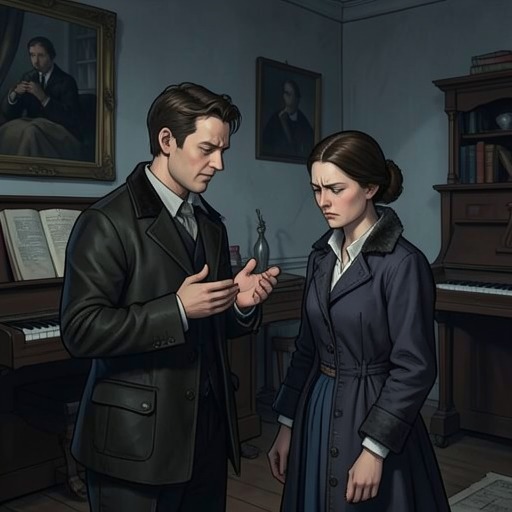
The stage directions make that pressure concrete. Constanze Mozart enters from the rear looking tired, wearing a padded apron that indicates the advanced state of her pregnancy. She sits opposite Mozart on an ordinary stool, wrapped in a shawl. Mozart is also wrapped in a blanket as he sits at his table and begins writing music. Constanze says she is cold and that there is no firewood for the fire. The deprivation is not merely reported as a general condition: it governs the bodies and clothing onstage while work goes on. The household’s need for warmth remains unresolved as Mozart turns to composition.
The apartment made visible
Rauhensteingasse is presented not as an isolated room but as one side of a deliberately arranged double scene. As the gold emblem is removed, the production reveals both apartments at once. The Mozart side contains a long, ordinary table loaded with manuscripts and bottles, as well as an ordinary stool turned upside down during the stage change. Across the stage, servants place a small golden table, a full cake stand, and three golden chairs from Salieri’s shining salon. The material distinction is built into the objects: the Mozart apartment is furnished with ordinary, utilitarian pieces; Salieri’s space gleams with gold and abundance.
That contrast shapes how the audience reads the address. The cramped domestic setting and the luxurious salon are not left to separate scenes, where their difference might be forgotten; the production keeps them in view together. Salieri sits in one of his golden chairs and eats a cake while Mozart sits at the plain table, wrapped in a blanket and writing. The stage picture makes unequal comfort simultaneous. Rauhensteingasse therefore functions as more than a named residence: it is the visible measure of the distance between Mozart’s household and the security represented by Salieri’s rooms.
Work, secrecy, and observation
The apartment is also where Mozart’s musical labor and his dangerous disclosure meet. Salieri tells the audience that Mozart confided everything to him: initiation ceremonies, blindfolded ceremonies, and rituals copied from the Vienna Freemasons. He interprets the disclosure as Mozart preparing his own destruction, in a house where life grows more horrible each day. The account places secret knowledge beside the ordinary domestic objects and hardship of Rauhensteingasse. The apartment is at once a home in distress and the setting in which Mozart has trusted Salieri with information that Salieri believes may turn the Vienna Freemasons against him.
The scene’s arrangement complicates Salieri’s position as observer. He comments on Mozart’s condition and describes the apartment’s deterioration, but he is not sharing the household’s cold: he sits in the golden salon and eats while Mozart writes and Constanze Mozart shivers. The two spaces remain close enough for the contrast to be legible, yet their occupants experience sharply different material conditions. Salieri’s account of the Mozart home thus carries both knowledge and distance; he can describe its misery while watching from comfort.
Poverty and artistic persistence
At Rauhensteingasse, Mozart’s work does not pause for the household’s hardship. The manuscripts are already on the table, and the stage direction shows him beginning to write as Constanze Mozart sits opposite him. Her lack of firewood and his blanket establish the immediate conditions of composition without suggesting that the scene resolves them. Instead, the location holds practical need and artistic activity together: music is being written in a home that the characters describe as a hovel and associate with desperation.
Mozart’s brief acknowledgment of his father’s prediction gives that poverty a personal and familial dimension. He says that his father had been right and that they have ended as beggars. The statement turns the apartment’s visible privation into the fulfillment of an earlier warning, while the scene offers no escape from the present circumstances. Rauhensteingasse consequently concentrates several pressures at once: repeated moves, inadequate means, pregnancy, cold, and Mozart’s continuing work. Its dramatic significance lies in that conjunction, and in the stage’s refusal to let the household’s vulnerability disappear behind the brilliance of Salieri’s neighboring rooms.