Schönbrunn Palace
AmadeusSchönbrunn Palace gives the play a recurring stage for imperial authority, turning court decisions about music and employment into visible acts of power. Its golden mirrors and great fireplace frame a world in which access to the Emperor can shape an artist’s prospects, while Salieri’s position within that world lets him influence what the court offers—and withholds.
Setting and Stage Image
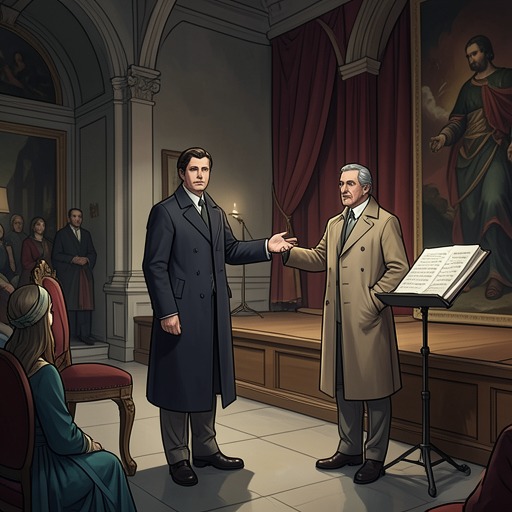
The palace is presented through sharply composed stage pictures rather than as a broadly described building. In one scene, Johann von Strack, Count Orsini-Rosemberg, and Gottfried van Swieten stand rigidly at the back of the stage in the illuminated “Light Box,” while Salieri remains lower down. Johann von Strack hands the Emperor’s written instruction to the Opera Director: a comic opera in German is to be commissioned from Wolfgang Amadeus Mozart. The arrangement places the court’s officials and its command above Salieri, making the palace’s hierarchy part of the scene’s visual meaning.
Another entrance shifts the lights to Joseph II, standing before golden mirrors and a fireplace with Johann von Strack attending him. Count Orsini-Rosemberg and Gottfried van Swieten hurry in from opposite sides to announce that Mozart has arrived. The Emperor responds with plans for celebrations and fireworks. The palace thus first registers Mozart’s arrival as a court occasion, before the play reveals how unevenly the court’s attention will translate into material support.
The Court as a Gatekeeper
The palace is associated with decisions that can open or restrict professional opportunities. Mozart seeks a position as instructor to Princess Elizabeth and asks Count Orsini-Rosemberg to speak on his behalf. The request exposes the importance of recommendation: Mozart has the ability to petition, but an influential courtier’s word may determine whether the position is secured. The palace setting gives this dependence an institutional center, even as the play also shows that not every plea takes place within its rooms.
That dependence becomes more consequential when Mozart is short of money and the Emperor calls for an employment solution. At Schönbrunn, Salieri intervenes by telling Joseph II that no position is available. When Joseph II proposes that Mozart replace Gluck as Chamber Composer, Salieri accepts the office in principle but recommends only 200 florins a year, against Gluck’s former salary of 2,000. Joseph II approves the reduced sum. The palace is therefore not merely where musical patronage is announced: it is where the value attached to an artist’s work can be set, and where Salieri turns access to the Emperor into a means of limiting Mozart’s security.
Recurrence and Dramatic Significance
The palace returns as a frame for changes in court power. Its golden setting accompanies Joseph II’s consideration of Mozart’s employment and later the announcement that a vacancy has opened after Kapellmeister Bonno’s death, with the Emperor visible at the back of the stage and flanked by Johann von Strack and Count Orsini-Rosemberg. Repeated formal groupings make authority appear stable and ceremonious, while the decisions made within them alter musicians’ prospects.
This contrast gives Schönbrunn its dramatic force. The palace’s splendor and rigid pageantry stand beside the small sums and personal recommendations that govern artistic livelihood. Mozart’s arrival can inspire talk of fireworks, yet his actual security remains vulnerable to Salieri’s advice and the Emperor’s allocation of court resources. Schönbrunn embodies the promise of imperial recognition and the limits imposed by those who control it.