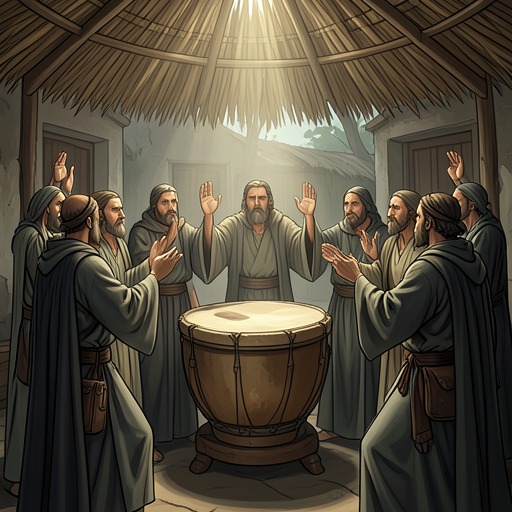
Confucius returned to Lu and organized the music
AnalectsConfucius’ return from Wei to Lu culminates in the reform of music: he says that the Royal songs and Praise songs were restored to their proper places. The action makes musical ordering part of a larger concern with ritual and political order, rather than a detached exercise in taste.
Return and Musical Reform
Confucius identifies both the sequence and the result plainly: he returned from Wei to Lu, and only then was the music reformed. The statement does not describe the mechanics of the work, but it assigns the reform to the period after his return and makes the change a decisive consequence of that journey.
The reform’s stated outcome is that the pieces in the Royal songs and Praise songs each found their proper places. Its emphasis is not on new composition or performance, but on restoring an ordered relation among inherited musical forms.
Music, Ritual, and Order
Elsewhere, Confucius treats ritual observance as a matter of substance rather than expendable custom. When Zigong proposes abolishing the sheep offering associated with the first day of each month, Confucius distinguishes his concern for the rite from Zigong’s concern for the animal. That exchange clarifies why the placement of ritual music matters: practices and forms preserve meanings that can be lost when their outward observance is discarded or disordered.
His criticism of the head of the Ji clan for having eight rows of pantomimes in his courtyard likewise shows that performance is not presented as socially neutral. The spectacle represents a breach of established distinctions, and Confucius condemns the presumption behind it. Against such misuse, restoring the songs to their proper places suggests music aligned once more with an ordered ceremonial framework.
The Work’s Political Resonance
Confucius connects proper government with the ordering of rites and music. He argues that when authority is rightly situated, rites and music proceed from the Son of Heaven; when political order fails, they issue instead from lesser rulers and ministers, a shift that signals the weakening of legitimate authority. Musical reform therefore carries a political resonance: placing the songs correctly belongs to the same broad effort to recover a coherent relationship between forms, responsibilities, and authority.
The account remains concise. It names the return, the reform, and the restored placement of the songs, without describing a public ceremony or claiming a particular political outcome. Its significance lies in that compact association: after returning to Lu, Confucius presents the reordering of music as one concrete expression of putting inherited forms back in order.