Lu Ji Shi used eight ranks of dance and Yong music improperly
AnalectsThe Ji clan’s appropriation of eight rows of dancers and the “Yung” ode turns ceremonial privilege into a visible sign of political disorder. Confucius treats these acts not as harmless departures in performance but as violations of the distinctions that give ritual and authority their meaning; across the Analects, that breach belongs to a larger pattern in which power slips downward from its proper holders and threatens the state’s stability.
The dancers and the violated boundary
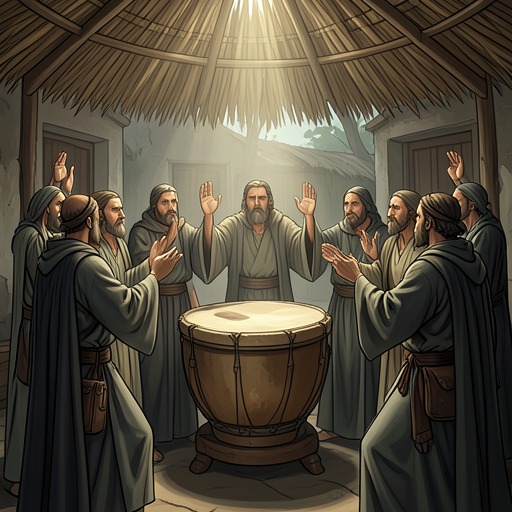
Confucius speaks of the head of the Ji clan having eight rows of dancers perform in the clan’s courtyard. His response makes the spectacle a measure of what the powerful man is prepared to tolerate: if this usurpation can be endured, he asks, what could not be endured? The pointed question converts a specific ceremonial excess into a warning about political limits. The issue is not simply the number of performers, but the use of a form associated with a higher rank by a subordinate house.
That judgment rests on ritual’s public function. In the Analects, ceremonial forms mark distinctions of status and authority; when a powerful family adopts privileges that do not belong to it, the performance announces that established limits no longer command obedience. Confucius’s rebuke therefore reaches beyond the courtyard: tolerating the violation makes further violations imaginable.
The “Yung” ode in the three families’ hall
The same conflict appears in a second ceremony. At the conclusion of a sacrifice, the three families use the “Yung” ode while the vessels are being removed. Confucius recalls its lines about princes assisting and the Son of Heaven appearing solemn, then asks what those words could be doing in the hall of the three families. The mismatch between the ode’s imagery and the household setting exposes the appropriation: language that evokes the ruler’s ceremonial precedence has been placed in the service of powerful families.
Together, the dancers and the ode show that usurpation can operate through different parts of ritual. One makes rank visible in the arrangement of performers; the other borrows words that signify a superior order. In each case, ceremonial display claims an authority the users do not properly possess. Confucius’s questions make the contradiction itself the indictment.
Ritual, government, and the distribution of power
The Analects frames these acts within a broader account of political authority. Confucius says that when sound government prevails, ritual, music, and punitive expeditions issue from the Son of Heaven. When order deteriorates, those powers pass to the princes; if they pass further to great officers or their subordinate ministers, the holders of power are increasingly unlikely to retain it across generations. The sequence describes political fragmentation as a transfer of functions away from their rightful center.
The Ji clan’s ceremonial appropriation thus belongs to a systemic crisis, not an isolated breach of etiquette. Confucius also insists that a ruler should employ ministers according to ritual and that ministers should serve with loyalty. These paired obligations clarify the standard the clan’s conduct violates: authority is bounded by forms of reciprocal duty, not simply asserted through the ability to command resources or stage a grand ceremony.
The warning carried by the scene
Confucius’s later criticism of the Ji clan’s plan to attack Zhuanyu gives the earlier ritual transgression a political counterpart. He challenges the clan’s advisers, Ran You and Zilu, over their assistance to a campaign against a territory within the state, and warns that the clan’s danger may lie within its own court rather than at its frontier. The episode does not establish that the dancers or ode caused the planned attack; rather, the scenes share a concern with power exercised without proper limits and with the failure of those responsible to restrain it.
The ritual episodes condense that concern into memorable images: eight rows of dancers in a clan courtyard, and an ode evoking the Son of Heaven heard in the hall of lesser houses. Their force comes from the gap between the authority a ceremony represents and the authority its users claim. By making that gap visible, Confucius presents ceremonial usurpation as an early sign of a wider disorder in which names, roles, and political responsibilities no longer align.