Three Huan clans
AnalectsThe Three Huan clans are the aristocratic houses whose political ascendancy in Lu illustrates a central concern of the Analects: when authority and ritual prerogatives pass from their proper holders to subordinate powers, public order is weakened and those who seize power imperil their own standing. The text links their conduct to breaches of ceremonial rank and to a longer transfer of government away from the ruler’s court.
Political Authority and Its Transfer
Confucius describes political decline as a sequence of delegated power moving down the hierarchy. When good government prevails, ritual, music, and punitive military expeditions proceed from the Son of Heaven; under disorder, these powers pass to the regional rulers, then to their great officers, and finally to the great officers’ subordinate ministers. The text associates each further transfer with a shorter horizon before political loss: rulers who take such powers generally lose them within ten generations, great officers within five, and subordinate ministers within three. In this account, the Three Huan clans belong to a broader crisis in which authority has slipped away from its proper center.
The account makes the condition of the ruling court explicit: the income had been removed from the ducal house five generations earlier, while government had fallen into the hands of the great officers for four generations. Confucius concludes that the descendants of the Three Huan clans are consequently declining. Their power is thus not described as a stable achievement; the same displacement of authority that has enlarged their influence also marks the political fragility of their position.
Ritual Rank and Public Display
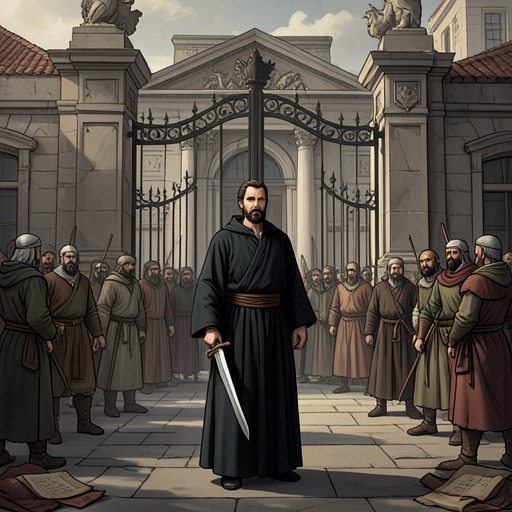
The text gives the breach of hierarchy a visible form in the head of the Ji family’s use of eight rows of performers in his own courtyard. Confucius condemns the display by asking what such a man could possibly refrain from enduring, making the ritual violation a measure of how far the family’s presumption might extend. The scene presents rank not as an abstract distinction but as something enacted through ceremonial forms that powerful households could claim for themselves.
A second ritual reference concerns the three families using the Yong hymn while removing sacrificial vessels. The hymn’s words invoke the assembled princes and the solemn bearing of the Son of Heaven; Confucius asks what those words are doing in the hall of the three families. The mismatch between the ceremony’s language and its setting exposes the difference between possessing the means to stage a rite and holding the authority the rite represents.
Service, Responsibility, and Political Legitimacy
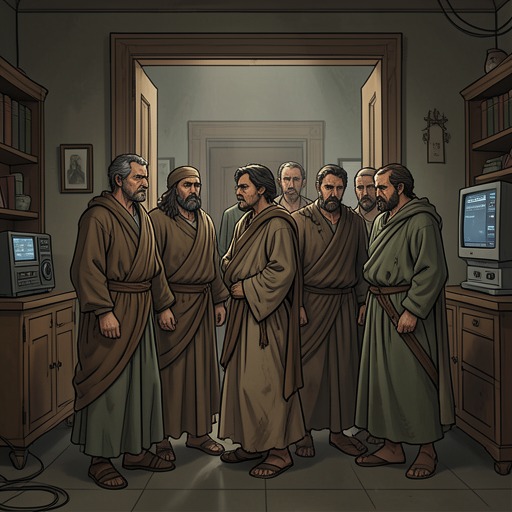
The critique also reaches officials who serve the Ji family. When Ran You and Zilu tell Confucius that their chief intends to attack Zhuanyu, they say that neither of them wants the campaign. Confucius challenges Ran You directly: an officer unable to perform the responsibilities of his post should leave it, just as a guide is useless if he does not support someone who stumbles. He then asks who is responsible when a dangerous animal escapes its cage or a precious tortoiseshell or jade is broken inside its case. The images turn the ministers’ disclaimer into an accusation of responsibility: those charged with assisting a powerful house cannot treat its actions as someone else’s business.
The proposed attack is justified by the claim that Zhuanyu is fortified and close to Bi, and that leaving it untaken will create trouble for the family’s descendants. Confucius rejects this evasive reasoning and argues that a ruler should be concerned not simply with scarcity but with unequal distribution, not merely with poverty but with insecurity. Proper government, in his account, creates balance, harmony, and stability; if distant people remain unconvinced, the answer is to cultivate civil virtue and welcome them, then secure their well-being. He warns that the advisers have failed both to attract those beyond the state and to preserve unity within it, yet are planning armed action at home. The danger to the Ji family, he concludes, lies not in Zhuanyu but within its own court.
Decline and the Text’s Judgment
Across these episodes, the Three Huan clans appear within a political order where inherited rank, ritual practice, and administrative responsibility have come apart. Their appropriation of ceremonial forms dramatizes the breach; the transfer of revenue and government records its institutional reach; and the threatened campaign against Zhuanyu shows how advisers and rulers may compound internal weakness with outward aggression.
The text’s forecast is pointed: authority exercised by great officers is precarious, and the descendants of the Three Huan clans are already described as declining. Their story therefore serves not simply as a record of aristocratic power, but as an account of its limits. Political standing detached from proper authority and responsible government contains the conditions of its own erosion.