State of Lu
AnalectsThe State of Lu is the principal political setting through which the Analects tests whether authority can be made legitimate by ritual, restraint, and competent conduct. The book presents it not as a single, consistently governed polity but as a field of competing powers: rulers, great officers, their retainers, and advisers whose choices can uphold or unsettle the order they are meant to serve.
Political Order and Ritual Authority
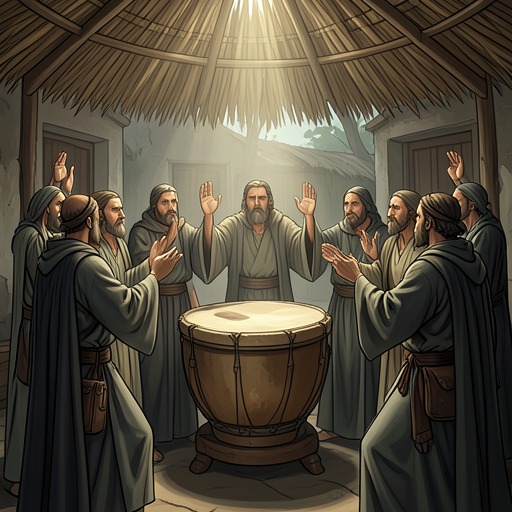
The text makes ritual practice a measure of political rank. Confucius condemns the head of the Ji clan for having eight rows of dancers in his courtyard, an arrangement that claims a privilege associated with the highest authority. His pointed response turns the spectacle into a warning: if such an encroachment can be tolerated, the limits on further abuses are uncertain. Ritual here is not decoration. Its forms mark who may exercise authority, and a breach in those forms exposes a breach in the political order itself.
The question of proper authority also appears in the exchange with Duke Ding of Lu about how a ruler should employ ministers and how ministers should serve their ruler. Confucius answers by joining reciprocal duties: a ruler should employ ministers according to ritual, and ministers should serve with loyalty. The formulation makes neither side's obligation disappear into the other's. Government depends on conduct appropriate to each role, rather than on rank alone.
A broader account of political legitimacy appears in the discussion of where ritual, music, and military expeditions originate. When proper principles govern the realm, these powers issue from the Son of Heaven; when order has broken down, they pass to regional rulers, then to great officers, and eventually to subordinate retainers. The text associates each downward transfer with increasing political fragility: powers exercised by rulers may be lost within ten generations, those exercised by great officers within five, and those seized by their retainers within three. The sequence makes Lu's local contests part of a larger diagnosis of authority being delegated or appropriated until the center can no longer command it.
The Ji Clan and the Strain on Lu
The State of Lu's political conflict becomes most explicit when the Ji clan plans to attack Zhuanyu. Ran You and Zilu bring the proposal to Confucius, but Ran You attempts to separate the ministers' responsibility from their chief's intention, saying that the chief desires the attack while the two advisers do not. Confucius rejects this distancing. An officer who accepts a position, he argues, must either carry out its responsibilities or withdraw when unable to do so; an assistant who fails to support someone in danger is no more useful than a ritual attendant who cannot steady a person about to fall.
The argument sharpens when Confucius compares the danger to a caged animal escaping or a precious object being broken inside its container. Those entrusted with the safeguards cannot disclaim responsibility for what happens within them. Ran You then offers a strategic defense: Zhuanyu is fortified and close to Bi, and, if it is not taken now, it may threaten the Ji family's descendants in the future. Confucius objects not only to the proposed attack but to disguising desire as necessity. In his view, an adviser should not supply a pretext for a policy he ought to challenge.
Confucius sets the proposed campaign against a different account of the duties of a ruling house. A polity should be concerned not simply with scarcity but with unfair distribution, not merely with poverty but with insecurity. Fairness, harmony, and stability are presented as conditions under which poverty, a lack of people, and political collapse can be addressed. If distant people do not submit, the proper response is to cultivate civil virtue and draw them near, then make their position secure. Military action within Lu's own domain reverses this work: the advisers cannot attract outsiders or preserve unity at home, yet assist their chief in planning a domestic campaign. Confucius consequently warns that the Ji family's danger may lie not beyond its borders at Zhuanyu but within its own court.
Government, Names, and Accountability
The book also connects the health of Lu's government to the accuracy of political roles and language. When Zilu asks what Confucius would address first if the ruler of Wei entrusted him with government, Confucius answers that names must be rectified. Zilu treats the priority as impractical, but Confucius traces its consequences step by step: incorrect names make speech unsuitable, unsuitable speech prevents affairs from succeeding, failed affairs obstruct ritual and music, and their disorder leaves punishments unjust and ordinary people unable to act securely. Political language matters because titles and descriptions establish expectations about what officeholders must actually do.
This insistence on accountable conduct recurs in a maxim about personal example: when a ruler's own conduct is correct, government works without orders; when it is not, commands will not be followed. The contrast makes obedience more than a matter of issuing directives. Authority can secure compliance through its example, while a ruler whose behavior contradicts his commands weakens the force of those commands. In this account, political effectiveness begins with the officeholder's own conduct.
The same relationship between office and responsibility emerges when Ji Kangzi asks whether Zilu, Zigong, and Ran You can serve in government. Confucius gives distinct reasons for each man's fitness: Zilu is decisive, Zigong perceptive, and Ran You skilled in varied abilities. These assessments present administration as a practical use of differentiated talent. Yet the Zhuanyu episode shows that competence alone is not enough: advisers may possess ability and still fail in their duty if they lend that ability to an unjust or destabilizing policy.
Service, Refusal, and the Limits of Power
The State of Lu's political world also contains a boundary between service and complicity. When the Ji clan seeks to appoint Min Ziqian as governor of Bi, he asks that his refusal be conveyed and says that if the request is repeated, he will be across the Wen River. The terse response contrasts with the detailed counsel offered to Ran You and Zilu. Where they already occupy advisory offices and must answer for their support of a policy, Min Ziqian declines the appointment rather than enter the Ji clan's service. The text presents refusal as a real alternative to participation in an authority one does not accept.
Across these episodes, the same test applies to rulers and ministers: does their conduct match the responsibilities attached to their positions, and does it preserve the order those positions are meant to sustain? The answers are not secured by formal titles. A ruler who fails to embody proper conduct cannot expect his commands to carry weight; an adviser who helps his chief misuse power cannot escape responsibility by claiming reluctance; and a great family that appropriates privileges or turns force inward reveals the instability of its claim to govern. The State of Lu thus serves as a concrete setting for the book's argument that political order depends on ritual limits, honest naming, sound distribution, and officeholders willing either to fulfil their duties or refuse them.