Scotland Yard
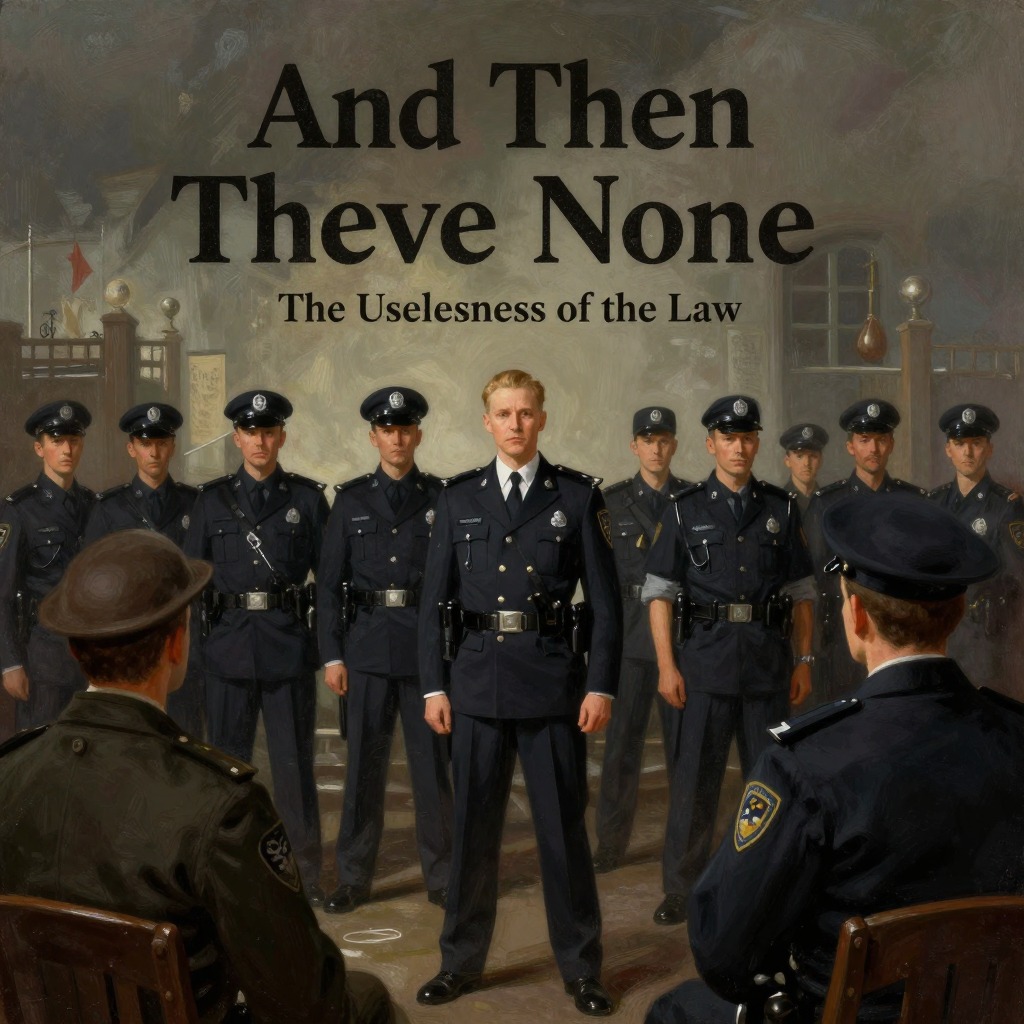
Scotland Yard, the Metropolitan Police headquarters, enters the narrative of And Then There Were None only after the last death has occurred, serving as the official investigative authority that must reconstruct the impossible events on Indian Island. The Assistant Commissioner, Sir Thomas Legge, and Inspector Maine are the principal figures who confront the case, and their baffled exchange in the epilogue underscores the central mystery: ten people are dead on a barren island, with no living perpetrator in sight. Legge's opening exclamation—"But the whole thing's incredible!"—and Maine's stolid reply, "Nevertheless, it happened, sir," establish the Yard's position as the rational, law-bound institution tasked with making sense of a crime that defies all conventional logic.
Investigation and the Limits of Evidence
The Scotland Yard investigation proceeds methodically but hits a wall at every turn. Inspector Maine reports that the police surgeon's examination of the bodies confirms the cause of each death—Wargrave and Lombard shot, Marston and Miss Brent poisoned by cyanide, Mrs. Rogers overdosed on chloral, Rogers and Macarthur bludgeoned, Blore crushed, Armstrong drowned, and Vera Claythorne hanged—but provides no clue as to the sequence or the identity of the killer. The Yard interviews the locals at Sticklehaven, who confirm that the island was purchased through a man named Isaac Morris, acting for a third party, and that Morris had instructed them to ignore any distress signals as part of a "desert island" wager. Maine notes that the villagers, accustomed to the extravagant parties of the previous owner, Elmer Robson, found nothing suspicious in the arrangement. The investigation also traces the gramophone record to a theatrical supply firm, ordered by U. N. Owen through Morris, ostensibly for an amateur play. Every lead terminates at Morris, who conveniently died of an overdose of sleeping drugs on the night of August 8th—a death Legge immediately calls "a damned sight too opportune."
The Unsolvable Puzzle
The Yard's central problem is the impossibility of the killer's escape. Maine explains that the signals from the island were seen by boy scouts on the morning of August 11th, but the storm made it impossible to launch a boat until the afternoon of the 12th. All witnesses are certain that no one could have left the island before the rescue party arrived. This forces the investigators to consider that the murderer must have been one of the ten victims. Maine systematically reviews each possibility: Armstrong could have killed the others and drowned himself, but his body was found dragged above the high-water mark, proving someone was alive after his death. Lombard could have killed Blore and Vera, then shot himself, but the revolver was found in the house with Vera's fingerprints. Vera could have shot Lombard, killed Blore, and hanged herself, but the chair in her room was found neatly against the wall, not kicked over—a detail that points to a third party tidying up after her death. Blore, the final candidate, is dismissed as psychologically incapable of such a suicide. Legge and Maine are left with the conclusion that "there must have been some one else on the island," yet no trace of that person exists.
The Confession and the Yard's Role
The novel's final section, a manuscript confession sent to Scotland Yard by the master of a fishing trawler, provides the solution that the Yard's investigation could not reach. The confession reveals that Lawrence John Wargrave, the retired judge, was the mastermind behind the entire plot. He selected his victims, orchestrated their arrival, and executed them in accordance with the nursery rhyme, faking his own death to become an invisible observer. The confession is addressed to the Yard as the ultimate arbiter of justice, and Wargrave includes three clues he believes might lead a clever investigator to the truth: that Edward Seton was actually guilty, making Wargrave the only innocent person on the island and therefore the logical murderer; that the "red herring" of the nursery rhyme points to Armstrong's deception; and that the manner of his own death—shot through the forehead—is the "brand of Cain." The Yard, however, never solves the case; the confession arrives by chance, a message in a bottle that reveals the truth only after the official investigation has failed. Scotland Yard thus stands as the symbol of institutional law, powerless against a crime that was designed from the start to be an unsolvable puzzle, and the confession serves as both its vindication and its indictment.