The Cult (Aniara)
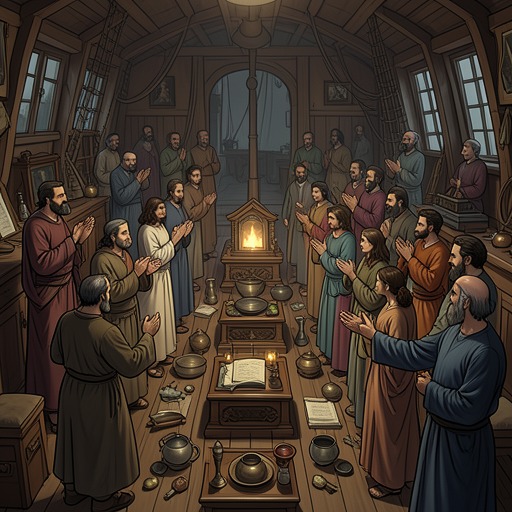
AniaraThe Cult (Aniara) is a religious community whose rites give passengers a shared form for confronting the rigors of space and the loss of ordinary life. Its ceremonies center on Mima and her sanctuary, where the narrator serves as Mimarobe, responsible for the burst illusions. The group’s history in the poem is not a simple account of durable faith: ceremonies once revived under pressure accumulate signs of strain, until worshippers repeat their practices amid grief and a failing sense of the sacred.
Formation and Ritual Practice
The pressures of space impel the passengers toward rites and altar services that they had scarcely performed since the Pre-Goldondic Era and had half forgotten. The ceremonies therefore answer both an immediate need and a break in cultural continuity: practices that had receded return as life in space makes ritual newly compelling. Their revival is presented as a response to circumstance, not as the restoration of an unchanged institution.
The narrator’s role as Mimarobe places the work of producing illusions inside this religious setting. When entering to begin the mima, the narrator encounters people bowing before an altar, and has heard them whispering. The available account leaves the words of those whispers unstated, but makes clear that the mima is not merely a private spectacle: the people’s bodily response gives it a ceremonial audience and frames the Mimarobe’s work as service within Mima’s sanctuary.
The cult’s gathering brings desire and piety together in one place. A chariot rolls in, drawn by a pair composed of men and women of the cult. This detail presents participation as collective and mixed, while the chariot gives the ceremony a visible processional form. The scene does not specify a formal hierarchy or explain the chariot’s symbolism; what it does show is a ritual setting in which communal movement and devotion occupy the same space as desire.
Mima’s Sanctuary and the Dead
The cult’s ceremonies extend to the treatment of Mima’s grave. At the reliquary, identified as Mima’s grave, a lamp is touched to it three times for luck. The gesture is exact and repeated, joining an appeal for good fortune to the preservation of a sacred site. The grave is at once a place of veneration and a material focus for ritual action; the poem’s attention to the lamp and its three touches gives the practice a concrete shape without explaining a doctrine behind it.
A further scene places a supplicant at the saintly vault. After her needs have been satisfied, Yaal pauses there and pleads; elsewhere, the graveside chorus is formed with Chebeba. The sequence connects individual supplication with collective observance. Mima’s tomb is not simply remembered from a distance: it is approached, addressed, and made the center of communal acts. The contrast between the private pause and the chorus also suggests how the cult accommodates both personal appeal and shared ceremony.
Grief, Recantation, and Decline
The cult’s life unfolds alongside the collapse of Libidel. One winter evening, behind the mima-hall, Libidel sits making herself up, wearing a thigh-bell and a buddha-cat. The poem places this specific act of self-presentation near the hall, but does not explain it as an official rite or establish Libidel’s precise position in the organization. Later, her collapse comes with a drug she has placed on her tongue, and the community sings by her grave. The change from preparation and adornment to death and communal mourning makes Libidel’s fate a human measure of the world around the cult: ceremonial life continues, but it cannot protect its members from collapse.
The Memory Hall provides another setting for the community’s response to loss. Recanters’ fêtes take place there, drawing together those most deeply immersed in recanting, with ashes strewn upon their heads. The narrator hears the resulting anthems as hideous and is appalled by what is enacted as a trampling of the self. Rather than finding a cure in this public performance of recantation, the narrator remains concerned with rousing Mima’s broken breath. The contrast is pointed: the gathered mourners intensify their ritualized abasement, while the narrator’s stated concern turns toward the possibility of restoring Mima.
The Cult’s Later Meaning
In the later scenes, supplicants stand ceaselessly practising their threnody in Mima’s hall. Their mouths are swollen, and they suck blood from their divinity. The image makes devotion physically costly and collapses the distance between worshipper and object of worship: those assembled before Mima seem to draw sustenance from the sacred even as the act exposes the damage of their practice. The passage does not present this as a healthy renewal of communal faith; it is an image of devotion persisting in a damaged, increasingly desperate form.
The cultic priests are described as having souls frozen through, and the flow of sacrificial blood seems cold to them. Their numbness contrasts with the vivid bodily violence of the supplicants’ actions. Sacrifice remains legible as ritual, but its expected force or warmth no longer reaches those who serve it. The reference to what remains of Mima, who loved the true, places this exhaustion beside the diminished presence of the figure at the center of worship.
Across these scenes, The Cult (Aniara) is both a means of gathering and a record of religious forms under pressure. The bowing at the altar, the processional entry, the lamp at the grave, the graveside chorus, and the threnody in the hall show practices that make sacred places and repeat communal gestures. Yet repetition does not guarantee consolation or renewal: Libidel dies, Mima’s breath is described as broken, and the priests experience sacrificial blood as cold. The cult’s significance lies in that tension. Its rites give the passengers a language and a place for grief, but the poem also shows how ritual can persist after the faith that once animated it has been eroded.