Bill Joyce's cancer diagnosis
AnimalsBill Joyce’s cancer diagnosis enters the story not as a single medical announcement but as a rupture in family knowledge: Bill had known for months before his daughters were told, and Laura learns how deeply the diagnosis has altered his sense of time by overhearing him alone. The disclosure and its aftermath bring illness into ordinary domestic space, where its impact appears in strained family silences, visible treatment effects, and the practical work of care.
Discovery and Delayed Disclosure
By the time Laura recalls the family’s response, Bill has known about the cancer for six months. He told Laura and Mel five months earlier, at their mother’s insistence, and only two days before his operation. The sequence leaves a month between his discovery and the family’s knowledge, then places the disclosure close to surgery. The diagnosis is therefore also a story about when information becomes shared: Bill’s daughters do not experience the first moment of knowing alongside him, and Laura’s understanding grows retrospectively from what she overhears and later sees.
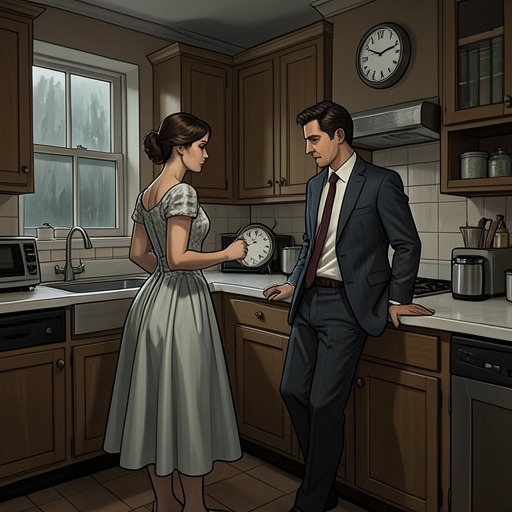
The announcement is recalled against an ordinary family setting. On a grey day, Laura goes upstairs to use the bathroom while her mother and Mel remain downstairs. Mel keeps returning to the fact that they had not recognized what was happening. Her distress at their failure to notice gives the silence a second edge: the family is confronting not only Bill’s illness but the limits of what they had been able to see. Laura’s memory does not describe a formal conversation about the diagnosis in detail. Instead, the scene turns toward the words she hears from the landing, making her an unintended witness to a response he did not mean her to hear.
Bill’s Private Response
Laura first hears Bill speaking quietly and then raising his voice. He curses an unseen addressee and accuses it of waiting until after his retirement to bring this upon him. The complaint connects the illness to a life-stage reversal: retirement might have suggested time finally available to him, but the diagnosis makes that future uncertain. The anger is not presented as a considered explanation of cancer. It is a private protest against its timing, overheard from outside the room rather than offered to the family as a composed account.
That distance matters to the scene. Laura stands rigid on the landing, conscious that Bill would be mortified if he knew she had heard him. His words expose a vulnerability he has not chosen to share with her directly; her silence preserves the separation between his private outburst and his public role in the family. The diagnosis thus changes what Laura knows without turning the moment into a mutual conversation. She becomes a witness to fear and anger while remaining unable to acknowledge that she has heard them.
Bill’s plea for ten more years gives the outburst its clearest measure of what he fears losing: time. The number is a request, not a prognosis, and the passage supplies no medical estimate that would make it one. Its force comes from the contrast between a bounded future and the open-ended life he had apparently expected. The diagnosis has made the future newly countable, while the plea shows how fiercely he resists accepting that calculation.
Treatment and Family Care
The later image of Bill places the diagnosis in the continuing present of treatment. Its effects are visible in thinning, ashen hair and mottled skin, and his movements become abrupt as he scans the room. Even while appearing physically altered, he makes a playful gesture, forming his hands into a gun shape and reassuring Laura that he has her back. The moment holds illness and familiar interaction together: treatment is visible, but Bill is still acting toward his daughter, not appearing only as a patient.
The surrounding account also registers care as labor. Laura’s mother distinguishes her own experience of tending to him from Laura’s, referring to nights when he cannot sleep because of cramps and to repeated washing of his bedding. This detail conveys the illness’s reach into domestic routines without presenting care as a simple, symbolic gesture. It involves interrupted sleep and recurring practical work, and the mother’s rebuke indicates that family members have not shared those burdens equally. The diagnosis has consequences beyond the moment of disclosure, changing the texture of home life and the demands placed on those closest to Bill.
Narrative Significance
The episode is built from belated knowledge rather than a complete account of the medical event. Its chronology distinguishes Bill’s initial discovery, his eventual disclosure to his daughters, and Laura’s later witnessing of both his private anger and the visible effects of treatment. That arrangement makes the diagnosis legible through what the family could not see, what Bill did not intend Laura to hear, and what treatment later makes difficult to miss.
Cancer also unsettles the family’s ordinary measures of time. Bill’s retirement, the five-month interval since he told his daughters, and his request for another decade all give time different meanings: a life stage, a period of secrecy, and a hoped-for future. The scene does not resolve those tensions or turn Bill’s anger into reassurance. Instead, it records a change in the family’s understanding: illness is no longer something they failed to recognize, but a reality that shapes conversation, care, and the future they can imagine.