Tyler’s GHB Overdose
AnimalsTyler’s GHB Overdose brings Laura face to face with the physical danger of Tyler’s substance use and the limits of what she can do when Tyler refuses medical help. At 3:46 a.m., Laura finds her unconscious in a room marked by vomit and discarded evidence of the night. The emergency becomes a sustained act of care: Laura tries to rouse Tyler, urges her to go to hospital, and finally helps her wash. The next morning, a pair of letters on the floor connects the crisis to another painful discovery: Tyler’s father has died.
Background to the crisis
The overdose follows a pattern of drug use already established by Tyler’s relationship with mandy. In an earlier episode, she arrives with a massive jar of the drug, which she says she stole from a dealer. She tries to fit it into the freezer, explaining that it needs to be kept cold for freshness. The jar’s everyday size and intended use for spaghetti or cereal make the quantity of the stolen drug especially conspicuous: an ordinary kitchen container has become evidence of a dangerous and deliberate theft.
Tyler’s use is not confined to possessing the jar. Laura recognizes the signs that Tyler has snorted some of its contents, and Tyler admits that she did so “once or twice.” She says she could not feel it at the time and had reached a point where she needed variety. The later overdose does not establish that mandy caused the emergency; Tyler identifies the liquid in the wine glasses as GHB mixed with Vimto. But the earlier episode gives the crisis a wider context of escalating, varied use rather than presenting it as an isolated encounter with one drug.
The emergency at 3:46 a.m.
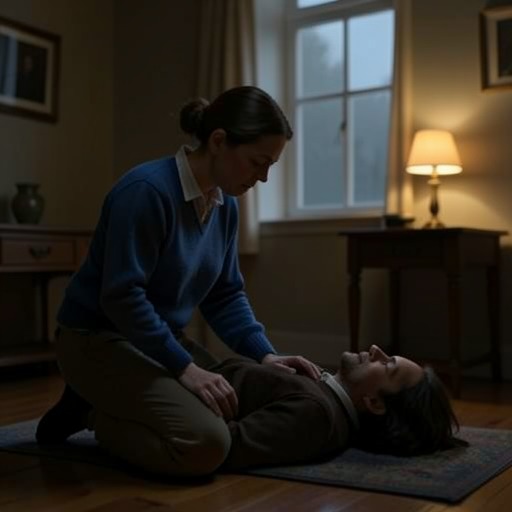
The time marker, 3:46 a.m., gives the scene a stark precision. Laura has reached Tyler’s home after a night in which she has imagined retaliating against Jim and Kirsten, but those fantasies have not relieved her distress. When she enters the lounge, she finds Tyler on her back in the middle of the rug, with vomit on her and around her. A lamp is on and music is playing; the ordinary room has become the setting for a life-threatening emergency.
Laura shakes Tyler, turns her onto her side in an approximation of the recovery position, hits her back in case she is choking, and clears vomit from her mouth with her fingers. She checks for a pulse and listens for breath. Her thoughts turn to the first-aid training she never took, and to the practical knowledge she imagines Tyler would have had. The scene makes care urgent and physical: Laura has to act with what she knows, while fearing that it may not be enough.
When Tyler begins to respond, Laura asks what she has taken and decides to call an ambulance. Tyler shakes her head and resists. Laura offers a taxi and says she will clean her up first, but Tyler insists that she is not going. She argues that hospital staff would put her on a drip, keep her waiting, lecture her, or try to send her to rehab. She describes the crisis as a bad day, a minimization that sits uneasily beside her condition and Laura’s alarm.
What Tyler reveals, and what Laura does
Laura notices two wine glasses containing purple liquid and calculates the danger of two glasses shared by one person. Tyler identifies the drink as GHB mixed with Vimto. Asked who was there, she names Nick; asked whether he brought the GHB, she says he did. This disclosure identifies the immediate source of the drug, but does not resolve exactly how much Tyler consumed or explain the circumstances of Nick’s presence. The two glasses remain a visible, troubling measure rather than a reliable account of the dose.
Tyler is too weak to stand without help. Laura supports almost all her weight as they make their way to the bathroom, where Tyler bumps into the wall. Laura sits her on the toilet, runs a bath, removes her clothes, helps her step in, and washes her slowly and gently. The care continues even though Tyler has refused the ambulance and Laura has no assurance that the danger has passed. When Laura asks whether Nick hurt her, Tyler interprets the question as asking whether she was raped. The exchange registers a further fear within the crisis, without establishing that an assault occurred.
The aftermath and its significance
The following morning, the wine glasses are still on the table. Laura picks them up, then gathers the papers from the floor and realizes they are two letters, one long and one short. The short letter explains that papers found while Tyler’s father’s house was being cleared have been forwarded to her, and that she can choose whether to open them. The letters are addressed to Tyler; Laura reads the short one first and then sees the reference to her father and a phone number. She concludes that he has died, though she does not know when.
Laura puts the letters at the back of the cocktail cupboard, behind the glasses, and finds the plastic jug they use when they are sick. When she carries it into the living room, Tyler asks, “Don’t leave me, Lo.” Laura answers, “I’m not going anywhere.” The episode thus ends not with a confirmed recovery or a decision to seek medical treatment, but with a promise of presence. The letters remain unread and put away, while the drug-related emergency has exposed another burden Tyler has not yet confronted. The juxtaposition does not explain the overdose through her father’s death; it shows Laura encountering physical danger and buried grief in the same room, and choosing to stay with Tyler through both.