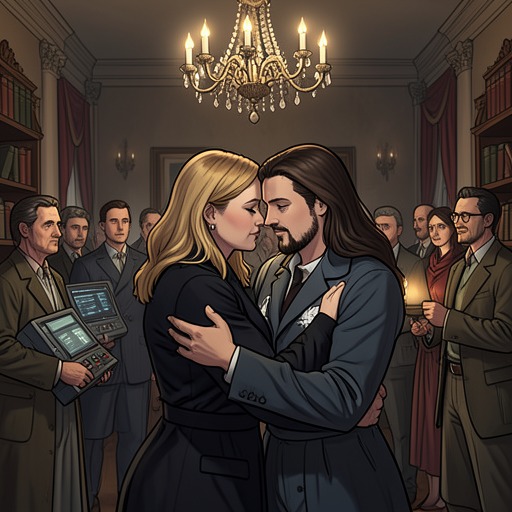
Laura and Jim's engagement
AnimalsLaura and Jim's engagement is a deliberately informal turning point: they commit to a future together before they have resolved what marriage means to either of them. On New Year's Eve, after leaving a party at Tyler’s early, Laura and Jim sit on the rug in Tyler’s lounge with a bottle of port left by Tyler’s parents. Talking about the future, they agree that being together for ever is what they want. They are so drunk that neither can later remember who asked whom. The uncertainty does not undo the decision; the scene places the force of the engagement in their shared intention rather than in a remembered proposal or a carefully staged declaration.
The engagement and its setting
The evening begins at a party at Tyler’s, where Tyler is in the process of making a fuss. The couple leave early, but the departure goes unnoticed when someone puts on “Buffalo Stance.” The detail gives their engagement an unceremonious prelude: the party carries on around them, while the consequential conversation happens elsewhere, on the rug in Tyler’s lounge. Their setting is domestic and borrowed rather than grand. The bottle of port has been left by Tyler’s parents, and the couple drink it as they talk; the scene makes no suggestion that they have prepared a formal proposal or planned a ceremony.
The decision emerges from a conversation about what each wants in the future. Its central point is not a practical plan but the agreement that a lasting life together is the thing they both value. The narration’s uncertainty over who asked whom is therefore more than a comic lapse caused by drink. It shifts emphasis away from the conventional proposal as a single person’s act and toward the choice they arrive at together. Their engagement has a clear emotional direction, even when the precise exchange that produced it cannot be reconstructed.
Commitment before certainty
The engagement follows Laura’s earlier difficulty imagining marriage as something concrete. She had used the idea of being married as an abstraction, without knowing whether marriage was for her or considering what it would entail. When the idea took on material form, she imagined it as an enormous, heavy, expensive object appearing at the foot of the bed. That image conveys not simple refusal but the weight and scale of a social institution she had not yet learned how to inhabit. The later engagement does not erase that uncertainty. Instead, it shows Laura and Jim able to affirm their attachment even while marriage itself remains hard to picture.
Indeed, after they agree that they want to be together for ever, the idea of marriage suddenly seems crazy, dramatic, and over the top. The contrast is central to the episode: their commitment feels right, while the institution’s larger implications still feel bewildering. The engagement is consequently not presented as the resolution of every question about marriage. It marks a more intimate agreement, made in their own terms, whose emotional certainty exceeds their clarity about what follows.
The morning after
On New Year’s Day, Laura and Jim wake and turn toward one another with apprehension about what happened. Each asks whether the other meant it, and each answers yes. Their brief exchange changes the drunken decision into a consciously confirmed commitment. The moment does not depend on either of them remembering the exact proposal; what matters is that both claim the choice once sober enough to revisit it.
The relief that follows is small but decisive. The prior night’s uncertainty has not become a rejection, and neither treats the other’s agreement as a mistake. Instead, the morning establishes a simple mutual test: the commitment stands because each independently confirms it. The episode gives the engagement both its spontaneity and its seriousness, allowing the emotional weight of the decision to appear in the pause before their answers as well as in the answers themselves.
Marriage, age, and competing futures
Other conversations in the book place this commitment beside anxieties about life stages, partnership, and the timing of parenthood. Tyler and Jean are very close, making Jean’s pregnancy feel to Tyler like a betrayal and the loss of a friend to a decade of motherhood. Elsewhere, Tyler resists the assumption that she should already want a baby, insisting that she has at least fifteen years before she needs to panic and that any decision would be hers rather than a performance for a supposed baby audience. Another conversation describes the pressure of a biological window and the desire to have another child before thirty-five. These differing positions give the engagement context without making parenthood its stated subject: relationships are repeatedly measured against expectations about when adulthood should bring marriage or children.
Laura and Jim’s agreement stands apart from those schedules because its stated priority is their continuing life together, not a timetable for starting a family. It does not settle how either will respond to later pressures, nor does it promise that their shared future will remain uncomplicated. Its significance is narrower and more immediate: at this point, they choose one another, then confirm that choice when morning returns. The engagement’s blend of resolve and uncertainty prepares the reader to understand marriage not as a fixed destination already mapped out, but as a promise whose meaning the couple will have to encounter in lived experience.