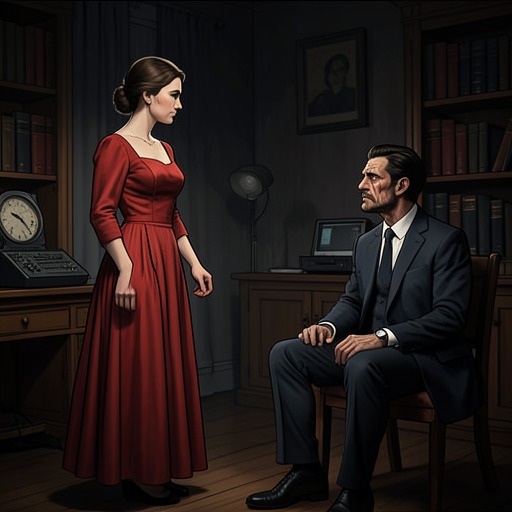
Laura's drunken late-night visit to Jim
AnimalsLaura Joyce’s drunken late-night visit to Jim becomes a test of the life they are trying to build together: she arrives across a boundary they had agreed on, and the next morning Jim asks whether she can live with him and whether her drinking leaves room for a shared future. The episode is told retrospectively through its aftermath, so the visit first appears as a warm, recently vacated dent in Jim’s bed. What follows is neither a clean reconciliation nor a simple quarrel. Familiar gestures and desire persist, but they sit alongside the possibility that his flat may not feel like home to her and his fear that her nights out will keep making their life unpredictable.
Background and the Broken Rule
The account opens after the night has already passed. Laura wakes in Jim’s room and recognizes that she has gone to his place: a choice she immediately understands as bad because it violated one of their new rules, not turning up at Jim’s late at night. The rule is especially fragile when she is drunk. In that state, she reflects, actions that would otherwise seem unwise can present themselves as excellent ideas; the list of examples turns the breach into part of a broader pattern of intoxicated impulsiveness rather than an isolated visit.
Her recollection supplies the evening’s sequence. Around two in the morning, she left Tyler with Nick in a tiki bar on Stevenson Square. Tyler and Nick were sharing a fish-bowl cocktail in a hammock, and Tyler tried to stop Laura from going to Jim’s, pointing to the text messages with which he had been pursuing her. Laura had been ignoring both Tyler’s warning and Jim’s messages. The scene places the visit between competing claims on her attention: a friend trying to restrain her, a former or estranged partner seeking contact, and Laura’s own drunken conviction that going to him is a good idea.
The night’s most consequential words come back only when Jim raises them the following morning. Laura had told him she was unsure about moving into his flat and had suggested that they look for somewhere else because she did not know whether his place could ever feel like home. She cannot remember arriving, much less saying this. The gap between her impaired recollection and Jim’s clear memory makes the morning conversation the event’s delayed center: the visit has brought an underlying doubt about belonging into the open, even though Laura initially cannot retrieve having voiced it.
Morning After: Home, Drinking, and Marriage
Morning details establish both the intimacy of Jim’s flat and Laura’s uneasy position within it. Sunlight cuts through the blinds while she hears Jim in the kitchen, and the sounds of the waking flat stir a familiar, difficult yearning. She is thirsty and drinks water left beside the bed. The domestic setting is not simply alien to her: its sounds, routines, and objects are intimately known. On an earlier occasion at Laura’s home, she mistook a glass containing Jim’s contact lenses for water and drank them. That comic memory makes the present glass of water a small marker of their shared history, while the remembered mistake also underscores how easily familiarity and discomfort coexist.
In the kitchen, Jim tops up orange squash with water. Laura likes watching him drink and notices his habit of clenching and unclenching his free hand near his chest, a gesture she has decided not to tell him about. She embraces him from behind; they stand together and perform a slow, silent dance. The moment is tender and observant, down to the thin vest that still carries the smell of the night. Yet ordinary domestic closeness does not settle the question raised in the night. The tumble dryer’s flashing instruction to clean its door filter catches Laura’s attention; she switches it off, and Jim pulls her back toward him. Care, habit, and desire remain available between them even as the prospect of a shared home is in doubt.
After they dress and walk to the shop, Jim takes Laura’s hand and notices the dirt beneath her fingernails. His question about what she said makes the emotional stakes explicit. He asks whether her doubt about moving in is real, because, if it is, they need to talk properly. Laura experiences that prospect as almost professional: she thinks the wedding is making them feel formally involved, as if their relationship were becoming a work meeting. She dismisses her earlier statement as probably nonsense, but Jim tells her she should be careful. Her attempt to retract it does not erase what he heard or the uncertainty it disclosed.
Jim then explains that he does not want to give her a hard time, especially that day, but needs to know the pattern will not keep happening. He does not want a life in which he cannot know when she will come in or what state she will be in; after her words the previous night, he could not get back to sleep. The concern is not only about the content of one drunken conversation. It is about the recurring uncertainty attached to her drinking and the effect that uncertainty has on their future together. When Laura stops walking, Jim asks what is wrong, but the passage does not turn her distress into a resolution.
Back at the flat, they make eggs and sit in the living room. Jim asks whether she has considered drinking less. Laura answers that she usually thinks about it in the morning and changes her mind by evening. Her reply names a cycle without claiming she has escaped it. Jim says he increasingly wonders how they can stay on the same level during the precious time they have together, then tries to clarify that he is being realistic about both their needs, not trying to spoil breakfast. Laura stops eating and lets him worry briefly before explaining that she has had enough of the eggs. The joke interrupts the tension but does not answer his question. Jim also tells her that his parents want to invite a few more people to the wedding, returning the conversation to a future whose practical arrangements continue even while its foundations feel uncertain.
Intimacy and Emotional Aftermath
The visit does not end with the morning conversation. Later, in the bedroom, Jim suggests having sex without a condom. Laura is drawn to the prospect of a quick, uninhibited encounter in the absence of alcohol. She allows him to belt her wrists to the bed frame and registers his frustration; she also understands herself as permitting that frustration and punishing him within the encounter. Her response is deliberately unreadable: she gives him no indication of whether she is enjoying it, makes herself like a china doll, and describes the pose as an abandoned, uninhabited shell. Physical closeness therefore does not provide a straightforward answer to the emotional distance raised earlier. The scene holds consent to a particular sexual arrangement alongside Laura’s stated emotional withholding; it cannot be reduced to proof that their differences have disappeared.
The book’s image of night as a zoo and the next day as its museum gives the episode its retrospective shape. At night, intoxication makes the journey to Jim seem possible and the things said there are difficult for Laura to remember. By morning, the visit is preserved in the objects, conversations, and consequences that remain: the dent in the bed, the water glass, Jim’s sleeplessness, and the question of whether his flat can be home. Laura’s comic deflections and gestures of affection keep the relationship alive in the scene, but they do not resolve Jim’s concern about drinking or the couple’s capacity to share an ordinary future. The episode’s decisive turn is not simply that Laura goes to Jim’s; it is that her drunken visit exposes a doubt about belonging that sobriety cannot make disappear.