Tyler's Thirtieth Birthday Night
AnimalsTyler's Thirtieth Birthday Night is a gathering whose exuberant surface sits beside questions of age, friendship, and parenthood. Its most striking turn comes when an unfamiliar woman enters the bar and Tyler quietly slips beneath a table; later, back at the flat, Tyler takes command of the room while Laura measures the hours toward leaving. The account does not explain the woman’s identity or Tyler’s reaction, leaving that interruption unresolved rather than converting it into a disclosed secret.
Age and the Prospect of Parenthood
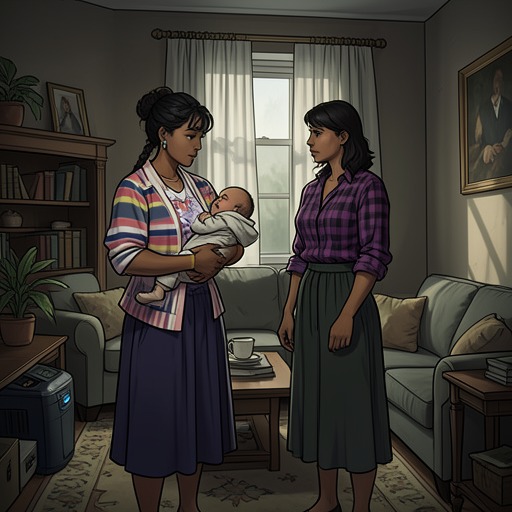
The birthday carries particular weight against Tyler’s earlier response to Jean’s pregnancy. The sisters had been close, and Tyler experienced Jean’s pregnancy as a compounded betrayal: Jean was only a year younger, yet her impending motherhood seemed to Tyler like another friend lost for a decade. Her first reaction was theatrical, delivered with a sweep of her kimono sleeve, as if she were a Roman emperor ending the games. The gesture makes the hurt comic in form without making the underlying sense of separation disappear.
In another exchange, Laura asks whether Tyler fears she is getting too old to have a baby. Tyler answers that she has at least fifteen years before she needs to worry. She rejects the idea that she is merely angry at being left out of a baby-centered social circle, describing instead a decision she would make privately rather than market as an exclusive event. Her insistence on having her own definitions and developing theories does not resolve her uncertainty: she also acknowledges that a lonely, hungry longing will remain with her. The birthday’s milestone age therefore meets a position that is neither a simple rejection of motherhood nor an uncomplicated wish for it.
A separate conversation in the surrounding evidence makes the pressure of timing more explicit. A woman worries that her partner wants to delay having another child and says she wants one before she turns thirty-five, invoking the biological window as a euphemism. That concern provides a contrast to Tyler’s claim that she has time: the same question of when to have a child can be framed as a personal freedom or as a narrowing opportunity.
The Bar and the Unexplained Interruption
At the bar, Laura occupies herself by watching people arrive and leave, trying to infer how they know one another and how much they care. About an hour later, a woman who seems vaguely familiar comes in, accompanied by two men in their twenties. Laura notices the woman’s nervous appearance and then turns toward Tyler to ask whether she recognizes her. Before Laura can establish that connection, she sees Tyler’s face turn ashen and watches her begin to slide slowly beneath the table. Nick, nearby, does not realize what is happening.
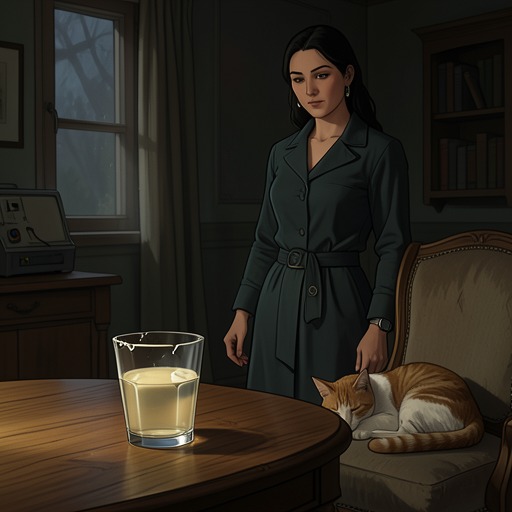
The scene’s suspense rests on a gap in knowledge. Laura thinks the newcomer looks familiar, but the account does not confirm that Tyler recognizes her, explain why Tyler reacts, or identify what the men’s presence means. Tyler eventually climbs out, sits down, and empties the bottle. That concrete return to the group closes the immediate action, but not the uncertainty created by her retreat. The passage presents the shift through Laura’s observation, so the reader shares her limited view rather than receiving an explanation from Tyler.
The Birthday Takes Over the Flat
Later, Nick lies across the sofa while Laura sits on a floor cushion beside the coffee table, tapping a cigarette into an empty beer can. Tyler brings out the jar from the ice-box, takes some, and stands in the middle of the room talking. When either Nick or Laura tries to join in, she interrupts and talks over them until they give up. The gathering becomes, in Laura’s wry description, a dominion of the birthday celebrant: Tyler’s energy sets the terms, while the others recede into listeners.
Laura checks her phone and sees that it is one in the morning. She thinks she may leave soon, but the intention keeps moving. At four, she sets five as an absolute cutoff and reassures herself that leaving at five would still be fine. The repeated postponement gives the night its own small measure of drift: the decision to go is clear before the ability to carry it out follows.
Departure and Narrative Significance
At last, Laura calls a cab, grabs a barely packed bag, and runs out of the flat with half her jacket on. Nick’s laughter follows her down the stairs. The departure is abrupt rather than ceremonious; the scene ends not with a resolution of the tension at the bar or a settled account of the birthday, but with Laura breaking away from the room and its prolonged night.
The event places Tyler’s performance of confidence beside vulnerabilities the surrounding conversations have already made visible. She can dominate the birthday gathering, yet her earlier talk about motherhood admits both self-definition and enduring longing; her unexplained response at the bar briefly interrupts the party’s apparent control. Laura’s delayed exit supplies a parallel tension between intention and action. Together, these details make the birthday less a simple celebration of turning thirty than a scene in which age, intimacy, and the wish to remain free of other people’s timetables press against one another.