1998 Class 3 disasters
AnotherThe 1998 Class 3 disasters are the defining catastrophe of the year’s Third-Year Class 3 at Yomiyama North Middle School: a sequence that begins before the full class understands that anything is wrong, spreads through deaths and violent episodes, and reaches its most destructive expression during the August trip to Sakitani Memorial Hall. Their decisive significance lies in the way ordinary school safeguards are replaced by emergency rules. The class attempts to survive by making people “not there,” while altered records and memories conceal the Extra Person whose presence has already destabilized the group.
Causes and Hidden Beginning
The disasters began in April, with the death of Misaki Fujioka in the hospital. Koichi Sakakibara and Mei Misaki eventually identify her as the first victim, the “death of April,” which changes the apparent chronology of the year’s calamities. At first, the class believes that the disasters began in May, because when Koichi returned to school at the beginning of that month there appeared to be one desk too few. The later interpretation is more disturbing: the Extra Person had entered the class in April, before Koichi arrived at Yomiyama North Middle School, when the classroom had originally contained the correct number of desks.
The hidden presence is protected by more than ordinary forgetfulness. Tatsuji Chibiki confirms that while the Extra Person, also called the Casualty, is concealed within the class, records and memories are tampered with throughout the surrounding reality. Details that would normally be impossible are made to seem coherent, and no one recognizes the Casualty’s true identity. The result is a catastrophe whose cause cannot be isolated through ordinary testimony, because the evidence needed to identify it has itself been altered.
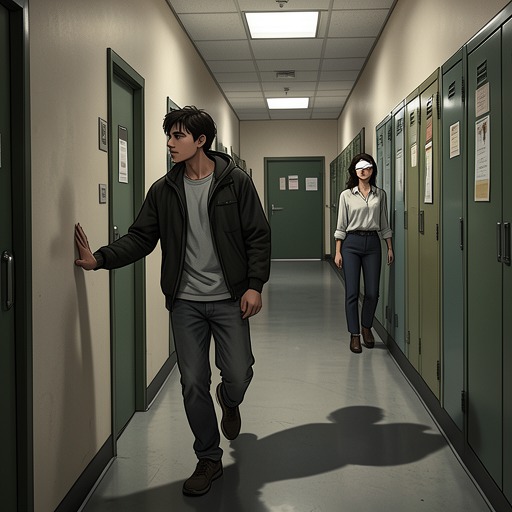
The class responds by treating Mei and Koichi as if they are “not there.” Tatsuji Chibiki explains that people with no direct connection to Third-Year Class 3 are comparatively safe, whereas contact with the class can expose others to the phenomenon. Mei’s intermittent visits to the Secondary Library and Chibiki’s conversations with her are possible because he has no direct tie to the class. The students therefore convert social exclusion into a protective tactic, hoping that increasing the number of people regarded as absent will reduce the danger.
That strategy fails. Because making both Mei and Koichi “not there” has no effect, the class gradually stops ignoring them after Mr. Kubodera’s death. No formal decision marks the change; instead, behavior shifts imperceptibly, until Naoya Teshigawara once again treats Mei as present during a conversation at lunch. The disasters thus expose the instability of the class’s emergency order: its rules are treated as necessary, but their authority depends on collective behavior that can change without discussion or clear explanation.
Escalation and Violent Course
The sequence moves from a concealed death into open violence. Mr. Kubodera, whose condition deteriorates before the class, reaches a point at which his speech breaks into unintelligible sounds while the students watch in stunned silence. He then slowly withdraws his right hand from a bag on his desk, revealing a sharp-bladed object alien to an ordinary middle-school classroom. His death becomes one of the events that transforms the class’s treatment of Mei and Koichi, while also demonstrating that the disasters can erupt inside the school itself and not merely through distant accidents.
The later violence is intensified by failures of recognition. Naoya Teshigawara becomes convinced that Tomohiko Kazami may be the Extra Person after discovering that Kazami cannot remember shared childhood experiences, including a secret base by the river and an abandoned plan to cycle to the ocean. Teshigawara says that he had been quietly testing Kazami’s memory, and Kazami’s unfamiliarity with those memories made him seem fundamentally altered. The suspicion turns uncertainty into a target and leads Teshigawara to attack his friend rather than treating the memory gap as evidence of the phenomenon’s wider distortions.
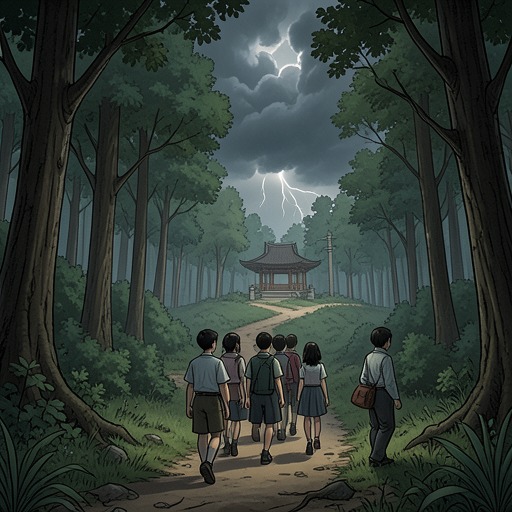
During the trip, Koichi encounters a darkened dining hall and finds blood before entering. He considers withdrawing to follow the others but moves forward instead, only to discover that the strange sound and smell come from a fire consuming the room. Later, when he realizes that someone is watching him, he runs in fear of being attacked and killed. The episode converts the group’s attempt to escape the disasters into another site of danger: the trip does not restore communal safety but concentrates the crisis in an enclosed, unstable space.
The Sakitani Memorial Hall disaster is ultimately revealed not to have been a simple fire. The caretaker Kensaku Numata is stabbed in the neck with numerous metal cooking skewers and then burned. Four students—Manabu Maejima, Yone mura, Sugiura, and Nakao—die from blood loss after being stabbed and cut repeatedly with a sharp blade. Izumi Akazawa appears to die after breaking her spine in a fall from a second-floor balcony. The forensic findings establish that none of the six died because of the fire itself.
The killings are attributed to Mieko Numata, Kensaku Numata’s wife and co-manager of the Sakitani Memorial Hall. After killing the six victims, she is believed to have scattered kerosene through the kitchen and started the fire. Tatsuji Chibiki restrains her, but before she can be surrendered to the police she dies by biting through her tongue in an apparent suicide. Her motive remains unclear, and the ordinary criminal explanation does not erase the wider question of why the disasters created such a setting of fear, confusion, and lethal opportunity.
August Toll and the Vanishing Extra Person
The count of August deaths reaches seven when the deaths of the Numatas are considered together. Tatsuji Chibiki investigates further and discovers that the Numatas were Takabayashi’s maternal grandparents, extending the disaster’s reach through a family connection that had not initially been recognized. This addition makes the August episode more than a contained massacre at the memorial hall: its consequences radiate through the personal histories of the students and the adults connected to them.
After the fire, Koichi believes that the Extra Person must have died that night. The conclusion carries an immediate contradiction. If the Extra Person existed until the fire and then disappeared, the class should be able to identify who had occupied that role. Instead, the survivors can no longer remember. The Extra Person’s death removes the person physically while preserving the phenomenon’s power to erase or rearrange knowledge of that person.
The trip’s numbers expose the scale of the erasure. Fourteen students went, or fifteen people if Tatsuji Chibiki is included. Koichi concludes that there must originally have been sixteen people, although no one remembers the missing participant. The disaster therefore ends with a negative fact rather than a recovered identity: the class knows that someone was present, yet the ordinary social and memorial structures that would preserve that presence have failed.
Recognition, Exclusion, and Aftermath
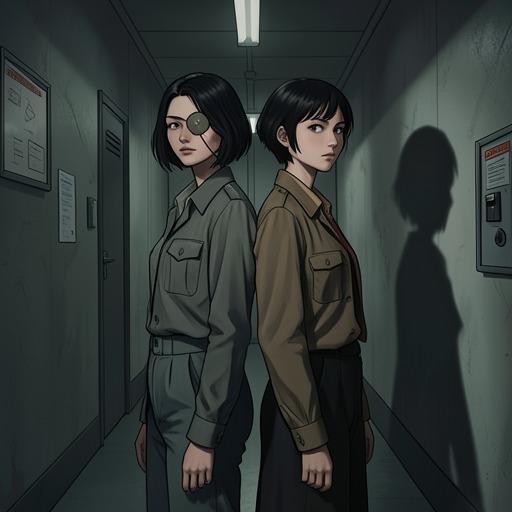
The disaster’s logic also explains the painful contradiction in the relationship between Koichi and Reiko Mikami. At school, Koichi calls her Ms. Mikami and treats her as separate from the Reiko who lives with him; at home, the two acknowledge their family relationship. Reiko is his aunt, and both maintain the separation required by the Fourth North Yomi Fundamental. At school she never calls him Koichi and treats him as Sakakibara, the transfer student, while he observes the same reserve toward her.
Mr. Kubodera and most of the class know the truth of their relationship. That knowledge explains why Kubodera refers to Ms. Mikami’s “difficult position” while discussing the June tactic of treating Mei and Koichi as absent. Her difficulty is not abstract: she must ignore her nephew at school as though he does not exist, despite sharing a home with him after school. The disasters thus place ordinary kinship under the authority of a collective survival rule, making recognition itself potentially dangerous.
Tatsuji Chibiki later acknowledges publicly that he understands the peculiar circumstances surrounding the year’s Third-Year Class 3. His statement freezes the atmosphere because it brings the hidden mechanism into an official setting without resolving it. The disasters are consequently sustained by a tension between disclosure and concealment: the class needs rules that depend on knowledge, but the phenomenon corrupts the records and memories through which knowledge could become reliable.
The final aftermath is not restoration but an altered communal memory. No one except Mei and Koichi remembers that Reiko Mikami had existed in the class since April, served as its assistant head teacher, became its substitute head teacher after Mr. Kubodera’s death, partially recovered memories of her own experience fifteen years earlier, organized the camping trip as a desperate countermeasure, and attended it as a chaperone. Even her role in the final effort to confront the disasters is erased. The 1998 Class 3 disasters therefore end by defeating the most basic promise of history: that the dead, the missing, and the people who acted to save others will remain identifiable to those who survived.