Sakitani Memorial Hall massacre
AnotherThe Sakitani Memorial Hall massacre is the central violent catastrophe of the 1998 Class 3 disasters. What begins as a school-sanctioned camping trip intended to break the curse ends with six deaths at the school-owned lodge, multiple students attacked by a sharp blade, a fire deliberately set in the kitchen, and a final revelation that the caretaker’s wife, Mieko Numata, caused the killings before dying by suicide. The event turns an attempted communal ritual of protection into the very disaster the class had hoped to prevent.
Causes and Background
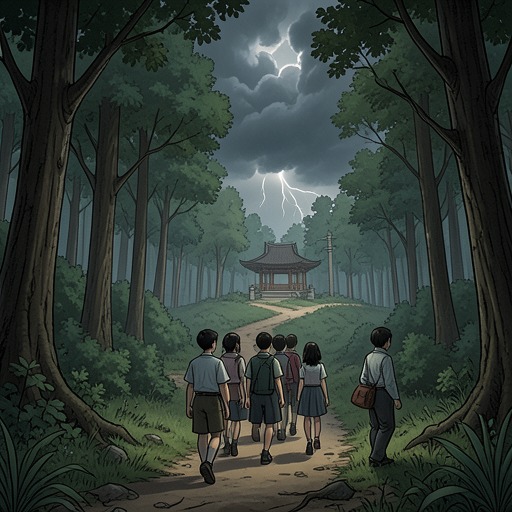
The incident grows out of a camping trip for Yomiyama North Middle School Third-Year Class 3, held for two nights and three days beginning on August 8, 1998. The group stayed at Sakitani Memorial Hall, a lodge owned by the school at the foot of Yomiyama. The head teacher, Mr. Koga, proposed the trip and linked it to a visit to Yomiyama Shrine, presenting the outing as a practical response to the class’s worsening crisis.
The shrine visit carried an explicitly ritual dimension. The shrine was associated with the mountain and town, and oral traditions connected Yomiyama with Yomi, the land of the dead. Some traditions described the shrine as a linchpin separating the living world from the next. The shrine itself was severely neglected, appearing almost forsaken, so the students cleaned it together and became convinced that their work might break the curse. Mr. Koga confidently assured them that everything would be all right. The attempt failed, and the students’ confidence in a simple collective remedy collapsed into renewed fear.
The class arrived at the lodge under a tightening atmosphere of suspicion. Earlier disasters had already produced arguments about responsibility. Izumi Akazawa accused Mei Misaki and Koichi Sakakibara of bearing responsibility for the deaths and other misfortunes since May, then demanded an apology from Mei for having acted as though nothing had happened after ceasing to be “not there.” The accusation transformed uncertainty into blame, making individual students into possible causes of a collective calamity. Yuya Mochizuki later confessed that he had suspected Tomohiko Kazami of being the “extra person” and had killed him because Kazami could not remember shared childhood experiences. These acts of suspicion and misdirected certainty form the social background against which the lodge massacre unfolds.
Course of the Massacre
The violence first becomes visible when Koichi notices blood and enters the dark dining hall rather than following the other students. Inside, an unexpected hand grabs his ankle. The scene then shifts from unexplained danger to open catastrophe: when he opens a heated door, he realizes that the strange sound and smell come from a fire consuming the room.
In the flames, Koichi sees a man lying in the kitchen. The victim’s head faces him, and the fire is about to catch on his clothing, yet the body does not move. Metal cooking skewers used during dinner have been driven deeply into the man’s neck and face, apparently causing his death before the fire began. Koichi identifies the victim as Manabu Maejima nearby and tries repeatedly to wake him, but Maejima gives no response. After checking his pulse, breathing, and heartbeat, Koichi determines that Maejima is dead.
The fire does not remain confined to the kitchen. Heat and smoke force Koichi backward, while the body of Maejima collapses and becomes impossible to move. At the same time, Akazawa is attacked on a second-floor balcony. The assailant raises a hand that may hold the same knife used against Maejima, and the attacker and victim struggle together at the railing. Koichi then sees the grappling figures topple over the balcony, still locked together. Akazawa’s fall becomes fatal, while the blaze and the attacks make the lodge a space in which escape, rescue, and identification are all dangerously confused.
The immediate explanation comes from Tatsuji Chibiki. After observing the scene and the person responsible, he concludes that Mieko Numata, the wife of caretaker Kensaku Numata and a co-manager of the lodge, began the attack. He identifies the sequence as beginning with the assault on Kensaku Numata, followed by Maejima’s stabbing and the fire. His response is practical rather than interpretive: he orders Koichi to leave through the gate quickly, treating survival as the only remaining objective while the disaster continues around them.
Deaths and Reconstruction
The official reconstruction, given in the days after the event, records that firefighters reached Sakitani Memorial Hall before dawn on August 9, 1998, but could not prevent the lodge from being almost completely destroyed. Six bodies were found at the scene. The scale of the destruction initially makes the fire appear to be the common cause of death, but the coroner’s inquest and court-ordered autopsies establish the opposite: not one of the six victims died because of the fire.
Kensaku Numata had been stabbed in the neck with a large number of metal cooking skewers and was burned afterward. Four students—Maejima, Yonemura, Sugiura, and Nakao—died from blood loss after being stabbed and cut in multiple places with a sharp blade. Akazawa died when her spine snapped in the fall from the second-floor balcony. The forensic findings therefore separate the massacre into distinct mechanisms of killing: skewers for the caretaker, repeated knife wounds for four students, and a fatal fall for Akazawa, with the fire serving as a subsequent destructive and concealing force rather than the direct cause of any death.
The evidence and witness testimony establish Mieko Numata’s responsibility conclusively. After murdering her husband, she is believed to have scattered kerosene around the kitchen and set the lodge alight. Tatsuji Chibiki restrained her, but before she could be handed over to the police, she died in an apparent suicide by biting through her tongue. The investigation can determine what she did, yet it cannot determine why she did it. Her motive remains unclear even after the sequence of crimes has been reconstructed.
Consequences and Significance
The massacre destroys the students’ belief that ritual cleaning, shrine visitation, or careful adherence to adult guidance can restore order. The class had gone to Yomiyama Shrine because the outing was supposed to contain the curse; instead, the trip places its members inside an isolated lodge where ordinary protections fail. The shrine’s neglected condition and the failed cleaning ritual become a stark counterpoint to the fire at Sakitani Memorial Hall: communal action produces temporary conviction, but not safety.
The adults also respond through competing forms of control. Tatsuji Chibiki repeatedly attempts to calm the students and preserve obedience, insisting after another crisis that the situation is an ordinary attack associated with Mieko Numata’s condition rather than an extraordinary event. The narrative exposes this reassurance as a lie. His calm language is meant to prevent panic, but it also shows how institutional authority manages terror by withholding its full meaning until the danger has passed.
The massacre further demonstrates how the class’s search for an “extra person” converts fear into violence. Izumi Akazawa’s accusations against Mei Misaki and Koichi, Yuya Mochizuki’s suspicion of Kazami, and the later attacks at the lodge all show a community attempting to make an invisible supernatural threat legible through identifiable bodies. The result is not restored order but a chain of real injuries and deaths. The Sakitani Memorial Hall massacre thus stands as both a literal murder scene and the terrible consequence of a collective need to assign responsibility before the truth is known.
Its final irony is that the disaster is at once fully documented and fundamentally unresolved. The victims, weapons, fire, and perpetrator can be identified with forensic certainty, but the motive remains inaccessible. The event therefore closes one level of mystery while preserving another: the human acts are reconstructed, yet the wider pressure of the 1998 Class 3 disasters continues to make ordinary causation feel insufficient. The burned lodge becomes the physical record of that contradiction, preserving evidence of deliberate violence while leaving the deepest reason for it unanswered.