Reiko Mikami's death
AnotherReiko Mikami's death is the climactic “returning” of the extra person to death, an act that ends the disasters afflicting Yomiyama North Middle School Third-Year Class 3 while shattering the characters’ memories and relationships. The event is both a murder and a desperate attempt to restore the boundary between the living and the dead: Koichi Sakakibara accepts Mei Misaki’s deduction that Reiko, whom he knew as his aunt, was the casualty, then kills her with a pickax when she is trapped beneath lumber at Sakitani Memorial Hall.
Discovery of the Extra Person
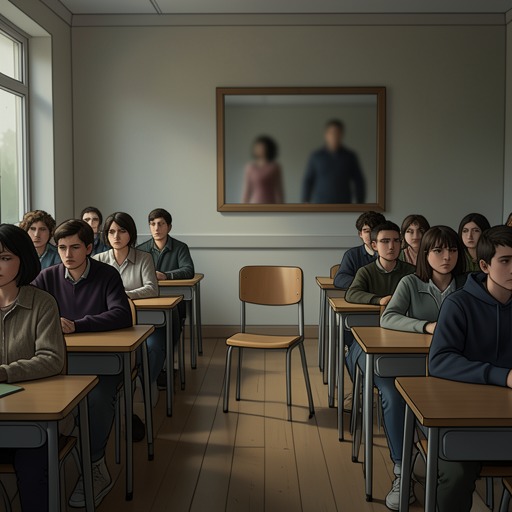
The discovery begins with an institutional anomaly rather than a recovered memory. Mei points out that Third-Year Class 3 is the only class at the school with an assistant head teacher. The existence of Reiko in that role had been accepted without question, but the exception becomes evidence once the class’s history is reconsidered. Mei concludes that Reiko must have died the year before last, when she was head teacher of Class 3, and that the disasters began after the second semester started, when Sakuma abandoned the role of being “not there.”
Other facts reinforce the deduction. The art club had been suspended until the spring because Reiko, its sponsor, had died; its resumption in April corresponded to the phenomenon restoring Reiko as the substitute head teacher. The class had also been short one desk at the beginning of the semester—not in the classroom, but in the teachers’ office—despite the disasters already having begun in April. These material discrepancies become more reliable than the characters’ memories, which the phenomenon has altered or erased.
Koichi realizes that his own history may have been falsified as well. He suspects that he had already visited Yomiyama one and a half years earlier, during the autumn of his first year of middle school, perhaps to attend Reiko’s wake and memorial service after her death the previous autumn. The possibility explains why his recollections feel incomplete and why the truth cannot be recovered simply by searching inward: while he remains inside the phenomenon’s distorted world, objective fragments are the only route toward the buried event.
The Killing at Sakitani Memorial Hall
The confrontation takes place during the class camping trip at Sakitani Memorial Hall, the school-owned lodge at the foot of Yomiyama. The trip had been proposed by head teacher Koga and included a visit to Yomiyama Shrine. The shrine’s neglected condition led the students to clean it, briefly convincing them that a ritual act might break the curse; the attempt failed, and the disasters continued. The later ascent of the mountain is likewise surrounded by anxiety, with Tatsuji Chibiki warning the students to be careful and acknowledging that deteriorating weather could cancel the outing.
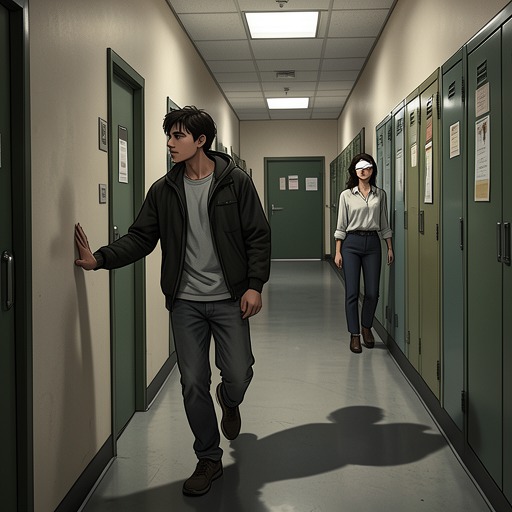
At the lodge, Koichi finds Reiko trapped beneath lumber while Mei stands over her holding a heavy pickax. Mei insists that Reiko is the extra person and that the only way to stop the disasters once they have begun is to return the casualty to Death, a conclusion attributed to Katsumi Matsunaga’s account from fifteen years earlier. Koichi takes the pickax from Mei. Its haft is roughly sixty or seventy centimeters long, and its pointed iron head is sharp enough to inflict fatal wounds; the physical weight of the tool makes the proposed act brutally concrete rather than symbolic.
Koichi’s decision is marked by uncertainty rather than certainty. He tells himself that he will believe Mei, while recognizing that this may mean only that he wants to believe her. Nevertheless, he swings the pickax overhead despite Reiko’s scream for him to stop. The blow enters her back and reaches her heart. The act produces an immediate bodily shock in Koichi, whose pain recalls the X-ray of his damaged lung after its third collapse, linking the violence against Reiko to his own history of physical vulnerability and mortality.
Disasters, Violence, and False Explanations
The killing occurs within a wider chain of fear in which the class repeatedly converts uncertainty into accusation and violence. Izumi Akazawa tells Mei and Koichi that they bear responsibility for the disasters, including Mr. Kubodera’s death, and demands an apology from Mei for having ceased to be “not there” while behaving as though nothing had happened. The accusation gives the class a visible target, but it does not resolve the underlying mechanism; instead, it intensifies resentment toward those associated with the unexplained deaths.
The class’s confusion is also sustained by official minimization. After Mr. Kubodera suffers a violent attack, Chibiki assures the students that the incident is merely an attack associated with Kubodera’s condition, not an extraordinary event or freak accident, and orders them to calm down and go to bed. Koichi recognizes that Chibiki is lying. The contrast between the adults’ controlled explanations and the students’ fear shows how the class’s protective structures have become instruments for concealing the disaster rather than preventing it.
The lodge itself becomes another site where ordinary explanations collapse. Koichi enters a dark dining hall after noticing blood and encounters a hand grabbing his ankle. Elsewhere, a strange sound and smell lead him to a room whose door is hot to the touch; when he forces it open, he discovers that the entire room is on fire. The fire is later found not to have killed the victims directly. Kensaku Numata’s wife, Mieko Numata, killed six people, including her husband, before spreading kerosene in the kitchen and setting the fire. Chibiki restrained her, but she died before surrendering to the police after biting through her tongue in an apparent suicide attempt. The immediate criminal explanation therefore coexists with the supernatural question of the extra person, making the night a convergence of human violence, disaster, and distorted causality.
Aftermath and Restoration of Memory
In the aftermath, Koichi and Mei believe that the extra person died in the fire that night. The remaining students count fourteen people, or fifteen if Chibiki is included, although Mei and Koichi know that there must originally have been sixteen. Their knowledge is isolated because they were deeply involved in Reiko’s death; Mochizuki, Teshigawara, and Chibiki no longer remember that an art teacher named Reiko Mikami had existed as the assistant head teacher of Class 3 since April.
The erased history includes more than Reiko’s name. She had become the substitute head teacher after Kubodera’s death, partially remembered her own experience from fifteen years earlier, planned the camping trip as a desperate countermeasure, and attended the trip as its chaperone. Once she is returned to death, the phenomenon corrects the class’s records and recollections. Mei later reports that a class member connected with the disasters from two years earlier had actually made the total eight people rather than seven, and that the memories of everyone involved had returned to normal. The class list no longer contains the entry “Assistant Head Teacher: Reiko Mikami.”
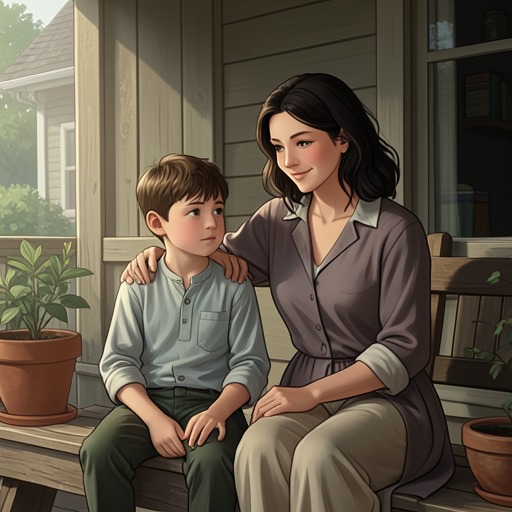
Reiko’s death therefore ends the immediate cycle by restoring the world’s official record to a form that excludes her. Yet the correction is not comforting. Koichi is left with the knowledge that the woman he killed was connected to his family as the person he knew as his aunt, and with the possibility that he had attended her funeral without retaining the memory. The event stops the disasters by making Reiko absent from both life and collective remembrance, but it leaves Koichi and Mei as the only witnesses who must carry the truth of what happened.
Narrative Significance
The event gives concrete form to the principle of returning the casualty to death. At first, the phrase can sound like a rule or ritual formula; at Sakitani Memorial Hall, it becomes an irreversible choice between preserving a familiar relationship and ending a chain of deaths. The evidence does not present Reiko as a simple villain. She is an apparently living teacher, a remembered relative, a former head teacher, an art-club sponsor, and a woman who had taken part in the class’s desperate attempt to prevent further disasters. Her status as the extra person makes those identities mutually unstable.
The scene’s decisive value shift is from threatened life to deliberate death, followed by the restoration of a precarious communal order. Koichi’s act is framed as necessary, but necessity does not remove its moral violence: he must choose an interpretation of incomplete evidence and kill someone who is terrified and physically helpless. The disappearance of Reiko from memory and records confirms the phenomenon’s power while denying the survivors a stable public account. Reiko Mikami's death thus resolves the disaster mechanically but preserves its deepest wound—the living can be saved only by accepting that someone they knew as alive must be recognized as dead.