Antigone–Haemon relationship
AntigoneThe Antigone–Haemon relationship binds a genuine, if briefly glimpsed, love to an ending neither can escape. Haemon’s choice of Antigone rather than the more conventionally admired Ismene makes their engagement surprising; Antigone’s later insistence that she cannot marry him makes that bond a source of pain as well as tenderness. After Antigone dies, Haemon finds her in the tomb and takes his own life beside her, so the promised marriage ends not in a shared future but in a second death.
Identity and Unequal Expectations
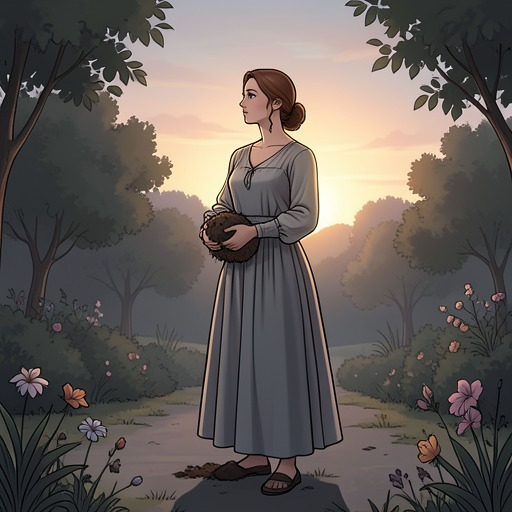
Haemon is Creon’s son and Antigone’s fiancé. From the outset, their engagement is presented as unexpected. The Chorus describes Haemon as drawn to games, dancing, happiness, and success, and notes that Ismene is much prettier than Antigone. At a party, Haemon dances with Ismene, radiant in a new dress, but then finds Antigone alone in a corner, daydreaming with her arms around her knees. He asks Antigone to marry him. No one knows why he chooses her; Antigone looks at him seriously, shows no surprise, and accepts with a small, sad smile.
That beginning places the couple under the shadow of knowledge Haemon does not share. The Chorus says he does not know that Antigone can never have a husband on earth, and that the honor of marrying her will bring him an early death. The engagement is therefore both a declaration of attachment and a promise already marked by tragedy. Antigone’s sad smile, set against Haemon’s unexplained choice, makes the relationship’s tenderness inseparable from its foreknowledge of loss.
Affection and the Imminent Separation
When Antigone meets Haemon privately, she runs to him and asks forgiveness for their quarrel the previous night, taking the blame for it. In a later moment, she huddles against him and asks whether he truly loved her that night he first chose her. Her question returns the relationship to its beginning: the decision that seemed inexplicable to others is, for Antigone, something she needs to know was grounded in love.
Antigone eventually gives Haemon an answer that does not cancel her affection but makes a future together impossible. Turning away and hardening her voice, she tells him that she wanted to be his wife the night before because she loves him very much, and because she can never marry him. The admission holds love and refusal together. She does not present the engagement as false; she distinguishes the love she feels from the life she knows they cannot share.
Haemon stands stunned. Antigone runs to the window and reminds him of his promise to leave without speaking or approaching her. She threatens to throw herself from the window if he does either, and invokes the little boy they imagined having together in their dreams as the only child she will ever have. She orders Haemon to go quickly, telling him that he will understand tomorrow, or soon. Despairing, she persuades him to obey. The imagined child gives concrete form to the future she is renouncing: marriage and family exist between them only as a dream she names while sending him away.
Irreconcilable Choices
Their separation reflects the larger conflict between Antigone’s refusal to compromise and the demands of political order. Antigone says that everyone has a part to play: Creon must have them put to death, and they must bury their brother. Later, she insists that she has not said yes and can still refuse what she does not want; the choice belongs to her, while Creon, with his crown and guards, can have her put to death. These declarations establish that her choice is not a negotiation over how to preserve the engagement. She accepts the consequence of refusal rather than trade away the decision she considers her own.
Antigone says that she can at least do what remains possible and must do what she can. Her position makes her love for Haemon no less real, but it cannot overrule the course she has chosen. Her demand for everything, whole and complete, or nothing gives the separation a broader meaning: a compromised happiness is not an outcome she will accept. The relationship is caught between two standards that do not meet—shared life and happiness on one side, an uncompromised refusal on the other.
Creon’s account of political responsibility sharpens the contrast. He says someone must say yes and steer the ship while disorder threatens it, and argues that a ruler must act without the luxury of making every distinction. Antigone’s insistence on the right to say no confronts that model directly. The conflict is not simply between two people who love one another but cannot remain together; it is entangled with the opposing claims that define Antigone’s confrontation with Creon. Haemon’s place as Creon’s son makes the relationship bear the cost of that conflict within the family as well as within Antigone’s private life.
Death and Consequence
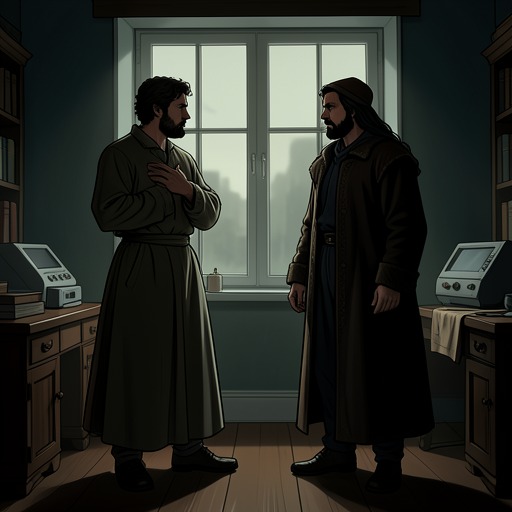
After Antigone is condemned, Creon tells Haemon that he tried everything to save her and that she could have lived, but that she chose death. He also says she does not love Haemon. That judgment stands in sharp contrast to Antigone’s own declaration that she loved Haemon very much. The account thus leaves a consequential difference between the private truth Antigone disclosed to Haemon and Creon’s interpretation of her choice. Her love does not change her decision, and her decision does not prove that the love was absent.
The final scene confirms the cost of their separation. When Antigone has just been placed in the cave and the last stones are being set, a cry comes from inside. Creon recognizes that it is not Antigone’s voice and orders the stones removed. Inside, Antigone is dead, and Haemon is on his knees holding her. When Creon enters and tries to raise his son, Haemon ignores him, turns toward him, and spits in his face. He then draws his sword and, without speaking, takes his own life, collapsing against Antigone. The relationship’s final image is not a wedding or reconciliation but Haemon’s return to the woman he loved in death, while his rejection of his father adds the rupture between father and son to the tragedy of the lost couple.
Narrative Significance
The relationship is introduced through dramatic irony: the Chorus tells the audience that Haemon will become Antigone’s husband, but also that no husband can exist for her on earth and that the supposed honor will cost him his life. Later, Antigone’s private confession supplies what that early prediction could not: the engagement mattered to her, and she loved Haemon, even as she sent him away. The ending makes the prediction literal and completes the movement from promise to separation to shared death.
Haemon and Antigone’s bond also brings political conflict into intimate life. Antigone’s refusal is at once a decision about what she can accept and a challenge to Creon’s authority; Haemon is both her fiancé and Creon’s son. Their relationship cannot be insulated from those roles. Its tragedy lies not in an absence of affection but in affection’s inability to produce a future when Antigone’s choice, Creon’s rule, and the consequences of her sentence have closed that future off.