Antigone–Ismene relationship
AntigoneThe relationship between Antigone and Ismene turns on a shared family bond that cannot produce a shared decision. Ismene thinks through the danger and clings to the living; Antigone accepts that Creon will put them to death and insists that they must bury their brother. Their later reconciliation attempt comes too late: when Ismene offers to accompany Antigone, Antigone refuses to let her join a death she had not chosen at the outset.
Sisters Facing the Decree
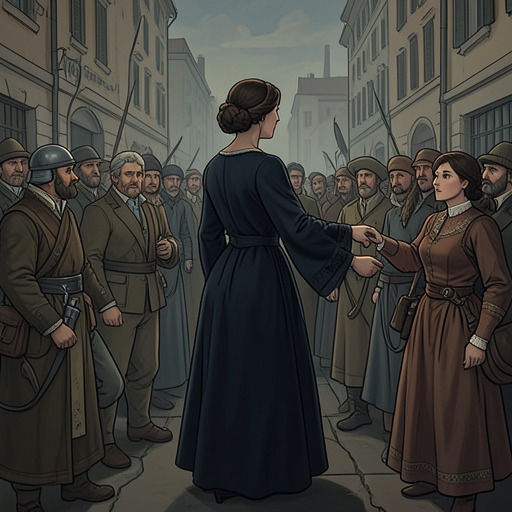
Ismene opens their confrontation by telling Antigone that she has thought about the situation a great deal. Her deliberation leads not to defiance but to fear: she expects Creon to have them put to death. The threat is not abstract. Ismene points to Creon’s power as king and to the thousands of people around them in the streets of Thebes who agree with him. For her, the scale of public consent makes resistance seem impossible as well as dangerous.
Antigone answers from a different understanding of what the danger means. Creon must have them killed, she says, just as they must bury their brother; each has been assigned a part, and she asks what Ismene expects them to do about it. The sisters thus recognize the same likely outcome but draw opposite conclusions. Ismene treats death as a reason to hold back; Antigone accepts it as the consequence of carrying out the family obligation.
Fear, Persuasion, and Refusal
Ismene’s concern is also relational: she asks what will happen to Haemon. Her appeal places Antigone’s choice alongside the living people who love or need her, rather than treating the burial as an isolated act. Later, when Antigone is still at risk of going out to bury Polynices, Ismene says she cannot sleep because she fears her sister will attempt it even in daylight. She reminds Antigone that Haemon, Nanny, and Ismene are there with her, along with Ginger, her dog; they love her and need her. She urges her to forget Polynices, whom she describes as dead, unloving, and a bad brother who had remained a stranger to them.
Antigone does not accept comfort as a substitute for action. She says that burial is the one thing she can do, and that she has to do what she can. The difference is not that Ismene feels nothing for their brother or for Antigone: her sleeplessness and her appeal to their living household show her attachment. Rather, the sisters assign different weight to the same claims. Ismene presses the value of survival and reciprocal care; Antigone regards the act she can perform for the dead as binding even when it brings death upon her.
Their argument becomes physically charged when Ismene tries to hold or comfort Antigone. Antigone pulls away, tells her to leave her alone, and rejects the prospect of the two of them weeping together. She challenges Ismene’s claim to have thought everything through, asking whether the city’s hostility and fear of death are really enough to settle the matter. The gesture of withdrawal makes the disagreement more than an exchange of reasons: Antigone refuses both Ismene’s physical consolation and the shared grief that might soften their separation.
A Bond Strained by Opposed Choices
Antigone casts the sisters’ conflict as part of a larger pattern of assigned roles. She says that everyone has a part to play: Creon must order their deaths, and the sisters must bury their brother. The formulation makes their relationship tragic not because they fail to understand the danger, but because they respond to it differently. Ismene sees a king backed by the city; Antigone sees an obligation that remains hers to perform regardless of the force arrayed against her.
The distinction sharpens when Antigone tells Creon that she did not say yes, and that she alone can choose to refuse what she dislikes. She sets her refusal against Creon’s responsibility to say yes and exercise power, declaring that he can put her to death because he accepted that role. Ismene is not present in this exchange in the evidence here, but the contrast clarifies what divides the sisters: Antigone makes an uncompromising claim for individual refusal, while Ismene’s earlier reasoning remains grounded in the consequences of opposing royal authority and communal agreement.
The emotional language of Antigone’s later confrontation with Creon gives that division another measure. She rejects a modest accommodation with happiness and insists on wanting everything whole and complete, or nothing. That absolutism helps explain why Ismene’s plea to preserve the life they still share cannot persuade her. Their attachment is real, but it cannot make Antigone accept a partial settlement in which survival requires abandoning the act she considers necessary.
The Offer That Comes Too Late
When Ismene enters during the confrontation, she asks Antigone’s forgiveness and says she has found courage and will go with her now. The offer marks a change: the sister who earlier feared the king and the city is at last willing to join Antigone. But its timing is decisive. Antigone refuses, saying that now it is she alone and that Ismene will not come die with her. She calls the alternative too easy, refusing to let a late act of solidarity erase the earlier difference between their choices.
Antigone makes that difference explicit: Ismene chose life, while she chose death. She reminds her sister that Ismene could have come with her earlier, at night, and could have returned with her on the second attempt to dig up the earth with her fingernails and be arrested like a common thief. The concrete recollection turns their disagreement into a history of missed opportunities: Ismene’s present courage cannot retroactively accompany Antigone through the earlier acts of defiance.
The relationship therefore ends in separation without simple indifference or reconciliation. Ismene’s fear, sleepless vigilance, and eventual offer show love expressed through protection and a belated willingness to share danger. Antigone’s refusal shows that, for her, solidarity must coincide with the moment of choice; it cannot be added afterward to make the consequences easier to bear. Their bond remains emotionally close, but the sisters cannot occupy the same position toward life, death, and their duty to their brother.