before the play
The Brothers’ Agreement
After [Oedipus](entity:character-recall-character-c3f19a761464)’s fall, his sons [Eteocles](entity:character-recall-character-134a2ac38208) and [Polynices](entity:character-recall-character-c9fdcbcca9dc) agreed to rule [Thebes](entity:location-recall-location-4e8de5820aec) in turn, each for a year. The arrangement promised a peaceful succession, but it rested on the brothers’ ability to surrender power when their allotted time ended.
Eteocles refused to yield the throne at the close of his first year. The broken agreement set the brothers against one another and made their struggle a crisis for the city as well as a family feud.
before the siege
Polynices Leaves Thebes
After a violent quarrel with his father, [Polynices](entity:character-recall-character-c9fdcbcca9dc) left home and joined the [Argive army](entity:organization-recall-organization-argive-army-5ac0a6cb03be). [Creon](entity:character-recall-character-23e9206c3a48) later recounts that the quarrel followed [Oedipus](entity:character-recall-character-c3f19a761464)’s refusal to pay one of Polynices’s gambling debts; Polynices struck his father and went away without seeing the family for a long time.
His departure became part of a wider struggle against Oedipus and the ruling house. In Creon’s account, Polynices helped turn that grievance into a campaign against [Thebes](entity:location-recall-location-4e8de5820aec), though [Antigone](entity:character-recall-character-87fd4c2d0384) remembers him through a tender childhood token he once brought home.
before the final battle
The Rival Princes’ Treasons
[Creon](entity:character-recall-character-23e9206c3a48) reveals that both brothers plotted against their father and their city. [Polynices](entity:character-recall-character-c9fdcbcca9dc)’s attacks against [Oedipus](entity:character-recall-character-c3f19a761464) were followed by assassins who confessed to being paid, while [Eteocles](entity:character-recall-character-134a2ac38208), later celebrated as loyal and virtuous, was also preparing to sell [Thebes](entity:location-recall-location-4e8de5820aec) to the highest bidder.
The disclosure overturns the public distinction between a good brother and a traitor. Creon says the brothers were both petty thieves who turned on each other over the spoils, leaving him to manufacture a usable political story from their ruin.
at the end of the brothers’ year of conflict
The Princes’ War
[Polynices](entity:character-recall-character-c9fdcbcca9dc) gathered seven foreign princes to his cause and attacked [Thebes](entity:location-recall-location-4e8de5820aec). The defenders beat the invading force at the city’s seven gates, but the conflict ended in a terrible symmetry: [Eteocles](entity:character-recall-character-134a2ac38208) and Polynices fought and killed each other outside the walls.
Their deaths left the throne vacant and the city exhausted. The brothers were found mangled together on the battlefield, their identities difficult to distinguish, giving [Creon](entity:character-recall-character-23e9206c3a48) the immediate problem of deciding which corpse would receive honor and which would be abandoned.
immediately after the battle
Creon Takes the Throne
With [Oedipus](entity:character-recall-character-c3f19a761464) and his sons dead, [Creon](entity:character-recall-character-23e9206c3a48) became king and set aside the quieter pursuits he had once enjoyed: music, old manuscripts, and browsing antique shops. He took up the practical burden of governing a city emerging from war.
The play presents his rule as work rather than personal triumph. Creon believes the office requires him to restore order, even when the decisions it demands are distasteful and leave him isolated.
after the battle and before the play’s opening
The Rival Funeral Verdict
[Creon](entity:character-recall-character-23e9206c3a48) ordered a grand state funeral for [Eteocles](entity:character-recall-character-134a2ac38208), proclaiming him the loyal defender of [Thebes](entity:location-recall-location-4e8de5820aec), and prohibited the burial of [Polynices](entity:character-recall-character-c9fdcbcca9dc) as a rebel and traitor. The body of Polynices was to remain exposed to scavengers; anyone who performed the funeral rites would be put to death.
Creon later admits that the public distinction was a political necessity, not an honest account of the brothers. He says he could not allow both sides to have a villain, so he chose one corpse for civic honors and the other for disgrace, although he did not even know which body was which.
at the opening
The Chorus Frames the Tragedy
The [Chorus](entity:character-recall-character-e51e1c58ba19) introduces the characters gathered onstage and describes [Antigone](entity:character-recall-character-87fd4c2d0384) as a withdrawn young woman on the verge of becoming herself by confronting [Creon](entity:character-recall-character-23e9206c3a48). She knows that she is young and wants to live, yet feels the play’s ending already drawing her away from everyone who will survive the night.
The Chorus also sketches the people around her: [Haemon](entity:character-recall-character-14d2db5be22a), her fiancé; Creon, the tired king; [Eurydice](entity:character-recall-character-cd542b1f6c4a), who quietly knits; the future messenger; and the guards, whose ordinary appetites and unquestioning service will carry out the law. Their introductions establish a world in which private lives are already caught in public consequences.
the night before Antigone is captured
The First Burial
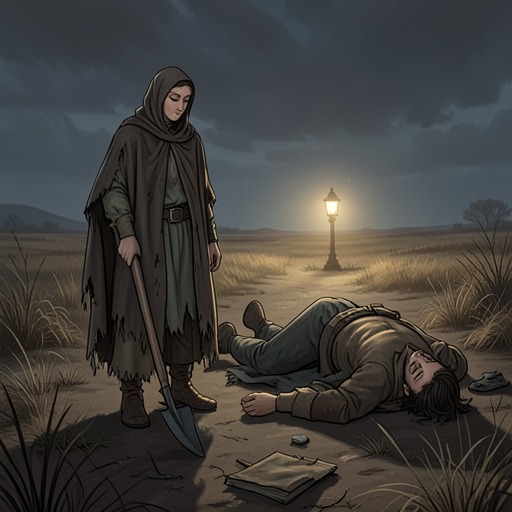
At night, [Antigone](entity:character-recall-character-87fd4c2d0384) went to [Polynices](entity:character-recall-character-c9fdcbcca9dc)’s exposed body and covered it with a little earth, performing the burial gesture forbidden by [Creon](entity:character-recall-character-23e9206c3a48). She used Polynices’s small shovel, which the family had once taken on holiday for building sandcastles and which he had marked with his name.
The act fulfilled Antigone’s conviction that the dead deserve rest, but the guards soon uncovered the body. To her, the burial was a duty to her brother; to Creon’s government, it was a direct breach of the decree carrying a death sentence.
before dawn on the day of her arrest
Antigone’s Dawn Return
[Antigone](entity:character-recall-character-87fd4c2d0384) returned barefoot from outside as the house slept, carrying her sandals. She described the gray dawn, the sleeping garden, and the wet fields she had entered quietly, but the [Nurse](entity:character-recall-character-2a22f8b7f2c7) quickly realized that she had been out at night and demanded to know where she had gone.
Antigone first answered playfully and let the Nurse believe she had met a lover. When the Nurse grew upset, Antigone comforted her and assured her she was pure, but warned that she could not be a little girl that morning. Her strange farewell-like tenderness hints at the danger she is carrying alone.
early morning on the day of the arrest
Ismene Refuses the Burial
[Ismene](entity:character-recall-character-f090a53355e0) told [Antigone](entity:character-recall-character-87fd4c2d0384) she had spent the night thinking about their plan and could not join it. She feared the guards, public hatred, and torture, and argued that [Creon](entity:character-recall-character-23e9206c3a48) was king and had to set an example. Antigone rejected the demand that she understand and accept the decree, insisting that she could not live by merely accommodating what she found wrong.
Ismene pleaded that Antigone was young, engaged, and able to be happy, while Antigone admitted that she was not fearless and did not want to die. Their disagreement makes clear that Antigone’s decision is not born from ignorance of its cost: she knows the danger and refuses to let fear settle the question for her.
early morning, before Haemon arrives
Antigone’s Farewell to the Nurse
The [Nurse](entity:character-recall-character-2a22f8b7f2c7) brought [Antigone](entity:character-recall-character-87fd4c2d0384) coffee and toast, and Antigone asked for the familiar comfort of her hand against her cheek. She then asked the Nurse to be gentle with Ginger, her dog, and to speak to her as if she were a person, even if Antigone could no longer do so herself.
When Antigone spoke of the possibility that Ginger might wait sadly for her, the Nurse failed to understand the implication. Antigone softened the farewell by extracting a promise about the dog, turning ordinary domestic care into a quiet preparation for her absence.
morning on the day of her arrest
Antigone’s Confession to Haemon
[Haemon](entity:character-recall-character-14d2db5be22a) arrived, and [Antigone](entity:character-recall-character-87fd4c2d0384) apologized for their quarrel the previous night. In his arms she asked whether he truly loved her, whether he had ever wished he had chosen [Ismene](entity:character-recall-character-f090a53355e0), and whether he could imagine the child they might have had; Haemon reassured her that she was the woman he loved.
Antigone then confessed that she had dressed and used Ismene’s perfume and lipstick because she doubted Haemon’s desire for her. She revealed that she had come to him the night before intending to become his wife, but that she could never marry him. She made him promise to leave without questioning her and threatened to throw herself from the window if he came closer.
morning, immediately after Antigone’s confession
Haemon Is Sent Away
[Haemon](entity:character-recall-character-14d2db5be22a) obeyed [Antigone](entity:character-recall-character-87fd4c2d0384)’s demand and left without making her explain her decision. Once he was gone, Antigone sat alone and murmured that it was finished for him, sealing the separation before he knew that she had already acted against [Creon](entity:character-recall-character-23e9206c3a48)’s decree.
[Ismene](entity:character-recall-character-f090a53355e0) returned and urged Antigone to forget [Polynices](entity:character-recall-character-c9fdcbcca9dc), arguing that the dead brother had been a stranger and that the living people around her loved and needed her. Antigone told her it was too late: when Ismene had seen her that morning, Antigone had already returned from the burial.
after dawn on the day of the arrest
The Guards Discover the Burial
The guards found that someone had scattered earth across [Polynices](entity:character-recall-character-c9fdcbcca9dc)’s body. They initially considered whether an animal had disturbed the ground, but recognized that the gesture resembled a funeral rite; they found no clear tracks, only a very light footprint and a child’s rusty shovel.
[Jonas](entity:character-recall-character-b0b8ae6b1abc) was sent to report the breach to [Creon](entity:character-recall-character-23e9206c3a48). Creon suspected that political enemies might be using a child to provoke him, ordered the guards to keep the discovery secret, and threatened them with death if news spread. He also kept the same three men at the body, trying to contain a crisis before it became public.
after the guards’ first report
The Chorus Explains Tragedy
The [Chorus](entity:character-recall-character-e51e1c58ba19) describes tragedy as a tightly wound mechanism that begins with a small gesture and then runs toward its conclusion. In contrast to melodrama, where hope and rescue might still alter events, tragedy is clean and certain: its people are trapped in the roles they have been given.
The reflection ends as the guards bring [Antigone](entity:character-recall-character-87fd4c2d0384) in. The Chorus says that she has been caught and, for the first time, can be herself. The theory becomes immediate action: her capture releases the conflict that [Creon](entity:character-recall-character-23e9206c3a48) had tried to keep concealed.
later that day
Antigone’s Arrest
The guards caught [Antigone](entity:character-recall-character-87fd4c2d0384) beside [Polynices](entity:character-recall-character-c9fdcbcca9dc)’s body as she tried to cover it again, this time digging with her hands after they had taken the shovel. She fought them because she believed the body was not yet completely covered, and they brought her to the palace in handcuffs.
[Creon](entity:character-recall-character-23e9206c3a48) was alarmed that the guards had abandoned their post and exposed the affair. Once he confirmed that Antigone had acted alone and that no one had seen her on the way, he sent the guards out and faced her privately. Her arrest transformed a hidden act of mourning into a confrontation between the king’s law and her refusal to obey it.
immediately after Antigone’s arrest
Creon Offers a Cover Story
[Creon](entity:character-recall-character-23e9206c3a48) proposed that [Antigone](entity:character-recall-character-87fd4c2d0384) return to her room, claim she was ill, and say she had not gone out. He would make the guards disappear, preserving a chance to save her before anyone else learned what she had done.
Antigone refused the offer because she intended to go back and bury [Polynices](entity:character-recall-character-c9fdcbcca9dc) again. When Creon asked why she had defied him, she said she had to: the unburied dead, in her belief, wandered without rest, and her brother had a right to return to the family waiting beyond death.
during the private confrontation
Creon’s Political Defense
[Creon](entity:character-recall-character-23e9206c3a48) argued that [Antigone](entity:character-recall-character-87fd4c2d0384) had not acted because she believed herself above the law. He insisted that the decree applied especially to a king’s daughter, and claimed that a servant might have stayed home and mourned privately rather than risk execution.
Antigone answered that even as a servant she would have left her dishes and gone out to bury her brother. She said she had known Creon would have her killed, rejecting his claim that royal status had made her reckless. Their dispute shifted from the burial itself to the motives and obligations behind political obedience.
during the private confrontation
Creon Recalls Oedipus
Seeing [Oedipus](entity:character-recall-character-c3f19a761464)’s pride in [Antigone](entity:character-recall-character-87fd4c2d0384), [Creon](entity:character-recall-character-23e9206c3a48) compared her to her father and described the family’s appetite for a grand, personal encounter with death. He contrasted that inherited defiance with his own ordinary name and his effort to restore order through the daily work of kingship.
Creon tried to end the crisis as if Antigone were still a child, reminding her that a spanking and an early bedtime could once have settled her troubles. He urged her to obey, marry [Haemon](entity:character-recall-character-14d2db5be22a), and live, invoking his affection for her and the doll he had once given her. Antigone’s quiet answer showed that he knew where she was going and that his kindness could not turn her back.
during Creon’s attempt to dissuade Antigone
The Funeral Rite Is Questioned
[Creon](entity:character-recall-character-23e9206c3a48) challenged [Antigone](entity:character-recall-character-87fd4c2d0384)’s belief that a formal burial ritual would secure [Polynices](entity:character-recall-character-c9fdcbcca9dc)’s soul. He described [Thebes](entity:location-recall-location-4e8de5820aec)’s priests as careless and mechanical, reducing the ceremony to hurried gestures and recited words; Antigone admitted she had seen such hollow performances herself.
Creon asked whether she had considered that real grief might make a mourner cry out for the dead to be silent and gone. Antigone said she had considered it, yet remained determined to repeat the burial. The exchange exposed the difference between her personal duty and the public ritual whose meaning Creon dismissed as political theater.
during the private confrontation
Antigone Chooses Herself
[Creon](entity:character-recall-character-23e9206c3a48) asked whether [Antigone](entity:character-recall-character-87fd4c2d0384) was acting for the people or for her brother. She answered that she was acting for nobody but herself. When he asked whether she truly wanted death, she refused to be sentimental and told him to do what he had to do quickly, while her courage lasted.
Creon said he wanted to save her, but Antigone insisted that he could neither save nor stop her; he could only order her death. She rejected torture as another pointless delay and made clear that she would not withdraw her choice merely to postpone its consequences.
during the private confrontation
Creon Defends the Decree
[Creon](entity:character-recall-character-23e9206c3a48) accused [Antigone](entity:character-recall-character-87fd4c2d0384) of turning him into the villain of her drama and herself into its heroine. He said he was not a barbarian, but that her contempt and attacks exploited his hesitation to summon the guards. He still tried to rescue her, insisting that the rotting body and the ban on burial were matters of political order.
He explained that he would have buried [Polynices](entity:character-recall-character-c9fdcbcca9dc) for sanitation, but wanted the city to smell the corpse so its people would understand the cost of disorder. Antigone called the reasoning disgusting and asked why he had accepted the crown. Creon said he had felt obliged to take the work rather than refuse it; Antigone replied that he had said yes, and that the choice remained hers to say no.
during the private confrontation
The Ship of State
[Creon](entity:character-recall-character-23e9206c3a48) described kingship as seizing the wheel of a ship taking on water. The crew, he said, pillages or refuses to work while the storm threatens everyone, leaving the ruler to issue orders and sometimes shoot at the crowd to keep the vessel afloat. Responsibility erases the individual names of both ruler and victim, he argued, because the ship and storm matter more than private innocence.
[Antigone](entity:character-recall-character-87fd4c2d0384) refused the logic of compromise. She said she did not want to understand and had come to say no and die. Creon called refusal easy and cowardly, while Antigone countered that his required yes had made him responsible for the consequences he claimed merely to endure.
during the private confrontation
Creon Reveals the Brothers’ Truth
Before proceeding, [Creon](entity:character-recall-character-23e9206c3a48) asked [Antigone](entity:character-recall-character-87fd4c2d0384) whether she understood what she was dying for and offered to tell her the story of her brothers. He recalled how [Polynices](entity:character-recall-character-c9fdcbcca9dc) had once brought the young Antigone a paper flower from a night out, and correctly guessed that she had looked at it before her burial attempt to give herself courage.
Creon then described Polynices as a reckless gambler and partygoer who had struck [Oedipus](entity:character-recall-character-c3f19a761464) over a debt and later joined the [Argive army](entity:organization-recall-organization-argive-army-5ac0a6cb03be). Antigone protested that the account was false, but Creon continued, dismantling the cherished image of the brother whose burial had become the focus of her defiance.
during Creon’s revelation
Creon Exposes the State Funeral
[Creon](entity:character-recall-character-23e9206c3a48) admitted that [Eteocles](entity:character-recall-character-134a2ac38208), celebrated in a grand public funeral as [Thebes](entity:location-recall-location-4e8de5820aec)’s loyal son, had also plotted against [Oedipus](entity:character-recall-character-c3f19a761464) and prepared to sell the city. [Polynices](entity:character-recall-character-c9fdcbcca9dc)’s treason was therefore no unique crime; both princes had lied and betrayed their family and their city.
Creon explained that he needed one brother to become a hero and the other a villain, so he chose the less mangled corpse for the national funeral and ordered the other left to rot. He did not know which body he had honored. The revelation stripped the decree of moral certainty and showed how public memory had been arranged to serve the stability of the state.
immediately after Creon’s revelation
Antigone Temporarily Yields
[Antigone](entity:character-recall-character-87fd4c2d0384) asked why [Creon](entity:character-recall-character-23e9206c3a48) had told her the truth. He answered that it would have been worse to let her die for a ridiculous story. She admitted that perhaps it would have been better, because she had believed in the brother for whom she acted.
When Creon asked what she would do now, she rose as if sleepwalking and said she would go to her room. She agreed to see [Haemon](entity:character-recall-character-14d2db5be22a) and marry soon, appearing momentarily to accept the life Creon had offered. The pause suggested that his revelation had shaken the story she had used to explain her defiance.
after Antigone appears to yield
Creon Praises Ordinary Happiness
[Creon](entity:character-recall-character-23e9206c3a48) urged [Antigone](entity:character-recall-character-87fd4c2d0384) to hold on to life, describing happiness not as a grand ideal but as ordinary things: a loved book, a child at one’s feet, a tool in the hand, or a bench outside the home. He said that life slips away when people are young and becomes a small, tangible treasure only when they learn to grasp it.
Antigone questioned what her happiness would require her to do: whom she would have to flatter, deceive, sell herself to, or allow to die while looking away. Creon dismissed her as unreasonable, but she demanded to know what living meant if it meant accepting the compromises he had made.
during the argument about happiness
Antigone Rejects Compromise
[Antigone](entity:character-recall-character-87fd4c2d0384) said she loved [Haemon](entity:character-recall-character-14d2db5be22a) as the young, demanding, faithful man he was, but could not love a future husband worn down into a comfortable stranger who had learned to say yes. She rejected a life that would reduce love and conviction to habit, and insisted that she wanted everything whole and perfect or nothing at all.
She accused [Creon](entity:character-recall-character-23e9206c3a48) and the contented people around him of accepting scraps of happiness while calling that acceptance wisdom. Creon recognized the resemblance to [Oedipus](entity:character-recall-character-c3f19a761464) and ordered her to be quiet, but Antigone’s refusal now extended beyond [Polynices](entity:character-recall-character-c9fdcbcca9dc)’s burial: she would not settle for a life purchased through compromises she despised.
near the end of the confrontation
Antigone Invites the Crowd
[Antigone](entity:character-recall-character-87fd4c2d0384) mocked the people who pursued happiness at any cost, declaring that they looked like cooks. [Creon](entity:character-recall-character-23e9206c3a48) tried to silence her and warned that people in the antechamber could hear, but she demanded that he open the doors and let them listen.
The private argument was about to become public, making it impossible for Creon to preserve the discreet escape he had offered. Antigone deliberately forced the conflict into the open, where the king’s authority and the decree could no longer be separated from the spectacle of her punishment.
immediately before Antigone’s condemnation
Ismene Offers to Die
[Ismene](entity:character-recall-character-f090a53355e0) entered and told [Antigone](entity:character-recall-character-87fd4c2d0384) she had found the courage to go with her. She offered to share the death sentence, but Antigone refused: Ismene had chosen life when there was still time to join the burial, and Antigone would not let her claim the choice only after the danger had become unavoidable.
Ismene promised to go the next day, but Antigone seized on the offer as proof that others might follow once they heard her. She taunted [Creon](entity:character-recall-character-23e9206c3a48) to summon the guards, forcing him to choose between allowing the defiance to continue publicly and enforcing the decree.
after the confrontation becomes public
Creon Condemns Antigone
[Creon](entity:character-recall-character-23e9206c3a48) finally called the guards and ordered them to take [Antigone](entity:character-recall-character-87fd4c2d0384) away. Antigone greeted the order with relief, and the guards seized her as [Ismene](entity:character-recall-character-f090a53355e0) called after her. By insisting that Creon act, Antigone made the end of the confrontation irreversible.
The [Chorus](entity:character-recall-character-e51e1c58ba19) told Creon he was out of his mind and warned that [Thebes](entity:location-recall-location-4e8de5820aec) would bear the scar for centuries. Creon answered that Antigone wanted to die and that no one had been strong enough to make her want to live; he now saw [Polynices](entity:character-recall-character-c9fdcbcca9dc)’s burial as only the pretext for a deeper refusal of life.
after Antigone is taken away
Haemon Pleads with Creon
[Haemon](entity:character-recall-character-14d2db5be22a) arrived and demanded that [Creon](entity:character-recall-character-23e9206c3a48) release him. Creon held his son and insisted he had tried everything to save [Antigone](entity:character-recall-character-87fd4c2d0384), claiming she did not love Haemon and had chosen death. Haemon struggled to follow her, while Creon said that the whole city already knew and the king could no longer spare her.
The [Chorus](entity:character-recall-character-e51e1c58ba19) suggested declaring Antigone mad or removing her from the city, but Creon feared the people would see such a move as favoritism toward his son. Haemon argued that the people did not matter and that Creon was master; Creon answered that he ruled under the law, not above it.
during the confrontation between Creon and Haemon
Haemon Loses His Father
[Creon](entity:character-recall-character-23e9206c3a48) told [Haemon](entity:character-recall-character-14d2db5be22a) that he had to accept the loss of [Antigone](entity:character-recall-character-87fd4c2d0384) and become a man, presenting grief as the painful passage into adulthood. Haemon answered that the loss had already happened and recalled the father he had admired: the protector who held him as a child and the scholar who shared the secrets of old books.
Creon admitted that those memories belonged to him, but said Haemon had admired him too long and must now see his father clearly. Haemon recoiled, called for Antigone, and ran from the room. Creon recognized that his son loved her, but claimed there was nothing more he could do.
after Haemon runs from the palace
Antigone Faces the Mob
The guards returned [Antigone](entity:character-recall-character-87fd4c2d0384) to [Creon](entity:character-recall-character-23e9206c3a48)’s presence as a howling crowd pressed into the palace. She told Creon she could no longer bear to see or hear the people and asked to be left alone until her death.
Creon ordered the doors guarded and the palace emptied, leaving Antigone with [Jonas](entity:character-recall-character-b0b8ae6b1abc). The public pressure had made her punishment unavoidable in Creon’s eyes, while Antigone now sought only privacy for the last interval before it began.
during the final wait before her execution
Antigone Speaks with Jonas
Alone with [Jonas](entity:character-recall-character-b0b8ae6b1abc), [Antigone](entity:character-recall-character-87fd4c2d0384) asked him to let her look at him, then questioned him about his age, children, service, and advancement. He answered at length about his career and benefits, failing to engage with her questions about death except to say that he had heard she would be sealed alive in a cave.
The contrast between Antigone’s approaching death and Jonas’s practical concerns deepened her sense of isolation. She compared the condemned to animals pressing together for warmth and said she was alone; Jonas offered to send for anything she needed, but could not offer the human connection she sought.
shortly before she is taken to the tomb
Antigone Dictates a Letter
[Antigone](entity:character-recall-character-87fd4c2d0384) asked [Jonas](entity:character-recall-character-b0b8ae6b1abc) to deliver a letter after her death and offered him her gold ring. Worried about the risk, he proposed writing her words in his own notebook and delivering the page in his handwriting, accepting the ring as payment.
She began a message to [Haemon](entity:character-recall-character-14d2db5be22a), saying that she had wanted to die and that he might no longer love her. As she spoke, she admitted that [Creon](entity:character-recall-character-23e9206c3a48) had been right and that she no longer knew why she was dying; beside this strange man, the act seemed terrible and she was afraid. She then ordered Jonas to strike out the confession and write only “Forgive me,” followed by her love and apology to those who would have had peace without her.
immediately after the letter
Antigone Is Led Away
The other guards entered, and [Jonas](entity:character-recall-character-b0b8ae6b1abc) closed his notebook and pocketed the ring. When [Antigone](entity:character-recall-character-87fd4c2d0384) looked at him, he raised his voice and returned to his official manner, telling her she had said enough. She smiled sadly and went with the guards without another word.
The [Chorus](entity:character-recall-character-e51e1c58ba19) declared that Antigone’s story was over and that [Creon](entity:character-recall-character-23e9206c3a48)’s turn would come. Her private farewell was left in the keeping of a man who had treated it as a risky transaction, and the play moved from her execution toward the consequences awaiting those who remained.
later that day
Antigone Is Sealed in the Tomb
The Messenger reported that [Antigone](entity:character-recall-character-87fd4c2d0384) had been placed in her tomb and that workers were rolling the final stones into position when they heard a cry from inside. [Creon](entity:character-recall-character-23e9206c3a48) understood first and ordered the stones removed; he joined the laborers, working with bleeding hands as they opened the sealed entrance.
At the rear of [Antigone’s tomb](entity:location-recall-location-89d8506db182), Antigone was hanging from her belt. [Haemon](entity:character-recall-character-14d2db5be22a) was on his knees beside her, holding her body and moaning. The burial intended as a slow execution had become the scene of her suicide and the discovery that her fiancé had reached her too late.
moments after Antigone is found
Haemon’s Suicide
[Creon](entity:character-recall-character-23e9206c3a48) tried to lift [Haemon](entity:character-recall-character-14d2db5be22a) from [Antigone](entity:character-recall-character-87fd4c2d0384)’s body and begged him, but Haemon ignored him. He turned toward his father with the face of the boy he had once been, spat in Creon’s face, and drew his sword.
After staring at Creon with contempt, Haemon plunged the sword into his own stomach and collapsed against Antigone, embracing her in a pool of blood. His death made the failed rescue of Antigone a direct and devastating consequence for Creon’s family.
after Haemon’s death
Creon Mourns the Lovers
[Creon](entity:character-recall-character-23e9206c3a48) entered after the bodies had been washed and laid beside one another. He described [Antigone](entity:character-recall-character-87fd4c2d0384) and [Haemon](entity:character-recall-character-14d2db5be22a) as pale but peaceful, like lovers the morning after their first night, and said their story was over.
The [Chorus](entity:character-recall-character-e51e1c58ba19) corrected him: [Eurydice](entity:character-recall-character-cd542b1f6c4a) was still alive, and Creon had more to learn. The warning shifted the scene from the deaths of the young couple to the final consequence of Creon’s decisions within his own household.
after news of Haemon’s death
Eurydice’s Suicide
The [Chorus](entity:character-recall-character-e51e1c58ba19) told [Creon](entity:character-recall-character-23e9206c3a48) that [Eurydice](entity:character-recall-character-cd542b1f6c4a) had heard of her son’s death while knitting. She finished her row, put down her needles carefully, returned to her lavender-scented room, and cut her throat.
She lay on one of the twin beds where Creon had once seen her as a young woman, her face bearing the same quiet smile. The poor of [Thebes](entity:location-recall-location-4e8de5820aec) would be cold that winter without the sweaters she made for them, while Creon was left to reckon with a household emptied by the catastrophe.
at five o’clock, after Eurydice’s death
Creon Returns to Work
[Creon](entity:character-recall-character-23e9206c3a48) accepted that the dead were all sleeping and admitted that a day of such losses had been rough. Alone with his young Page, he defended the necessity of doing the dirty work waiting in front of a ruler, asking who would do it if he refused.
The Page said he wanted to grow up, and Creon called him a fool, wishing he would remain young. When the clock struck five, Creon learned that a council meeting was scheduled and went to it, leaning on the Page rather than stopping to mourn.
near the ending
The Guards Resume Their Game
The [Chorus](entity:character-recall-character-e51e1c58ba19) concluded that everyone who had to die was dead, while the survivors would slowly forget the dead and confuse their names. [Antigone](entity:character-recall-character-87fd4c2d0384)’s fever had subsided, leaving [Thebes](entity:location-recall-location-4e8de5820aec) and the empty palace in a great, sad quiet as [Creon](entity:character-recall-character-23e9206c3a48) waited for death.
The guards returned with beer, unbuttoned collars, and cards. To them, the tragedy meant nothing and was not their business; their ordinary game continued as the curtain fell, closing the play on the persistence of routine after catastrophe.