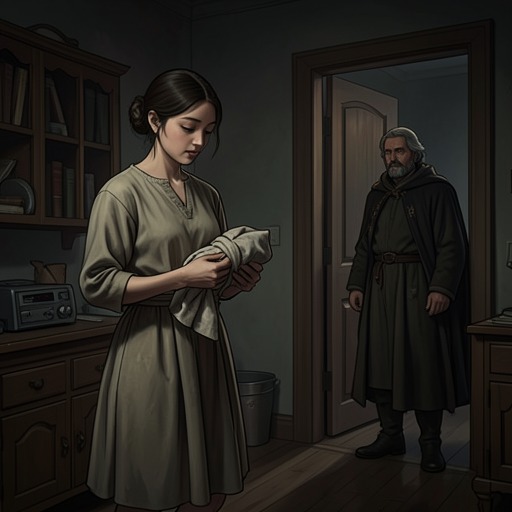
Antigone–Creon relationship
AntigoneThe Antigone–Creon relationship is the play’s central collision between a ruler trying to preserve political order and a young woman who refuses to exchange her convictions for survival. Creon sees silence as a practical route by which he might save Antigone; she sees his offer as another demand that she consent to a world she rejects. Their conflict begins in kinship and the burial of her brother, but becomes a contest over whether a person can still refuse when authority controls the consequences.
Kinship and the Roles They Claim
Creon approaches Antigone not only as king but as an older relative addressing a young woman he considers still within reach of family discipline. He takes her arm and reminds her that she is Oedipus’s daughter, but also twenty years old; until recently, he says, her disobedience might have been settled with a spanking and a night without supper. The gesture and the deliberately domestic comparison make his first strategy intimate and paternal: he tries to place her act within a familiar family order, where an elder can correct a child and the crisis can end without becoming public.
Antigone does not accept that framing. When she says that Creon must have them put to death while she and Ismene must bury their brother, she describes the conflict as roles already cast. The statement makes their positions appear not like negotiable preferences but like parts each has been assigned. Creon’s authority can determine the punishment, but in Antigone’s view it cannot cancel the duty she has taken upon herself. That division—his power to impose death, her resolve to bury—sets the terms of their relationship before either can persuade the other.
Creon’s Offer to Save Her
Creon’s effort to keep Antigone alive rests on concealment and silence. He warns that if anyone beyond the three guards learns what she tried to do, he will be forced to have her executed. If she abandons what he calls her madness and stops speaking about it immediately, he still has a chance to save her; that chance, he insists, will disappear within five minutes. His appeal makes the unequal conditions between them explicit: the king controls the machinery of punishment, but he presents the remaining opportunity as dependent on Antigone’s willingness to withdraw her defiance.
He presses the appeal further after seating her in the middle of the room. Taking off his jacket, he advances with concentrated purpose and sets aside the work awaiting him after the failed revolution. He says he does not want her to die over politics and insists that she is worth more than that. In his account, Polynices’s anguished soul, his decomposing body watched by guards, and the drama inflaming Antigone are all political matters. Creon claims to be meticulous rather than tender-hearted: the body rotting in the sun disgusts him too, and by evening the sea wind carries its smell into the palace. His horror at the physical indignity of the corpse does not, however, lead him to accept Antigone’s action. He separates that action from the burial duty she believes it serves and urges her to survive by letting the crisis be managed as politics.
Antigone rejects the bargain at its premise. She says she has not agreed and can still say no to what she does not like; the choice, she insists, belongs to her alone. Creon, with his crown, guards, and royal responsibilities, can have her put to death, but she frames even that power as the consequence of his own yes. The contrast is stark: his yes authorizes action and government, while her no preserves a private freedom that his office cannot persuade her to relinquish. She adds that she knows she can do little beyond this, but that what she can do is enough to impose a duty on herself.
Two Standards of Responsibility
Creon’s most urgent defense of his position is an image of a ship taking on water. Someone, he argues, has to say yes and steer: crime, poverty, and misery are overwhelming the vessel; the crew is refusing to work and pillaging the hold, while officers build a raft stocked with fresh water for themselves. With the mast cracking and sails tearing, he cannot pause to make exact distinctions about the moral price of each decision. A ruler must seize the wheel, give an order, and shoot at the first advancing figure in the mob, he says, because the ship and the storm are all that retain names in the chaos.
This is not merely an explanation of Creon’s office; it is the answer he gives to Antigone’s refusal. He presents political responsibility as action under emergency, where hesitation threatens everyone and the individual actors disappear into the nameless crowd. Antigone’s standard runs in the opposite direction. She insists on the individual choice that Creon’s image subordinates to the ship’s survival: she will not say yes simply because governing requires someone to do so. Their disagreement is therefore not resolved by discovering a shared description of the crisis. Creon treats compromise and obedience as necessary costs of responsibility; Antigone treats refusal as the one act still entirely her own.
The Argument Breaks Open
As their exchange continues, Antigone attacks the life Creon is trying to preserve for her. She accuses those around her of clinging to happiness and compares them to dogs licking whatever they encounter, content to seize small chances so long as they do not ask for too much. Against that modest accommodation she sets her demand for everything, whole and immediate, or nothing. In the same confrontation, the shift from formal address to familiar address marks a deliberate breach of respect. Her language refuses not only Creon’s policy but the deference that would affirm his authority over her.
Creon demands that she be quiet; Antigone answers that he wants silence because he knows she is right, and that he will not admit it because he is defending his happiness. The scene sharpens their difference into a conflict over what each is willing to protect. Creon argues that his responsibilities require him to preserve a workable public order, even at the cost of harsh acts. Antigone refuses the happiness available on those terms. Neither can make the other accept the other’s measure of a life worth saving, and Creon’s attempt to rescue her by negotiation collapses into confrontation.
Recognition and Irreversible Consequence
After Antigone is gone, the Chorus confronts Creon, calling him out of his mind and asking what he has done. Left to account for the outcome, Creon says that she wanted to die and that none of them was strong enough to make her want to live. He now interprets Polynices as a pretext: when Antigone had to give that reason up, she found others soon enough. In his final account, what mattered to her was saying no and dying.
That recognition clarifies the distance between them without repairing it. Creon had treated Antigone’s refusal as a position he might reverse by buying time, keeping the guards’ knowledge contained, and offering a path back to life. Antigone had treated refusal as an obligation that did not disappear when its first stated cause could be taken away. His late explanation may name the intractability he failed to change, but it comes after his effort to save her has failed. The relationship ends with the king able to interpret her choice only when there is no longer an opportunity to negotiate with her.