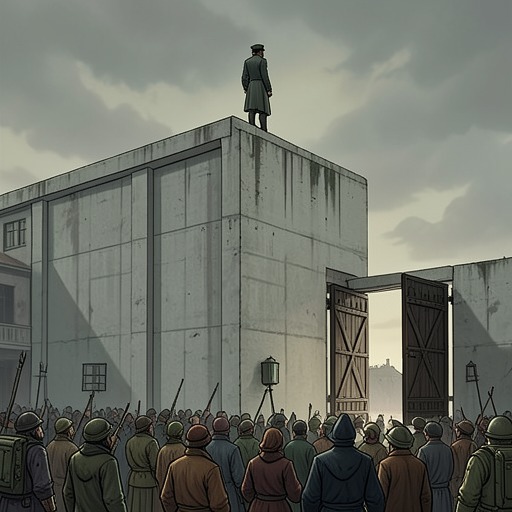
Creon’s decree forbidding Polynices’ burial
AntigoneCreon’s decree forbidding Polynices’ burial turns the aftermath of civil war into a conflict between political authority and funeral obligation. It grants Eteocles a grand funeral but denies Polynices mourning and burial, threatening anyone who gives him the sacred rites with death; Antigone accepts that danger and insists that burying her brother is something she has to do.
Background and Terms
After Eteocles and Polynices kill each other outside the walls of Thebes, Creon, now king, orders the city to distinguish between the brothers even in death. Eteocles is named the good brother and receives a grand funeral. Polynices is branded a villain and traitor, and is to be left unburied as food for jackals and vultures. The decree thus makes a public judgment about the brothers’ rival claims to the city endure beyond their deaths.
The command is backed by an explicit penalty: whoever dares to perform Polynices’ sacred funeral rites will be put to death without mercy. Creon later asks Antigone whether she heard the edict proclaimed in the square and saw the notice on every wall in the city. He also makes her confirm that she knew the punishment applied to anyone, whoever they were, who gave Polynices funeral rites. The order is therefore presented not as hidden law but as a publicly announced prohibition whose risk Antigone understands.
Antigone’s Defiance
Antigone frames the decree and her response as roles already assigned: Creon has to have them put to death, and she and her sister have to bury their brother. She does not treat the threat as a reason to abandon the burial. When pressed on what she can accomplish, she answers that she can at least do this, and that she has to do what she can. The burial obligation is limited in practical reach but absolute in her own choice.
Her refusal becomes explicit in the confrontation with Creon. Antigone rejects his assumption that she will care about his politics, obligations, or explanations, and insists that she can still say no to what she dislikes. She presents the choice as hers alone, while Creon’s crown and guards give him the power to have her killed. The decree’s coercive force is real, but it cannot make her assent to its judgment.
Creon’s Political Defense
Creon answers Antigone’s refusal with an image of government as a ship in danger. Someone, he argues, has to say yes and steer: the vessel is taking on water, the crew refuses to work and pillages the hold, officers build a raft for themselves, and the mast and sails are failing in the storm. In that emergency, he says, the ruler cannot stop to make fine distinctions about each person or deliberate over the cost of every order; he must seize the wheel, issue commands, and act against the first person who advances.
The metaphor explains how Creon understands political responsibility: the survival of the ship, and therefore the city, takes precedence over individual names and claims. In the same speech, he describes the person struck down in a crowd as losing his name, just as the ruler loses his own while holding the wheel. That argument sets the decree against Antigone’s insistence on an obligation to one particular dead brother. Their disagreement is not simply about the existence of danger, but about whether emergency rule can erase the claims of the person whom the state has chosen to leave unburied.
Consequences and Significance
The decree makes Polynices’ burial an act of open resistance rather than a private family rite: its penalty is death, its terms are posted throughout the city, and Antigone knowingly refuses to submit. It also exposes the incompatible standards at the center of the confrontation. Creon regards saying yes and maintaining order as necessities of rule; Antigone regards saying no and doing what she can for her brother as duties she cannot trade away for safety or compromise.
The conflict sharpens when Antigone contrasts her demand for everything, whole and complete, with a life that accepts modest happiness and asks for no more than a small chance at contentment. In that light, the decree is more than a restriction on funeral practice. It gives political authority the power to define which dead person deserves public rites, while Antigone’s defiance insists that this power cannot settle what she owes her brother. The threatened punishment makes the cost of that insistence explicit from the start.