Callisto’s Pregnancy and Banishment
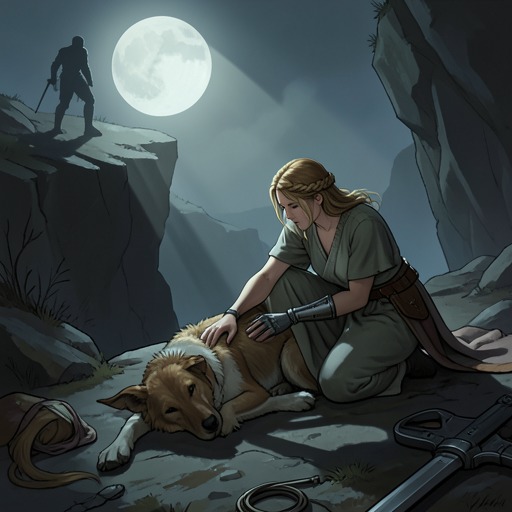
ArtemisCallisto’s Pregnancy and Banishment is the crisis in which Artemis discovers that Callisto is pregnant, expels her from the retinue, and drives her into the forest, where Hera transforms her into a bear. The episode turns intimacy into accusation: Callisto describes a past encounter with Artemis, but Artemis rejects her account and treats the pregnancy as proof that Callisto broke her vow. Hera, watching the confrontation, understands that Zeus was responsible, leaving Callisto to suffer the consequences of a divine act she says she did not choose.
Discovery and Accusation
During a morning gathering, Artemis is bathing with her nymphs while her Oceanides practise their verses. Callisto’s cry interrupts the scene: the music stops, and Artemis rises, frightened by the sound of her beloved in pain. The companions bring Callisto forward, with Opis and Loxo holding her as she tries to cover herself with cloth. Artemis sees that Callisto does not appear injured, but notices her swollen belly and realizes that she is pregnant.
The recognition quickly becomes a crisis of trust. Artemis calls Callisto a traitor, saying she had favored her and accusing her of breaking the vow and deceiving her. Callisto answers that the encounter was with Artemis, not another lover. Her account reaches back several months, to a time when she was gathering olives in the woods: she says Artemis came to her in a glade, and that she did not understand what had happened to her until after the encounter. Callisto presents the pregnancy and the broken vow not as a deliberate betrayal but as the result of an experience she did not intend.
Artemis refuses this explanation. She insists that she did not cause the pregnancy and demands to know whom Callisto lay with. Her refusal to accept Callisto’s account makes the scene’s central injustice plain: Callisto is required to answer for a pregnancy while the truth of the encounter remains unknown to Artemis. The accusation hardens into punishment before the women can resolve that contradiction.
Expulsion from the Retinue
Artemis declares that Callisto must leave the retinue and never return. Though tears flow from her eyes, she does not withdraw the order; she frames it as punishment for breaking her vow and betraying her trust. Callisto pleads for forgiveness, but Artemis instead demands her bow and arrows. The request turns a personal expulsion into a threat of force.
When the nymphs do not move, Artemis whistles for her hounds. Their growls frighten Callisto, who has no choice but to flee. She runs naked and frightened through the forest, weeping and keeping her hands over her pregnant belly. The hounds’ arrival ends her place among Artemis’s companions and converts the retinue, once her community, into the force before which she must escape.
Hera’s Transformation
Hera has observed the argument and identifies Zeus as the one responsible for Callisto’s pregnancy. Her response is not to reveal that truth to Artemis or protect Callisto. Instead, anger and old grievances against Artemis lead her to cast an enchantment that changes Callisto into a large brown bear. The transformation takes place as Callisto is already fleeing the threat of Artemis and her hounds; it adds another divine punishment to the consequences of the hidden encounter.
Callisto remains out of sight, but the roars of her bear form carry across the land. The change makes her exclusion physical as well as social: she has been ordered from the retinue, driven into the forest, and transformed into a beast by Hera. Her pregnancy and vulnerability remain part of the circumstances of the flight, while the immediate cause of the transformation is Hera’s intervention.
Causes and Consequences
The episode belongs to a wider pattern of divine power shaping women’s reproductive lives. Earlier, Hera’s jealousy of Zeus’s relationship with Leto led her to curse Leto’s pregnancy, forbidding her to give birth anywhere the sun shines. When Leto later labors on Delos, Hera restrains her own daughter Eileithyia from assisting and confines her for thirty days, leaving Leto to face childbirth without the goddess of midwifery. These earlier events do not make Callisto’s experience identical to Leto’s, but they establish a recurring conflict in which divine rivalries place the burden on pregnant women.
The narrative also recalls Artemis’s own stated connection to childbirth. In asking Zeus for authority to aid women suffering the pains of labor, she explains that the Fates ordained her as a helper because Leto suffered no pain when Artemis was born. Against that stated role, Artemis’s response to Callisto’s pregnancy is striking: she does not offer aid, but expels Callisto from her company. The story sharpens the contrast between a divine promise to help women in childbirth and the personal anger that leaves Callisto without support.
A related episode at Aulis shows another way a woman’s body becomes the price of a conflict among powerful figures. Menelaus reminds Agamemnon of his oath and the Greek alliance against the Trojans; Agamemnon then orders that his daughter Iphigenia be taken to the altar as a sacrifice to appease Artemis. Clytemnestra leads Iphigenia toward the altar, and Iphigenia accepts her father’s decision as the cost of preserving his plan. Callisto’s banishment is a different event, but both episodes place women at the point where male obligations, divine demands, and family power meet.
Callisto’s flight ends neither in reconciliation nor in a just recognition of what happened. Hera knows Zeus was responsible, but Callisto remains transformed and separated from Artemis. Only later, as Callisto is dying, does Artemis learn the truth and call on Zeus to redeem his deed; Zeus then permits Callisto to ascend among the stars. The later resolution underscores what the banishment leaves unresolved: the woman punished for the pregnancy is not the one who caused it, and the truth arrives only after her separation and suffering.