Behavior-based ward progression policy
AsylumThe Behavior-based ward progression policy governs movement from the admissions ward to a downstairs ward according to how patients behave and appear to be coping. Its central tension is that the institution treats visible self-control as evidence of improvement, while patients may experience that same expectation as a demand to perform recovery under confinement.
How Progression Works
The policy is presented as a practice of the hospital rather than as a written regulation. Patients are expected to manage frustration over a period that may stretch from months to years, especially as medication is reduced and boredom becomes harder to bear. An outburst can undo weeks of careful restraint. The desired presentation is calm and good-tempered, amiable but not hysterical, composed but not depressed; patients must also keep the effort itself from becoming obvious to attendants. The uncertainty is part of the strain: they cannot know how long they must sustain this conduct or whether staff have noticed it.
For Stella Raphael, the prospect of remaining indefinitely on the admissions ward sharpened the stakes. She understood that a visible lapse could delay progression, and that there was no clear point at which she could be sure she had demonstrated enough. After only a few days, she was told she would be moved downstairs. Her case shows how quickly a transfer could follow an apparently acceptable performance, without removing the uncertainty built into the process.
The Patient’s and Clinician’s Accounts
The meaning of the criteria changes with the viewpoint. From a patient’s perspective, the upstairs ward is a place where unusual or distressed behavior attracts little surprise because everyone is presumed mad. Downstairs, by contrast, patients appear to cease being mad when they behave as though they are not in a madhouse and accept being locked up without knowing when they will leave. The policy can therefore make acquiescence look like recovery.
The clinician’s account is different: the self-control required to calculate how to behave and then maintain that behavior is described as a necessary first step toward getting better. The narrative does not make these interpretations identical. It sets the institution’s therapeutic rationale beside the patient’s awareness that outward adjustment is being judged, leaving open the difference between genuine change and successful conformity.
What a Transfer Changes
Downstairs status brings greater privacy and some freedom of movement. Patients can, in the narrator’s phrase, be distressed without being seen: for some, this means having room to weep over a ruined life, a broken family, a lost spouse, or a dead child. Yet even private grief remains subject to clinical interpretation. Weeping is treated as a symptom of depression and may lead to medication; the drugs, in turn, can diminish the alertness and clarity that patients value.
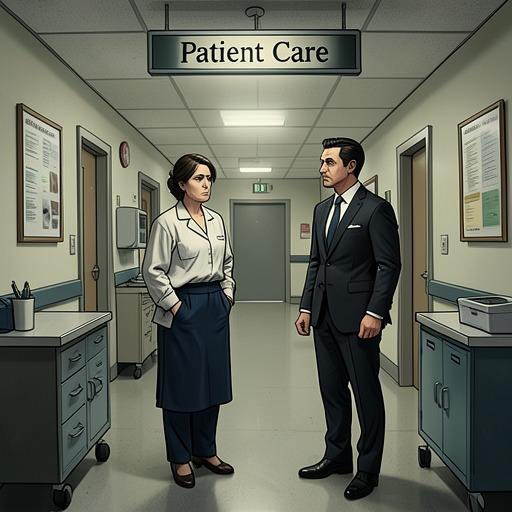
Patients downstairs are also allowed to wear their own clothes. Stella’s transfer thus altered more than her ward assignment: she could dress in her own dark skirt and elegant cream blouse rather than remain in the admissions ward’s institutional setting. The movement downstairs offers practical privacy and autonomy, but it does not end surveillance or the pressure to make distress compatible with the institution’s signs of improvement.
Institutional Significance
The policy makes ward placement both a clinical judgment and a change in daily conditions. It links apparent behavioral adjustment to access to privacy, movement, and personal clothing, while placing the burden on patients to demonstrate that adjustment in ways attendants can accept. Because the criteria depend on observable conduct, a composed manner can be legible as progress even when suffering persists out of view. In Stella Raphael’s case, the rapid transfer follows a period of deliberate self-management; the arrangement offers a step toward greater freedom while preserving the institutional power to decide what counts as recovery.