The hospital parole system
AsylumThe hospital parole system is the arrangement through which selected patients at the Maximum-security hospital and grounds could leave their wards for supervised work on the estate. It offered limited movement and responsibility without ending confinement: a patient might tend gardens or move between assigned tasks while remaining under institutional authority. Its most consequential test came in the summer of 1959, when Edgar Stark’s work privileges gave him repeated access to the grounds around Max Raphael’s home, helped make possible his relationship with Stella Raphael, and ultimately exposed the risks of relying on supervision that could be uneven in practice.
Purpose and limits
Parole privileges were not the same as discharge. Edgar Stark had spent five years at the hospital after murdering his wife, Ruth Stark. Although he regained his equilibrium and functioned at a high level of intelligence, he remained fixed in the belief that his wife’s supposed infidelity had justified the killing. The signs he treated as evidence included ordinary incidents and objects: a flushing toilet, a stain, a box of washing powder, and, in a later account, a crease in a pillow or a mark on a skirt. Because he did not recognize the delusional basis of his accusations or relinquish his justification for the murder, the staff considered him unready for release, despite his otherwise recovered sanity.
The system therefore placed patients in an intermediate position: they could take part in work beyond the wards, but their status remained conditional and their future depended on institutional assessments. Edgar’s assignment did not mean that the hospital had judged the central danger resolved. His continuing delusion remained a reason to hold him, even as his skills and conduct made him useful on outside work parties. The arrangement depended on staff supervision and judgments about individual risk, not simply on a patient’s ability to perform a job.
Daily work and controlled movement
Every morning that summer, several parties of parole patients left through the Main Gate with an attendant supervising each group. They maintained the estate grounds in baggy yellow corduroy trousers and blue shirts, with white canvas jackets slung over their shoulders. The work took place beyond the wards but still within the hospital’s institutional landscape, where attendants and the estate’s boundaries structured patients’ movement.
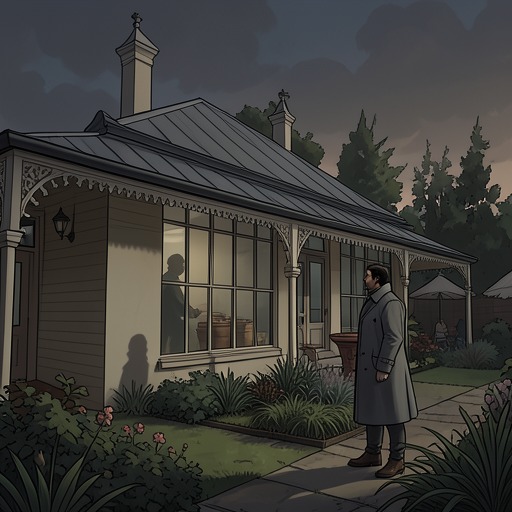
Edgar Stark was assigned to the garden at the deputy superintendent’s house. Stella Raphael often saw him while collecting vegetables or flowers, and the repeated encounters gave her opportunities to speak with him. Their contact began within the ordinary routines of the work assignment: a patient was present in the garden, and the deputy superintendent’s wife could approach him there. The parole arrangement thus opened a channel between the hospital’s working life and the private life of a staff household. Stella’s attraction to Edgar and her growing friendship with him developed through those encounters, though the system did not authorize the intimacy that followed.
Edgar’s carpentry skills also allowed him to move between the garden at the deputy superintendent’s house and a greenhouse project at the chaplain’s house. He was often needed at both sites and moved between them unescorted. The Cricket pavilion stood near the path he took down the hill; Stella had keys to the building as a member of the cricket committee. These particular circumstances created a place where the two could meet. They show how a system based on supervised work could, in practice, include gaps in direct oversight and routes that patients could use for purposes beyond their assigned labor.
Institutional discretion and vulnerability
The system’s dependence on staff judgment is especially clear in the hospital’s response to suspicion. When Jack Straffen heard that alcohol was being brought in, he had no evidence establishing that Edgar Stark was responsible. The suspicion rested on the assumption that a patient, rather than an attendant, must be bringing it in, and that an outside-work patient was therefore a likely suspect. Stella understood what this could mean: Edgar might be removed from the work party, lose his parole status, and have his discharge delayed by months or years. The threat arose before proof, because staff controlled access to privileges and the institution’s decisions carried immediate consequences for a patient who had little power to answer them.
The incident also exposes a difference between formal supervision and effective protection. Edgar’s movements were supposed to take place within work assignments, but the staff relied on attendants and on the practical assumption that patients would remain where expected. The arrangement offered selected patients a measure of access to the estate while leaving the institution in control of whether that access continued. It could therefore feel both like an opportunity and a vulnerability: one suspicion might close the route back outdoors, while an oversight might allow a patient to disappear from it.
Escape and consequences
Edgar Stark’s escape demonstrated the danger of those weak points. He told John Archer that he was wanted in the chaplain’s garden, went off alone, and retrieved Max Raphael’s clothes, which he had hidden in the woods at the end of the garden. Wearing them, he avoided the road until he was clear of the estate and then made his way toward London, apparently by hitchhiking, bus, or train. The hospital later recognized that patients needed clothing and money to abscond successfully; Edgar had obtained the clothes, and Stella had previously given him enough cash to reach London.
The delay in locating him compounded the failure. After discovering that Max Raphael’s clothes were missing, Max spent close to three hours before Edgar’s absence was established and reported to Jack Straffen. The hospital first organized a search of the estate, including the farm, marsh, and part of the forest, and informed local police after the search had failed to find him. The episode showed that an outside-work arrangement could become an escape route when a patient had time, suitable clothing, money, and an opportunity to move without an attendant.
The escape also became a public crisis. Edgar Stark’s case returned to the press, and questions were raised about why a man who had murdered his wife and whose insanity defense had been accepted could work daily in the hospital gardens. Peter Cleave anticipated that the escape would bring press scrutiny, questions in Parliament, condemnation of the parole system, and a setback of five years for the hospital. The evidence establishes those fears and the questions that followed, not a specific formal redesign of the rules. What it does establish is the system’s double edge: work privileges could give patients limited participation beyond the wards, but their use depended on fallible supervision and exposed patients, staff, and the institution to consequences far beyond the garden.