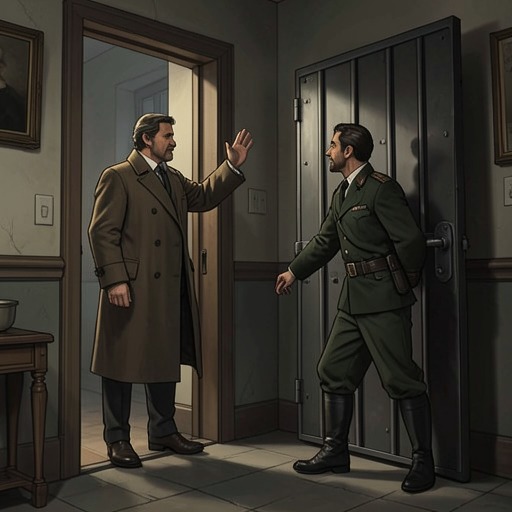
German Federal Defense Forces
AuerhausThe German Federal Armed Forces enter the novel less as a battlefield than as a system of deadlines, examinations, files, and compulsory choices. For the narrator, the prospect of conscription hangs over ordinary work and school; for Frieder, a psychiatric certificate exempts him from even attending the medical examination. The contrast sharpens when Frieder later takes the narrator’s examination file: the institution’s power to classify and deploy young men is real, but so is the possibility of obstructing its paperwork.
Conscription and the Prospect of Service
The narrator first feels the Bundeswehr’s reach while working evenings at a chicken farm. He had taken the job from a young man who had to report for military service, and on his bicycle rides to the farm he kept thinking that his own call-up notice could arrive in the mailbox at any time. He had no settled plan for what to do if it came. The possibility of service was therefore not an abstract political question; it accompanied him through a job among the farm’s enormous sheds and made an ordinary journey feel like a countdown.
His classmates had already begun to arrange their lives around the same institution. Some were drafting explanations for refusing military service and choosing civilian service; others were planning how to take their military leave in one block so they could finish in time for the start of university. A few, whom the narrator regards with contempt, were considering signing up for two years. Frieder mocks one such classmate, nicknamed Central-Locking Axel, by imagining that a tank will have a hatch rather than central locking. The joke punctures the glamour of enlistment by reducing military equipment to an awkward, literal detail.
The narrator does not want either military life or its social rituals. He imagines firing weapons, crawling through dirt, obeying orders from men he considers fools, and drinking after work with people who accept that world as their own. None of it appeals to him. His provisional strategy is to ignore the call-up, buy time, and leave for Berlin as soon as he can. The plan is a postponement rather than a resolution: the institution’s summons remains an open possibility, and the narrator remains unsure what course his life will take.
Exemption, Classification, and the Examination
The contrast between the narrator and Frieder becomes explicit after Frieder’s suicide attempt and hospitalization. The psychiatric hospital sends the military authorities a certificate, and Frieder is officially classified as mentally ill. He is exempt from service without even having to attend the examination. The narrator bitterly observes that, because Frieder once tried to shorten his life, he has been given fifteen months free. The phrasing turns an administrative exemption into a grim measure of time: the state converts a psychiatric crisis into a service category and a calculable span.
The narrator, by contrast, continues to face the summons. After he has failed to appear for two call-ups, a police officer shows him an official document, complete with stamp and emblem, directing the police to take him to the examination. The order makes clear that conscription is backed not only by military administration but by police enforcement. The officer waits outside the district military replacement office so that the narrator cannot run away. Inside, the building’s brown-gray walls, corridors, benches, and uniforms seem to merge into one institutional surface. The narrator and Vera pass through it toward registration while boys and young men wait; Vera is the only woman among them.
The medical examination turns the narrator’s body into another object of procedure. A red-faced doctor reads his file in silence, slowly drawing breath through his nose for what seems like a full minute, then throws the file onto his desk and orders the narrator to undress, allowing him to keep his underwear on. When the narrator says he is not sick, the doctor answers that he must cooperate and warns that refusal would violate the military service law. The examination thus combines physical inspection with the authority of the record: the narrator’s own account of himself does not cancel the state’s power to assess him.
After a long wait, the narrator is called before a four-man examination commission, with Vera accompanying him. The doctor announces a visual examination result of T1, fully fit for service. One official says this makes the narrator suitable for the guard battalion; another suggests the paratroopers. The verdict does not merely describe health. It translates an examination into possible military assignments, narrowing a young man’s future into categories of fitness and deployment.
The File as an Object of Resistance
The examination file returns as the focus of Frieder’s intervention. During a search, he works upward through the house, opens the freezer compartment, removes the ice cubes, and finds the narrator’s conscription file. Its importance is at once practical and symbolic: this is the document through which the military authorities have recorded and classified the narrator, and now it is in Frieder’s hands.
When a suited man examines the file, the charges attached to it reveal what Frieder has done to its official surface. The man identifies theft and suppression of documents; the papers bear federal eagles on their letterheads and stamps, and Frieder has drawn a line through every eagle. Underneath, he has made small campfires. The prosecutor also names offenses for defaming the state and its symbols, document forgery, and property damage. The altered emblems turn a stack of administrative papers into a deliberate counter-image: the state’s insignia are crossed out and made to resemble roasting spits, with fires beneath them.
The episode exposes two sides of bureaucratic authority. The file has been prepared to make the narrator legible to the conscription system, but it can also be stolen, marked, and made evidence against the person who interferes with it. Frieder’s action is not a formal argument against military service; its force lies in attacking the document that carries the institution’s classification and in accepting the legal consequences that follow. The charges show how quickly a private act of defiance is translated into the state’s own language of offenses and records.
Narrative Significance
The novel places conscription beside school, work, policing, and psychiatric care as one of the systems that sort young people into authorized futures. Some classmates plan around service; the narrator tries to delay it; Frieder is removed from its reach by a psychiatric certificate, then reaches back into the system by taking and defacing the narrator’s file. The sequence moves from an anticipated letter in a mailbox to an enforced examination and finally to a document physically altered by the person resisting the process.
That trajectory also complicates any simple division between personal choice and institutional power. The narrator’s unwillingness does not prevent the examination commission from declaring him fully fit, and an official summons can bring the police to his door. Frieder’s exemption, meanwhile, is produced by an institution’s diagnosis, not by a negotiated choice about what kind of service he might prefer. His later intervention makes the official file vulnerable, but does not erase the categories or penalties it embodies. The German Federal Armed Forces matter to the story not simply as a destination the narrator fears, but as the bureaucratic machinery through which uncertainty becomes an order, a bodily examination, and a recorded judgment.