Event 1
Jack and Selfia’s Wedding and Coronation
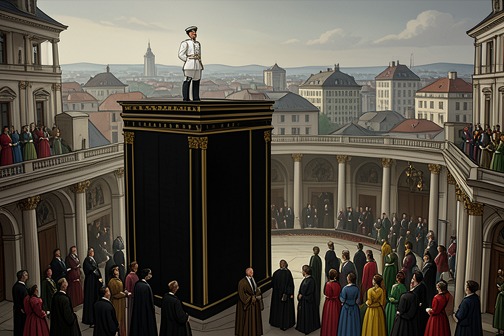
[Jack and Selfia’s Wedding and Coronation](entity:event-recall-event-1147e2da6131) is the ceremony through which Jack Knight becomes Jack Cordelica, husband of [Selfia Cordelica](entity:character-recall-character-selfia-cordelica-4d8ab9d85def) and King Consort of the [Selfian Empire](entity:location-recall-location-selfian-empire-857c6a4b0e89). Staged above and within the imperial capital, it is both a marriage and a succession ritual: a carefully governed display of rank that is abruptly transformed when Jack names the lineage he has concealed. The event therefore does not merely formalize a relationship. It converts personal identity into public power, exposes the unstable foundations of the court, and binds Jack’s future to [Selfia](entity:character-recall-character-selfia-644b93c8da27)’s dynasty.
## Setting and Political Ritual
The ceremony begins on top of a high-rise tower of ebony and gold, where Jack looks down over the metropolis, described as the crown jewel of the Selfian Empire. His position above the city establishes the scale of the occasion before he enters the ceremonial chamber: the marriage is already framed as an imperial act rather than a domestic celebration. Jack is dressed in a pristine major’s uniform, an unusual choice in a court crowded with generals and colonels and one that prompts aristocratic resentment. The spectators question why Selfia selected a major when more senior officers were available and complain that a supposedly unknown man has won the crown.
[Duchess Belia Bell](entity:character-recall-character-duchess-belia-bell-ca4d75b13a69) escorts Jack to the ceremony. Because Jack’s mother is deceased and Duchess Belia Bell is the head of his mother’s noble house, she serves as the nearest available parental figure. Her role follows the imperial custom that mothers, or mother-figures, lead sons down the aisle. The gesture makes the procession simultaneously familial and dynastic: Jack enters as a son of a noble house, but also as a political candidate being delivered into the imperial marriage system. Duchess Belia Bell’s instruction that he correct his posture, coupled with her joking reference to angering a room full of politicians, acknowledges that the ritual’s surface solemnity conceals a contest over legitimacy.
The contrast with [Corporate Alliance](entity:organization-recall-organization-8f828844737d) and nomadic wedding customs further marks the ceremony as specifically imperial. Jack walks beside Duchess Belia Bell as orchestral music begins and hundreds of strangers watch him. Across from him stands Selfia, dressed not in conventional bridal attire but in a blue military uniform, her long white hair gathered into a bun with a rose-shaped pin. The visual language of the ceremony thus fuses marriage, military authority, and succession. Selfia appears as a bride, but also as the sovereign whose choice has already unsettled the aristocracy.
## The Vows and the Revelation
Selfia’s vow openly establishes her dynastic credentials. She identifies herself as the daughter of the Red Empress and the Knight of One [Lancelot](entity:character-recall-character-lancelot-b3e9e9f4505d), Queen of the Imperium, and heir to the Cordelica bloodline before taking Jack as her husband. Her affirmation presents the marriage as an alliance between Jack and the ruling house, while also placing the bride’s lineage at the center of the public rite.
Jack’s response initially carries a different kind of danger. His hesitation is not caused by fear of marriage or by the prospect of becoming King Consort. He understands that the words required of him will initiate a sequence of irreversible consequences. With invisible support from [Sahaqiel](entity:character-recall-character-sahaqiel-e7c47f684c53), who materializes for him as a cheerleader bearing his name on her shirt, Jack proceeds. He declares himself “Jack Knight, son of the Blood Rose and the Burning Devil, heir to [House Bell](entity:organization-recall-organization-house-bell-a1c4f34aa9c3),” and takes Selfia as his wife.
The formula functions as a disclosure rather than a simple affirmation. Jack’s identity, apparently that of a random major, is revealed as connected to powerful and feared names. The chamber responds with shocked silence; even the priestess is left with her jaw open. The silence marks the instant in which the ceremonial script breaks. A woman shouts in disbelief, an elderly noble collapses, and the nobles’ earlier contempt for Jack is replaced by alarm. The revelation changes the value of the scene from controlled legitimacy to exposed danger: the marriage remains valid, but its political meaning can no longer be managed by the court’s expectations.
## Selfia’s Embrace and the Inversion of Order
Selfia does not attempt to restore decorum after Jack’s disclosure. Instead, she smirks while her Bell Guards turn toward the uproarious crowd and invites Jack to have fun before pulling him into an embrace and sealing the marriage with a kiss. Her reaction is decisive because it converts scandal into triumph. The court’s hierarchy has been momentarily overturned: the aristocrats who believed they could judge the sovereign’s choice are forced to confront a bridegroom whose concealed inheritance makes him far more consequential than they assumed.
The scene’s energy comes from the collision between rigid ritual and disruptive bodily action. Jack is instructed to maintain posture and move in step, while the ceremony requires fixed declarations of lineage and obedience. Yet the event culminates in shouted outrage, a noble fainting, guards facing the assembly, and Selfia physically embracing Jack. The kiss is not a retreat from politics into romance. It is Selfia’s public decision to claim the revelation and make Jack’s newly exposed identity part of the imperial spectacle. The ritual that should stabilize rank instead dramatizes how quickly rank can be mocked, reversed, and reasserted through royal performance.
Sahaqiel’s unseen encouragement adds another layer to the public-private divide. Jack must stand before a room of hostile witnesses, but the support that steadies him comes from a presence visible only to him unless she chooses otherwise. His smile appears more genuine because of her intervention, suggesting that the ceremony’s official union contains an intimate, concealed network of loyalties beyond the knowledge of the court.
## Dynastic Consequences
The marriage immediately links Jack to the Cordelica succession and supplies the imperial order with a new royal figure. Jack is no longer merely Jack Knight, a major selected over more senior officers; through the union he becomes Jack Cordelica and King Consort. Selfia’s own title and bloodline give the rite an institutional force, while Jack’s declaration prevents the court from treating him as a politically convenient outsider. The event creates a royal partnership whose foundations include military authority, noble inheritance, concealed identity, and personal defiance.
The ceremony’s consequences extend into the family and succession structure that develops afterward. A birth certificate later bears the names of [Celeste Cordelica](entity:character-recall-character-celeste-cordelica-386cd3234e39), Jack, and Selfia, establishing [Celeste](entity:character-recall-character-celeste-9b8251b96088) as First Princess and making the marriage part of a new lineage rather than an isolated political arrangement. Selfia’s role also becomes maternal in practice: she directs Celeste during a formal preparation, asks whether the child knows her lines, and pats her head when Celeste answers, “Yes, Mommy.” The later family scene shows how the wedding’s public union is translated into titles, care, and inheritance, even as those roles remain emotionally complicated for others around them.
The marriage also helps define the political mythology of the wider narrative. Later, Jack addresses citizens as Jack Cordelica and King Consort while offering surrender and promising humane treatment in a future Cordelica Democracy. Selfia, in turn, uses imperial speech to call humanity toward a final attack against the demonspawn, presenting military action as the means of securing survival. The wedding’s ceremonial language of bloodline and crown therefore precedes later speeches about citizenship, humanity, and the future. It marks the point at which Jack’s personal name becomes an instrument of state communication.
## Recurrence and Narrative Significance
The event establishes a recurring pattern in which sacred or political symbols conceal a more unstable truth. Sahaqiel, privately present at Jack’s vows, is later represented publicly through a statue identified by Theocracy clergy as Saint Citri, founder of the Theocracy. The statue is treated as a protective sacred object whose presence limits demonspawn power, while Sahaqiel herself is confused and distressed by the unexplained likeness. The contrast recalls Jack’s wedding revelation: institutions build authority around images and lineages, but the person behind the symbol may know that the official story is incomplete.
The ceremony also foreshadows the narrative’s persistent entanglement of family and crisis. Jack’s royal identity later appears amid war alerts and domestic responsibilities, with Celeste resisting school while he carries her under one arm and cradles a crying baby boy with the other. His public status as King Consort does not replace the bodily work of parenthood; it coexists with exhaustion, disorder, and immediate care. By the time Selfia appears as president, flanked by guards and recognized as Madam President, the political order has changed again, but the wedding remains its foundational image: a controlled procession that became a revelation, a kiss that answered an uproar, and a marriage that turned concealed inheritance into public destiny.
Event 2
Opening of Frelia Public Academy
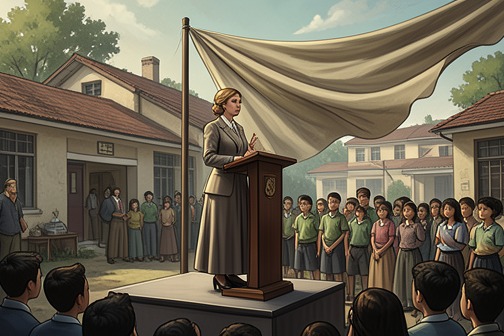
The [Opening of Frelia Public Academy](entity:event-recall-event-frelia-88313d0bdef2) is both a public-education initiative and a carefully staged declaration of royal policy. [Selfia Cordelica](entity:character-recall-character-selfia-cordelica-4d8ab9d85def) presents the academy as the first institution in a national educational program, but the ceremony also binds that ideal to the royal family through the enrollment of her daughter, [Celeste Cordelica](entity:character-recall-character-celeste-cordelica-386cd3234e39). The event therefore converts knowledge into a civic promise while making the monarchy itself the visible guarantor of that promise.
## Reform Announced in Public
Selfia Cordelica addresses the assembled crowd from a podium in an unusually authoritative posture, presenting the academy as a bastion of education intended to extend across the nation. She acknowledges that the initiative has met pushback and doubt, then invokes the principle that knowledge is power. Her argument is practical rather than ornamental: true strength depends on understanding the world and the threats surrounding the nation, and the country is only as strong as its weakest citizens.
The speech gives education a national-security dimension without reducing it entirely to military preparation. Learning is described as a means by which ordinary people can become capable of confronting danger, making the academy part of a broader attempt to strengthen society from below. [Selfia](entity:character-recall-character-selfia-644b93c8da27)’s language also establishes the institution as the first step in a larger project rather than an isolated school opening.
## [Celeste](entity:character-recall-character-celeste-9b8251b96088) as the Reform’s Proof
The ceremony’s decisive turn comes when Selfia announces that her own daughter, Celeste Cordelica, will enroll at the academy in the spring. The crowd erupts before the sentence is even completed, and the announcement transforms an abstract policy into a royal family matter. Celeste waves to the hundreds of cameras and says hello, while Jack pats her head, placing a small familial gesture inside an intensely public scene.
Selfia presents Celeste’s enrollment as evidence of personal commitment. The royal child is not merely a symbol displayed at the event; she is identified as a future student of the institution whose quality and openness the crown is asking the public to trust. That decision also exposes Celeste to public scrutiny, showing how the academy’s legitimacy is built through the family’s willingness to submit its own life to the reform’s visibility.
## Access, Curriculum, and Spectacle
Applications are opened through the intranet site, with a billboard displaying the enrollment instructions above the event. The academy accepts applicants while places remain available and offers a broad progression from Early Childhood and Kindergarten through Schuleingangsstufe and Weiterführende Schule, as well as vocational training. The range of programs presents [Frelia Public Academy](entity:location-recall-location-frelia-public-academ-81b5b19af1b3) as an institution intended to cover multiple ages, educational stages, and practical futures rather than serving only an elite academic population.
At the same time, access is announced through a spectacle dominated by cameras, applause, tabloid writers, and shouted questions. The crowd photographs Selfia and Celeste while Jack carries his daughter from the venue and leaves beside the queen. Public education is thus introduced through public visibility: the same ceremony that promises wider access also demonstrates how royal authority manages the image through which that promise reaches the population.
## Jack’s Managed Royal Presence
The opening occurs within a day of tightly scheduled appearances. Jack reads the instructions on an Intellipad: Selfia will announce the academy, Celeste will be revealed to generate interest, and the royal party will continue to a museum opening, a meeting with investors, and El Negro Gato, the shop his earlier actions helped place on the map. The academy launch is therefore one component of a larger program combining reform, commercial support, cultural presentation, and royal publicity.
Jack’s participation is controlled from the outset. Two weeks after his marriage to Selfia and coronation as king, he remains confined to his luxurious room, unable to leave freely and permitted only limited visitors, including [Kamila](entity:character-recall-character-kamila-985f1e6cd10e) bringing food, [Ada](entity:character-recall-character-ada-10673482132c), and scheduled playtime with [Leona and Celeste](entity:relation-recall-relation-leona-celeste-400722b1ae79). At the academy, the restriction takes a softer but still unmistakable form: he carries Celeste, walks in step with Selfia, ignores questions, and enters the armored limousine amid continuous photography. Even the use of paper folders elsewhere in his circle, preferred because tablets can be hacked and Intellipads compromised, reflects a political environment organized around security, secrecy, and controlled information.
## Departure and Institutional Continuity
After the announcement, Jack and the royal party leave under a barrage of photographs and questions. Later, [Madam Hightower](entity:character-recall-character-madam-hightower-30bdb7ca7598) greets Jack at the academy and tells him that she is happy to see another of her students survive. Her presence connects the new institution with the educational world damaged by earlier destruction, while her guidance of Celeste gives the departure an immediate personal consequence.
Celeste cries that she will miss her father. Jack answers that he will miss her too and tells her to be good for Madam Hightower. The child then walks up the stairs of the academy with the headmistress, turning the political announcement into an actual separation between parent and daughter. The school’s opening consequently ends not with the applause of the crowd but with Celeste entering the institution that has been presented as the foundation of a stronger nation.
## Political Significance
The event joins reformist idealism to royal discipline. Selfia’s appeal to universal strength and understanding gives the academy a vision of collective improvement, yet the opening is inseparable from monarchy, media management, security precautions, and the conversion of Celeste into a public guarantee. The institution’s promise is expansive, but its first public image is produced through hierarchy and ceremony.
That tension is reinforced by Jack’s position. He has recently become king, yet he experiences royal life as confinement, moving through the city with security, a chauffeur, and official schedules rather than personal freedom. By the time he drives toward Yun and Tyrah’s apartment, he possesses status, family, and political power but feels hollow, with guilt and remorse suppressed and a new eagerness taking their place. Against that emotional background, the academy opening reads as a moment when the crown projects confidence and national renewal even while the people inside its ceremony remain constrained by the systems that make the projection possible.
Event 3
Magna Galla Attack
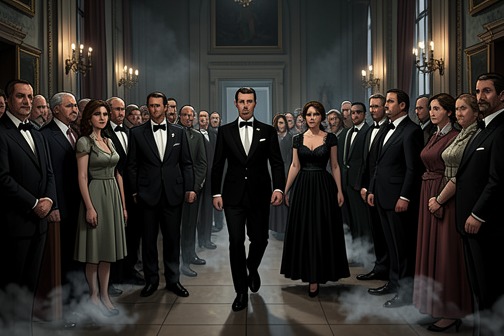
The [Magna Galla Attack](entity:event-recall-event-castle-morne-edbccc2f5c8b) is the catastrophic assault on the royal gala at [Castle Morne](entity:location-recall-location-castle-morne-4c09d5fe97bf), where an event advertised as a prestigious celebration hosted by the Queen and her benefactors becomes a coordinated attack on the imperial center. The attack breaks the protective surface of masks, ceremony, music, and aristocratic order: guests are first absorbed into a supernatural performance, then trapped inside a burning, collapsing building. For Jack, the event is both a public disaster and a private trauma, because [Ada](entity:character-recall-character-ada-10673482132c) is inside the castle when the explosions begin and his immediate response is not political calculation but an attempt to save her.
## Political and Ceremonial Background
The attack is prepared against a deliberately theatrical political setting. News reports announce that the city of [Lunacrypt](entity:location-recall-location-lunacrypt-e95a1db9a984) is preparing for the Magna Galla, while the [Royal Guard](entity:organization-recall-organization-royal-guard-6059cab8c0be) patrols the streets to display the strength and vigilance of the regime. The gala itself is a controlled spectacle of imperial identity. Hundreds of strangers watch Jack enter the ceremonial chamber, and Jack arrives in a pristine black uniform bearing the insignia of a major. [Duchess Belia Bell](entity:character-recall-character-duchess-belia-bell-ca4d75b13a69) leads him by the hand, following the imperial custom in which a mother, or a mother-figure, escorts a son down the aisle. Because Jack’s mother is dead and Duchess Belia Bell is the head of his mother’s noble house, she occupies the nearest available place to a parent. The gesture gives the ceremony an intimate foundation even as the surrounding crowd turns him into a political object.
The formal procession also places Jack inside the machinery of the monarchy. He walks beside Duchess Belia Bell as the double doors open to orchestral music, his boots keeping time with her red heels while hundreds of unfamiliar eyes settle on him. The event therefore begins with an image of continuity: family substitution, noble inheritance, public ritual, and disciplined movement all combine to make imperial authority appear stable. The later destruction of the castle reverses that image. What seems to be a celebration of order becomes proof that the palace itself can be penetrated, manipulated, and annihilated.
## The Masquerade and the Jester’s Performance
Inside the ballroom, the ceremony gives way to masquerade. The floor is covered by black gowns, black masks, and elaborate jewelry, while the guests discuss weather reports, business transactions, trade agreements, and the condition of the Imperium. Jack has been ordered by [Selfia](entity:character-recall-character-selfia-644b93c8da27) to mingle, socialize, and remain discreet, but he stands apart because he has little to say to people whose safe conversation conceals the political tensions of the empire. He is pretending to be one of the red-eyed Imperials, and the mask becomes more than an accessory: it marks his uneasy participation in a society whose language and loyalties he does not share.
[Ada Nguyen](entity:character-recall-character-ada-nguyen-4b18510d3c5f) reaches him within this setting in disguise, wearing a floral-patterned black dress with lace sleeves and a cat-shaped mask topped by a black bow. Her appearance briefly brings personal recognition into the public spectacle. Jack identifies her immediately and asks what she is doing there, while the surrounding ballroom continues to operate according to the rules of anonymity and display. The encounter makes the gala’s danger more concentrated: the person Jack most needs to protect is not an abstract member of the court but Ada Nguyen, physically present in the same enclosed space.
The mood changes when a flash interrupts the music and draws every eye toward the stage. A woman in a jester’s outfit appears, her face hidden by a smiling white mask. Jack recognizes the figure as familiar, and his blood runs cold beneath his own disguise. The Jester plays a violin, producing music that fills the ballroom despite the absence of a visible band. Her red eyes remain fixed on Jack, and the narration makes clear that she recognizes him at once, even through his mask. The performance is thus an act of exposure concealed within an act of disguise: the audience believes it is attending entertainment, but the performer has already identified the one person who resists her control.
The Jester’s music becomes an instrument of mass enthrallment. Jack receives the notification that he has resisted the Maestro’s Music, while the guests fall under the performance’s influence and move in synchrony. The crowd becomes an ocean of dancing bodies, and Jack stands as the lone unmoving figure, an island staring at the woman onstage as the tempo increases and mana touches his skin. This is the attack’s first decisive value shift. A ballroom associated with leisure, status, and social connection becomes a mechanism for stripping the guests of agency. The music does not merely accompany the assault; it converts the victims into part of its choreography.
## Detonation and Castle Collapse
The supernatural spectacle gives way to physical destruction when the ballroom loses all light and the chandelier shuts off, casting the room into darkness. The Pawns then make their hostility explicit. The Man Maid, bloodied but defiant, spits an insult at [Tenno](entity:character-recall-character-tenno-f739c82aa1ce) and gives him the middle finger just before the world is illuminated by a small sun. The crude gesture and the apocalyptic blast occupy the same beat, collapsing the distance between grotesque mockery and mass violence. The attack refuses the dignity expected of a royal gala; its agents turn the court’s polished ceremony into an obscene and uncontrolled rupture.
Jack’s first cry is for Ada. [Ruby Viole Lamperouge](entity:character-recall-character-ruby-viole-lamperou-01d5276eaecc) seizes his shoulder and pulls him back as Ada is caught in the blast, while Ruby’s shield absorbs the force of the explosion. Jack and Ruby are thrown through the impact, but Jack unfurls his silver wings and takes flight. They dive through a window and turn in midair, giving Jack a clear view of the castle already engulfed in flames. The distance offers no safety or emotional detachment. It shows him the scale of the disaster while leaving Ada inside it.
The building is not merely damaged; it is already collapsing inward under multiple detonations at its base. Jack cries out again and dives into the red mushroom cloud, ignoring the heat as it burns away what remains of his expensive clothes. His clothing, status, and disguise are discarded almost incidentally as he presses toward the wreckage. [Sahaqiel](entity:character-recall-character-sahaqiel-e7c47f684c53) clears a path through rubble and debris, turning Jack’s flight into a rescue attempt directed against the collapsing architecture itself. The castle becomes a hostile enclosure whose walls, floors, and ceremonial chambers are being erased around the trapped survivors.
## Immediate Consequences and Political Violence
The destruction of the gala cannot be separated from the wider purge that follows. Selfia later reveals to Jack that the regime killed its own guards and that a purge was taking place across the empire. Three hundred and sixty-nine lives had been marked for elimination, possibly more: political opponents, rivals, dissidents, and anyone who might obstruct the advent of the [New Republic](entity:concept-recall-concept-new-republic-5ad5d624da75). Selfia explains that removing those figures would allow her to solidify power. The revelation changes the meaning of the gala’s security failure. The absence of guards and [Awakened](entity:concept-recall-concept-awakened-dbe36d6a62b6) forces was not simply an enemy triumph; it was connected to a deliberate political operation.
Selfia insists that she did not lie when she promised to arrest the people on the list. She had intended to remove them from the political field, but her method was killing rather than lawful detention. The Magna Galla Attack therefore stands at the intersection of external assault and internal purification. The castle’s destruction is spectacular, but the quieter purge is broader in scope: it turns the entire empire into a potential crime scene and makes the language of survival inseparable from authoritarian consolidation.
The attack also contributes to the collapse of the old imperial order that Jack later invokes in his address to the citizens of the empire. He offers surrender on the grounds that the old Imperium is dead and that a future society can be built from its ashes, promising humane treatment and free citizenship in the Cordelica Democracy to those who lay down their arms. The offer gains force from the gala’s destruction. Castle Morne has demonstrated that the existing system cannot guarantee security, preserve its own sacred spaces, or protect the people gathered under its authority.
## Memory, Power, and Narrative Significance
The event’s power comes from the collision of ritual and violation. The opening procession presents monarchy as a family structure enacted through the substitute mother-figure of Duchess Belia Bell; the masked ballroom presents aristocracy as a community bound by coded behavior and safe conversation; the Jester’s music reveals that the community can be made to move as one body; and the explosions reduce the palace to rubble. Each stage removes another layer of apparent control. Ceremony becomes masquerade, masquerade becomes enchantment, enchantment becomes helplessness, and helplessness becomes destruction.
The attack also foreshadows the story’s recurring use of sacred or symbolic images to authorize political action. In the Theocracy, a statue identified as Saint Citri, founder of the Theocracy, is said to limit the power of demonspawn attacking the city, and the statue is secretly a likeness of Sahaqiel. Elsewhere, Selfia frames a later military expedition as humanity’s necessary response to apocalypse, declaring that the only option in the darkest hour is to attack. These later appeals to saints, human survival, and the future echo the Magna Galla’s transformation of public ritual into political violence. The gala is not an isolated spectacle; it establishes a pattern in which institutions manufacture legitimacy through ceremony while violence determines who controls the future.
In the longer political aftermath, Jack’s public identity shifts from royal consort and participant in imperial ritual toward revolutionary spokesman. Selfia is eventually addressed as Madam President, signaling the emergence of a republican order after the imperial world has been dismantled and remade. The Magna Galla Attack is the hinge between those forms of rule. It leaves the court physically ruined, exposes the regime’s willingness to kill its opponents, and gives Jack a personal reason to reject the safety and performance of the old order. The masquerade ends not when the masks are removed, but when the building that sustained them falls.
Event 4
Days of Decimation
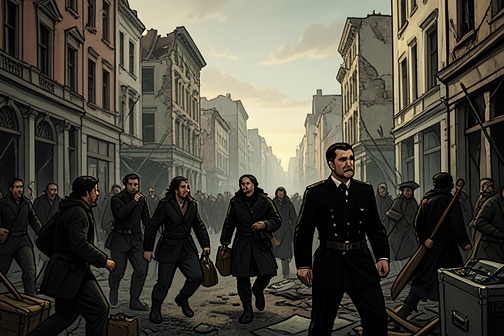
[Days of Decimation](entity:event-recall-event-days-of-decimation-1becbbbbb028) is the regime-wide purge that transforms [Selfia Cordelica](entity:character-recall-character-selfia-cordelica-4d8ab9d85def)’s attempt to secure a new political order into an atrocity that Jack Cordelica cannot accept. The event combines secret executions, the destruction of opposition, attacks across the empire, and a public language of survival. Its decisive significance lies in the struggle over what the killings mean: [Selfia](entity:character-recall-character-selfia-644b93c8da27) calls them the unavoidable foundation of humanity’s future, while Jack sees the deaths of dissidents, bystanders, children, and entire bloodlines as a choice for which no political program can provide absolution.
## Causes and Political Background
Days of Decimation emerges from the collapse of the old imperial order and Selfia’s effort to replace it with the [New Republic](entity:concept-recall-concept-new-republic-5ad5d624da75). She tells Jack that the purge removed political opponents, rivals, and dissidents who would obstruct the new government, while also eliminating the remaining structures of resistance. The operation therefore has both an ideological and an immediate political purpose: Selfia claims to be defending the continuity of mankind, but she also openly acknowledges that removing her enemies creates a power vacuum that she intends to fill.
Selfia’s explanation reveals that the operation was concealed from Jack precisely because she knew he would oppose it. She had presented the names on her list as people who would be arrested, allowing him to believe that their removal from political life would occur through detention rather than execution. When Jack confronts her, she admits that she did not lie about wanting to solidify her power; she lied about the method. Her justification is paternalistic as well as political: she says the truth would have damaged his sanity and that the deception gave him a target to blame. The claim only deepens the betrayal, because it treats Jack’s moral resistance as a weakness to be managed rather than a judgment to be respected.
The purge is also inseparable from the violence already spreading through the empire. News reports describe attacks associated with the [High Table](entity:organization-recall-organization-6ec2e99b8fb1) and call the preceding days the Days of Decimation, while Selfia frames the disorder as the opening through which democracy can be built. Later, she argues that the empire’s enemies will exploit the chaos created by collapsing military forces and simultaneous operations. Her proposed response is to strike everywhere and leave no place unsearched, turning uncertainty into a reason for escalation. The event thus grows from a state of emergency in which ordinary restraints are repeatedly displaced by claims of necessity.
## The Purge and Its Immediate Human Cost
Selfia gives the scale of the operation with a precise figure: three hundred and sixty-nine lives are being extinguished, with the possibility of more deaths if the operation continues. Those targeted include political opponents, rivals, and dissidents, but the violence does not remain confined to identifiable enemies. Jack points to the deaths of roughly three hundred people shown on the news and emphasizes that some were bystanders and innocents. Selfia’s political arithmetic cannot erase that distinction; the purge’s stated targets and its actual victims occupy different categories.
The personal stakes become unavoidable when Jack learns that the danger reaches his own family. He accuses Selfia of placing [Ada Nguyen](entity:character-recall-character-ada-nguyen-4b18510d3c5f) and his unborn child at risk, asking what would have happened if [Ada](entity:character-recall-character-ada-10673482132c) had miscarried or if the child had been harmed by the queen’s actions. Selfia insists that Ada and [Kamila](entity:character-recall-character-kamila-985f1e6cd10e) were never in genuine danger because Jack is too valuable to alienate permanently, but this assurance does not repair the breach. For Jack, deliberately creating danger around the people he loves is itself an act of violence, regardless of whether the threatened outcome was intended to occur.
Selfia does not retreat from the moral implications. She declares that she would repeat the purge without hesitation because the fate and continuity of humanity are, in her view, at stake. Her imagined future is one in which monsters like herself no longer need to exist, yet she accepts becoming monstrous as the route toward it. She extends the logic to its most extreme form, saying that infants, cities, and thousands of lives may be sacrificed if millions survive. The event’s horror therefore lies not only in the number killed but in the conversion of every limit into a negotiable cost.
## Jack’s Rejection of Necessity
Jack’s confrontation with Selfia is the event’s central moral collision. He rejects her attempt to rename murder as an act that simply had to be done, insisting that another path existed and that uninvolved people should not have been killed. His anger is intensified by the discovery that the list included children and entire bloodlines. What Selfia describes as the removal of obstacles appears to Jack as an attack on families, including the family he is trying to protect.
The disagreement is not a minor dispute between political allies. Jack had entered public life through imperial ceremony, escorted by [Duchess Belia Bell](entity:character-recall-character-duchess-belia-bell-ca4d75b13a69) as the nearest surviving parent-figure and presented before hundreds of strangers in the formal world of power. That ceremonial image of legitimacy is later inverted by the purge: the same political order that dresses authority in ritual and public dignity operates through concealed killing. Selfia’s transformation from queen and ally into the architect of mass violence makes Jack’s earlier participation in that order feel compromised by knowledge he did not possess.
Jack’s response is also shaped by the broader evidence of institutional cruelty. In the Theocracy, a bishop defends the abuse of orphaned children by claiming to have fed, clothed, and given them purpose; Jack answers that the supposed care is sickness. In another facility, he finds children confined in cages as test subjects, some starving, decomposing, or already dead. These discoveries provide a material counterpart to the political purge: both systems use protection, purpose, or survival to justify the destruction of vulnerable people. Days of Decimation places Jack between competing forms of sanctioned violence and forces him to decide whether victory can remain meaningful when its methods reproduce the enemy’s crimes.
## Public War and the Expansion of the Logic
The purge’s language later becomes the language of war. Jack broadcasts an offer to surrender, declaring that the old imperial doctrine forbidding surrender while resistance remains possible belongs to a dead imperium. He promises humane treatment and citizenship in the Cordelica Democracy to those who lay down their arms. The speech presents a contrast with the indiscriminate violence associated with the purge, but it also shows how the new regime seeks legitimacy through a carefully staged promise that political submission can produce safety.
Selfia’s own speeches make survival the central political myth of the period. She names fallen strongholds and ruined monuments, warns that humanity will be exterminated, and concludes that the only option is to attack. The expedition she announces is described as the greatest since humanity went to space, an action that will end the demonspawn threat and place the future back in human hands. This rhetoric converts collective fear into mobilization. It also preserves the structure Jack had condemned: catastrophe is invoked to make violence appear not merely permissible but obligatory.
The operation’s consequences extend beyond its initial killings. Reports continue to circulate about attacks on [Frelia](entity:location-recall-location-frelia-b1a5afd812bb) and experimental facilities where kidnapped people were held, while Selfia describes documents being leaked, dissidents being silenced, and the High Table being confronted through a coordinated political offensive. The Days of Decimation therefore functions as both purge and information war, combining physical elimination with control over the narrative that explains it. Its perpetrators seek not only to remove opponents but to determine which account of the removals will survive.
## Consequences and Historical Meaning
The immediate consequence is a permanent fracture between Jack and Selfia. Jack’s love of family and his resistance to the murder of innocents become incompatible with Selfia’s willingness to sacrifice anything for a projected human future. Their argument exposes the instability of their political and personal alliance: Selfia believes Jack must eventually understand the necessity of her mission, while Jack sees that understanding as a demand to surrender his moral judgment.
The event also establishes a recurring pattern in the wider conflict. Religious authorities defend cruelty as care; military leaders defend annihilation as protection; [Michael](entity:character-recall-character-michael-119cca2a9432) later invokes twenty millennia of suffering and insists that every crime was worth committing if it could save humanity from its cycle of war. Jack rejects that argument as well, answering Michael’s appeal to the greater good with the question of whether all of Jack’s suffering was necessary. The same justification returns across different institutions, and each recurrence makes the original purge less an isolated excess than a template for the world’s political violence.
Days of Decimation finally becomes a foundational contradiction of the new order. Selfia wants the purge to clear the path toward democracy and a future without monsters, yet the path is built through secret execution, threatened families, civilian deaths, and the abandonment of moral restraint. The event’s lasting importance is therefore not reducible to its casualty count. It marks the moment when the promise of human survival is openly separated from the obligation to preserve individual lives, leaving every later claim of protection shadowed by the question Jack asks through his anger: whether a future purchased by killing the innocent can still be called a future for humanity.
Event 5
Battle for the Holy City

The [Battle for the Holy City](entity:event-recall-event-0bf66208cf34) is the major coalition assault on the Theocracy’s frozen capital, where Imperial commandos, [Templars](entity:organization-recall-organization-templars-725399286aa8), [Paladins](entity:organization-recall-organization-paladins-8c41efa1fb20), rebels, and allied air and armor units attack the [High Table](entity:organization-recall-organization-6ec2e99b8fb1) and its Cintelli collaborators. Planned as a rapid strike, the operation becomes a three-day battle across streets, bridges, airspace, and the citadel itself. The assault transforms former enemies into an uneasy military coalition while forcing Jack to confront a city whose religious authority is inseparable from military power, sacred symbolism, and clandestine experimentation.
## Causes and Sacred Foundations
The battle is directed against High Table forces entrenched within the [Holy City](entity:location-recall-location-holy-city-286f6d99c722) and supported by traitorous Cintelli elements. The city is not merely a strategic settlement. Its ice-covered churches, armed clergy, Paladins, and Templars embody a political theology in which sanctity functions as defense. Beneath one church stands a human-sized statue identified by Lita as the statue of Saint Citri, founder of the Theocracy. According to her explanation, the presence of the Theocracy’s patron saint limits demonspawn power when they attack the city, while traitors search for the statue because they understand its military value. The supposed holy image is also charged with a disturbing personal revelation: Jack recognizes the likeness as [Sahaqiel](entity:character-recall-character-sahaqiel-e7c47f684c53), and Sahaqiel is unable to explain why her own form has become the object of worship.
The coalition therefore enters a space where sacred identity, military infrastructure, and supernatural force cannot be separated. Around the statue, armed Paladins and Templars carry submachine guns and staves while black-robed clergywomen defend the chapel. Religion is presented as an organized war apparatus, and the city’s sanctity is made tangible through weapons, guarded access, and the supernatural effects attributed to the saint’s presence.
## Opening Assault and Coalition Tension
Before the attack, a dozen figures in white-patterned armor wait beneath a sewer grating leading toward the sprawling metropolis of ivory and stone. Jack’s Imperial commandos stand apart from the Templar soldiers, with the two groups segregated on opposite sides despite their alliance against the High Table. Their palpable tension preserves the memory of former enmity: cooperation is necessary, but it has not produced trust.
Jack waits for the appointed assault time, his head-up display reading 1859 as he prepares for the attack at 1900. Timed detonations then shatter the pause. Jack leaps through the paved road with his wings protecting his head and emerges onto a city street already engulfed in flames and explosions. Aircraft, tanks, and irregular rebels pour from concealed positions into the Holy City, while the cries of thousands of combatants catch the papal soldiers off guard. The attack is framed by a liberation imperative, but its immediate form is mechanized devastation.
The operation quickly expands beyond a street assault. Three days later, the city lies beneath fire and ash as lead and ionized bolts pass between massive machines fighting for control of the air. Jack, wearing white armor with silver wings and wielding a silver gunblade stained with black ichor, urges the coalition forward from atop bodies and wreckage. What was intended to be a blitz becomes a brutal, drawn-out clash throughout the ruined city, involving both urban combat and air warfare.
## The Battle Widens
The coalition’s initial advance is complicated by the arrival of Roland airships. Roland forces reinforce the Cintelli traitors, while demonspawn commanded by the Green Bishop emerge from laboratories beneath the city. The apparent assault has become a trap: the enemy is not simply defending a capital but releasing additional horrors from an underground complex. Jack responds with extreme violence, using his wings as weapons while continuing to direct the broader operation.
The battle nevertheless produces visible breakthroughs. Jack rescues three Templar pilots and sends them, together with a prisoner, to Lita. Lita reports that Roland air support is withdrawing toward the citadel and that the 8th Armor and 14th units are advancing. Imperial and Theocracy forces then move together through the city, an image Jack finds strange because his distrust of the Templars remains intact. The political meaning of the alliance is unresolved, but battlefield necessity overrides personal apprehension.
Lita later arrives atop a Templar battle tank and reports that the 9th, 12th, and 56th units have secured their sectors. Roland air support is fleeing from Jack’s King’s Raven, and the remaining objective is the citadel. Jack boards an Empire-supplied Eclipse-Class battle tank and advances with the Paladins, recognizing that the true target is not only the visible fortress but the facility beneath it.
## The Citadel and the Green Bishop
Inside the citadel, the defenders create a golden barrier through their choirmen. The barrier resists the Theocracy’s own assault, while two hellspawn have already killed scores of Paladins. [Superbia](entity:character-recall-character-superbia-d167b4975846) remains engaged with General Cerda, leaving Jack to push toward the inner chambers. The siege thus combines conventional military resistance with ritualized sound, mana, and demonic guardianship.
When the barrier finally falls, nuns and clergywomen kneel and plead before Jack. Years of warfare and bloodshed have stripped away his sympathy for the enemy, yet he does not kill them indiscriminately. Instead, he leaves the prisoners for Lita to handle, tears a vault door from its hinges with enhanced strength, and orders Jessica and Commander Verlance to remain behind and contact Colonel Python. His stated objective is the Green Bishop, but his thoughts turn to his wife and child as he looks into the abyss below, linking the military operation to private fear and responsibility.
The confrontation below reveals another layer of the city’s horror. Jack is blasted into a wall and shields himself with his feathers before concentrating on a choir of children singing in a language he cannot understand. Sahaqiel understands the language of the angels and weeps because she has not heard it since childhood. Through Jack, her grief becomes present in the battle, turning the choir from an enemy device into an echo of an ancient, lost world.
Jack ultimately captures the Green Bishop in mana-suppressant shackles and has Imperial commandos carry him to a gray-metal transport. The capture is strategically valuable because Jack needs information about what happened to his sister. It also exposes a conflict within Jack’s own forces: [Lilith](entity:character-recall-character-lilith-88bb50d17890) demands the Bishop’s immediate death, accusing him of using and deceiving them in the name of ascending humanity, but Jack discovers that her powers now answer to him and orders her to stand down until the information is obtained. The Bishop is therefore defeated as a military commander but preserved as a source of knowledge.
## Consequences and Narrative Significance
The immediate result of the battle is the coalition’s penetration of the Holy City, the retreat of Roland support, the securing of multiple sectors, and the capture of the Green Bishop. Yet the victory is deliberately incomplete. The city is devastated, the High Table’s underground operations have been exposed rather than erased, and the children left motionless after their master orders them to stop singing remain as evidence of an enemy whose violence has turned innocence into an instrument.
The battle also alters the meaning of alliance. Imperial and Theocracy troops fight side by side against a common enemy, even while Jack continues to regard the Templars with apprehension. The former division between political and religious forces is temporarily displaced by a broader struggle against the High Table, but the uneasy arrangement suggests that military unity does not amount to reconciliation.
In the wider political arc, the assault foreshadows Jack’s later public appeal to Roland citizens to surrender and his rejection of the old Imperial war doctrine that forbids surrender while resistance remains possible. It also anticipates [Selfia](entity:character-recall-character-selfia-644b93c8da27)’s later call for a vast expedition against the demonspawn, in which survival is framed as a collective human destiny requiring attack. The Holy City thus stands at the intersection of sacred kingship, revolutionary coalition, and total war: its defenders invoke sanctity, its attackers invoke liberation, and both claims are tested by the ruined streets beneath them.
Event 6
Seventh Solomon Expedition
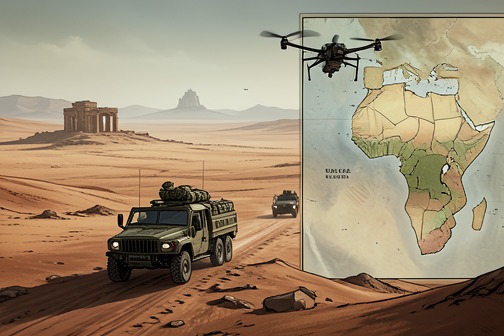
The [Seventh Solomon Expedition](entity:event-recall-event-0ba3f23541f5) is the last expedition undertaken by Imperial forces in the Solomon series and one of the decisive hidden operations behind the world’s political and supernatural crisis. Officially, it belonged to a coalition seeking to navigate and scout the [Lost Lands](entity:location-recall-location-lost-lands-cea564ae4344); in Jack’s reconstruction, however, it was an instrument of a far older design, directed by the Black King toward something buried beneath humanity’s cradle. The expedition’s records turn a distant military campaign into evidence that the Empire, the [Corporate Alliance](entity:organization-recall-organization-8f828844737d), and the Theocracy were all entangled in an Archangel’s search for power.
## Purpose and Historical Setting
The expedition formed part of [Project Solomon](entity:concept-recall-concept-project-solomon-e4675877f6b2), an Imperial-led coalition involving corporations, military industrialists, and nations. Its stated practical function was to enter and survey the continent once called Africa and known to the wider world as the Lost Lands. The undertaking therefore combined exploration with military logistics: it required a force capable not only of crossing an unknown region but also of establishing a secure presence in territory hostile to ordinary human life.
The Lost Lands were described as having been overrun by demonspawn and covered in an apparently endless corruptive smog. The same kind of corruption had already transformed citizens of [Frelia](entity:location-recall-location-frelia-b1a5afd812bb) into mindless beasts, so the continent represented more than an unexplored frontier. It was a zone where the environmental threat, the demonspawn threat, and the threat of irreversible bodily and mental alteration converged. The expedition’s setting thus explains why an operation presented as exploration demanded the resources of an international military-industrial coalition.
## The Hidden Objective
Jack discovers the expedition while searching the airship’s main data vault for references to Solomon. The directory labeled Project Solomon leads him to the Seventh Solomon file, the latest Imperial expedition and the one that included his Uncle [Mike](entity:character-recall-character-mike-cb6fa8ab1468) and Mi’shika. The discovery gives personal weight to what had initially appeared to be an obscure historical operation: Jack is not examining an abstract campaign but an undertaking connected to members of his own family and to the actions of the forces that shaped his life.
The records clarify that the Black King wanted something in the Lost Lands. Jack concludes that the object of the repeated expeditions lay buried beneath the cradle of humanity, and that every expedition had been undertaken on the Black King’s orders. The campaign was therefore not simply a failed attempt to map dangerous territory. It was a succession of searches directed toward a concealed prize, with military exploration serving as the means by which an immensely powerful figure tried to reach it.
That conclusion also changes the political meaning of the expedition. Jack realizes that the Theocracy, the Corporate Alliance, and the Empire were secretly under an Archangel’s control. The expedition becomes a point where apparently separate powers are shown to share a hidden dependency. Institutions that present themselves as sovereign actors were participating, knowingly or otherwise, in a search governed by an older supernatural authority.
## Participants, Violence, and Records
The Seventh Solomon Expedition included Uncle Mike and Mi’shika, placing the campaign within the network of imperial operations that Jack must investigate. The files also connect Solomon’s history to a mercenary whom Uncle Mike murdered and whose body bore a tattoo of a staff and the number seven. The mark becomes a disturbing clue: the number is not merely the expedition’s place in a sequence but part of a trail linking military personnel, covert missions, and the unexplained presence of angels and demons in human history.
The wider evidence surrounding Jack’s investigation shows the scale of violence associated with the forces that operated in this world. [CHECKMATE](entity:organization-recall-organization-checkmate-2b9c8287eda9)’s files contain recovered combat data, including a bodycam record in which Python and other [Awakened](entity:concept-recall-concept-awakened-dbe36d6a62b6) fight Pawn number 5, Cobalt Claw. The encounter ends with Python killing Cobalt Claw by strangling him with vines, while the broader archive reveals that nearly four years of operations produced only three pawn deaths at [Selfia](entity:character-recall-character-selfia-644b93c8da27)’s hands and one at Jack’s. Although this battle is not itself part of the Seventh Solomon Expedition, the record supplies the military context in which Jack reads the Solomon files: powerful, globally supported organizations have repeatedly failed to contain the hidden enemy.
The expedition’s danger is also foreshadowed by the question Jack asks after considering the tattooed mercenary and the existence of beings from religious lore: if angels and demons exist, where did they all go? The question shifts the expedition from a matter of lost geography to a missing chapter in the history of the world. What lies in the Lost Lands is not only a place or weapon but part of the disappearance, concealment, or suppression of powers that humanity has mistaken for myth.
## Revelation and Consequences
The immediate consequence of Jack’s research is an altered understanding of the Black King’s position. Python assumes that the Black King’s strength and army should make protection unnecessary, but Jack recognizes that even such a figure lacks the resources and manpower to establish a safe beachhead in the Lost Lands. The expedition’s purpose is consequently double-edged: it is evidence of the Black King’s power, yet also evidence of his limitation. He must use empires, corporations, militaries, and nations because the territory containing his objective cannot be entered or secured by his existing forces alone.
Jack withholds the full truth from Python, saying that the Black King seeks to control the demonspawn and bend the world to his will, while keeping silent about reincarnation and souls. His restraint indicates that the expedition has exposed knowledge too dangerous or horrifying to share casually. The campaign is connected not only to territorial conquest but to the fate of the dead and the possibility that human lives are being treated as resources in a design that reaches beyond ordinary political rule.
The expedition also prepares the later revelation of the [Infinity Machine](entity:object-recall-object-infinity-machine-f51070e3d825). [Sahaqiel](entity:character-recall-character-sahaqiel-e7c47f684c53) explains that the machine reads all data flow, translates what people call mana, and once halted and reversed the world’s mana flow to eliminate those who exhibited mana capability. [Eve](entity:character-recall-character-eve-09bb1968b5f4)’s recorded testimony identifies the Infinity Machine as a tool created to resuscitate those who fell in a great war and guide lost souls back to the living. Together, these disclosures recast Solomon as part of a technological and spiritual history in which magic, souls, bodily life, and information are governed by the same system.
## Narrative Significance
The Seventh Solomon Expedition functions as a buried hinge in the plot. It connects the visible institutions of the Empire, the Corporate Alliance, and the Theocracy to the concealed authority of the [Archangels](entity:creature-recall-creature-archangels-4ec67aa54674); connects Jack’s family history to the search for the Lost Lands; and points forward to the sealed source of immense mana that Jack and Sahaqiel later approach. The expedition’s records do not resolve the mystery by themselves. Instead, they make the mystery larger, revealing that the campaign’s apparent failure or incompleteness is part of a continuing search whose consequences reach the Infinity Machine and the survival of humanity.
Its significance also lies in the contrast between public narratives and operational truth. The Empire later presents war as a necessary defense of humanity, while Jack appeals to citizens to abandon the old imperial order and join a future in which surrender will be treated humanely. Selfia similarly frames a new offensive as the only path to survival when cities such as [Lunacrypt](entity:location-recall-location-lunacrypt-e95a1db9a984) and [Solarus](entity:location-recall-location-solarus-c4eb2698b2bb) have fallen. Against these speeches, the Solomon files preserve a darker political reality: expeditions, alliances, and national projects can be mobilized under slogans of security while serving a hidden supernatural objective.
The event is therefore both an expedition in the literal sense and a narrative descent into suppressed history. It sends armies into a poisoned continent, but its deeper movement is investigative. When Jack opens the Seventh Solomon folder, he begins to see that the world’s wars have been organized around absences—missing angels, buried powers, lost souls, and a prize hidden beneath the birthplace of humanity. The expedition’s decisive legacy is not a publicly celebrated victory but the knowledge that the search never belonged solely to humanity in the first place.
Event 7
Siege of Windermere
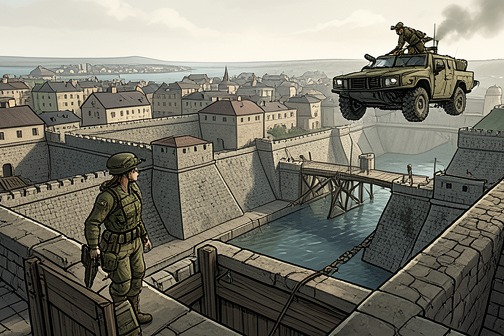
The [Siege of Windermere](entity:event-recall-event-windermere-8cf3c945d37d) is the Selfian campaign to capture a heavily fortified Roland port city and break the last major bastions of the Roland army. Its military importance is inseparable from its personal stakes: [Colette](entity:character-recall-character-colette-dffbffa759f2), once [Victoria](entity:character-recall-character-victoria-fef24d0cf051)’s bodyguard and the absent mother of Jack Cordellica’s daughter [Celeste](entity:character-recall-character-celeste-9b8251b96088), commands part of the city’s defense. The operation therefore becomes more than a final act of conquest. It forces Jack to confront the woman who abandoned his family while deciding how much destruction can be justified in bringing the war to an end.
## Causes and Background
The offensive begins after Selfian forces use revived Earth orbital relays and weaponized satellites to bring the Roland army “to its knees.” [Selfia](entity:character-recall-character-selfia-644b93c8da27) identifies [Windermere](entity:location-recall-location-windermere-e3bd0f4c4e09) as a fortified port whose capture could take months, making it both a strategic obstacle and a costly delay. Roland’s forces are already weakened, but [House Light](entity:organization-recall-organization-house-light-ec5ac8fd13b9) continues to impede the Selfian advance, and Colette commands one of the city’s trench lines as a representative of that house.
Selfia presents Jack with an aerial image of Colette and offers him the chance to approach her before the assault. The proposal is not based on any expectation that Colette will defect. Selfia has already tried to persuade her and regards her as a loyalist who will not abandon House Light. Her reason for involving Jack is personal: she knows Colette matters to him. Jack’s response reveals the emotional fault line beneath the campaign. He remembers that Colette gave up Celeste, and he questions why she would listen to him after four years without speaking and four years since Celeste’s birth.
The siege also follows Jack’s transformation from secluded royal prisoner into a public and military instrument of the Selfian state. Shortly after his marriage to Selfia and coronation as king, he is confined to a luxurious room, permitted only restricted visitors and supervised contact with [Ada](entity:character-recall-character-ada-10673482132c), [Leona](entity:character-recall-character-leona-fc6ab8aabbbc), and Celeste. Later appearances are organized through schedules, security, Intellipads, armored transport, and carefully controlled information. By the time of the Windermere campaign, the former man who once relied on public transit has a chauffeur, guards, a child, and access to scattered wills and testaments, yet feels hollow and strangely eager. The siege gives that unease a battlefield outlet: the larger the impact he makes, the farther its ripples will travel.
## Forces and Operational Plan
Aboard the Roland, Eat a Bag of Dicks, Jack receives the briefing as Selfian forces approach the city. [Admiral Skirita](entity:character-recall-character-admiral-skirita-5f32271ff03e) reports that fifteen battle groups are an hour from the Windermere staging point. After linking with the other groups, the Selfian forces will disembark their ground troops and engage the Roland Air Force. Jack questions why the plan calls only for a skirmish rather than immediate air dominance, but the operation is constrained by the city’s defenses.
The first stage is to locate and eliminate enemy anti-aircraft emplacements. Selfian airships can provide only limited cover while those guns remain active, and Roland command is expected to have mage officers protecting the batteries. Once the anti-aircraft defenses are destroyed, the fleet will attack the enemy trenches before assaulting the city itself. Skirita retains operational command even though Jack is officially in charge of the campaign as king consort. Jack accepts the arrangement, acknowledging that his strength lies more in striking enemies than in planning a complex siege.
Colette’s defensive position is designed to exploit the same delay that makes Windermere so valuable. From a concrete bunker layered with titanium sheets, she observes the Selfian force from a hundred klicks away. Hoffman notes the enormous number of enemy aircraft hovering beyond the range of the city’s 155-millimeter Tarkov anti-armor cannons. These guns were originally built to fight Titan-class demonspawn, but the war has repurposed them against human armies. Colette’s strategy is to keep Selfian forces away from the batteries and force their logistic lines to sustain both a frontal assault and the continuing threat of demonspawn. The defenders need only buy time.
## Course of the Assault
Before the attack begins, Jack orders a call for surrender. He asks the Selfian command to establish a dedicated unit for receiving and housing prisoners, arguing that unnecessary casualties should be avoided. The request places a humanitarian limit inside an otherwise overwhelming campaign, although Skirita makes clear that Jack cannot compromise the operation’s security. Surrender is offered as a practical reduction of bloodshed, not as an abandonment of the siege.
The battle escalates when Jack and [Sahaqiel](entity:character-recall-character-sahaqiel-e7c47f684c53) combine their power with the opposing Anti-Army force. A hurricane forms as tropical-level winds gather around Jack, and the interaction of the two Anti-Army skills turns the battlefield into a violent vortex. Through Jack, Sahaqiel calls upon nature; the storm wipes away Roland cannons and drowns out the screams of the combatants. At its center, Jack appears before Colette, bringing the strategic assault into direct personal confrontation.
Jack urges Colette to admit that Roland has lost and to come home. Colette rejects the appeal because her loyalty belongs to House Light rather than to the shortsighted ruler whose war has placed the city in danger. She draws an Armytheum blade and declares herself a stalwart knight whose duty cannot be displaced by Jack, even by their shared history. The exchange turns the siege’s central conflict into a clash between competing definitions of allegiance: Jack invokes family and surrender, while Colette invokes house and duty.
Jack’s growing command of mana makes the battle a test of power as well as conviction. He experiences the flow of mana as a force he can guide, and the sensation resembles freedom to him. Yet the same awakening carries an immediate moral cost: he is about to use natural forces to bring down a 160-yard air destroyer upon a city. He opens his glowing gold eyes as the vessel, still firing its 120-millimeter guns, crashes into the city wall and explodes. The scene makes liberation and devastation indistinguishable. Jack feels newly attuned to the world precisely while using that connection to destroy part of it.
After the Roland army abandons the city, Windermere is not safe. Jack descends through the rain toward the port, only to be met by black artillery pieces firing from the walls. His mana barrier absorbs the explosive flak, and his continuously replenished mana makes the defenses appear nearly unbreakable. The abandonment of the main army therefore does not end resistance; it changes the assault from a conventional siege into a dangerous entry operation against a city that remains armed.
## Consequences and Aftermath
The battle’s personal cost is crystallized when Hoffman stumbles and passes Jack during the fighting. Jack catches the soldier by reflex, but Hoffman falls limp in his arms. Jack’s confusion gives way to hollowness when he realizes that Hoffman’s core has ceased to exist to him. The death is not treated as an abstract casualty in the campaign ledger. It interrupts Jack’s movement through the battlefield and registers as an absence in his perception, reinforcing the human consequences of the immense forces he has unleashed.
Windermere consequently marks a double victory whose meaning remains unstable. Militarily, the Selfian advance overwhelms the Roland defenses and targets a port city identified as one of the final bastions of Roland resistance. Politically, the campaign demonstrates the reach of Selfian power, from orbital weapons and fifteen battle groups to Jack’s Anti-Army storm. Personally, however, Jack does not obtain the reconciliation Selfia hoped he might secure. Colette remains bound to House Light, and the battlefield exposes rather than resolves the fracture between her duty and her abandoned family.
## Narrative Significance
The siege compresses the book’s recurring tensions between institutional control and individual agency. Jack’s movements are repeatedly organized through rooms, schedules, security procedures, paper folders, armored vehicles, and Intellipads; at Windermere, that managed royal figure becomes a weapon whose body and mana can alter the weather. The transformation appears liberating, but it also makes him more useful to the machinery of war. His private sense of freedom arrives at the moment he accepts the power to destroy a city wall and an air destroyer.
The event also inverts the expected homecoming. Jack approaches Colette with the language of return, asking her to come home, but the battlefield has made “home” a contested moral position rather than a place of safety. Colette’s refusal leaves the family conflict unresolved, while Hoffman’s death prevents the offensive from becoming a clean heroic triumph. Windermere is therefore significant not simply because it advances the war, but because it reveals the price of turning personal grievance, royal authority, and supernatural power into one instrument of conquest.
Event 8
Situation RED
[Situation RED](entity:event-recall-event-1f28d687b2af) is the worldwide activation of the [Red-Eye Curse](entity:state-recall-state-red-eye-curse-19d1e0c5c9cd), a coordinated supernatural disaster that transforms the Empire’s inherited red eyes from a sign of purity into evidence of enslavement. The outbreak kills civilians across major population centers, reveals that the curse is commanded through the soul by the Black King, and changes the strategic objective of the surviving leadership from managing a war to attacking the source of an impending mass exodus of souls.
## Outbreak Across the World
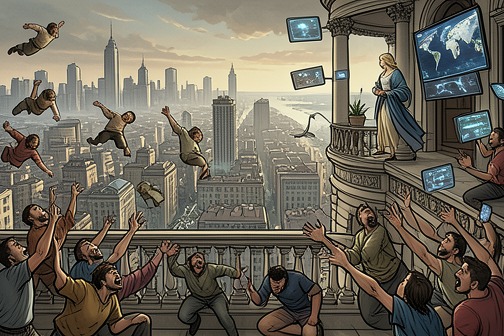
Situation RED begins amid an attack whose scale is initially unclear. In the Imperial capital, [Selfia](entity:character-recall-character-selfia-644b93c8da27) stands on the balcony of her palace while screams rise from the city below, and the capital’s disorder reaches her even as she is already exhausted by war. [Jin](entity:character-recall-character-jin-962fbeb69b78) and other royal guards warn that the palace itself is unsafe. Selfia responds by demanding an immediate situation update and activating the sanctum’s surveillance network: a dozen floating arms operate around her while multiple screens display thousands of connected cameras.
The screens convert the crisis into a simultaneous global image. Everywhere Selfia looks, people are spasming. The same phenomenon appears not only among citizens of the Empire but also in feeds from the Hoshido village and the [Corporate Alliance](entity:organization-recall-organization-8f828844737d). People are dying, making the event more than a local attack or a military diversion. It is a synchronized assault whose geography cuts across political borders and social divisions.
The event is formally identified as Situation RED. On the bridge of SIA “Fuck You, Roland,” Jack stands among what remains of the command staff: Director York, Lieutenant Harper, and Captain Helena are down, while personnel with red eyes have either been confined to the brig or reduced to corpses in the ship’s cold storage. Selfia reports that the phenomenon is worldwide, though not completely universal, and that every major city from the Alliance to the Empire has been affected. The available data indicates that only people with red eyes are suffering the attack.
## The Curse Behind Imperial Purity
The first explanation offered is biological warfare. [Admiral Skirita](entity:character-recall-character-admiral-skirita-5f32271ff03e) asks whether the disaster is a new biological weapon, but [Sahaqiel](entity:character-recall-character-sahaqiel-e7c47f684c53) rejects the frame entirely. Appearing before the officers in white-and-gold regal armor, she states that the population was played and identifies the supposed purity of Imperial blood as a curse.
Sahaqiel explains that the curse is a spell comparable in scope to the system, but subtler and more sinister. Every person with red eyes bears a mark on the soul, and that mark is commanded by the Black King. The red eye therefore functions as a visible sign of an invisible instrument of control: what the Empire treated as hereditary distinction is also a spiritual vulnerability shared by an entire population. The revelation reverses the meaning of Imperial identity. Purity is no longer protection, legitimacy, or superiority; it is the condition that makes the afflicted population targetable.
Selfia immediately recognizes the political cost of the disclosure. She objects that knowledge of an entire cursed population should have been treated as essential information, especially because Sahaqiel has concealed it until the crisis is already underway. Her anger also exposes the limits of the palace’s surveillance regime. Selfia can see thousands of bodies and locations through the screens, yet she did not understand the mark governing those bodies. Visibility has produced information without producing comprehension.
## Strategic Reversal
Once the curse is identified, the crisis changes from an emergency of containment into a conflict over its source. Jack looks at the display of the Roland capital and declares that the source of the problem must be attacked: the Black King. Skirita warns that a full assault on a heavily fortified city would be suicide because the forces are already depleted. Jack nevertheless treats the assault as an order, and Selfia supports him.
Sahaqiel supplies the reason for that escalation. She says that the Black King’s plans are already underway and that a mass exodus of souls is a prelude to gathering power. The immediate death toll is therefore not the final measure of the disaster. If the source is allowed to continue, the number of dead will become irrelevant because no one will remain to care. Situation RED consequently turns the logic of the war inside out: the military exhaustion that should counsel delay becomes the very condition in which delay permits the enemy to accumulate strength.
The reversal also gives the event a personal dimension for Jack. Earlier, his public royal life had been organized through surveillance, paper records, security arrangements, and tightly managed appearances. He had been confined to a luxurious room after his marriage to Selfia and coronation, later moved through the city with a chauffeur and security detail, and made to follow schedules displayed on an Intellipad. Situation RED ruptures that controlled political routine. The same systems that once organized his image of kingship now display spasms, corpses, and panic, forcing him to act against a threat that cannot be managed by ceremony or administration.
## Political Violence and Emergency Power
The outbreak occurs against a background in which exceptional measures have already been justified as necessary for humanity’s survival. Selfia previously acknowledged that a purge was taking place throughout the Empire, with three hundred and sixty-nine lives already being extinguished and possibly more to follow. Political opponents, rivals, dissidents, and anyone thought likely to obstruct the [New Republic](entity:concept-recall-concept-new-republic-5ad5d624da75) were marked for death. Jack’s response was that the plan had created chaos and killed bystanders and innocents, including people whose deaths could endanger [Ada](entity:character-recall-character-ada-10673482132c)’s pregnancy and his child.
That earlier purge gives Situation RED a disturbing political echo. The Empire had treated mass killing as a means of securing order; the Red-Eye Curse reveals a deeper system in which an entire population has been silently prepared for extermination or spiritual extraction. In both cases, authority uses the language of necessity while ordinary people lose the protections associated with citizenship. Jack’s later warning to Theocracy survivors follows the same emergency logic in a different register: evacuate to the Flying City and settle within Imperial territory, because the alternative is death when the demonspawn arrive. Situation RED makes such ultimatums newly unstable, since the institutions claiming to save populations may also be unable to recognize the invisible forces controlling them.
The event therefore exposes the danger of confusing protection with power. Selfia’s palace can monitor the Empire, mobilize guards, and issue orders, but it cannot prevent the curse from reaching its subjects. Jack can command an assault, but the order is made under conditions in which the enemy has already penetrated the population. The crisis strips away the reassuring boundary between the state’s protective apparatus and the mechanisms that render bodies expendable.
## Aftermath and Larger Threat
The immediate aftermath is a command crisis. The bridge of SIA “Fuck You, Roland” is populated by the remnants of its staff, while red-eyed personnel are segregated as prisoners or dead. Selfia’s reports establish the breadth of the catastrophe, but Sahaqiel’s explanation establishes its meaning. Her authority is reinforced when Selfia calls her a goddess whose vessel is Jack and orders the officers to treat her words as equivalent to the queen’s own.
Jack’s decision to strike the Black King follows from that alliance between revelation and command. Selfia gives him permission to do whatever must be done, while Sahaqiel warns that the departing souls are being gathered as power. Situation RED thus ends not with recovery but with mobilization toward the Roland capital. The event’s apparent medical mystery becomes the opening move of a supernatural campaign.
Later revelations deepen the danger behind that campaign. [Michael](entity:character-recall-character-michael-119cca2a9432) intends to awaken [Adam](entity:character-recall-character-adam-7e6d3c5ddcc8), the first [Awakened](entity:concept-recall-concept-awakened-dbe36d6a62b6) and first hunter, even though Sahaqiel warns that freeing him would kill the angels, doom the world, and destroy everyone caught in his hunt. Michael presents this not as destruction but as repair, claiming that the deaths of Sahaqiel and Jack can serve as the foundation of a newer world. Read against that threat, Situation RED is both an attack and a harvesting operation: the curse produces mass death while the Black King prepares a power structure capable of surviving the deaths of those he sacrifices.
As a narrative event, Situation RED is the moment when hidden history becomes visible through synchronized bodily collapse. Its horror moves from the unseen mark on the soul, to the public spectacle of people spasming on surveillance feeds, to the political recognition that the Empire’s defining sign has always contained the possibility of control. The outbreak makes knowledge itself a battlefield and leaves Jack with only one viable answer: pursue the Black King before a worldwide population becomes an instrument for his ascent.
Event 9
Battle of Rolanda
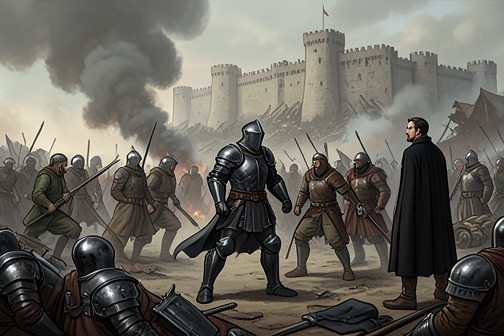
The [Battle of Rolanda](entity:event-recall-event-roland-92aa9c0256fd) is the decisive Imperial attack on the Roland capital, where military strategy, dynastic vengeance, and personal recognition collapse into one violent confrontation. Ordered after [Sahaqiel](entity:character-recall-character-sahaqiel-e7c47f684c53) warned that the mass exodus of souls signaled the Black King's attempt to gather power, the campaign brings Jack, [Selfia Cordelica](entity:character-recall-character-selfia-cordelica-4d8ab9d85def), Roland Cordelica, [Lancelot](entity:character-recall-character-lancelot-b3e9e9f4505d), and the Black King's forces into direct conflict. Its most devastating revelation is not the fall of a fortress but the discovery that the black-armored knight who has opposed Jack is [Mike](entity:character-recall-character-mike-cb6fa8ab1468), Jack's uncle, whose final act is to absorb Roland's attack and tell Jack that he is proud of him before dying.
## Causes and Strategic Stakes
The immediate cause of the assault is the perceived threat posed by the Black King's movement of souls. Sahaqiel argues that the mass exodus is a prelude to concentrating power and that delay could leave no one alive to care about the dead. [Selfia](entity:character-recall-character-selfia-644b93c8da27) therefore authorizes Jack to do whatever is necessary, orders [Admiral Skirita](entity:character-recall-character-admiral-skirita-5f32271ff03e) to prepare the fleet, promises reinforcements, and declares that she will meet the force on the way to Roland's home. Her decision makes the campaign both a military operation and a family reckoning: Selfia explicitly wants to confront her brother, Roland Cordelica.
The Imperial plan is built around containment rather than an immediate frontal duel. At the outskirts of the capital, Selfia's flagship, the [Middle Finger](entity:object-recall-object-middle-finger-5bcafa17901f), reports that the forces are in position, demonspawn interception teams have been deployed, and the blockade is complete. [Ivan](entity:character-recall-character-ivan-462384841865) reports that the Black King remains inside the capital citadel with Roland, so Selfia and the assault force intend to enter first and trap both enemies within the city. Jack is specifically warned to conserve his strength, placing his individual power inside a larger operation involving tanks, MECHFrames, armored soldiers, airships, and the Imperial navy.
## The Assault on the Capital
After days of fighting, Jack reaches the air above the golden palace used by Roland, who has proclaimed himself king. The setting makes the political conflict visible: beneath black winds, Jack faces Roland before the gates of the golden castle while Selfia's airships prepare to fire. Roland is identified as both a usurper and the Black King's White Knight, binding the disputed throne to the supernatural power that the Imperial forces are trying to contain.
Selfia immediately deploys troops to prevent an enemy retreat. Roland denounces her for sending her supposed puppet instead of facing him herself, points his golden blade at Jack, and accuses the queen of cowardice while her navy fires indiscriminately on the city. Jack lands in a ruined street of concrete and rubble, with Roland's soldiers positioned in bombed-out houses and defensive dugouts around him. Their reluctance to attack allows Jack to enter the defensive line almost openly, but the apparent standoff quickly becomes a contest between Roland's challenge and Selfia's operational command.
The confrontation escalates when Roland reveals that the golden weapon is [Excalibur](entity:object-recall-object-excalibur-a2b72b99cb6d). As he prepares an Anti-Army skill, Jack detects Roland's core changing from purple to silver. The battle's mechanics make a point-blank clash especially dangerous: Anti-Army skills can cancel one another in open conflict, but when activated at close range their collision can implode the effects, concentrating and mushrooming the mana rather than simply neutralizing it. Roland appears willing to exploit the presence of Selfian troops, perhaps expecting Jack to hesitate before unleashing such force near his own side.
Jack answers with Manawraith Tempest, while Roland invokes Excalibur through Exaltation: Judgement Slash. Roland's blade releases a beam of radiant energy that pierces the heavens; Jack's skill creates a hurricane at point-blank range in the city center, tearing apart the surrounding structures. The collision removes sound and light from the scene before a brilliant explosion rips the battlefield apart. The siege thus reaches its critical turn not through the gradual capture of the capital but through two competing assertions of power that threaten to destroy the city around them.
## Mike's Sacrifice and the Recognition
When the explosion clears, a shadow knight stands before Jack with almost half his body missing. The knight has not been facing Jack. Instead, he turned his back and took the brunt of Excalibur's special properties, which had merged with Roland's Anti-Army skill and cut through Jack's and Sahaqiel's hurricane. The apparent enemy has therefore become an unrecognized protector at the exact instant when Jack's own attack and Roland's attack meet.
The helmet is shaved away, exposing the knight's face. Mike can barely move, but he turns his green eyes toward Jack and addresses him as “kiddo.” Jack recognizes his uncle only after the armor and helmet have been damaged, converting the battlefield's anonymous shadow into a member of his family. Mike's final words, “I’m so proud of you,” follow the recognition immediately. He then falls to the ground, and his death strikes Jack with such force that Jack can only scream in shock.
The revelation changes the meaning of the entire encounter. Mike was the specter Jack had been fighting against all this time, yet his final movement is an act of protection rather than aggression. The battle's central reversal is consequently emotional as well as tactical: Jack survives because the enemy he thought he knew sacrifices himself, while Roland's attack becomes the instrument that exposes the hidden relationship.
## Extraction and Immediate Aftermath
Jack's shock is interrupted by the arrival of the [Damocles](entity:object-recall-object-damocles-1101b088a2ad), [Tangerine](entity:character-recall-character-tangerine-92552f325c36)'s [MECHFrame](entity:object-recall-object-mechframe-acda05e426bc). It cuts through the Solaris's Valkyrie force and lands beside him while the battle remains active. Tangerine tells Jack that it is time to leave, secures him in the machine's massive hands, and reports that the package is secured and egressing to friendly lines.
The Damocles escapes under booster power, using its CIWs in every direction to repel Valkyrie pilots attempting to intercept it. Its superiority is emphasized through the contrast between the new machine and the MECHFrames of old: Tangerine's machine is described as a pilot melded with artificial intelligence and metal, while the older machines are reduced to relics beside Selfian Titan technology. The extraction preserves Jack's life after Mike's sacrifice, but it also removes him from the immediate confrontation at the moment of greatest personal devastation.
## Significance
The Battle of Rolanda joins a strategic campaign against the Black King to a dynastic conflict between [Selfia Cordelica and Roland Cordelica](entity:relation-recall-relation-selfia-cordelica-rol-ae58241c8d50). Selfia's fleet, blockade, reinforcements, and interception teams represent organized imperial force; Roland's golden palace, Excalibur, and title as the Black King's White Knight turn the capital into a stage for contested kingship. Jack occupies the unstable center between those forces, treated by Roland as Selfia's puppet while being relied upon as the assault's decisive weapon.
The event also exposes the limits of military certainty. A carefully planned containment operation cannot control the personal meanings hidden inside the battlefield. Jack is told to conserve his strength, yet the decisive exchange demands a point-blank Anti-Army clash; Roland is treated as the enemy, yet the most important intervention comes from Mike; and victory is measured against the survival of the capital, but Jack's immediate experience is defined by the death of the uncle he had unknowingly fought. The battle's lasting consequence is therefore not merely the pressure placed on Roland's regime or the Black King's plans, but the irreversible transformation of Jack's understanding of the war and of the masked figure who stood against him.
Event 10
Attack on Hoshido

[Attack on Hoshido](entity:event-recall-event-hoshido-39a114110538) is the formative atrocity behind Jack’s later conflict with [Ivan](entity:character-recall-character-ivan-462384841865) and one of the central wounds shaping his moral collapse. The attack destroyed Jack’s village and people, made the Theocracy into an enemy he had once had no reason to hate, and left him caught between vengeance, political manipulation, and the need to protect those still alive. Its decisive force lies not only in what happened to Hoshido, but in how the event continues to govern Jack’s choices long after the immediate violence has ended.
## Destruction and Concealed Responsibility
The attack is treated as a buried political crime rather than a fully exposed battlefield episode. When Jack confronts [Selfia](entity:character-recall-character-selfia-644b93c8da27) over whether she knew about the assault on his village, the question carries the weight of a survivor demanding accountability from the ruler whose government now needs his support. Selfia swears that she did not know about the attack or Jack’s survival, explaining that Ivan had been an embedded agent involved in a deep infiltration and that neither Jack nor Ivan was supposed to meet again. Her answer separates direct knowledge from the larger machinery that allowed the catastrophe to occur: Selfia may not have ordered or understood the assault, but Jack’s people were still destroyed within a war whose institutions had made such violence possible.
Selfia’s insistence that Ivan must be kept alive further changes the meaning of the attack. Ivan is not merely a killer awaiting punishment; he is also a source of intelligence about the [High Table](entity:organization-recall-organization-6ec2e99b8fb1), including the location of the Green Bishop and information concerning the Gold Queen and the Red Rook. The political value of the man connected to Hoshido’s destruction therefore competes with Jack’s personal claim to retribution. The attack becomes a test of whether justice can survive strategic necessity, and whether Jack can distinguish the person who harmed his people from the systems that used him.
## Jack’s Memory of Hoshido
Jack recalls Ivan as a former classmate who had once been relatively decent, fond of jokes and pranks, and occasionally restrained by Mai when his behavior caused trouble with Sergeant Dave and other teachers. That earlier image makes the attack’s aftermath more painful. Mai’s death during a training mission changed Ivan, according to Jack, turning him ruthless and sending him into a campaign of hunting Theocracy soldiers without mercy. Jack describes the loss of light in Ivan’s eyes as the consequence of bereavement, but he does not absolve him. Ivan’s grief explains his transformation without removing his responsibility for what he chose to do afterward.
Jack also recognizes a disturbing symmetry between them. He says that the Theocracy gave his side a reason to hate, made children into killers, and took something from Ivan; Ivan then answered by taking from Jack’s side. The attack thus appears within a chain of reciprocal deprivation in which every act of violence creates the justification for another. Jack cannot blame Ivan entirely for what he became, yet he concludes that Ivan made his choice and that Jack must now take from him in return. Revenge is presented not as a clean moral decision but as a burden inherited from a war that has made innocence increasingly difficult to recover.
The attack’s emotional residue is visible in Jack’s treatment of [Yukino](entity:character-recall-character-yukino-55a5aa1c97a6). Her behavior reminds him of Mai, drawing his thoughts back toward the people and relationships that Ivan’s history has damaged. Jack wants to tell Yukino that revenge against Ivan is approaching, but he withholds the truth because Ivan’s intelligence remains strategically useful. By keeping silent, Jack protects an operation while also preserving Yukino’s temporary emotional stability. He knows that her apparent return to normality may be only a facade that will collapse when the truth emerges. Hoshido therefore continues to shape the behavior of people who were not present at the original assault, spreading through secrecy and anticipated revelation.
## From Survivor to Instrument of War
The attack changes Jack’s position in the world. After marrying Selfia and becoming king, he looks down upon a bustling city from the balcony of a luxurious room, yet his royal status does not give him freedom. Two weeks after the marriage and coronation, he is confined to his chambers, permitted only limited visitors, with [Kamila](entity:character-recall-character-kamila-985f1e6cd10e) bringing food and [Ada](entity:character-recall-character-ada-10673482132c), [Leona](entity:character-recall-character-leona-fc6ab8aabbbc), and [Celeste](entity:character-recall-character-celeste-9b8251b96088) forming the narrow circle of approved contact. The contrast between the visible life of the city and Jack’s effective imprisonment reflects the political aftermath of Hoshido: the survivor has been elevated, contained, and made useful at the same time.
His public role is similarly managed through schedules, security, and controlled information. An Intellipad lists appearances connected to Selfia, the opening of the first public academy, Celeste’s reveal, a museum opening, a meeting with investors, and a visit to El Negro Gato. Yet Jack’s movements are surrounded by protection and surveillance, including a heavily armored limousine designed to resist mana attacks. Paper files are treated as safer than tablets because digital systems can be hacked, while Jack later reviews files, notes, and [CHECKMATE](entity:organization-recall-organization-checkmate-2b9c8287eda9) data concerning the High Table. These practices place the personal memory of Hoshido inside a broader regime of dossiers, restricted access, intelligence, and managed visibility. The attack is not only remembered; it is processed through institutions that decide which truths may be seen and which people may be used.
Jack’s sense of purpose becomes increasingly tied to impact and retaliation. He thinks that the larger the splash he creates, the farther its ripples will travel, and he deliberately approaches political and military action as a means of causing those ripples. At the same time, the accumulation of power does not restore him. While driving through a city he once traversed by public transport, he notices that he now possesses security, a chauffeur, a child, and the last wills and testaments of people including Yun, Tyrah, and Jena Leslie. Despite these signs of authority and attachment, he feels hollow. The attack has made material advancement incapable of answering the original loss.
## Moral Injury and Recurring Violence
Jack’s response to Hoshido develops into a pattern of moral injury. He describes killing as a physical and spiritual weight, as though each death carves away a small portion of his soul. The memory of the wilted Nest and the overlapping voices of millions intensifies that burden, while the people condemned by Selfia’s orders at a gala make him fear that Ada and others could suffer the same fate. The attack on Hoshido is therefore linked to every later scene in which Jack must decide whether survival justifies atrocity. The question is no longer whether violence is permissible in the abstract; it is whether protecting loved ones will require him to reproduce the methods that destroyed his own community.
That fear becomes explicit when [Leona and Celeste](entity:relation-recall-relation-leona-celeste-400722b1ae79) confront Jack in a nightmare-like accusation, asking why he killed [Jill](entity:character-recall-character-jill-c58a30f04db5). [Eleanor](entity:character-recall-character-eleanor-f86629a4f595), Hoffman, and other dead or endangered figures likewise appear to demand explanations for the deaths he could not prevent. The accusation does not isolate Hoshido as a single past event. Instead, the village attack becomes the first term in a growing ledger of loss that includes Eleanor, [Mike](entity:character-recall-character-mike-cb6fa8ab1468), Mai, Fujimaru, Itadori, Hoffman, Yun, Tyrah, Jena, and Jill. Jack later tells Ada that since meeting [Sahaqiel](entity:character-recall-character-sahaqiel-e7c47f684c53), everyone he cares about has continued to die or be hurt, and that strength has never been enough. He fears losing Ada, Leona, Kamila, his children, and his home until nothing remains.
The attack also helps explain the dangerous relief Jack experiences when guilt and remorse begin to disappear. He wonders whether [Lilith](entity:character-recall-character-lilith-88bb50d17890)’s tampering has removed the dread that once accompanied every movement, leaving him eager rather than burdened. That change offers efficiency but not healing. By the time Jack admits that he is filled with fear and hatred, can see what he is becoming, and no longer cares, Hoshido’s destruction has been converted into a general willingness to inflict the same kind of devastation on others. The survivor’s moral boundary has not vanished because the original wound was forgotten; it has been worn down because the wound has become the logic of his world.
## Political and Human Aftermath
The attack’s consequences extend beyond Jack’s private revenge. Jack later argues that a ruined, overrun city should not be abandoned to eventual slaughter. His proposal is to bring the city and its inhabitants into the empire, settle thousands of refugees in neutral territory as a free city, and gain both allies and access to whatever secrets lie beneath the floating settlement. The plan acknowledges the practical difficulty of resettlement, including logistics, resources, religious differences, and hostility from much of the empire. Jack answers that the empire itself does not like people like him, and that a place without discrimination is needed.
This proposal reframes the meaning of Hoshido’s destruction. A city can be treated as lost, or its population can be treated as expendable, but Jack insists that survival may still be organized after conquest and ruin. His response is imperfectly entangled with military advantage: refugees would become allies, the floating city would be preserved, and hidden knowledge might be recovered. Nevertheless, the plan marks a counterforce to the logic that made Hoshido disposable. The attack produces not only a demand for revenge, but also an attempt to prevent another population from being abandoned to the same fate.
In the wider arc, Attack on Hoshido is the event that binds personal memory to global conflict. It explains why Jack’s confrontation with Ivan cannot be reduced to a duel between former friends, why Selfia’s political assurances fail to settle his anger, and why intelligence work repeatedly collides with the claims of the dead. Even moments of apparent transcendence, such as Jack floating in the thin air above the world while Sahaqiel speaks of escaping its troubles, remain haunted by the history Jack carries upward with him. Hoshido is gone, but its destruction persists as a political secret, a revenge imperative, a refugee crisis, and a measure of the person Jack is becoming.
Event 11
新天使诞生
The New Angel’s Birth is the decisive transformation of Jack Tanjihiro Chae-wong from a wounded, grieving human into a newly awakened angel. [Jill](entity:character-recall-character-jill-c58a30f04db5)’s death breaks the last structure holding Jack’s identity together: his cry becomes manic laughter, the surrounding world responds to his anguish, and the [Angel System](entity:object-recall-object-angel-system-b43a22ecc903) declares that its tutorial has been completed. The event is both an intimate catastrophe and a global supernatural turning point, because [Michael](entity:character-recall-character-michael-119cca2a9432) recognizes the emergence of a new angel while ancient malevolent beings and forgotten gods stir across the world.
## Causes and Immediate Circumstances
The awakening follows Jack’s desperate attempt to reach Jill on a battlefield. His arms are broken and initially useless, yet he crawls through the dirt, calling his sister’s name until he reaches her. Once his arms heal, he drags himself upright and holds her body, whispering and pleading for her return. His physical effort and his repeated appeal do not reverse the death; instead, they bring him to an emotional limit at which grief can no longer remain contained.
The surrounding crisis is also mediated through the Angel System. Earlier, Jack’s contact with Jill’s masked, corrupted form produced pain, a storm of voices screaming his name, and a blast of putrid energy. The system then displayed an error warning about data corruption, emphasizing that Jill’s condition could not be solved through a simple technical correction. This failed attempt to save her gives the awakening its immediate pressure: Jack seeks a power capable of overcoming corruption, but the answer arrives only after the person he is trying to save has been lost.
## The Moment of Awakening
Jack’s response begins as an inarticulate cry directed toward the sky, described as a howl carrying the burdens of his soul. The cry changes into a chuckle and then into manic laughter. This is not relief or triumph. It is anguish becoming so intense that it acquires physical force: the mana in the air answers his madness, the earth shakes, and the sky weeps while unseen molecules react violently to the laughter.
At the point of rupture, something inside Jack snaps and shifts. His entire morphology becomes attuned to the fracturing world around him, turning the transformation into a bodily and environmental event rather than a private change of mind. The system announces, “Congratulations On Completing the System Tutorial, Angel.” The message recasts his suffering in the language of progression and authorization, translating the death of Jill and Jack’s psychological collapse into a completed stage of an abstract program.
Brilliant gold and white energy then pours from Jack’s body with a purity powerful enough to draw a pleased smile from Michael, who watches from a distance. The radiance marks the emergence as more than a new skill or temporary enhancement. It is the visible arrival of a new supernatural being, one whose birth is witnessed by an opposing power that has evidently been waiting for it.
## System, Power, and Recognition
The awakening is foreshadowed and confirmed through repeated system states. Jack’s earlier development includes the increase of the Authority of [Gehenna](entity:concept-recall-concept-gehenna-b53c70fa9a0b) from Level 2 to Level 3, shown after he opens his eyes amid dead and decaying plants with golden eyes mixed with red. That image establishes a recurring contrast between deathly surroundings and an increasingly transformed body. The later Angel System identifies him as Level 10 and gives him the title [Nephilim](entity:concept-recall-concept-nephilim-bbb5eb35fa51), with enhanced regeneration and mana synthesis. His emergence therefore combines authority, altered physiology, and system-defined classification rather than relying on a single unexplained flash of power.
The system also continues to unfold after the birth. When Jack needs a means to save people at the brink of destruction, a Radiant Skill becomes available, followed by the announcement that an Anti-Army Class Skill is accessible. These later unlocks show that the angelic state is not a closed endpoint. The awakening opens a new range of capabilities whose practical purpose is tied to Jack’s refusal to lose anyone else, even though that resolve was forged through Jill’s death.
By the time Jack later commands, “Awaken, Angel System,” the system has become something he can reveal and activate before a gathered group. Golden interfaces appear around the ruins, but Jack’s own interface is labeled Administrator. [Selfia](entity:character-recall-character-selfia-644b93c8da27) recognizes its similarity to the System and to abilities lost five years earlier. Jack’s body radiates warmth and comfort as he presents this power, creating a marked contrast with the violent, corrupted energy and manic laughter of the original awakening. The new angel thus develops from a force born in catastrophe into an authority capable of public revelation and world-shaping control.
## Global Consequences and Narrative Significance
Michael identifies the event as the birth of an angel after forty thousand years, giving Jack’s personal tragedy a vast historical scale. His declaration accompanies a worldwide reaction: old things stir, beings of malevolence awaken, and forgotten gods respond to the demi-god’s emergence. The event therefore changes the story’s horizon. Jack is no longer merely a participant trying to survive a battlefield and rescue his sister; his existence becomes a signal that summons powers dormant across the globe.
The value shift is stark. Jack begins the sequence trying to preserve Jill and ends it unable to restore her, but the failure produces a radically expanded form of power. Life and family are lost while supernatural agency is gained. The narrative does not present that exchange as a clean victory: the gold-and-white radiance is inseparable from the body holding Jill and the laughter that follows his howl. Jack’s awakening is consequently both an ascension and a wound, an empowerment whose source is irreparable bereavement.
The event also exposes the tension between human grief and programmed destiny. Jack’s pain is intensely bodily and singular, while the Angel System interprets it as tutorial completion and Michael interprets it as the arrival of a long-awaited angel. Those external readings do not erase the personal cause of the transformation, but they place it inside systems of classification, prophecy, and cosmic expectation. The New Angel’s Birth matters because it joins these levels without resolving their conflict: Jill’s death breaks Jack as a brother, the system names him as an Angel, and the world begins reacting to him as a historical power.
Event 12
Cordell Plaza毁灭
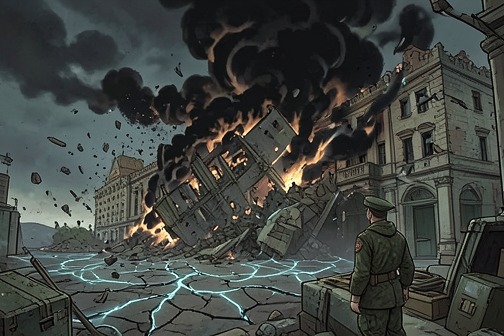
[Cordell Plaza](entity:location-recall-location-cordell-plaza-c7159c019de3) Destruction is the moment when Jack’s campaign against [Michael](entity:character-recall-character-michael-119cca2a9432) crosses from targeted warfare into mass retribution. In [Eden City](entity:location-recall-location-eden-city-0e297982fc2b), he destroys Cordell Plaza with a single black-energy attack, erasing the building, its surrounding forces, and everyone caught within the blast. The event is decisive because Jack does not mistake the engineers for soldiers or claim that they personally intended [Jill](entity:character-recall-character-jill-c58a30f04db5)’s fate; he knowingly destroys them because he believes that removing every connection to the machinery of her transformation is necessary to keep his family safe.
## Causes and Background
Cordell Plaza is the home of Cordell Engineering, an organization controlled by the Black King and responsible for engineering parts used in [High Table](entity:organization-recall-organization-6ec2e99b8fb1) projects. Those parts were used in creating the monster Jill had become, giving the building a direct material connection to Jack’s deepest personal wound. The plaza is therefore not merely an enemy facility in his mind. It has become a visible emblem of the system that turned his sister into something inhuman.
The immediate conflict is also shaped by Jack’s refusal to return home. [Sahaqiel](entity:character-recall-character-sahaqiel-e7c47f684c53) reminds him that he has already missed the births of his daughter and son and urges him to rejoin the family before he loses their lives as well. Jack rejects the appeal while looking over the carnage below. He argues that his children will not have a life unless he does what must be done, because Michael remains at large and several lost battles have not ended the war. His reasoning binds family protection to continued violence: returning home becomes, in his judgment, impossible until every threat has been removed.
Sahaqiel recognizes the impending attack and objects on both moral and practical grounds. Jack has already killed the Gold Queen, but Cordell Engineering’s personnel are engineers rather than combatants, and the report indicates that they did not know what they were doing. She also invokes Jill’s wishes, insisting that Jill would not want the massacre. Jack’s eye twitches at the mention of his sister, showing that the appeal reaches the wound behind his decision without changing it. He answers that he will not stop until his family is safe, including the act of tying up every loose end.
## What Happens
Jack releases the attack while Sahaqiel is beside him. As mana warps around his body, he speaks the incantation “Fira.” A dense beam of black energy leaves his palm and cuts through the city in a straight path toward the distant tower. Its destructive line consumes everything in its way rather than distinguishing between infrastructure, combatants, and bystanders.
The attack culminates in the manifestation of a miniature sun around the tower. Cordell Plaza, the demonspawn swarms, and the survivors are swallowed together and instantly atomized. When the light fades, a perfect spherical crater occupies the center of the metropolis, with every sign of civilization within it deleted. The geometry of the crater gives the event an almost unnatural finality: the plaza is not damaged, occupied, or left in ruins, but removed from the city altogether.
Sahaqiel’s reaction emphasizes the scale and personal cost of the act. She whispers Jack’s name when the light dies, then cries out as the destruction becomes visible. When she reaches for him through their shared connection, Jack usurps the mana she tries to control, dominates it, and makes it his own. Sahaqiel collapses to her knees, out of breath, while the energy connected to her is inverted by Jack. His power thus harms not only the people at Cordell Plaza but also the companion attempting to restrain him.
## Consequences and Aftermath
The destruction confirms that Jack’s objective has changed in character. He still describes himself as fighting for his family and against Michael, but his method has become collective punishment. The engineers’ claimed ignorance does not protect them, and Sahaqiel’s appeal to Jill’s wishes cannot interrupt his logic of vengeance. The event makes “family safety” a justification broad enough to include the eradication of anyone connected, however indirectly, to Jill’s transformation.
Cordell Plaza’s removal also affects the physical landscape of the wider war. The city is left with a spherical crater where a major industrial and strategic site once stood, while the attack’s path has erased everything between Jack and his target. The black beam and miniature sun make the destruction read as both a military strike and an uncontrolled expression of grief: a technologically connected institution is answered by an overwhelming supernatural force that obliterates the distinction between culpability and proximity.
The event foreshadows the increasingly catastrophic scale of the conflict. Later battle scenes show Jack and Athena moving with enough force to split the earth and turn sand into smoldering glass, while the shores of the new continent are stained by poisoned water and the corpses of a larger war. The revelation of [Heaven](entity:location-recall-location-heaven-0167f964ad61) rising from beneath blood-soaked ground extends the same pattern from one destroyed city complex to structures capable of reshaping the battlefield itself. Cordell Plaza is therefore an early, concentrated image of a world in which military technology, demonic transformation, mana, and personal revenge continually amplify one another.
## Thematic Significance
Cordell Plaza Destruction reverses the expected heroic return. Sahaqiel offers Jack a path back to domestic life, reminding him of his newborn children and the family waiting for him; instead of accepting that return, he turns farther into the war. In a conventional heroic structure, the protagonist might bring hard-won knowledge home as a means of restoration. Jack rejects that movement, treating continued combat as the only condition under which home can remain possible. The result is a grim inversion in which the defense of family destroys the very restraint and intimacy that could sustain it.
The scene is built around a stark opposition between care and annihilation. Sahaqiel’s warm hand, concern for the children, and invocation of Jill’s wishes stand against Jack’s callous hand, fixed gaze, and demand to eliminate loose ends. The attack resolves neither grief nor danger. It converts grief into policy and danger into permission, leaving Sahaqiel physically weakened and Eden City permanently scarred.
The later world gives the destruction a historical counterimage. Five years afterward, [Ada](entity:character-recall-character-ada-10673482132c) can stand on a restored beach beside [Jacksonville](entity:location-recall-location-jacksonville-c0d4f40ef42e), where families and children play, fishermen use the piers, and the former bastion of Heaven has become a governmental capital with homes, shops, electric signs, and a functioning council. That reconstruction does not erase Cordell Plaza’s crater, but it demonstrates the alternative Jack could not yet choose: protecting a future through rebuilding rather than attempting to guarantee it through total erasure. Cordell Plaza Destruction remains the clearest point at which his promise to safeguard his family becomes inseparable from the devastation he claims to prevent.
Event 13
Forgotten Continent Expedition
The [Forgotten Continent Expedition](entity:event-recall-event-96572834416a) is the Coalition’s attempt to break through the world’s final strategic barrier: the corruption-choked [Forgotten Continent](entity:location-recall-location-forgotten-continent-e6446e71e802), where the [High Table](entity:organization-recall-organization-6ec2e99b8fb1)’s Red Rook is gathering people and matériel and where the Black King may still be pursued. The expedition is not simply a military raid. It is a logistical gamble, a hunt for the organizers of the apocalypse, and the first deliberate movement toward a continent that has become nearly inaccessible to the surviving forces of humanity.
## Origins and Strategic Target
The expedition takes shape after Jack learns that General [Dorian Jazz](entity:character-recall-character-dorian-jazz-103eba1102a5), known as the Red Rook, is assembling soldiers and survivors of the [Solomon Expeditions](entity:organization-recall-organization-solomon-expediti-953d5cb4208e) for a voyage to the continent. [Sahaqiel](entity:character-recall-character-sahaqiel-e7c47f684c53) had previously identified [Heaven](entity:location-recall-location-heaven-0167f964ad61) as being above the continent known as Africa, and Jazz’s use of specialized boats therefore gives the operation a possible route toward the Black King’s remaining power. By this point the High Table has already suffered major losses: the Gold Queen is dead, the White Knight is imprisoned, the Green Bishop is being experimented on in a basement, and the [Purple Pawn](entity:character-recall-character-purple-pawn-28c23759d591)’s head is mounted in [Selfia](entity:character-recall-character-selfia-644b93c8da27)’s office. The Red Rook and the Black King remain the two highest-value figures still outside the Coalition’s control.
Selfia’s intelligence briefing identifies [Zanzibar](entity:location-recall-location-zanzibar-45e731eaa111) as the immediate objective. Satellite imagery, information supplied by the resident angels, and reports from the [Black Hearts](entity:organization-recall-organization-black-hearts-491bd929ace1) reveal large movements of equipment and personnel into the port city. Zanzibar had previously been peripheral to Imperial territory and had experienced little demonspawn traffic, but contact with the city was lost several months earlier. That silence, combined with the concentration of men and supplies, suggests that Dorian Jazz is preparing another expedition into the Forgotten Continent.
The operation consequently has several linked aims: seize Zanzibar, interrogate Dorian Jazz, capture the boats, and possibly reach or eliminate the Black King. The ships matter because the Coalition cannot rely on its normal technological superiority in the continent’s atmosphere. The expedition’s objective is therefore both intelligence-driven and infrastructural: the Red Rook is the target, but the vessels are the means by which the wider war can continue.
## The Continent’s Logistical Barrier
The Forgotten Continent is described as a territory choked with corruption and demonspawn, hostile not only to human bodies but to the technological systems on which the Empire and the [Corporate Alliance](entity:organization-recall-organization-8f828844737d) depend. Mi’shka Domino, a veteran of more than a dozen combat sorties and reconnaissance missions under General Solomon, explains that a non-[Awakened](entity:concept-recall-concept-awakened-dbe36d6a62b6) soldier without a constantly supplied filter would die within seconds. Obsfiter generators and other mana-dependent equipment would be starved, MECHFrames would shut down, airships would stall, Awakened soldiers would be poisoned by prolonged exposure, and even robots would short out.
The miasma also defeats the Coalition’s systems of observation. Selfia’s satellites cannot image through the smog, leaving the expedition without the reliable surveillance that has supported operations elsewhere. The Empire has little reserve of seafaring craft because it is landlocked and has had no reason to maintain a large naval capacity. Capturing the boats in Zanzibar is therefore essential rather than incidental: without them, the Coalition lacks a workable way to enter, supply, and withdraw from the continent.
This environment reverses the normal balance of power. Airships, satellites, mana-fed weapons, mechanized frames, and automated equipment—symbols of the surviving states’ military modernity—become liabilities or useless instruments. The campaign must instead be organized around ships, supplies, filters, personnel, and the preservation of equipment under conditions that continuously consume or corrupt them. The expedition’s difficulty is thus established before the invasion begins, in the gap between what the Coalition can normally command and what the continent permits it to use.
## Coalition Mobilization at Zanzibar
The expedition is presented publicly as the opening of a much larger counteroffensive. On the docks of Zanzibar, thousands gather beneath the silver-and-blue banners of the Soldiers of the Coalition. Selfia appears before them in a bloodstained tank top and fatigues rather than the respectable clothing expected of a monarch, using the image of a ruler stripped down to the physical burden of war. Jack stands beside her while aircraft gather overhead behind a carrier-class airship, the visible spearhead of the force intended to open a beachhead for the invasion that follows.
Selfia frames the operation within a history of human survival. She recalls the destruction of [Lunacrypt](entity:location-recall-location-lunacrypt-e95a1db9a984), Soldaer, Clausterfiell, and [Solarus](entity:location-recall-location-solarus-c4eb2698b2bb), presenting the ruined cities as monuments of human existence being erased by genocidal monsters. Her conclusion is that humanity’s only remaining option is to attack. The expedition is therefore converted into a political myth as well as a military undertaking: the crossing toward the Forgotten Continent becomes an act through which the Coalition claims to seize humanity’s future rather than merely react to catastrophe.
Jack’s public role reinforces that claim. In an earlier broadcast he identifies himself as Jack Cordelica, son of the [Queen Slayer](entity:expression-recall-expression-queen-slayer-bfd90acc26f5) and King Consort of [Selfia Cordelica](entity:character-recall-character-selfia-cordelica-4d8ab9d85def), then offers Imperial citizens the chance to surrender before the coming battle destroys their city. He invokes a revised interpretation of Imperial war doctrine, promising humane treatment and citizenship in the Cordelica Democracy to those who lay down their arms. The Zanzibar operation consequently carries the language of liberation and political transition alongside its demands for military obedience.
## Conduct and Immediate Consequences
The available account shows the Coalition force fighting its way through demonspawn around the expedition’s staging area. Jack returns to the city after flying ahead of Sahaqiel and destroying the last of the creatures in the immediate engagement. Soldiers celebrate his return with salutes and bows, marking him as a visible champion of the newly named Coalition to Free Earth. The moment links personal combat to institutional mobilization: Jack’s battlefield presence supplies the heroic image, while Selfia works to assemble the armies and remnants of the world into a single force.
The expedition also exposes the political violence underlying that coalition. Selfia’s regime has already ordered a purge across the Empire in which at least three hundred and sixty-nine people—political opponents, rivals, dissidents, and others considered obstacles to the [New Republic](entity:concept-recall-concept-new-republic-5ad5d624da75)—are killed. Jack condemns the operation as chaos that has killed bystanders and innocents and may have endangered [Ada](entity:character-recall-character-ada-10673482132c)’s pregnancy. His objection establishes a central contradiction in the expedition’s public language: the Coalition claims to be saving humanity, but its mobilization is inseparable from emergency killings, coercive power, and the willingness to endanger civilians in the name of survival.
That contradiction is also visible in the treatment of defeated populations. When Jack orders the remaining Theocracy citizens to evacuate to the [Holy City Flying Fortress](entity:state-recall-state-holy-city-flying-fortre-84e1ff3b008d) and accept settlement within Imperial territory, he presents the command as a choice between relocation and death because their food, shelter, and ammunition are failing and the demonspawn will eventually arrive. The expedition thus develops from a campaign against external monsters into a broader program of forced movement, protection, and political incorporation. Its humanitarian promises coexist with the blunt authority of an ultimatum.
## Larger Meaning and Unresolved Threat
The Forgotten Continent Expedition marks a threshold in the narrative’s movement from scattered resistance to coordinated global war. A ray shift beacon can summon a Selfian airship to a city within minutes under ordinary circumstances, but the continent’s miasma makes that kind of mobility irrelevant. The expedition must cross the threshold by abandoning the assumptions of instantaneous transport and mana-powered intervention, making the captured boats symbols of an older and more fragile military reality.
The operation also turns Dorian Jazz into a bridge between past and future conflicts. He is a former Imperial commander who served in the Seventh Solomon Expeditions, the earlier search parties that used the resources of entire nations to seek the High Table. His new gathering of survivors and equipment suggests that the expedition is repeating an old quest under apocalyptic conditions, while Jack’s pursuit of him transforms the inherited expeditionary network into a target. The Red Rook is not merely another enemy commander; he is evidence that the institutions and secrets of the old world remain active beneath the new war.
Finally, the expedition’s stakes extend beyond Jazz. [Michael](entity:character-recall-character-michael-119cca2a9432) reveals that [Adam](entity:character-recall-character-adam-7e6d3c5ddcc8), the first Awakened and an unparalleled hunter of magically gifted beings, is being awakened as part of a plan that could kill the angels and doom the world. Sahaqiel’s horror makes clear that the threat facing Jack and the Coalition is not confined to Zanzibar or the Forgotten Continent. The campaign begins as a search for the Black King’s enforcer, but it points toward a larger confrontation in which humanity’s survival, the angels’ existence, and the fate of the world are bound together. Its decisive significance lies in that transition: Zanzibar is the beachhead, the boats are the key, and the continent is the road to the powers behind the apocalypse.
Event 14
Zanzibar战役
[Zanzibar](entity:location-recall-location-zanzibar-45e731eaa111) Campaign is the decisive seizure of a port that [Selfia](entity:character-recall-character-selfia-644b93c8da27)’s war effort desperately needs. Planned as part of the [Forgotten Continent Expedition](entity:event-recall-event-96572834416a), it is meant to capture Zanzibar, interrogate the Red Rook, and take control of the boats required to sustain operations in a continent where corruption, demonspawn, poisoned air, and mana-starving smog make ordinary military infrastructure unreliable. The operation becomes more than an amphibious raid: after a trap detonates among the captured vessels, Jack is forced into a duel with the Red Rook, and victory leaves him with ships, prisoners, intelligence, and a more complicated understanding of the enemy he has killed.
## Strategic Background
Selfia’s expedition is driven by survival rather than territorial ambition. The [Forgotten Continent](entity:location-recall-location-forgotten-continent-e6446e71e802) is so saturated with corruption and demonspawn that non-[Awakened](entity:concept-recall-concept-awakened-dbe36d6a62b6) soldiers can die within seconds without constant filter supplies; obsifiter generators and mana-fed equipment are deprived of power, MECHFrames shut down, airships stall, Awakened soldiers suffer poisoning through prolonged exposure, and even automated units can short out. Because Selfia is landlocked and has not maintained a large maritime fleet, boats are not a convenience but an operational necessity.
Selfia therefore defines the mission in three linked objectives: seize Zanzibar, interrogate the Red Rook, and capture the boats. The port is both a military target and a logistical gateway. Without vessels, the expedition cannot reliably move personnel and supplies through the continent’s hostile environment. The operation also reflects the wider political economy of the war, in which food, ammunition, replacement equipment, filters, transport, and intelligence are inseparable from battlefield success. Zanzibar is valuable because it can provide the material means to continue fighting.
The campaign takes place against a background of accumulated military collapse. Earlier battles have left soldiers covered in blood, uncertain whether it belongs to themselves or someone else; forces have raided [High Table](entity:organization-recall-organization-6ec2e99b8fb1) facilities, retreated toward capitals, and watched entire armies break under the impact of a single opponent. By the time the expedition reaches the new continent, war is already presented as a system of exhausted bodies, improvised alliances, and scarce resources rather than a sequence of clean victories.
## Infiltration and the Trap
Under cover of darkness, Jack surveys Zanzibar’s port from within the vapor of the clouds. He watches soldiers who seldom look upward and uses a periscope to study the unfamiliar vessels below. Having never seen a boat, he expects something resembling an airship or a heavily armed landship; the actual ships’ dull gray-metal appearance disappoints him. The mundane sight of the vessels contrasts with their extraordinary importance to the expedition.
The initial assault appears to succeed. Jack’s teams report that the bridge and crew of the Lancer have been subdued, and the Selfian force begins securing the harbor. The apparent victory collapses when sirens erupt aboard one ship and an explosion tears the vessel apart. Reports quickly reveal bombs throughout the reactor room and improvised explosive devices in the bunks, with wires running across the ship. Jack recognizes that the operation has been designed as a trap rather than a straightforward defense of the port.
Another ship explodes as the commandos race to disarm the remaining bombs. High Table guards rush Jack when gunfire proves ineffective, forcing him to raise a barrier of swirling wind against the attack. The scene reverses the expected value of the raid: the fleet that was supposed to be the reward becomes a collection of floating coffins, and the act of capturing Zanzibar places the invading force inside an enemy-controlled killing ground.
## The Red Rook’s Challenge
The trap’s purpose is finally disclosed when the Red Rook addresses Jack through a camera and welcomes him to Zanzibar. Jack holds enough mana to destroy the surrounding guards, but the Red Rook asks him to refrain from killing his men. The request establishes that the confrontation is not merely a hostage exchange or an attempt to delay the Selfian advance; the Red Rook has arranged the encounter in order to meet Jack personally.
The Red Rook steps from the crowd with an army behind him and a detonator in his robotic hand. He is neither physically imposing nor magically gifted. Jack sees an apparently ordinary officer with cybernetics and no mana core, yet the detonator gives him leverage over the trapped fleet and the soldiers aboard it. His power comes from preparation, command, and the ability to make other people’s lives part of the terms of negotiation.
After accusing Jack of killing when it suits his purposes, the Red Rook opens a crate and produces a large silver buster blade. He then proposes a fight to the death: no powers, no mana, only skill. He explains that Jack took someone precious from him, making the duel an exchange of losses, an eye for an eye. The challenge converts the larger battle into a personal trial while preserving the lives of the Red Rook’s followers as its unstated collateral.
Jack accepts. His blade strikes the enchanted weapon, which absorbs the force of his attack, and the Red Rook answers with a slash that releases kinetic energy and drives Jack backward. The duel strips away the advantages that normally define Jack’s battlefield identity. Rather than defeating an anonymous commander through superior magical force, he must meet an enemy on the narrower ground of technique, endurance, and judgment.
## Death and the Material Victory
Jack ultimately decides that the Red Rook must die because of his complicity in raising an army in the name of Archangel [Michael](entity:character-recall-character-michael-119cca2a9432) and because of the crimes attached to that cause. Before delivering the fatal blow, Jack asks for last words. The Red Rook asks only that Jack spare his men. He turns toward an officer, who disarms the detonator, and promises that everything Jack needs to know will be found on his desk. Jack agrees and brings the blade down.
The request changes the meaning of the execution. Jack kills the Red Rook, but he does not treat him as a purely disposable villain. He recognizes that the defeated commander has made an honorable request and kept his side of the bargain. The Red Rook’s final concern is not survival but the men under his command, a responsibility that forces Jack to distinguish between ideological guilt and the loyalty of the people caught within the organization.
The military outcome is substantial. [Admiral Skirita](entity:character-recall-character-admiral-skirita-5f32271ff03e) reports eight destroyer-class boats, three cruisers in drydock, and more than two thousand prisoners. Commander Houlihan begins organizing the captives, while the Selfian mechanized division enters the town without resistance. The force pays twelve casualties, making the operation costly but far less catastrophic than the initial explosions threatened. Zanzibar therefore supplies the expedition with the maritime capacity it lacks, as well as prisoners and a captured enemy base.
## The Desk, the Letter, and the Enemy Within History
After the battle, Jack sits at the Red Rook’s desk and examines a framed photograph of the man he has killed beside a familiar woman whom Jack has also killed. He sets the photograph down and takes a sheet of stationery covered in neat handwriting. The physical arrangement of desk, picture, and letter turns the battlefield’s immediate violence into an inquiry into memory, loyalty, and failed political belonging.
The Red Rook’s letter explains his misplaced faith in the Black King, his love for his soldiers and the Gold Queen, his ideology, and his dream of making the world better. It also records his distress at being abandoned by the crown and his powerlessness over failing to save his lover. The letter does not absolve him of responsibility, but it supplies motives that the duel could not reveal: his rebellion grew from political abandonment, emotional loss, and the conviction that existing authority had failed the people it claimed to govern.
Jack recognizes parallels between the letter and [Jena Leslie’s journal](entity:object-recall-object-jena-leslie-s-journal-c7aac0808cf5). She too belonged to the [Lost Battalion](entity:organization-recall-organization-b5e2fe71635f) and was another citizen failed by her nation. Influenced by the Red Rook and the Black King, she embraced dreams of change. Zanzibar thus connects an individual commander’s death to a wider pattern of damaged citizens entering destructive movements because official institutions have denied them protection, recognition, or hope.
The campaign’s narrative movement is consequently a value reversal rather than a simple conquest. The Selfian force begins by seeking ships and intelligence, then finds itself ambushed among explosives; Jack expects to confront an enemy commander and instead encounters a man who makes his soldiers’ survival the final condition of surrender. The Red Rook dies, but his letter prevents the victory from closing neatly. Zanzibar gives Selfia the boats needed for survival while leaving Jack with evidence that the enemy’s violence was intertwined with loyalty, grief, abandonment, and a failed political order.
## Aftermath and Continuing Cost
Zanzibar becomes a staging ground for the expedition’s next phase. Four days later, Jack’s judgments continue for two days as he sorts through people arriving with the expanding fleet. Landships, airships, caravans, refugees, suppliers, and would-be participants gather around the flow of materials entering the port. The captured harbor therefore attracts not only military assets but also civilians seeking safety and access to scarce resources.
The influx carries a new danger. Refugees are followed by demonspawn, and [Apostles](entity:creature-recall-creature-apostles-93ad83bc26df) butcher many before [Sahaqiel](entity:character-recall-character-sahaqiel-e7c47f684c53) and Selfia’s teams can intervene. The port’s capture solves an immediate logistical crisis without restoring security. It creates a concentration of people, equipment, prisoners, and supplies that becomes vulnerable to the same supernatural violence the expedition was formed to confront.
That unresolved cost anticipates the later landing on the continent, where [Ada](entity:character-recall-character-ada-10673482132c) finds beaches covered with corpses, flesh, and sinew, while poisoned water stains the sand red and Imperial soldiers and [Paladins](entity:organization-recall-organization-paladins-8c41efa1fb20) scavenge equipment from the dead. Zanzibar’s victory therefore belongs to a campaign in which every gain is contaminated by scarcity, death, and the need to reuse what the fallen leave behind. Its significance lies not only in the ships seized or the Red Rook defeated, but in how clearly it reveals the war’s central bargain: survival requires material capture, yet each successful act of survival draws more people into an expanding zone of ruin.
Event 15
Heaven的坠落
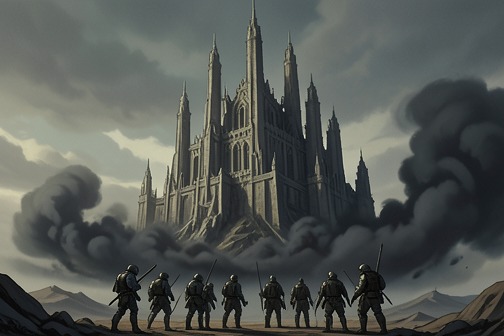
[Heaven](entity:location-recall-location-heaven-0167f964ad61)'s ascent and fall is one of the war's decisive reversals. What first appears to be a battlefield already turning in humanity's favor becomes the emergence of an ancient flying citadel, carrying hundreds of thousands or even millions of demonspawn, and then a desperate operation to stop it before it can complete its ascent. The fortress is slowed by attacks on its engines and ultimately thrown from the sky when [Python Est](entity:character-recall-character-python-est-04022277f435) rams the FYR into it, making victory inseparable from sacrifice.
## Emergence of the Hidden Fortress
The event begins with the battlefield itself becoming unstable. The air vibrates, the earth shakes violently, and miasma and mana swirl together as the ground ruptures. From the blood-soaked soil rises a structure so immense that Jack has never witnessed anything comparable. [Sahaqiel](entity:character-recall-character-sahaqiel-e7c47f684c53) recognizes it immediately as Heaven and realizes that the coalition is too late. The delayed recognition intensifies the scene's terror: the threat is not merely an enemy force approaching across open ground, but an ancient bastion concealed beneath the battlefield and capable of becoming airborne.
Once Heaven clears the earth, its scale becomes a strategic catastrophe. The citadel is larger even than the Imperial capital, lifted by massive thrusters, while hundreds of thousands or possibly millions of demonspawn spill from its edges. The landscape is torn apart, replaced by a gap in the earth and the rusted, demon-caked fortress. The image joins military technology to grotesque organic invasion: a ruined bastion rises like a buried corpse, and its ascent releases an army rather than simply transporting one.
## The Coalition's Counterattack
Jack asks for a plan while flying upward to track the vessel. Sahaqiel identifies the immediate weakness: [Gehenna](entity:concept-recall-concept-gehenna-b53c70fa9a0b) can breach Heaven's barrier, allowing [Selfia](entity:character-recall-character-selfia-644b93c8da27) to coordinate artillery against the fortress's six main thrusters. Destroying those engines would stop its ascent and break its link to the power sustaining the citadel. Jack agrees to work with [Lilith](entity:character-recall-character-lilith-88bb50d17890) while Sahaqiel returns to Selfia and orders the Imperial forces to prepare.
The attack is conducted under relentless pressure. Jack must analyze and tear through Heaven's mana barrier while fighting bonebats and mutant slicers. Selfia sends her MECHFrames into the struggle, and coalition airships bombard the exposed propulsion systems. Each engine disabled visibly slows the fortress, turning the battle into a race between Heaven's rising momentum and the defenders' ability to expose and destroy its means of flight. The operation therefore shifts the value at stake from ordinary battlefield advantage to the survival of everyone beneath the citadel.
The miasma worsens as the battle continues, making failure increasingly fatal for Selfia and the forces around her. On the King Raven-class airship, Python Est exhausts his ammunition and mana while Lieutenant Harper, after handing him another shotgun, collapses against a bulkhead. When the exhausted crew can no longer operate the vessel, Python takes command of the FYR. He understands that its weapons cannot destroy Heaven, but that the carrier can slow it through impact, and he broadcasts an order for all coalition forces to prepare for collision.
## Python Est's Sacrifice and [Heaven's Fall](entity:event-recall-event-c753f3704a83)
The decision turns the counterattack into an act of deliberate self-sacrifice. Jack sees the familiar airship, already coated with demonspawn, race toward Heaven and collide with the floating structure. The FYR's detonation creates a brilliant explosion, while Sahaqiel pulls Jack away and their wings shield them as they fall. Jack's repeated cry for Python carries rage, grief, and frustration, but the shockwave overwhelms it before the loss can be answered.
The collision completes what the engine attacks began. With half of its engines gone and the air carrier embedded in its assault, Heaven lists and rotates as its propulsion fails. The citadel flips, loses control, and begins to fall. Sahaqiel notices that she can breathe more easily, a physical sign that the immediate pressure of the fortress has broken. Jack's scream becomes the emotional counterpart to the structure's collapse, and the fortress finally smashes into the earth, releasing a shockwave across the ruined landscape.
## Political and Religious Echoes
Heaven's fall resonates with the wider conflict's repeated use of ceremony, sacred authority, and survival rhetoric. Earlier, Jack entered a political chamber in a formal black uniform with [Duchess Belia Bell](entity:character-recall-character-duchess-belia-bell-ca4d75b13a69), whose red heels kept time with his boots as she led him into a room of strangers. The Empire's ritual treated lineage and maternal authority as public symbols. In the Theocracy, Lita identified a statue of Sahaqiel as the image of Saint Citri, founder of the Theocracy, whose presence was believed to limit demonspawn power. The later emergence of Heaven grotesquely overturns that sacred order: a hidden fortress rises from the earth with a demonspawn host, and faith, warfare, and ancient power become physically indistinguishable.
The event also exposes the danger of political language that makes violence sound necessary. Selfia declares that attacking is humanity's only option in its darkest hour and presents the expedition as a means of securing survival. Jack has already condemned her earlier purge, in which 369 lives or more were killed to consolidate power, and he rejects the claim that mass death can be disguised as necessity. Against that background, Python's death is deliberately different in moral shape: it is not an unseen purge of opponents or bystanders, but a conscious choice made in the open to prevent Heaven from escaping. The contrast does not make the sacrifice easy; it makes the story's question of legitimate violence sharper.
## Consequences and Narrative Significance
Heaven's ascent changes the battlefield from a conventional advance into an emergency against a mobile fortress and an apparently inexhaustible enemy population. Its fall prevents the citadel from completing its escape and gives the surviving coalition forces a moment of relief, but the victory is permanently marked by Python Est's loss, the wreckage of the FYR, and the devastation caused when Heaven hits the earth.
The event's structure is a classic reversal: defenders appear capable of managing the threat, the buried fortress reveals that the apparent situation was incomplete, coordinated attacks produce measurable progress, and the final solution requires abandoning the possibility of survival for one airship and its commander. Heaven rises as an image of enemy power becoming almost cosmic in scale; it falls only when human cooperation, technological force, supernatural ability, and personal sacrifice converge. Its descent therefore does more than remove a fortress. It establishes that the war cannot be won through spectacle or slogans alone, because every claim to humanity's future is tested by the lives demanded to preserve it.
Event 16
Michael与Jack之战
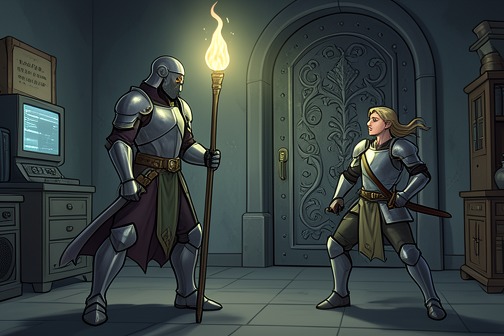
[Michael](entity:character-recall-character-michael-119cca2a9432) and Jack’s battle in the [Infinity Machine](entity:object-recall-object-infinity-machine-f51070e3d825) Sanctum is the decisive encounter that transforms the protagonists’ search for the Infinity Machine into a race against Michael’s apocalyptic design. At the sealed sanctum, Michael reveals that he has secretly followed Jack and [Sahaqiel](entity:character-recall-character-sahaqiel-e7c47f684c53), eliminated the threats that should have pursued them, acquired a second Sahaqiel as his key, and begun dismantling the restraints on [Adam](entity:character-recall-character-adam-7e6d3c5ddcc8), the first [Awakened](entity:concept-recall-concept-awakened-dbe36d6a62b6) and the first hunter. Jack cannot defeat Michael directly, but he and Sahaqiel recognize the danger, coordinate with [Lilith](entity:character-recall-character-lilith-88bb50d17890), and escape through a shrinking portal before Adam can reach them.
## Approach to the Sanctum
Jack and Sahaqiel reach an immense concentration of [Mana](entity:concept-recall-concept-mana-5a4962976c06) after passing through corrupted data destroyed by Jack’s [Gehenna](entity:concept-recall-concept-gehenna-b53c70fa9a0b). The source appears as an almost blinding presence to Jack’s angel senses and resolves into a large sealed stone door, its smooth surface covered in intricate carvings. The door establishes the sanctum as a space separated from ordinary passage and ordinary knowledge: it is not merely another chamber of the Infinity Machine, but the threshold of a concealed power whose access has been deliberately restricted.
The apparent security of the approach collapses when Michael appears without being sensed by Jack, Sahaqiel, or Lilith. Jack turns and swings [Gram](entity:object-recall-object-gram-dbd2d9ba7671), only for the blade to be caught by the fedora-wearing figure in the white suit. Michael’s face is eerily similar to Jack’s, making the confrontation both a physical ambush and an encounter with a threatening counterpart. Michael identifies himself as the Black King and taunts Jack as his father, immediately framing their conflict through a personal connection as well as through the struggle over the Infinity Machine.
## Michael’s Hidden Pursuit
Michael’s arrival explains the absence of the enemies Jack and Sahaqiel expected to face. Jack realizes that no [Demonspawn](entity:creature-recall-creature-demonspawn-327d8fee013c) or [Apostles](entity:creature-recall-creature-apostles-93ad83bc26df) came after them because Michael had been following them throughout the journey and quietly eliminating each threat before it could reach them. The revelation reverses the apparent pattern of their advance: what looked like successful progress was also a path cleared by an unseen pursuer who intended to use their movement for his own purposes.
Jack attacks, but Michael’s control over the confrontation is overwhelming. A lightning strike fails, bullets hang motionless in the air as though time itself has stopped them, and Jack’s electrified claw freezes a foot away from Michael. Sahaqiel tries to intervene, yet Michael remains able to restrain them both. His power turns the sanctum threshold into an arena in which Jack’s aggression and Sahaqiel’s angelic force cannot produce freedom; the protagonists can act only by finding a moment of cooperation and surprise.
Michael then addresses Sahaqiel as an old companion, calling her “Little bird” and asking her to open the door in deference to their shared bond. Sahaqiel rejects the man before her, saying that the leader she once followed would never have done what he has done. Michael answers that the leader she followed died when their world ended and claims that he will make the world anew and better. His language presents destruction as restoration, while Sahaqiel hears the same program as betrayal of the sacrifices that defined their former struggle.
## The Second Sahaqiel and the Prisoner
Michael opens the sanctum by producing his own key. Beside him manifests a blonde woman with snow-white wings and gold eyes who shares Sahaqiel’s face. The appearance creates the central shock of the encounter: there are two Sahaqiels before Jack, an impossibility that the narration initially leaves uncertain even as it asks whether the figure is truly a copy. Michael treats the duplicate as an instrument, later wrapping her around his shoulders like a cape and boasting that he possesses two angels, his saviors.
The duplicate is not simply a visual trick. It demonstrates Michael’s reduction of angelic identity to something reproducible and usable, while the original Sahaqiel remains emotionally and morally distinct from the figure he controls. The contrast intensifies the personal stakes of the battle: Sahaqiel is forced to confront an image of herself that has been converted into a mechanism for Michael’s plan, and Jack must distinguish the bond he shares with the real Sahaqiel from the counterfeit presence standing beside their enemy.
Once the entrance opens, Michael disables the defensive enchantments behind his throne. The wall falls away to reveal a chamber filled with pulsating flesh and crystalline figures, an image in which machinery, body, and corruption have become inseparable. The chamber resembles an open wound in the world, a scar of anguish and pain from which an unnatural power seeps. Suspended above a pit by tentacles and chains is a tanned man wearing only decrepit trousers, his body marked by crystals. Sahaqiel recognizes him immediately, and Jack recognizes him through the angel’s memories: he is Adam.
Michael identifies Adam as the first Awakened and the first hunter, capable of tracking magically gifted beings anywhere across the globe. Even weakened, Adam is so dangerous that a direct confrontation would end any living being. Michael explains that Adam hunted angels rather than lesser beings, as though he regarded ordinary humans as beneath him, and claims that Jack and Sahaqiel now meet the criteria that will draw Adam’s attention. The revelation changes the stakes from a conflict with Michael into a struggle against a creature whose release could threaten every powerful being in the world.
## The Attempted Release of Adam
Sahaqiel calls Michael a monster and warns that freeing Adam will kill them all and doom the world. Michael rejects the accusation. He says that he is not dooming the world but fixing it, presenting the deaths of Sahaqiel and Jack as the foundation of a newer order. His promise of salvation therefore depends on deliberate sacrifice: “the salvation of all mankind” is inseparable from using the angels as bait and releasing the hunter they fear.
The sanctum begins to shake as flesh grows around the throne room and the ancient seals on Adam’s body crack and shatter one by one. Beneath Adam, the pit emits black light. Jack perceives the light as raw magical information, data rising from the wound in the earth and pouring into the imprisoned man. The awakening is consequently portrayed not as a simple physical revival but as the reactivation of a vast store of magical knowledge. The Infinity Machine’s hidden chamber becomes a site where information itself can restore an ancient threat.
Jack and Sahaqiel find a narrow opening when Michael’s bindings hold them in place but Lilith remains able to act. Jack asks Sahaqiel whether she trusts him, and she answers that she trusts him with her heart and soul. He then orders Lilith to dispel Michael’s bindings. The exchange converts their emotional bond into immediate tactical coordination: trust is not an ornamental confession but the condition that allows them to attempt escape against an enemy who has neutralized their direct attacks.
## Escape and Consequences
Jack rushes forward, lifts Sahaqiel, and moves toward the portal as Adam stirs and fixes his attention on the nearest source of Mana. The pursuit is reduced to a single, terrifying instant. Jack’s fear is physical and immediate, but he acts rather than remaining paralyzed. As Adam reaches toward him, Jack ignites all of his magical energy and propels himself and Sahaqiel into the portal just as the opening shrinks.
The escape prevents Adam from immediately killing them, but it does not constitute a victory. Michael has opened the sealed entrance, exposed Adam’s prison, disabled the sanctum’s defenses, and begun undoing the ancient restraints. Jack and Sahaqiel survive the immediate encounter only by abandoning the chamber while Michael remains behind with the two angels and the awakening hunter. The event therefore ends on a deliberately unstable reversal: the protagonists escape the room, but Michael advances toward the power he sought.
## Political and Thematic Stakes
The sanctum battle echoes the political logic already associated with the [New Republic](entity:concept-recall-concept-new-republic-5ad5d624da75). [Selfia](entity:character-recall-character-selfia-644b93c8da27) justifies a purge of three hundred and sixty-nine lives, possibly more, by claiming that opponents, rivals, and dissidents had to be removed to guarantee mankind’s survival and consolidate her power. Jack condemns the operation as chaos that has killed bystanders and innocents. Michael extends the same emergency logic to a cosmic scale: he calls the destruction of the existing world a necessary repair and treats the deaths of those who resist as acceptable foundations for a better future.
The contrast exposes a recurring conflict between protection as a stated purpose and violence as an actual method. Jack’s earlier refusal to accept mass killing, especially when it endangers [Ada](entity:character-recall-character-ada-10673482132c) and his unborn child, becomes relevant to his response to Michael’s plan. Michael’s promise to save humanity requires him to expose Jack and Sahaqiel to Adam, just as political rulers invoke survival to justify purges and coercive evacuations. In the sanctum, that contradiction acquires a literal form: a supposed path to salvation opens through a chamber of flesh, chains, corrupted data, and a prisoner whose release may destroy the world.
The event also creates a sharp value shift. Jack and Sahaqiel enter seeking the source of Mana and the sealed heart of the Infinity Machine; they discover instead that Michael has engineered their approach and intends to use them as sacrificial targets. Their apparent advantage becomes entrapment, direct resistance becomes helplessness, and escape becomes the only attainable form of success. The final image of Jack carrying Sahaqiel through a closing portal preserves that incomplete victory: their trust allows survival, but Michael’s access to the sanctum and Adam’s awakening leave the larger conflict more dangerous than before.
Event 17
Resurrection Day
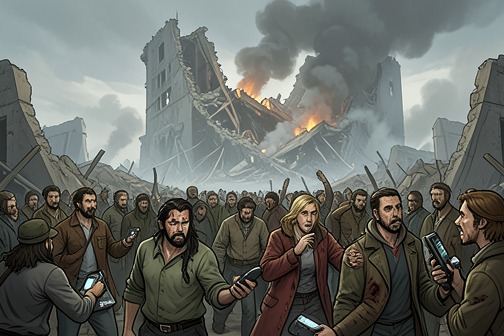
[Resurrection Day](entity:event-recall-event-a8ae35688ab9) is the decisive postwar turning point in which Jack's activation of the [Infinity Machine](entity:object-recall-object-infinity-machine-f51070e3d825)'s kill switch ends the magical order and unexpectedly restores thousands of people to life. It does not resemble a clean miracle: the survivors emerge amid wreckage, lost identities, disabled technology, and the collapse of [Heaven](entity:location-recall-location-heaven-0167f964ad61), forcing the characters to confront both the cost of the old world and the responsibilities of the new one.
## The World Before the Resurrection
The event follows a history of escalating violence. Political power had already been secured through mass killing: [Selfia](entity:character-recall-character-selfia-644b93c8da27) admitted that a purge was taking place across the empire and that 369 lives, possibly more, were being extinguished because they were opponents, rivals, or dissidents who might obstruct the [New Republic](entity:concept-recall-concept-new-republic-5ad5d624da75). Jack rejected the language of necessity, emphasizing that hundreds had died, including bystanders and innocents, and that Selfia's actions had placed [Ada](entity:character-recall-character-ada-10673482132c)'s pregnancy and his child in danger. The event therefore arrives after a political order has repeatedly treated human beings as expendable material.
The military crisis was equally severe. Jack had ordered the remaining Theocracy population evacuated to the Flying City or transferred into Imperial territory because they lacked adequate food, shelter, and ammunition and faced the approach of the demonspawn. He and Selfia also considered attacking every suspected [High Table](entity:organization-recall-organization-6ec2e99b8fb1) position rather than allowing an enemy diversion to dictate their response. These decisions establish the world in which Resurrection Day occurs: survival is pursued through emergency commands, preemptive violence, and choices that continually turn protection into another form of danger.
## The Collapse of the Old Order
The immediate setting is a landscape already marked by devastation. On the shores of a new continent, Ada encountered corpses, flesh, and sinew spread across sand stained red by the invasion; poisoned water lapped at her boots while Imperial soldiers and [Paladins](entity:organization-recall-organization-paladins-8c41efa1fb20) scavenged masks and equipment from the dead. During the same campaign, the earth violently ruptured as miasma and mana swirled, revealing Heaven, a structure so immense that [Sahaqiel](entity:character-recall-character-sahaqiel-e7c47f684c53) recognized that the expedition had arrived too late. The supernatural fortress rose from blood-soaked ground as though the buried history of the war itself were breaking back into the present.
The event's wider stakes become explicit when [Michael](entity:character-recall-character-michael-119cca2a9432) reveals that [Adam](entity:character-recall-character-adam-7e6d3c5ddcc8), the first [Awakened](entity:concept-recall-concept-awakened-dbe36d6a62b6) and the first hunter, has been preserved as a weapon against powerful beings. Sahaqiel protests that freeing Adam would kill the angels, doom the world, and betray all their sacrifices, but Michael insists that he is repairing the world rather than destroying it. Resurrection Day thus follows a final struggle over competing definitions of salvation: one side seeks to preserve humanity through control and sacrifice, while another must end the machinery that makes such salvation possible.
## The Kill Switch and the Returned
After the kill switch is activated, the consequences are physical and immediate. Selfia's floating limbs fall onto a sandy beach, and she can no longer feel her mana. Ada discovers that her nodachi will not move and that her own strength has vanished. The flying city crashes into the sea, while the landscape is stripped of the corruptive purple smog. Magic is not merely weakened as a battlefield resource; it disappears from ordinary experience, leaving formerly empowered people suddenly dependent on bodies, tools, and institutions that no longer function as before.
The cleared horizon reveals thousands of confused men and women wearing outdated uniforms and armor. Their clothing makes the restoration inseparable from history: the returned are not simply anonymous dead, but people brought back from earlier conflicts and eras, carrying the material traces of worlds that the living had already considered finished. Selfia recognizes [Eleanor](entity:character-recall-character-eleanor-f86629a4f595), a white-haired officer, and witnesses Eleanor reunite tearfully with a blonde, red-eyed woman in a [MECHFrame](entity:object-recall-object-mechframe-acda05e426bc) pilot's uniform. She then recognizes Ruby, alive and full of color, standing beside officers and Python. The reunion turns the event from an abstract global reversal into a sequence of intimate recognitions, each face forcing the present to admit that its dead have not remained safely in the past.
The emotional uncertainty is concentrated in Ada's question about Tanji. Ruby lowers her head, takes Ada's hands, and speaks to her for the first time as a living person. The evidence leaves the precise answer to that exchange outside the event's immediate revelation, but the gesture establishes the central condition of Resurrection Day: return does not erase grief, confusion, or absence. It creates a new burden of explanation, identification, and mourning among people who have been restored into a world that has moved on without them.
## Aftermath and Reconstruction
Five years later, the consequences have become visible in a transformed civic landscape. [Jacksonville](entity:location-recall-location-jacksonville-c0d4f40ef42e), called the Bastion of the [New Frontier](entity:location-recall-location-new-frontier-d72cbdc991db), stands on unexplored land where Lita and the Hoshido have established a sovereign country. A shoreline once associated with invasion and death has become a sunny public space, with families and children on the beach, tourists along the coast, and fishermen using the piers. The contrast between poisoned water and gentle waves, between corpses on foreign sand and ordinary recreation, gives the resurrection its most concrete measure: livability has returned, but only through time and collective labor.
Heaven undergoes an equally striking conversion. What remains of the former demonspawn stronghold becomes the capital of the Frontier's government and a forward base for explorers seeking lost treasures. Gold walls and marble pillars remain, but wires, electric signs, homes, shops, and silver-wing banners for the twelve-member Frontier council alter their meaning. The ruins no longer function as an untouchable fortress of supernatural power; they become administrative and commercial space within a society trying to organize the thousands of newly resurrected and give them homes.
That reconstruction is difficult rather than triumphant. Selfia anticipates a tremendous amount of paperwork while her detached limbs lie in the sand, and her attempt to call Mi'shka receives no response. The practical detail matters because it places bureaucratic work beside cosmic catastrophe. Once mana, flying cities, and resurrection systems cease to govern existence, survival depends on installation, housing, transportation, councils, delegations, and the slow conversion of ruins into places where people can live.
## Narrative Significance
Resurrection Day reverses the book's governing economy of death. The purge, the bloodbath on the new continent, the battlefields shattered by weapons and supernatural movement, and Michael's plan to awaken Adam all treat death as an instrument for constructing a promised future. The kill switch interrupts that logic. It ends the magical system, but it also releases people from the closed cycle in which institutions decide who may be sacrificed, preserved, or restored.
The event remains morally unsettled because restoration cannot return the lost world exactly as it was. The resurrected arrive in obsolete uniforms among strangers; survivors lose their mana and weapons; Heaven falls into the sea; and the former fortress is later rebuilt as a government capital. Resurrection therefore signifies neither a simple return nor a restoration of origins. It is a rupture in historical continuity, after which recognition, grief, political compromise, and environmental repair must do the work once assigned to magic. The final image of a populated beach and a civilized Heaven gives the event its lasting significance: humanity survives not by recovering the old order, but by making a habitable future from its ruins.