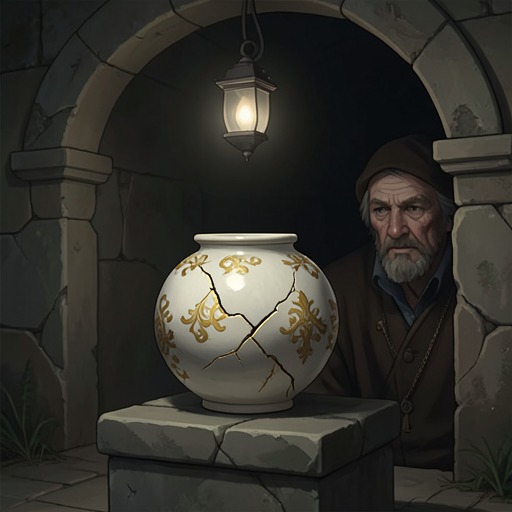
“Put it in a box”
Beautiful“Put it in a box” is a metaphor for carrying grief without pretending it has vanished. Gideon introduces the image to Ava Spirini by describing a feeling that grows smaller in relation to the self, small enough to imagine placing in a box. Ava then tests the idea against her loss of Kelly Waititi and finds that Kelly’s absence cannot yet be made to fit. As the image recurs, it becomes less a prescription for getting over bereavement than a language for its changing scale: grief remains, but it need not always be everything.
Gideon’s image of containment
Gideon explains that the feeling does not go away; rather, it becomes smaller in relation to him and to the sum of his parts. He makes that abstract change imaginable by describing a box: he puts the feeling inside and keeps it there. His account does not claim that the pain is gone or that the box is opened only when convenient. The feeling stays, but it is no longer the whole of his experience.
The exchange is shaped by the difference between explaining pain and trying to solve another person. Ava asks what Gideon means, acknowledging that his way of speaking can be difficult for her to follow. He answers with an image rather than advice. When she asks whether the feeling goes away, he says it does not; it simply is not everything. The distinction gives the metaphor its central force: containment is not erasure, and a persistent feeling can occupy less space than it once did.
Ava measures her grief against it
Ava responds by considering Kelly’s grief and her own bereavement. She says that Kelly’s was too big to put in a box, then describes it as bigger than the sum of her parts. Gideon answers without turning the comparison into a lesson or offering easy reassurance. His brief acknowledgment leaves room for Ava to name what she believes about Kelly’s pain and to recognize that her own experience does not fit neatly inside his account.
That mismatch matters because Ava’s grief has already disrupted her sense of time and ordinary life. Six months after Kelly’s death, Ava feels that time has slowed, and she fears that she will feel this way for the rest of her life. She remembers learning of the death when her father came to her room shortly after a call at 5:37 a.m.; the news seemed to shatter the life she had known. She later counts thirty-one Sundays since Kelly died and describes each Sunday as beginning in the same way. Against this recurrence, the box does not promise a quick or orderly progression. It gives Ava an image with which to compare two experiences while preserving the difference between them.
The metaphor alongside memory and choice
Ava’s understanding of Kelly’s death also develops through repeated recollection. Looking back on an ordinary afternoon with Kelly, she wonders whether a small gesture of affection had carried a meaning she did not recognize at the time. She revisits the circumstances of Kelly’s death and considers whether pain had become overwhelming. These thoughts show the limits of the box image as well as its usefulness: Ava is still searching for understanding, and the metaphor cannot settle every question that memory brings back.
Grief also presses into Ava’s choices and relationships. She says that being with Lincoln can make the rest of her troubles matter less for a while, though she distinguishes temporary relief from forgetting. After a night involving alcohol and Lincoln, she feels both embarrassment and gratitude that she had not made another decision she would regret. These episodes place the metaphor beside, rather than above, the practical consequences of grief: feelings persist, and the choices made under their pressure can matter. The box describes one possible relation to pain; it does not make every response harmless or automatically wise.
Return in therapy and later meaning
The image returns in Ava’s fortnightly therapy with Nola. Ava reports that she feels calm while still knowing that sadness, hurt, anger, confusion, grief, and love remain. She cannot say with certainty whether these feelings are in the box; she can say they are not bigger than the sum of her parts at that moment. This later formulation makes the metaphor less like a fixed destination than a measure that may change. The feelings are still present, but Ava’s immediate experience is no longer wholly occupied by them.
Ava’s reflections also distinguish moving forward from moving on. She does not believe that the love she shared with Kelly can simply be left behind, and she expects Kelly’s death to continue shaping her. Yet she concludes that this does not prevent movement: she must keep living, in part because she believes Kelly wanted the pain to end rather than Ava’s life. The box can hold grief within that continuing bond without asking Ava to discard it. Its significance lies in that balance: loss remains part of her, while happiness, calm, and the possibility of a future can exist beside it.