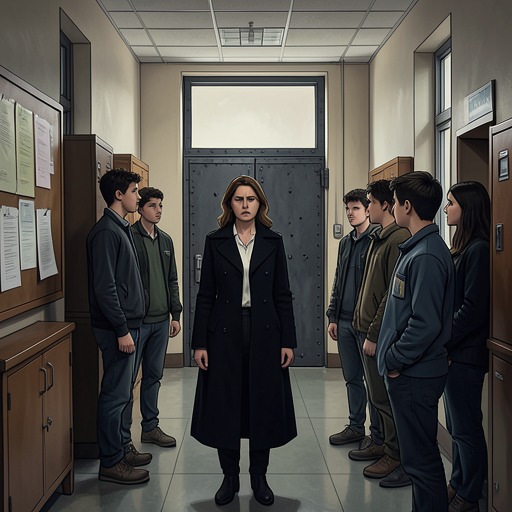
MacGreggor State College
BeautifulMacGreggor State College is the school Ava returns to after Kelly’s death, but it becomes more than a setting for her education: it is where public commemoration, private grief, and institutional discipline collide. The college presents itself as a community that can help its members, yet Ava experiences that promise as conditional on behaving in ways that make her grief easier for others to manage. Her confrontation with the school culminates in expulsion and a transfer meeting at TAPs.
School and Community
At a memorial assembly, Mrs Bryan describes the college as a community whose members should help one another after a fall, and presents a tree as a reminder of that solidarity. The language casts the gathering as an act of shared care. Ava rejects its framing: Kelly did not merely fall, she insists; Kelly died. Her interruption makes the difference between the school’s consoling metaphor and the fact Ava needs acknowledged impossible to ignore.
Ava’s outburst is also a break with her own immediate plan. On the morning of the assembly, she had written a reminder to blend in on the back of her hand. She had returned to school full-time only a month earlier, after several weeks attending part-time, and describes feeling watched, whispered about, and pointed at. Rather than making her less conspicuous, speaking out turns her into the center of the auditorium’s attention. The scene gives the school’s communal language a sharp counterpoint: the assembly can gather students around a symbol, but it cannot make Ava’s loss feel speakable on the school’s preferred terms.
Attendance, Rules, and Grief
The college’s concern about Ava is expressed through both attendance requirements and expectations for conduct. She has struggled to concentrate, skipped school, and missed work; she also resents being expected to discuss Kelly’s death with people whose comparisons to other losses seem inadequate to her. In her account, the school’s ordinary academic demands, including quadratic equations, feel radically out of scale beside the numb sadness occupying her attention. Her resistance is not simply to lessons: she objects to the demand that school proceed as if nothing has happened.
A later meeting in Mrs Bryan’s office makes the limits of the school’s support explicit. Ava’s father sits with her while Mrs Bryan says that staff and students are concerned and want to help, but only within the rules and expectations of school. Mrs Bryan has chosen not to take further action over Ava’s assembly outburst, yet says Ava needs counselling. Ava hears this as the institution managing a disruption rather than understanding its cause. She does not want therapy, in part because Kelly had received it, and she does not regret upsetting younger students: her own distress, she says, was the point. The college’s offer of help and Ava’s refusal therefore occupy the same conversation without resolving one another.
The consequences are practical as well as emotional. The response to the assembly includes a return to a shortened timetable for several weeks, while Mrs Bryan raises the possibility that Ava may have to repeat the year because of how much school she has missed. Ava’s father had not known the full extent of her absences; she had been skipping school and going to work instead. The timetable recognizes that she is not managing full-time attendance, but the possibility of repeating Year 11 also shows how quickly distress is translated into an academic problem with long-term consequences.
Discipline and Transfer
The school’s relationship with Ava worsens after she punches Trevor Lane, who had insulted Kelly. In a meeting with her father, Mrs Bryan says that the college has ceased to be able to support Ava and proposes another institution, explaining that she has contacted Rahila Saeed at TAPs. The referral is framed as a better fit for Ava’s needs and as a way to get her through Year 11 before reassessing her options. Mrs Bryan slides a bright red and yellow pamphlet across her desk, turning that proposed change into something concrete for the family to consider.
Ava has no say in the decision to attend a meeting at TAPs. At home, she tells her father she is not like the students there; he replies that she has no option. He agrees with Mrs Bryan that the college cannot support her, even while criticizing the principal’s competence. Ava’s own account places the referral beside a series of losses and conflicts: Kelly is dead, matters with Kelly’s parents are difficult, Ava does not know where she stands with Lincoln, and she has been expelled after punching Trevor. The move is thus not presented as a change of school alone. It marks the failure of Ava’s attempt to remain at MacGreggor State College while refusing the conduct and emotional composure it requires of her.
Narrative Significance
The college’s role is shaped by a tension between care and control. Mrs Bryan speaks in the language of community, concern, and support, and the school does make adjustments to Ava’s timetable and directs her toward counselling and another educational program. At the same time, those interventions are bounded by rules, attendance, and the school’s judgment that Ava can no longer be supported there. The institution does not appear as wholly indifferent; rather, the narrative shows how its forms of care can fail to meet the particular expression of grief in front of it.
The assembly tree and the later transfer pamphlet frame two different institutional responses. The tree is offered as a shared reminder, but Ava interrupts the ceremony to insist on the death beneath the consoling image. The pamphlet proposes a route forward, but the decision is made by adults and leaves Ava feeling disappointed in herself and excluded from her own future. Across these moments, MacGreggor State College becomes the place where public language about belonging meets the limits of belonging in practice. Ava’s departure to TAPs follows not because the school has ceased to matter, but because its version of support cannot accommodate the way she is grieving.