TAPs
BeautifulTAPs, The Alternative Program, is the alternative school Ava attends after her former school decides it can no longer support her. First imagined by Ava as a place for students who have been rejected or labelled as difficult, TAPs proves smaller, more flexible, and less judgmental than she expects. Its significance lies not in curing her grief over Kelly, but in offering an educational and social environment where she can begin to set goals, be candid about how she feels, and seek support without being treated as a problem to manage.
Referral and institutional contrast
Before Ava arrives, her former school has struggled to respond to her distress after Kelly’s death. Mrs Bryan tells Ava and her father that staff and students are concerned, but makes support conditional on Ava following school rules and refraining from disrupting an assembly. The school recommends counselling and, after learning that Ava has missed more school than her father realized, proposes a shortened timetable; Mrs Bryan also raises the possibility that Ava may have to repeat the year. Ava regards this response as a demand to behave as though nothing has happened, while the school presents it as an attempt to help within its rules.
The situation sharpens after Ava punches Trevor Lane for insulting Kelly. Her former school decides to expel her, explaining that it has other students to support and that it has ceased to be the right institution for Ava. Mrs Bryan has already contacted Rahila Saeed, TAPs’ head teacher, who is willing to meet the family. The referral is framed as a practical route through Year 11: Ava can attend a program considered better suited to her immediate needs, then reassess her options at the end of the year. For Ava, however, the placement initially carries the sting of being sent away after a disciplinary incident. The contrast is between a school that describes support while enforcing conditions Ava experiences as silencing, and an alternative whose suitability depends on making room for different needs.
Reputation and the school’s everyday scale
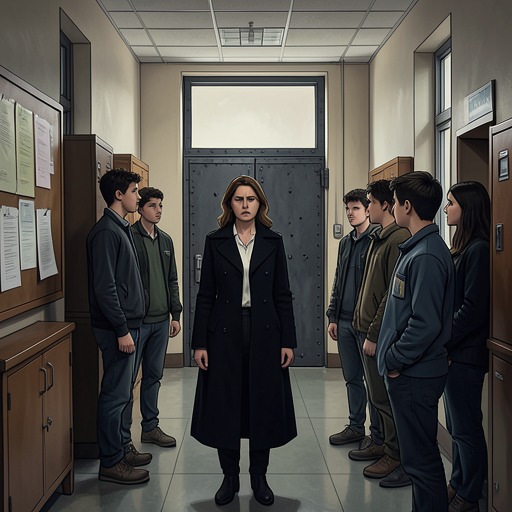
Ava arrives with a ready-made picture of TAPs as a bludge school for teenage parents, students bullied elsewhere, unconventional teenagers, and young people with anger problems. That view reduces the school to the stereotypes attached to its students. Her first encounter offers only partial reassurance: boys watching from behind a glass door laugh at her, and Rahila quickly signals them to leave. Rahila then greets Ava calmly, touches her arm, and encourages her not to be nervous. The school is not presented as free of awkwardness or social friction, but its head teacher responds to an uncomfortable moment rather than leaving Ava to negotiate it alone.
The practical arrangement helps explain why TAPs feels different. It has only forty students, no uniform, shortened days, and extracurricular programs students can choose to join. Teachers are addressed by their first names. These details mark a change in scale and routine from the institution Ava has left: the school does not require her to enter a uniformed, full-length day before she has found her footing. Its flexibility is part of the offer, not proof that education is unimportant. Rahila talks with Ava about what she wants and what goals she might set; when Ava says she has none, Rahila proposes making goals her first one. Ava agrees to try, and her father visibly relaxes. The conversation converts a placement imposed after expulsion into a possibility Ava can begin to participate in shaping.
Classroom belonging and new connections
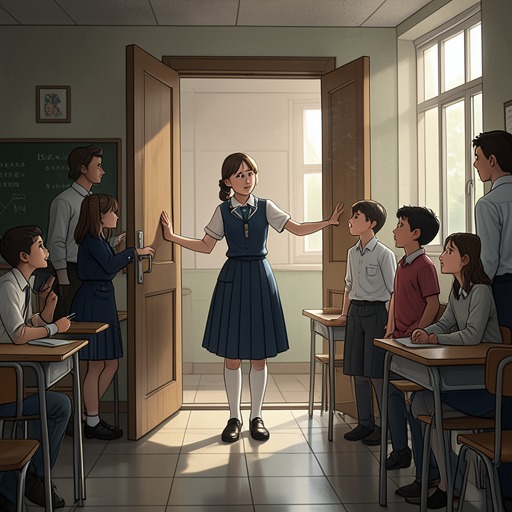
Ava’s first days also challenge her assumptions about the people at TAPs. In class, Minda asks whether Ava is happy. Ava answers honestly that she is not. Minda responds with easy recognition, and the other students accept the answer without turning it into a joke or pressing her to explain. The lesson continues. That ordinary response matters: Ava can admit distress without having to make it legible to people who claim to know exactly how she feels, or becoming the focus of the room.
The scene gives Ava a glimpse of relief because other students have their own difficulties and do not make her grief the sole fact about her. She recognizes that she had unfairly relied on stereotypes about TAPs and its students. Minda, who takes Ava under her wing from the first English lesson, helps make the unfamiliar school navigable by introducing her to others and explaining how things work. Belonging here does not depend on everyone sharing the same history; it comes through an unforced acceptance of the fact that each student has something of their own to deal with.
Counselling and the meaning of support
Counselling is part of TAPs’ support network, but the story distinguishes access from compulsion. Ava learns that students can see Nola if they want to. Nola explains that Ava does not have to disclose more than she chooses and that the purpose is to work out ways of coping with feelings she does not want to have. Her calm manner and lack of pressure contrast with Ava’s earlier experiences of therapists and counsellors, whom she found acceptable but felt spoke to her like a child; she had not returned to them, despite her father’s wishes.
Nola also offers an alternative to beginning with direct conversation. When Ava says she does not like talking, Nola suggests putting on music and drawing, so they can have something to discuss besides Ava herself. The arrangement gives Ava a way to enter the encounter without being forced into immediate disclosure. Ava later discusses her changing relationship with Gideon in therapy, showing that the space can hold concerns beyond the school transfer and her grief. She continues to see Nola every fortnight. TAPs therefore functions not as a cure or a promise that painful feelings will disappear, but as a setting where support can be adapted to the student and where asking for help does not erase the student’s control over what to share.